

Post
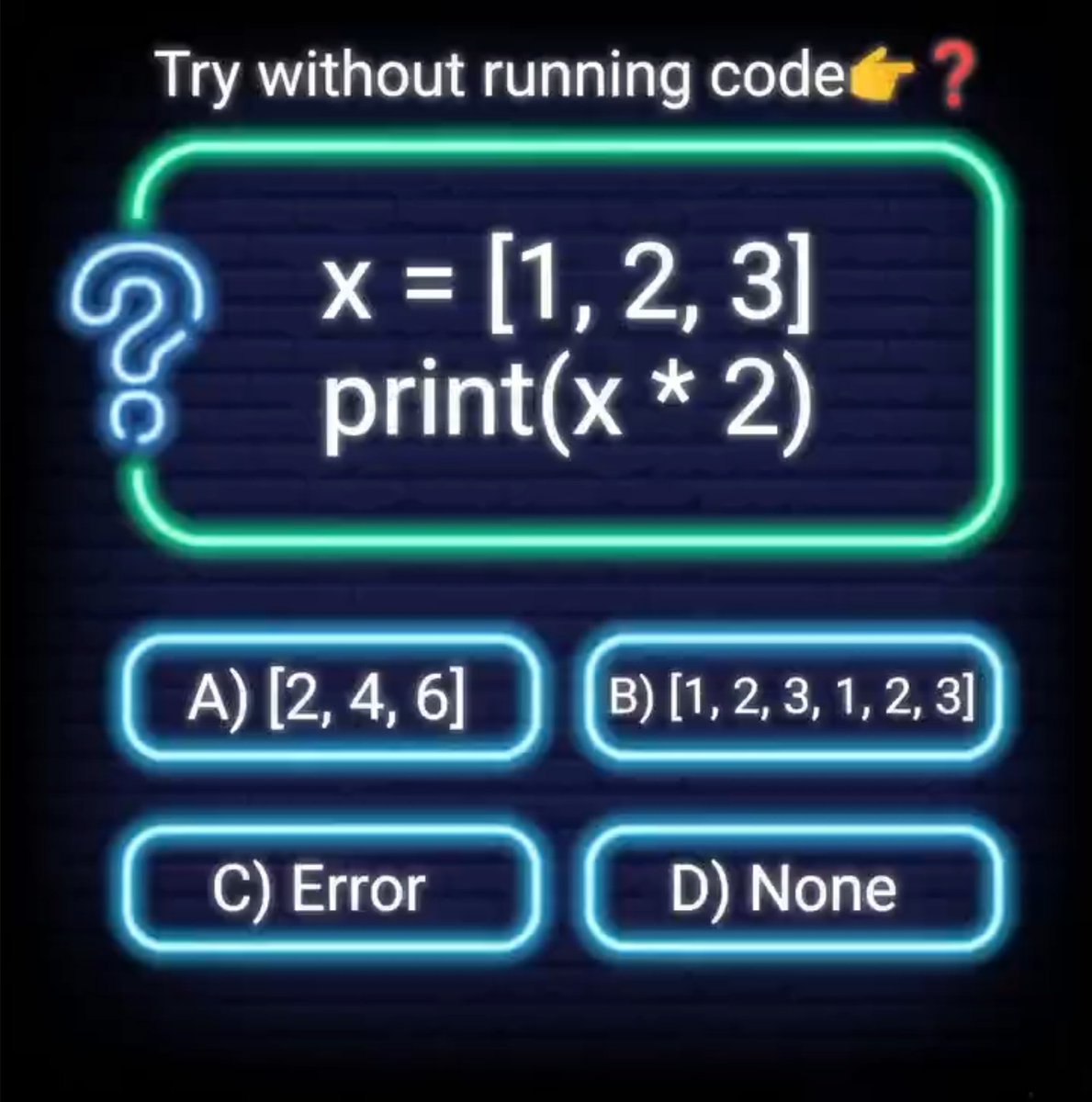

Answer: B) [1, 2, 3, 1, 2, 3]
List * int repeats the entire list:
› [1,2,3] * 2 = [1,2,3,1,2,3]
For beginners: This works not only for lists:
› List: [1,2]*2 = [1,2,1,2]
› String: "ab"*2 = "abab"
› Tuple: (1,2)*2 = (1,2,1,2)
But won't work for sets/dicts - they don't support *
English

@Python_Dv Ans---> B) [1, 2, 3, 1, 2, 3]
In Python, multiplying a list by an integer repeats the list, it does not multiply each element.
If it were element-wise multiplication, we’d need something like a loop, list comprehension, or NumPy.
English

@Python_Dv Output: B ✅
x * 2 on a Python list repeats the list, it doesn’t multiply each element.
Output: [1, 2, 3, 1, 2, 3]
English

@Python_Dv Answer: B) ✅
x = [1, 2, 3] is a list.
In Python, multiplying a list by an integer repeats the list, it does not multiply elements.
So:
x * 2
becomes:
[1, 2, 3, 1, 2, 3]
👉 Correct answer: B) [1, 2, 3, 1, 2, 3]
English

@Python_Dv B is correct answer.
Here it will not going to multiply with each number it simply will give sequence repetition.
English

@Python_Dv Answer: (b.
In Python, multiplying a list by an integer (n) does not perform element-wise multiplication. Instead, it concatenates the list with itself (n) times. In this specific case, the list (x) is multiplied by 2, which results in the list being
English


@Python_Dv It repeats the list:
x * 2 duplicates the elements → [1, 2, 3, 1, 2, 3].
English





@Python_Dv B. List multiplication repeats the list, it doesn’t do element-wise math.
English
