Post

Hubble
Hubble@NASAHubble·
Decked out in stars! The Necklace Nebula glows brightly in this Hubble image. These are actually the remains of a dying, Sun-like star, with a ring that consists of dense knots of gas that look like jewels on a necklace. Learn more for #JewelDay: go.nasa.gov/3P6yC5S
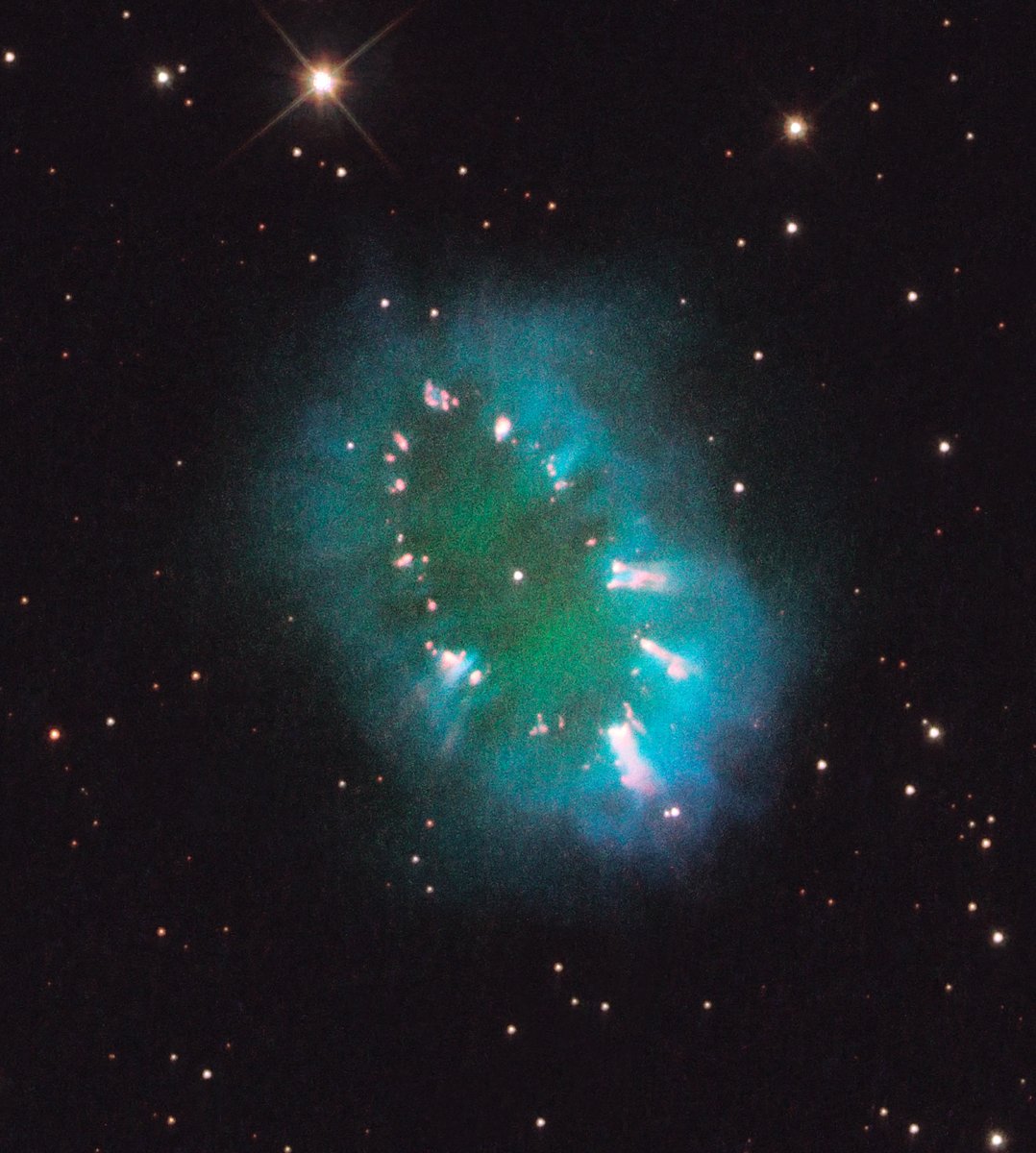
Hubble tweet media
English
29
274
1.3K
48.5K
5secondFacts
5secondFacts@5SecondFactsx·
Facts about the Necklace Nebula - The Necklace Nebula is a planetary nebula located about 15,000 light-years away in the constellation Sagitta - It formed when a Sun-like star shed its outer layers near the end of its life - The bright ring is made of dense knots of gas that glow as they are illuminated by the hot stellar core - Planetary nebulae are created when dying stars expel material into space - The unusual ring structure likely formed after a close interaction between two stars in a binary system
English
0
0
2
147
Nebula Chaser
Nebula Chaser@seahunter·
@NASAHubble Planetary nebulae like this are my white whale as an astrophotographer — that teal OIII glow is exactly what narrowband imaging was made for. Hubble makes it look effortless. The rest of us are out here freezing in our backyards at 2am for a fraction of this.
English
1
0
2
84
Ryzm
Ryzm@Goeun_6121·
@NASAHubble a star spends its whole life fusing hydrogen and at the end... jewelry. not a bad exit.
English
0
0
1
41
Norman Drax
Norman Drax@NormanDrax·
@NASAHubble The universe and the sky is soo beautiful. It reminds us how good God is because although the universe is unimaginably vast and we are so small, he only really thinks or cares about us. Don’t you think that is kind of him?
English
0
0
1
38
saoban sabrin
saoban sabrin@ITsaoban·
@NASAHubble Hydrogen (blue), oxygen (green), and nitrogen (red) using specific filters, revealing how such nebulae illuminate stellar evolution processes
English
0
0
1
33
Signal.Archive.Lab
Signal.Archive.Lab@Signal_Archive·
Absolutely stunning shot of the Necklace Nebula (PN G054.2-03.4)! 🌟 This glowing cosmic jewel is the glowing remnant of a Sun-like star that met a dramatic end ~10,000–25,000 years ago. A close binary pair caused the magic: one star expanded into a red giant and swallowed its companion → the smaller star kept orbiting inside, spinning the giant up so fast that gas was flung out mostly along the equator, creating this beautiful ~2 light-year-wide ring dotted with dense, diamond-like knots. The two stars are still super close today — orbiting each other in just ~1.16 days! That's faster than many of us drink our morning coffee ☕️ Happy #JewelDay everyone — space really knows how to accessorize! ✨
English
0
0
0
139
Falling Asleep with the Universe
@NASAHubble Cosmic jewelry at its absolute finest! It’s mind-blowing to think that the 'jewels' we see are actually dense knots of gas from a dying star. Hubble never fails to remind us how beautiful the universe's transformations are.
English
0
0
0
24
Cathy Myers
Cathy Myers@Cathy37687·
@NASAHubble It’s very beautiful despite dying There are many beautiful nebulae The Hubble photos are excellent
English
0
0
0
28
짚신
짚신@gimseongho47556·
@NASAHubble 중요한건.. 왜? 별이 죽어가는가, 의문이다, 현재..별의 수명을 애측할수 자료는 있는가? 앞으로..태양과 위성인 지구의 변형에 관심을 가져야한다!
한국어
1
0
0
36
مشاركة