
Bendix
2.9K posts


31. August 1939 – Der polnische Botschafter in London, Raczynski, berichtet von einer ernsten Lage, da die britische Regierung sich weigert, seinem Kurs in den Krieg zu folgen:
„Die Situation hier hat sich erneut dramatisch verschärft. Die britische Regierung hat unter dem Einfluss der Appeaser neue Verhandlungen aufgenommen, in der Hoffnung, ein Gleichgewicht zwischen Hitlers Forderungen und Polens vitalen Interessen zu finden.“

Deutsch
@G_M_Zz @ScheilDr So we’ve gone full circle and that’s basically what scheil said.
Directly from the polish institute of foreign affairs
pism.pl/webroot/upload…
English


@Bendix53930 @ScheilDr You're not arguing with me. You're arguing with the sequence of events. And losing. 😂
English
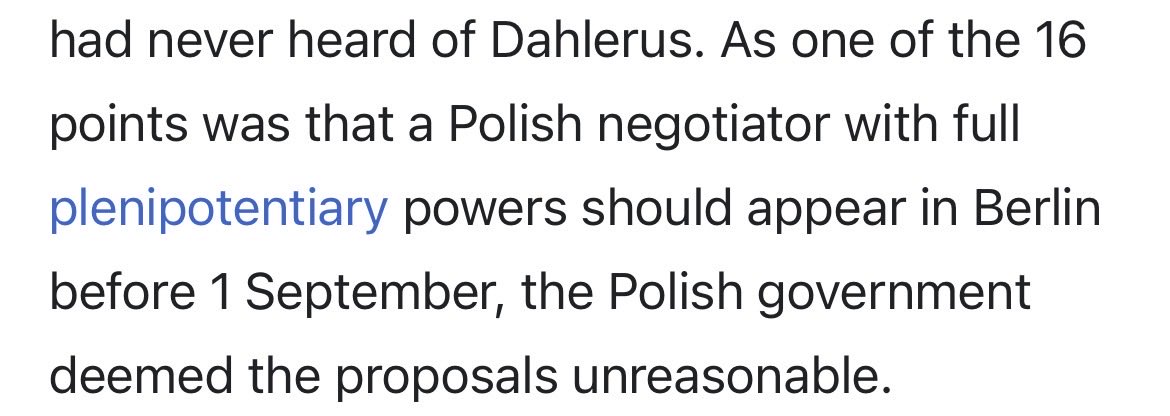
You're confusing the timeline. The deadline for a Polish plenipotentiary to arrive in Berlin was midnight August 30th set on August 29. That deadline expired before the midnight meeting even began. Ribbentrop himself told Henderson the proposals were now too late because no Polish representative had arrived by midnight. The 9 PM broadcast on August 31 was Germany announcing the rejection.
But none of this matters, and here's why: the document was delivered to the British not to Poland. Britain is not Poland. Henderson is not the Polish government. Poland never received an official diplomatic communication of the 16 points through any accredited channel. Germany then announced Poland had rejected proposals that Poland was never officially given.
You have now spent two hours arguing that the British eventually got a copy as if that constitutes official delivery to the country being invaded at dawn. It doesn't. And the invasion order was already signed regardless. Nothing Henderson understood or didn't understand, nothing Dahlerus delivered or didn't deliver, would have changed what happened at 4:45 AM on September 1st. Because the war wasn't about the 16 points. It was about Lebensraum. Hitler said so himself.
Last reply from me on this. The sources are in the thread. Anyone reading can check them.
English

@Bendix53930 @ScheilDr No I'm using a ouija board😂 Dahlerus handed a copy to the British not to Poland. After the deadline had expired. And Germany invaded twelve hours later. You keep repeating the same fact as if it changes the outcome. It doesn't. The war was already ordered.
English
@G_M_Zz @ScheilDr No the proposals were delivered the morning after the meeting, the deadline was on the same day at 9pm in the evening. You were saying that Henderson couldn’t have known about the proposal because it was delivered to him too fast and he got no copy but he got one the next morning
English
Yes Dahlerus, a Swedish businessman with no diplomatic accreditation, acting as Göring's private back-channel, delivered a copy on the morning of the 31st. And then what?
Dahlerus met Lipski at 11 AM. Lipski refused to accept representations from a man with no diplomatic standing, which is standard procedure. The deadline had already expired. Germany broadcast the proposals as 'rejected' at 9 PM that evening. The invasion order had already been signed. Germany invaded at dawn.
So Germany refused to deliver the document through official channels, then had it hand-delivered by a private Swedish businessman with no accreditation, after the deadline had already passed, and then announced Poland had 'rejected' proposals that were never officially presented to the Polish government.
You keep finding new details that prove the same thing: Germany engineered a process designed to fail, then used its failure as a pretext for a war that was already ordered.
English
How is it entrapment? Let me count:
Germany demanded a Polish plenipotentiary arrive in Berlin within 24 hours a deadline Britain called an ultimatum. Germany cut rail and telephone communications with Warsaw five days before the deadline. Germany read proposals at top speed and refused to hand over the document. Germany broadcast the proposals as 'rejected' before Poland received them. Germany had already signed a secret pact to partition Poland eight days earlier. Germany had already issued the invasion order before the broadcast. Germany staged false flag attacks that same night.
Henderson could have listened harder. Henderson could have asked Schmidt. Sure. And if he had? Germany would still have invaded at dawn. Because the invasion order was already signed. Because Fall Weiss was operational. Because Gleiwitz was already staged. Because the 16 points were, in the words of historian Hermann Graml, designed to let negotiations 'burst' and in Hitler's own words, 'Danzig is not the subject of the dispute at all.'
You're blaming a British diplomat's listening skills for a war that was already ordered. That's not an argument. That's desperation.
English
So let me get this straight. Your position is now:
Henderson didn't listen. Henderson didn't ask for a translation. Henderson didn't receive the document. And from this you conclude... Poland is to blame?
You've just described a meeting in which the British ambassador was denied the document, didn't fully follow the reading, and left without the proposals and somehow this is evidence of Polish aggression rather than a German diplomatic trap?
English
@G_M_Zz @ScheilDr Ribbentrop reads out the document, giving explanations in between Henderson expected it to be handed out to him afterwards, so he just doesn’t listen.
Schmidt expects Henderson to ask for a translation, but he doesn’t even after he learns that he won’t be receiving the document.
English
Happy to. Same page you linked avalon.law.yale.edu/imt/03-28-46.a… afternoon session. Here are Schmidt's exact words under oath:
Asked whether Henderson understood the document:
That is, of course, very hard to say. You cannot tell what goes on inside a person's mind, but I doubt whether he understood the document in all its details.
On Ribbentrop refusing to hand over the document:
When Henderson requested that the document containing the German proposals be submitted to him, the Foreign Minister said: "No, I cannot give you the document." ... I myself was rather surprised at the Foreign Minister's answer and looked up because I thought I had misunderstood.
On trying to help Henderson:
I looked at Henderson rather invitingly, since I wanted to translate the document, knowing how extraordinarily important a quick and complete transmission of its contents to the British Government was. If I had been asked to translate I would have done so quite slowly, almost at dictation speed, in order to enable the British Ambassador in this roundabout way to take down not merely the general outline of the German proposal but all its details and transmit them to his Government. But Sir Nevile Henderson did not react even to my glance so that the discussion soon came to an end and events took their course.
And during cross-examination by Sir David Maxwell-Fyfe:
Q: You remember and were very much astounded at the time at the refusal to hand over the vital document to the British Ambassador?
Schmidt: 'Yes, certainly.'
That's Schmidt, under oath, testifying for the defence, on the page you yourself linked. He doubts Henderson understood. He was surprised the document was refused. He tried to intervene because Henderson couldn't follow. He wanted to translate slowly because that was not what was happening.
It's all right there. You've had the source in front of you this entire time.
English
You're almost there. Yes, the Soviet witness was cross-examined and under oath. And the Tribunal weighed his testimony against the counter-evidence, found it unconvincing, and rejected the charge. That is exactly how courts work. Testimony under oath is not automatically true, it is testable. It can be corroborated or contradicted by other evidence.
And since you raised Katyn, the Tribunal got it right. The Soviet charge was rejected. And in 1990, the Soviet Union itself officially acknowledged that the NKVD committed the massacre. In 1992, Yeltsin released the sealed 'Package No. 1' files from the Soviet archives — including the original execution order signed by Stalin and the Politburo, and handed copies directly to the Poles. Russia confirmed what the Nuremberg Tribunal had already suspected: the Soviets lied, the evidence was fabricated, and the court was right to reject it. The system worked.
Now apply your own logic.
Schmidt's testimony on the Henderson-Ribbentrop meeting: corroborated by Henderson's own dispatch ('at top speed,' 'did not attempt to follow too closely'), corroborated by the US diplomatic cable ('so hurried the Ambassador was unable to grasp the contents'), and unchallenged by the prosecution. Multiple independent sources confirm it.
The Soviet Katyn testimony: contradicted by German documentary evidence, challenged by the defence, rejected by the Tribunal, and ultimately repudiated by Russia itself when it opened its own archives.
Same courtroom. Same oath. Same cross-examination. Different outcomes, because the evidence pointed in different directions. That is not a flaw in the system. That is the system. Testimony is weighed against corroborating evidence. Schmidt's account is confirmed by every surviving source from that meeting. The Soviet Katyn account was contradicted by every other source including, eventually, Russia's own.
You seem to think that because one witness in a trial was wrong, no witness in that trial can be trusted. By that logic, no court verdict in history is valid, because no trial has ever had a perfect record of truthful witnesses.
English
You've just made my argument for me.
Yes, the Soviet prosecution tried to pin Katyn on Germany at Nuremberg. It's one of the most infamous episodes of the trial. And what happened? The US and British judges saw through it. The defence presented counter-evidence. The Tribunal rejected the Soviet charge. Katyn was not mentioned in the final verdict. The Soviets failed, because the tribunal evaluated the evidence and found it wanting.
That is not a failure of the trial. That is the trial working exactly as it should. A false charge was tested, challenged, and thrown out. Which is precisely what courts exist to do.
And here's why your point actually destroys your own argument rather than supporting it. Schmidt was not a Soviet prosecution witness. He was called by the defence by Dr Horn, Ribbentrop's own lawyer. Schmidt was testifying for the defence. He had every reason to make Ribbentrop look as good as possible. His testimony was not hostile, it was friendly. And even then, testifying on behalf of the man he was trying to help, Schmidt said he doubted Henderson understood the document, was surprised when Ribbentrop refused to hand it over, and tried to catch Henderson's eye to offer help because Henderson couldn't follow.
If Schmidt, Ribbentrop's own defence witness, under oath, trying to help his former boss, still couldn't bring himself to say Henderson understood perfectly, that tells you everything. The truth was so obvious that even a friendly witness couldn't hide it.
So thank you for raising Katyn. It proves the Tribunal could distinguish truth from fabrication, which is exactly why Schmidt's sworn testimony, given for the defence, carries the weight it does.
English
I'll answer your question directly because it deserves a direct answer.
Sworn testimony under oath, subject to cross-examination by both prosecution and defence, given in a court of law with documentary evidence presented alongside it, is the gold standard of historical evidence. It is given under penalty of perjury. It can be challenged in real time by opposing counsel. It is recorded verbatim in official transcripts.
Memoirs written years later, during denazification, by a man seeking to rehabilitate his career, with no cross-examination, no oath, and every incentive to soften his account, are a secondary source. Every first-year history student learns this distinction.
But here's what makes it irrelevant: you don't need Schmidt at all. Henderson's own dispatch, written the same night, to his own Foreign Secretary says 'at top speed.' Henderson adds: 'I did not attempt to follow too closely.' That is the British ambassador's own account of his own experience, sent to his own government, hours after the meeting. It is not a memoir. It is not testimony. It is a contemporaneous diplomatic cable, the highest-quality primary source there is.
So even if you throw out Schmidt's Nuremberg testimony entirely, which no serious historian would do, you still have Henderson himself saying he couldn't follow the reading and didn't try. Scheil claims Henderson 'understood perfectly.' Henderson says the opposite. That isn't a matter of competing interpretations. It's a man being contradicted by his own source.
As for 'letting Scheil's sources count', name one. In this entire thread, Dr Scheil has cited Schmidt's memoirs selectively while ignoring Schmidt's sworn testimony, claimed Henderson understood perfectly while Henderson's own dispatch says the opposite, and called the 16 points 'genuinely moderate' while Hitler privately said Danzig was irrelevant to his actual objective. Every time a primary source is produced, Scheil either ignores it, misrepresents it, or dismisses the institution that recorded it. That is not a historian being silenced. That is a historian being caught.
The playing field is not uneven. The sources are publicly available. Anyone can read them. The problem for Scheil is not that the field is tilted, it's that the documents say what they say, and what they say is not what he needs them to say.
English
My motivation is right there in the thread, primary sources, cited by name, available online for anyone to check. Henderson's dispatch: 'at top speed.' Schmidt's Nuremberg testimony: he tried to intervene because Henderson couldn't follow. The Schmundt minutes: Hitler saying Danzig is not the subject of the dispute at all. These aren't perceptions. They're documents. They don't have motivations. They have dates, signatures, and archive references.
You say the 'narrative can't be attacked', and yet here you both are, unable to challenge a single source I've cited, reduced to questioning my motivation instead. That's not an argument. That's a concession dressed as defiance.
And you've just said the quiet part out loud: Scheil publishes at Antaios because the narrative he's pushing cannot survive contact with editorial standards. You think that's a defence. It's the prosecution's closing statement.
English