mono †@monosarin
Alrighty, @openservai keeps shipping (and as usual, it does it right). For some reason, I think people/users misunderstood what SERV Launch is.
SERV LAUNCH IS NOT A LAUNCHPAD.
If I had to categorize it, I'd say it's an AI Startup Factory.
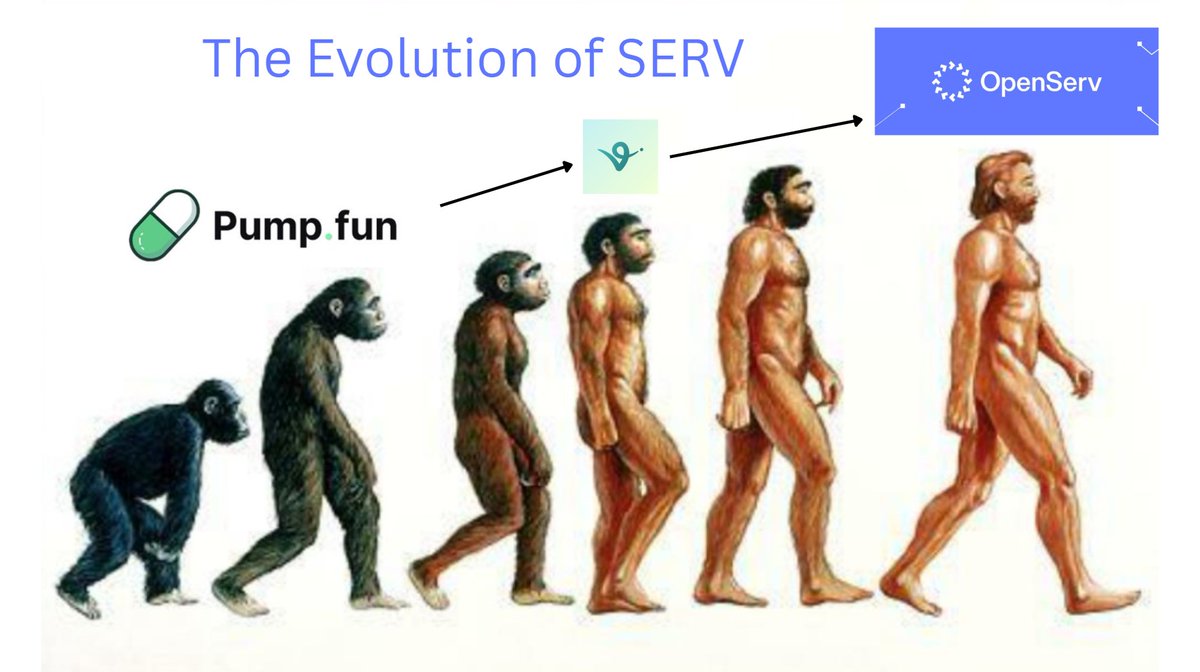
Most people hear "launchpad" and think pumpfun with extra steps. Fair token creation, bonding curves, maybe some anti-snipe mechanisms. Deploy a token, hope for the best (probably get rekt), move on. Maybe rinse&repeat if you're on the degen end of the crypto spectrum.
OpenServ has built something structurally different: a full-stack system where projects are built, funded, and operated under one roof. SERV Launch is just the funding layer inside that system. And when you understand the full picture, you start to see why the $SERV token is positioned to capture value at every single layer of the stack. Potentially, of course. Yes, this means that there is no financial advice in this post.
Ok, let's see how it works:
The pipeline:
1⃣ build
2⃣ fund
3⃣ operate
Here's a simple way to think about OpenServ:
It's a crypto-native Y Combinator for autonomous AI businesses...except permissionless, and powered by AI agents instead of humans.
For those unfamiliar: Y Combinator is the most famous startup accelerator in the world. It backed Airbnb, Stripe, Coinbase, and hundreds more. You apply, build during an intensive program, then pitch investors at Demo Day (aka D Day).
OpenServ follows the same structural logic:
BUILD Founders use OpenServ's AI agent platform, SDK, SERV Reasoning engine, and SERV Cofounder tools to create their product.
FUND When it's ready, they tokenize and raise capital through SERV Launch.
OPERATE Post-launch, they continue running their business with OpenServ's AI-powered team members (AI agents) for marketing, growth, community etc.
This is why calling SERV Launch "a launchpad" is not right. A launchpad is just a venue for degens to create, launch tokens, and forget about them.
Here, the launch is just the midpoint. OpenServ handles everything, from idea to revenue. You might as well describe it as a startup-as-a-service kind of a thing because it doesn't just host your project, it helps build it, fund it, and run it.
The Foundry: where it all actually starts
Before a project ever reaches SERV Launch, there's the SERV Foundry.
Foundry is a weekly build-in-public sprint where solo founders and small teams compete to ship real, working products. Compete to ship, not compete to pitch. That includes code with a live demo and a repo.
Winners get a $1k grant, free SERV Reasoning credits, and, most importantly, a direct path to launch their token on SERV Launch with a spotlight from the OpenServ team. They're expected to go live within roughly two weeks of winning.
Think of it as the audition round. Foundry filters for builders who actually execute (unlike Hoskinson and Cardano), and feeds the best ones directly into the tokenization pipeline. This creates a continuous flow of real projects entering the ecosystem; not anons launching memecoins and shitcoins, but vetted builders who've already proven they can ship.
The SERV token flywheel
This is where it gets interesting(especially if you hold the token). Every mechanism inside SERV Launch is designed to create structured demand or yield for $SERV holders. How tho? Well:
demand-side pressure (read: buy pressure)
Launch fees: Every project that tokenizes on SERV Launch pays a 5,000 $SERV fee. That's direct buy pressure every time a new project goes live. More launches means more SERV tokies are leaving the market.
Early access threshold: To get priority access to any launch, you need to hold at least 50,000 $SERV on Base or Ethereum. NOTE: hold, not spend. Anyway, this creates sustained, passive holding incentive across every wallet that wants to participate in future launches. It locks up (so to speak) circulating supply without requiring a staking contract.
Yield accrual for stakers:
5% auto-allocation: every token launched on SERV Launch has a fixed supply of 1 billion tokens. At deployment, 5% of that supply is automatically sent to the SERV staking contract. That's actually sexy. It means SERV stakers are passively accumulating proportional positions in every single project that launches on the platform, without buying anything. For example, if 10 projects launch in a month, stakers receive 10 different tokens. If 50 launch in a quarter, stakers hold diversified exposure across all 50. It's essentially an auto-compounding index of everything built on OpenServ, earned just by staking SERV. One token to rule them all. 🤝
Fee revenue: all liquidity pools on SERV Launch are created on Aerodrome CL and locked for 10 years. Trading fees from every LP are split as follows: 67% to the project creator, 33% to the platform. When SERV staking goes live, stakers will earn a share of that 33% cut from every active LP across the entire ecosystem.
The compounding effect [flywheel]:
more projects build on OpenServ means more Foundry submissions means more launches means another 5000 SERV fees absorbed means more 5% allocations flowing to stakers means more trading fee revenue means more incentive to hold and stake SERV means tighter circulating supply means the 50K SERV early-access threshold becomes more expensive in dollar terms...in other words: early positioning becomes more valuable.
So yeah, the token captures value at every step of the platform's growth.
Fair launch by design
In a market rekt by insider-heavy launches, presale dumps, and VC (vulture capital) unlocks, SERV Launch takes a different approach: no presales, no VCs, no OTC deals.
Every launch is transparent, with clear tokenomics and vesting terms. The SERV community gets in first, every time. Alright, OpenServ does have the right to say that it's "community first".
Every launch starts at an fdv of $15k (the valuation at the moment trading opens, before any market activity).
Anti-sniping: riered buy limits
The first 10 minutes of every launch are *exclusively* for qualified $SERV holders (50k+ SERV). Within that window, three phases protect against bots and whales:
First 70 seconds: Max 100k tokens per transaction, 1M per wallet.
Next 60 seconds (70–130s): Max 1M per transaction, 5M per wallet.
After 130 seconds: no limits (still SERV-holder-only for the remaining time).
After 10 minutes: public trading opens to everyone.
The design ensures no single wallet or bot can scoop a massive chunk at the lowest price. It forces distribution across more participants during those critical early moments, exactly the kind of protection retail has been asking for. TL;DR everyone SERV-maxxing gets a cut. Pretty much.
Programmatic fundraising:
Now this is quite a clever mechanism. Instead of raising money from VCs in private rounds before launch (SAFTs, private sales, seed deals), programmatic fundraising lets teams raise capital as their market cap grows organically after launch.
How? Like this: 5% of the token supply is spread across 14 price bands, ranging from a $500k market cap to $100M. As the token price climbs into each band, tokens from that band are automatically sold and the proceeds go directly to the team's wallet.
The total potential raise across all 14 bands is approximately $800k. Teams only get funded if the market actually values what they're building. No insider allocations, no early dumps from private investors. In other words: only those who build real stuff will get rewarded. And I like this a lot.
What's on the horizon?
SERV staking isn't live yet, but when it launches, stakers will earn platform fee revenue plus the 5% token allocations from every launch. That's the moment the full flywheel activates and the brrrrr starts.
Solana support is coming, expanding the market beyond Base. More chains will be added to the list as time goes on.
Foundry sprints continue to feed the pipeline weekly with vetted, shipping builders.
One thing I noticed and had me think is the fact that, right now, all LP creation and trading happens on Aerodrome, a fantastic DEX, but also a third-party one. That means a portion of the value generated by SERV Launch activity (routing fees, TVL metrics, trading volume) leaks to Aerodrome rather than staying inside the ecosystem. If OpenServ ever builds or integrates its own DEX, it would close that loop entirely: trading fees, LP mechanics, and custom AMM curves all designed specifically for their launch structure, with value captured fully within the SERV ecosystem. I mean, why outsource fees to a 3rd party DEX if you can build your own? That's just my 2 cents though.
The mother of TL;DRs:
OpenServ isn't competing with pumpfun or Virtuals on who can launch tokens faster. It's competing on who can produce real, operating AI-native businesses at scale. So they're not even in the same category.
The SERV token sits at the center of that; not as a governance token, not as gas (not yet, remember OpenServ L3 is part of the bigger picture), but as the economic backbone of an entire build-fund-operate system. Every project that enters the ecosystem creates demand for SERV (launch fees), rewards for SERV holders (early access), and yield for SERV stakers (token allocations/airdropsifyouwant + fee revenue).
And that right there...that's not launchpad tokenomics. Ergo, SERV Launch isn't a launchpad.
I rest my case here. 🫡