ExoHash

109 posts

ExoHash banner
ExoHash

ExoHash

@ExoHashIO

The settlement layer for provably fair onchain gaming. Consensus-embedded RNG. Protocol-enforced solvency. Pluggable WASM games. Pre-seed | Building the team

The Interchain انضم Aralık 2025
18 يتبع40 المتابعون
rip-ens.xns
rip-ens.xns@Walodja1987·
@YR29311585 Soon Cosmos could be even more advanced. Watching @ExoHashIO closely. It integrates random number generation and solvency into the chain itself. Novel idea. Could be used as infrastructure for all types of Casino games.
English
1
0
0
14
YRX
YRX@YR29311585·
Ethereum is dead too: Balancer Labs (original team fully shut down ops) Tally (governance platform for 500+ DAOs) Angle Protocol (EURA + USDA stablecoins) Forgotten Runiverse (MMORPG on Ethereum/Ronin) Ember Sword (full server shutdown) Symbiogenesis (Square Enix Ethereum game) Magic Eden (EVM marketplace + wallet closing) Polynomial Protocol (derivatives) DappRadar (one of the oldest dApp trackers, dead) dozens more games and dApps quietly disappeared in 2025-2026. Cosmos isn’t lonely in hell, bro 😀
Ethereum Daily@ETH_Daily

Cosmos is dead: Leap Wallet Penumbra Comdex Kujira Evmos Picasso Quasar Stride Pryzm Drop Milkyway Demex UX Chain Mars Protocol Osmosis (maintenance mode) Neutron (maintenance mode) NilChain (migrate to ethereum) Noble (migrate to EVM L1)

English
18
11
58
9K
ExoHash
ExoHash@ExoHashIO·
ExoHash architecture — 3 teams, zero overlap. Team 1: chain node, keeper, BFF, infra Team 2: WASM game calculators — Rust/Go, no blockchain knowledge needed Team 3: frontend — Next.js, consumes SSE events The keeper is a dumb database. All game logic in WASM. BFF is a dumb pipe. Frontend interprets game events. Adding a new game = one WASM binary + one .ts file. No chain upgrade. No BFF restart. Pre-seed. Building the core team. Join → discord.gg/whbMNhyb #buildinpublic #blockchain #gamedev
ExoHash tweet media
English
0
0
3
92
ExoHash
ExoHash@ExoHashIO·
How do you prevent malicious games on a permissionless gaming chain? Our approach: an on-chain auditor agent. Every WASM game binary must be signed by an approved auditor before deployment. The auditor runs automated checks: - Simulate 10K+ rounds, verify house edge converges - Fuzz test: random params, random actions, verify no fund locks - Gas budget: verify block_update completes within limits - Settle check: payout never exceeds reserved amount The auditor's public key is a governance parameter. Upgrade the auditor = governance vote. Old signatures stay valid. Basically GLI certification as code. Automated, deterministic, on-chain verifiable. #buildinpublic #blockchain #gaming #security
English
0
0
2
42
ExoHash
ExoHash@ExoHashIO·
@glazworks Block time now is 680 ms. 400ms very doable, but needed? UX from button click to ui response is 1.3sec. 1.3 sec is everything - tx acceptance in block N, rng resolution resolution in N+1, settlement, payout transfer, event emission to ui (network latency Helsinki-Nauenberg)
English
0
0
0
7
Vladimir Glazachev
Vladimir Glazachev@glazworks·
@ExoHashIO 44KB wasm binary for a full blackjack engine is tiny. TinyGo doing work. how's the latency on the on-chain state transitions during gameplay?
English
1
0
0
20
ExoHash
ExoHash@ExoHashIO·
Full blackjack game engine. 895 lines of Go. 44KB WASM binary. Hit, stand, split, double down, insurance — all on-chain. Dealer logic, deck management, payout calculation. The whole thing. Waiting for UI developers to join. The logic is ready. #gamedev #indiedev #WASM #TinyGo #OnChainGaming #CosmosSDK
English
1
1
5
115
ExoHash
ExoHash@ExoHashIO·
The path to pluggable games was tough: 1. Native Go modules — fast, but every new game = chain upgrade 2. CosmWasm — pluggable, but 55x slower than native 3. Our approach — wazero + direct host function calls. Skip CosmWasm entirely. 100 bets settled per block in 24ms. Near-native speed. No chain upgrades. Games are 30KB WASM binaries calling the keeper directly: reserve(), settle(), get_rng(). No message serialization. No contract framework. The keeper is a dumb database. All game logic in WASM.
English
0
0
1
14
rip-ens.xns
rip-ens.xns@Walodja1987·
@DefiIgnas Next big thing is probably @ExoHashIO, a chain with built-in randomness and solvency guarantees. Anyone can build casino games on top of it. Those looking for easy money can go and play casino games.
English
1
0
0
43
Ignas | DeFi
Ignas | DeFi@DefiIgnas·
Crypto easy money era has ended. Historically, most easy money periods last 3-7 years: - California Gold Rush lasted 7 years. - Tulip mania lasted 3 - The dot-com bubble about 5 years before the Nasdaq dumped by 78% - Japan's bubble was 6 years, then Nikkei took 34 years to recover So most speculative booms in history last 3-7 years. Crypto easy money started in 2017 with ICOs. Then DeFi summer 2020. NFTs in 2021. Airdrops. Points farming. Memecoins. That's ~8 years of easy money. We are already past that as every easy money model has been discovered, exploited, or arbitraged to max competition. Philosophical hard-forks like BTC -> BTC Gold or ETH -> ETH classic are over as crypto ossified not just technically. ICOs got regulated. Airdrops get farmed by industrialized sybils. Memecoin launches went from community fun projects to extraction tools. The gold rush analogy seems quite good here as FOMOs end the same way: Surface deposits get exhausted and then industrial mining takes over. (Literally same happened to BTC mining moving from retail to institutions who even IPOed from BTC mining.) So here’s where crypto is now: TradFi suits moving in, tokenization, RWAs, corpo-sloppo permissioned chains, and regulation. The Trump family & insiders are the last to get easy money from crypto. For retail, the surface easy money gold picking is gone. What's left to earn requires real infra, real users, real revenue which means more specialization, specific knowledge and REAL hard effort. Not sure how many of us who got easy money are ready to grind harder now. So many builders, KOLs, projects are extracting as much as they (we) can before leaving crypto coz adapting to the new hard-money period is gonna be hard. Question is: where to pivot for easy money? Asking for a friend.
Ignas | DeFi tweet media
English
169
83
696
70.3K
ExoHash
ExoHash@ExoHashIO·
Building the early team for ExoHash — the sovereign Cosmos L1 Cosmos for provably fair on-chain gaming. Pre-seed. No funding yet. That's the point. We're looking for: 🎰 Rust/Go dev — write WASM casino games (Blackjack engine live in ~800 lines TinyGo). No Cosmos knowledge needed. 🎨 Frontend dev — real-time game UI (on-chain logic ready). 📢 Community managers — help grow the movement. Early team = meaningful tokens + cash. The ones who show up before the raise are the ones who matter. #hiring #web3jobs #buildinpublic
English
3
0
4
153
ExoHash
ExoHash@ExoHashIO·
We tested WASM game engines in Rust — 55x slower than native Go modules. Switched to TinyGo. Now a full game calculator is ~500 lines, ~40KB, and runs at native speed. Write a game. Compile to WASM. Register on-chain as a transaction. No chain upgrade needed. #CosmosSDK #WASM #TinyGo #OnChainGaming
English
0
0
1
52
ExoHash
ExoHash@ExoHashIO·
@peraa223 @SonicLabs To my knowledge: Sonic is super fast, but it doesn’t have a true native VRF generated inside consensus like some chains. Most projects on Sonic still use Chainlink VRF (which is listed in their infra docs). Or you have another info?
English
0
0
0
45
Peraa
Peraa@peraa223·
Hey @ExoHashIO, solid point on the randomness For Sonic Ludo Arena, the dice rolls could be powered by Sonic’s native onchain VRF provably fair, fully transparent, and impossible to frontrun since everything lives on the L1. That’s exactly why Spawn + Sonic is such a beast for games: speed + real fairness without extra oracles. Would love to see how your BLS threshold setup feels in a super-fast multiplayer setting too. @SonicLabs, this randomness chat just proves how perfect Ludo would be to build next 👀 Let’s make it happen..
English
1
0
0
27
Sonic
Sonic@SonicLabs·
April Fools felt like the right day to do something real ♟️ Someone suggested we build a chess game - so we built it using Spawn, with every game and move onchain 250 $USSD is going out as a surprise thank you - check your DMs if you dropped that idea! Play now at chess.soniclabs.com - top 3 on the leaderboard win $S from the weekly prize pool What should we build next? Drop your idea below for a chance at 100 $USSD
English
146
77
403
27.5K
ExoHash
ExoHash@ExoHashIO·
This is a really honest take — the speed vs cryptographic certainty tradeoff is the core tension in on-chain iGaming. We ran into the same issue and decided to embed randomness directly into consensus with BLS threshold signatures (validators produce it every block). Got us to ~1.35s end-to-end verifiable settlement. Still slower than web2, but the trust model is completely different. How are you guys balancing that responsiveness vs verifiability in Aurumrun?"
English
0
1
1
27
Aurumrun
Aurumrun@PeaceYoungCarl·
Building a provably fair Web3 crypto casino sounds simple on paper. In reality, it is one of the hardest things to get right. You are not just building a casino. You are building a system where trust must survive transparency. Every spin, roll, and hand has to feel instant for the player, but under the hood, fairness has to be mathematically verifiable. That creates a brutal tension: Speed vs certainty. UX vs blockchain latency. Entertainment vs cryptographic proof. A player wants the result now. A blockchain gives you the result when the network is ready. That means developers are constantly fighting responsiveness. If you rely too heavily on on-chain finality, the game can feel slow, clunky, and frustrating. But if you abstract too much away for speed, players start asking the most important question in crypto gaming: “Can I really trust this?” That is where provable fairness gets deep. A real provably fair system is not just a buzzword slapped onto a game. It usually involves a carefully designed relationship between server seeds, client seeds, nonce progression, hashing, and verifiable outcomes. The goal is simple to describe but hard to execute: The house cannot secretly manipulate results, and the player can verify that outcomes were not changed after the fact. Now add blockchain to the mix. Suddenly, you are dealing with: network congestion wallet friction transaction confirmation delays gas costs cross-chain inconsistencies smart contract risk front-end state syncing with on-chain events and the nightmare of making all of that feel smooth on mobile Then there is the hardest part of all: Explaining fairness in a way normal players actually understand. Because cryptographic integrity means nothing if the user experience feels confusing. If players cannot instantly see how outcomes are generated, verified, and settled, then even a fair system can feel unfair. So the real challenge is not just coding randomness. It is engineering confidence. It is making a product that is: fast enough to feel exciting, transparent enough to feel trustworthy, and robust enough to survive real money at scale. And that is before you even touch affiliate systems, tracking, payouts, bonus logic, retention flows, fraud prevention, and performance optimization. A great Web3 casino is not built by luck. It is built through relentless iteration, deep technical design, and countless invisible hours solving problems players should never have to think about. We work overtime to make the experience awesome for affiliates and players alike. #Web3 #CryptoCasino #ProvablyFair #BlockchainGaming #iGaming #Crypto #SmartContracts #GameDev #Affiliates #DeFi #CasinoTech #TechStartup #UX #Innovation #Viral
English
4
0
7
137
ExoHash
ExoHash@ExoHashIO·
@peraa223 @SonicLabs Interesting point on dice randomness. On ExoHash we solved this by putting BLS threshold signatures directly in consensus so no one can frontrun. Curious how Sonic plans to handle fair dice rolls at scale?
English
1
0
0
28
Peraa
Peraa@peraa223·
Hey @SonicLabs, build Sonic Ludo Arena next! 🎲 A fun, fully onchain 4-player Ludo game where every dice roll (using fair onchain randomness) and every move is recorded on Sonic. Add casual tables for free play + ranked lobbies where players stake a little $USSD, winner takes the pot. Include live matchmaking, a way to watch games, a global leaderboard, and weekly tournaments with $S prizes. It’s the kind of game everyone already knows and loves, but now with real stakes and onchain transparency. Super addictive, mobile-friendly, and perfect to show how fast Sonic really is. What do you think?
English
1
1
1
525
ExoHash
ExoHash@ExoHashIO·
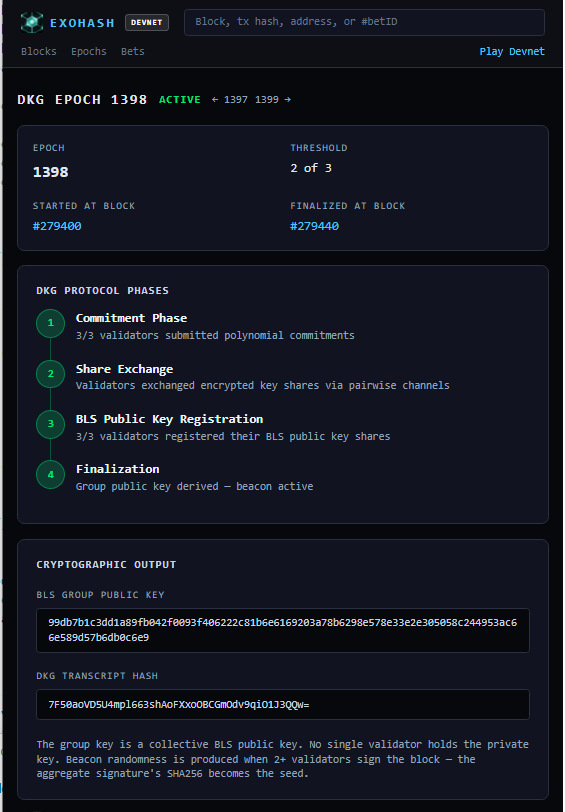
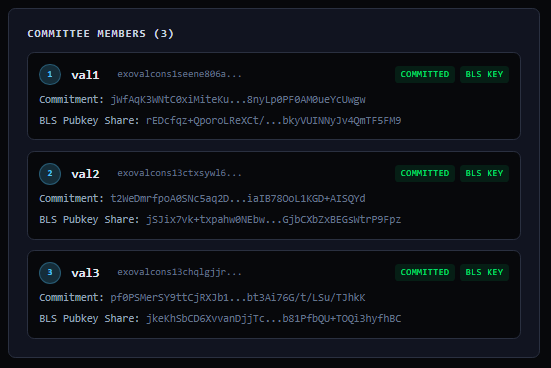
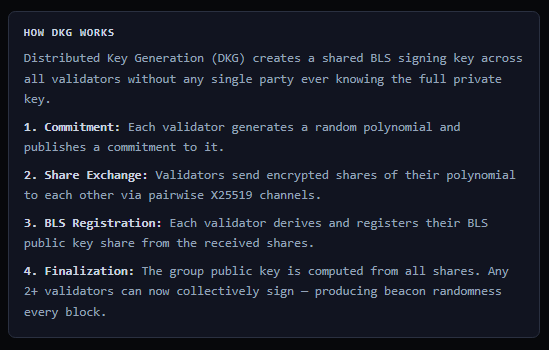
DKG & Beacon Randomness — Explained Simply =============================== Imagine 3 people each have a piece of a magic stamp. No one person has the whole stamp. But if any 2 of them press their pieces together, it makes a mark that everyone can verify came from the group. SETUP (DKG — happens once per epoch) ------------------------------------- 1. COMMITMENT Each validator picks a secret number and puts it in a locked box. They show everyone the outside of the box (commitment) so no one can change their number later. 2. SHARE EXCHANGE They each whisper a clue about their secret to every other validator through private tubes (encrypted X25519 channels). Now each validator has clues from everyone else. 3. BLS KEY REGISTRATION From these clues, each validator builds their piece of the stamp (BLS key share). They show the public part so everyone can verify. 4. FINALIZATION The pieces combine into one group stamp (group public key). Nobody ever saw the full secret — it exists only as a combination. USING IT (every block) ----------------------- Block 100 produced by proposer → Validator 1 stamps it with their piece → partial signature → Validator 2 stamps it with their piece → partial signature → 2 of 3 pieces combined → full signature (threshold met) → SHA256(full signature) = random seed for this block The seed is unpredictable because: - No single validator knows the full signing key - The seed depends on which validators participate - You need 2+ validators to collude to predict it - The proposer can't see the seed before committing the block WHY THIS MATTERS FOR GAMES ---------------------------- When the dice calculator requests RNG at height 100, it gets: SHA256(BLS_group_signature_of_block_100) A number that nobody could have predicted or manipulated. The "2 of 3" threshold means even if one validator goes offline or tries to cheat, the remaining two can still produce randomness. The chain never stalls waiting for a slow validator. CONCRETE EXAMPLE FROM THE EXPLORER ------------------------------------ DKG Epoch: 1398 Threshold: 2 of 3 validators Committee: val1, val2, val3 Group Public Key: 99db7b1c3dd1a89f...e589d57b6db0c6e9 This key is a collective BLS public key. No single validator holds the private key. When 2+ validators sign a block, the aggregate signature's SHA256 becomes the beacon seed for that block. That seed is what the game calculators use to determine dice rolls, crash points, and all other random outcomes.
ExoHash tweet mediaExoHash tweet mediaExoHash tweet media
English
0
0
1
57
ExoHash
ExoHash@ExoHashIO·
Chainlink VRF is definitely better than server-side RNG, but it still adds latency + cost per bet. On ExoHash (Cosmos SDK L1) validators generate fresh BLS threshold randomness inside consensus every ~680ms block — no oracle, no extra tx. Result: ~1.35s end-to-end verifiable bets with protocol-enforced solvency. Different approach for true iGaming use cases.
English
0
0
0
17
Onchain | Tricolon™
Onchain | Tricolon™@bigonchain·
Most onchain raffles are cooked. Too many players. Dogshit odds. Zero transparency. @the_prize_io actually flips the script. → Chainlink VRF = fully verifiable, onchain randomness → Still in open beta = low entries, your odds are actually good 5 raffles live right now (including a $1K pool) • 50% bonus on first deposit (limited time) This feels like one of the only times being early actually pays off. I’m in 🎁.
The Prize 🎁@the_prize_io

The Prize is built different. Undersaturated. Unmatched odds. Undeniably fair. • Still in Open Beta → fewer players, odds in your favour • 5 raffles live right now (including a $1,000 prize pool) • Fully onchain + verifiable via Chainlink VRF For a limited time only 👇 Deposit any amount & get 50% extra on your first entry. Enter now for real rewards: theprize.io 🎟️

English
33
3
45
1.5K
ExoHash
ExoHash@ExoHashIO·
Canopy is impressive for quick launches and progressive security. Personally, I still prefer Cosmos SDK. CometBFT + ABCI++ gives us the flexibility to embed critical features like verifiable randomness straight into consensus with BLS threshold signatures. In iGaming, that level of control is essential for real provable fairness without relying on oracles or servers.
English
0
0
0
7
Chris Mendez
Chris Mendez@Chris_Mz1015·
No more isolated chains. @CNPYNetwork brings universal security and interoperability so your appchain can connect, grow, and thrive in a decentralized ecosystem. Fast transactions, robust infra, and true sovereignty. The future is Canopy!
English
1
0
0
9