Exponential View 🔮 أُعيد تغريده

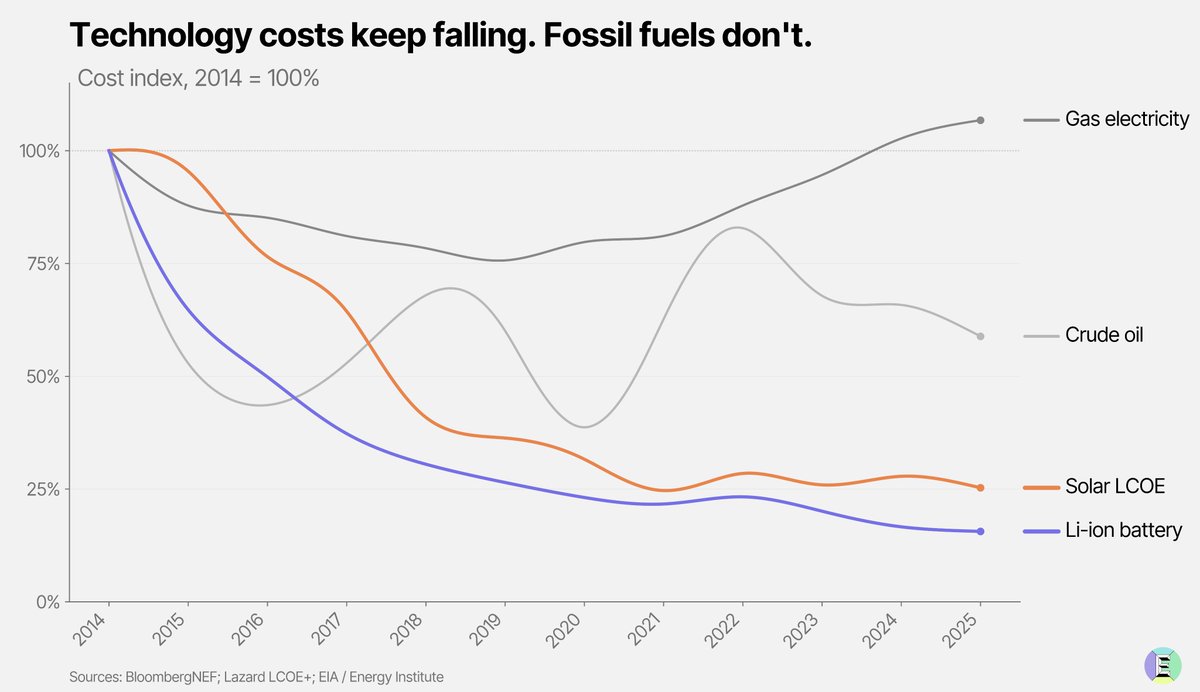
Chinese renewable energy is far more ambitious than just EVs or grid electrification.
This interactive chart from @ExponentialView by @azeem is a great way to see it: as solar gets cheap enough, it does not just take share in power generation. It starts to make entire incumbent systems vulnerable. Readers can play with the assumptions on the original site and see how quickly the timing changes.
A few examples of what ultra-cheap solar can start to unlock:
Grid power is the most obvious one. Global electricity generation reached about 30,900 TWh in 2024, and solar still provided only 6.9% of it, which shows how early we still are.
Aviation fuel is another. Global airlines’ fuel spend was projected at about $291 billion in 2024 and $248 billion in 2025, so this is already a roughly $250 billion to $300 billion annual market at current fuel prices.
Industrial heat may be even more important. Industry accounts for nearly 40% of global final energy demand, and much of that energy is used in heat-intensive processes. That implies an enormous incumbent fossil energy market, plausibly well above $1 trillion a year on a rough back-of-the-envelope basis.
Green hydrogen is especially interesting because it first displaces existing fossil hydrogen demand in refining and ammonia, and then could move into much larger industrial systems like steel. It is already being piloted at scale, and there are strong reasons to think it will ramp seriously over the next decade.
And then there are areas like desalination and carbon capture, where the value is harder to summarize as a single market number but could be enormous in social and economic terms.
Link to the chart in the comments. It is worth playing with the assumptions yourself to see when different cost thresholds start to make these incumbent systems vulnerable.

English