Eric Alston

635 posts

Eric Alston

Eric Alston

@IncompleteRules

I study institutions, namely property, constitutions and blockchains. Asst. Law Professor at University of Wyoming (Aug. 2026)

انضم Nisan 2020
518 يتبع731 المتابعون
Eric Alston أُعيد تغريده
sofia cossar
sofia cossar@CossarSofia·
Privacy is often treated as a right we either have or lose. We instead conceptualize it as an institutional equilibrium shaped by the incentives of governments, firms, and individuals, in interaction with technological change. Our new paper with @IncompleteRules introduces the institutional privacy dilemma: governments are tasked with protecting privacy while also needing to undermine it to govern. Encryption and ZKPs reshape the game: 🔐 Encryption suppresses observable signals → weakens government legibility and enforcement → induces workaround surveillance. ✅ ZKPs generate selective, verifiable signals → enable compliance without full disclosure → but do not remove the need for broader legibility or the costs of institutional adaptation. The result is a continuous coevolution of institutions and technology. papers.ssrn.com/sol3/papers.cf…
sofia cossar tweet media
English
0
1
1
46
Eric Alston
Eric Alston@IncompleteRules·
New from @CossarSofia and I: how emergent tech like ZKPs & E2EE affects the privacy the govt will provide given the "institutional privacy dilemma" - govts are unlikely to supply privacy sufficiently because these rights cut against enforcement priorities bit.ly/PrivacyZKPsEnc…
English
0
0
6
90
Eric Alston أُعيد تغريده
Michael Mosier
Michael Mosier@m_mosier_·
“distributed network governance creates dynamic fidelity, …whereby…distribution of protocol update authority among independent classes of actors (validators, developers, users, [etc.]) produces emergent checks & balances analogous to constitutional separation of powers”
Eric Alston@IncompleteRules

A new piece from me on why distributed network architectures are increasingly valuable for ensuring commitment credibility (↓ counterparty risk) and better protecting rights in digitally-intermediated contexts! bit.ly/DigitalConstit…

English
1
4
18
831
Eric Alston
Eric Alston@IncompleteRules·
A new piece from me on why distributed network architectures are increasingly valuable for ensuring commitment credibility (↓ counterparty risk) and better protecting rights in digitally-intermediated contexts! bit.ly/DigitalConstit…
English
1
2
9
1.1K
Eric Alston
Eric Alston@IncompleteRules·
@Etherealize_io Slashing penalties will be useful for future contexts where deploying many AI agents creates emergent systemic negative externalities - super cool that @ethereum already has them baked in (more here on aligning agents' incentives with penalty automation: bit.ly/SlashedStake)
English
0
0
2
547
Etherealize
Etherealize@Etherealize_io·
Vitalik Buterin explains why proof-of-stake is more secure than proof-of-work “I think proof of stake is very secure because to attack the system, you need to have basically as much stake as the rest of the network. Right now, for example, we have 5 million ETH staking, which means you have to come up with 5 million ETH and then join the network.” At the time of this writing, more than 37 million ETH are being staked, with 3 million ETH waiting to join via the validator queue. At today’s prices, that’s more than $80 billion of ETH someone would have to acquire to attack the network and revert finalized blocks, which is more than the cost of attacking even the Bitcoin network by some estimates. The other defense mechanism that proof-of-stake has that proof-of-work doesn’t is slashing, which makes Ethereum antifragile. Vitalik explains: “Recovering from attacks is much easier in proof-of-stake than proof-of-work. For many kinds of attacks you do against [the Ethereum] network, we have this concept of automatic slashing. In order to revert a finalized block, you basically have to have a big portion of your validators sign two conflicting messages. This is something where once these messages are on the network, you can go and prove ‘these people did it.’ So we have this feature in the protocol where you basically take all these people who provably misbehaved and you burn their coins.” Vitalik also acknowledges the possibility of censoring attacks, where if 1/3rd of validators refuse to attest, the chain can’t finalize. But, as he explains, Ethereum has a contingency plan for this as well: “Everyone who got censored would create a minority chain, and the community would have to do a soft fork. The would have to say, ‘this chain is clearly attacking us and this one is not attacking us, so we’re going to join this chain.’ Then what happens is, on that new chain, the attackers also lose a lot of coins. The difference between proof-of-stake and proof-of-work is that in a proof-of-stake system, you can identify specific participants — and this isn’t a human going in and saying ‘I don’t like you’. It’s all automated.” One last benefit of proof-of-stake is that security scales with the value of the network. As Vitalik put it five years ago, it is really relative security, and not absolute security, that matters: “The security needs of a thing have to be proportional to the size of that thing, because as a thing gets bigger, its enemies become bigger and more well-motivated. If BTC were 100x as big as it is today, the value from destroying it would be 100x higher, and the kinds of actors that would want to care about destroying it would be much bigger and scarier. This is also why countries of all sizes have roughly similarly sized militaries as a percentage of GDP. Hence, cost of attack divided by market cap really is the correct statistic to measure, and in the long run issuance-free PoW really does look not that good." Source: @lexfridman (Jun 2021)
English
88
147
995
101.1K
Eric Alston
Eric Alston@IncompleteRules·
@malekanoms Inveterate gamblers who think it's still more PvP than it is?
English
0
0
0
251
Omid Malekan
Omid Malekan@malekanoms·
Pump fun revenues are remarkably stable, not far from where they were a year ago, when crypto was a very different place. So once again I must ask, who are all these suckers still showing up to be extracted and exploited by industrial farmers, bot snipers, and MEV sandwichers?
English
18
3
89
8.6K
Christian Catalini
Christian Catalini@ccatalini·
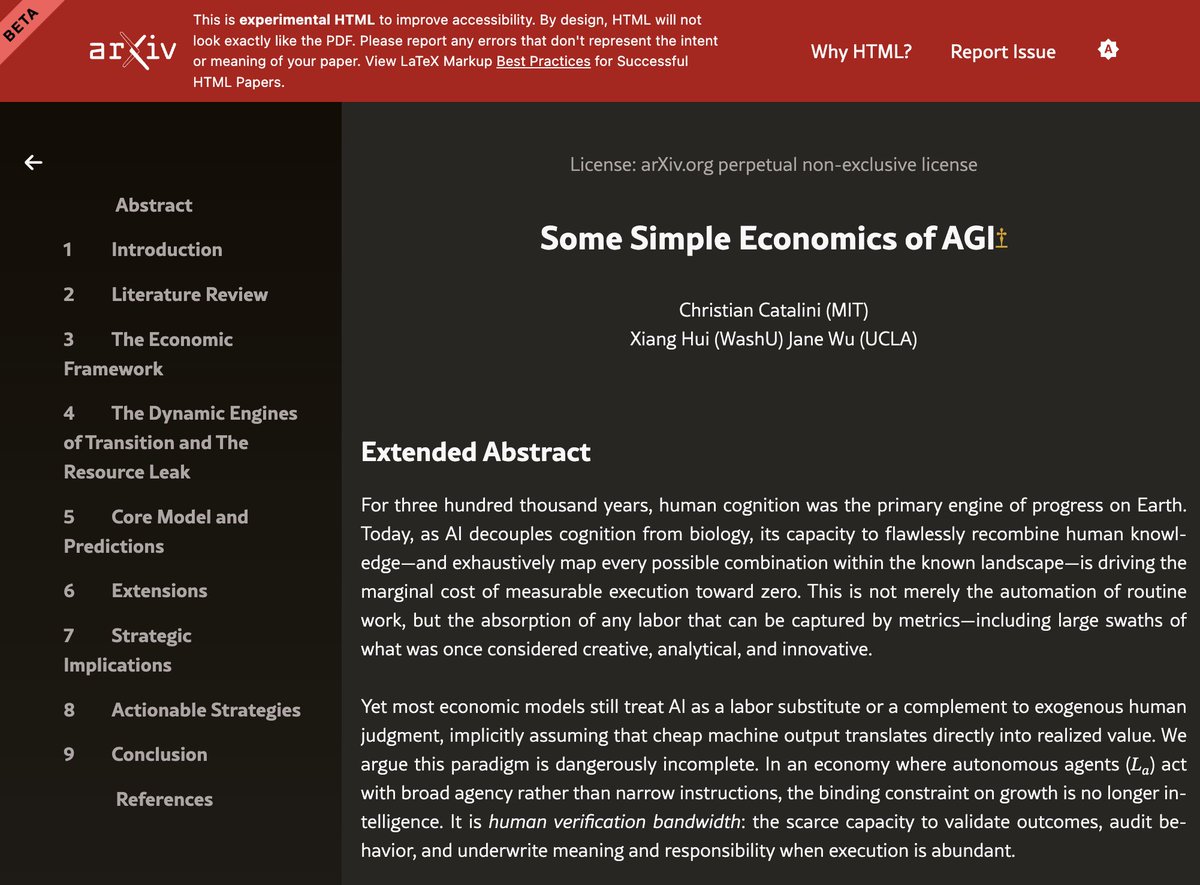
1/ Some Simple Economics of AGI—🔥🧵 Right now, there is a low-grade panic running through the economy. Everyone is asking the same anxious question: what exactly is AI going to automate, and what will be left for us?
Christian Catalini tweet media
English
146
378
2K
607.2K
Eric Alston
Eric Alston@IncompleteRules·
My coauthor and I link this notion to "human judgment" by considering canonical hard legal cases where the extant empirical heft (and recombinatorial possibilities thereof) are insufficient to dispositively determine outcomes (our "hard" cases involve novelty, imprecision, and incommensurability).
English
1
0
1
6
Eric Alston
Eric Alston@IncompleteRules·
@ccatalini Would (rate of increase of AI contribution to production + magnitude of verification need for that production) determine where loss of future verifiers will bind negatively the soonest?
English
1
0
1
28
Christian Catalini
Christian Catalini@ccatalini·
24/ This is the Missing Junior Loop: firms are rationally thinning the pipeline that produces future verifiers at precisely the moment the economy most needs to expand verification capacity. The old apprenticeship model is being quietly dismantled.
Christian Catalini tweet media
English
3
8
139
42.7K
Eric Alston أُعيد تغريده
EthBoulder
EthBoulder@ethereumboulder·
Privacy vs. Enforcement isn't a zero-sum game. ⚡️🔐 @IncompleteRules discusses how Zero-Knowledge Proofs (ZKPs) can tame the privacy dilemma. Imagine a world where you can prove compliance or solvency without revealing your entire balance sheet or identity. We’re moving toward a "middle ground" that preserves individual autonomy while satisfying legitimate audit needs. 🔱📡 Catch the breakdown from #ETHBoulder on ZK-tech as a bellweather for state capacity:
English
0
3
4
209
Eric Alston أُعيد تغريده
BlockchainGov
BlockchainGov@BlockchainGov·
This weeks article examines how shared norms & conflict accommodation function as interlinked inputs to resilient organizational constitutional design, from traditional orgs to DAOs. By @IncompleteRules From 2022. Available here: law.mit.edu/pub/governance…
BlockchainGov tweet media
English
0
2
9
189
Eric Alston
Eric Alston@IncompleteRules·
@federicoast I would like an introduction to your personal trainer and stylist, ser.
English
1
0
0
29
Eric Alston أُعيد تغريده
Center for Governance and Markets | Pitt
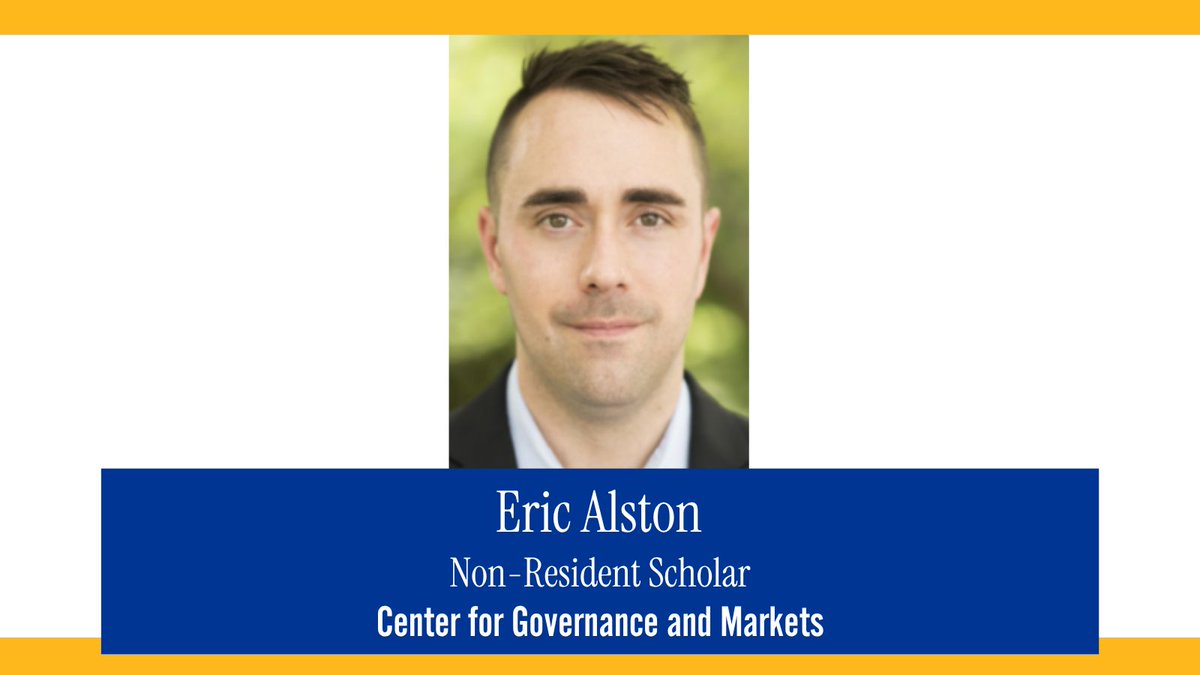
We are pleased to welcome Eric Alston as a Non-Resident Scholar. Eric Alston (@IncompleteRules) is a Scholar in Residence at the University of Colorado Boulder and Faculty Director of the Hernando de Soto Capital Markets Program. He also serves as a Research Associate with the Comparative Constitutions Project. His research spans law and economics, frontier rights development, constitutional design, and digital governance with a focus on blockchain networks. His current grant-funded work includes an NSF project on Colorado’s development and a Templeton project on digital currency markets.
Center for Governance and Markets | Pitt tweet media
English
0
1
5
206
Eric Alston
Eric Alston@IncompleteRules·
We call this "networked coordination of joint production", arguing that protocolized coordination can (to a significant extent) substitute for the firm's traditional role in coordinating that same production. bit.ly/SlashedStake How much AI can substitute for the to-date essential human cognitive role in governance responding in real time to the unforeseen is as yet unproven, but super cool to be speculating about!
English
0
0
0
43
Daniel Ospina
Daniel Ospina@_Daniel_Ospina·
What happens when AI and Blockchain meet rising global instability? How does capital allocation change? For the past six months, our team at @RnDAO__ has been working with @allo_capital to dive deep into this question, through theory and empirical data. We found that the traditional logic that held companies together for a century is breaking. AI makes cognition cheap. Blockchain makes trust accessible. Together, they unlock a new organizational form: the Networked Firm. We've put our findings into a comprehensive guide with cutting-edge case studies about the future of organisations and capital allocation. If you are a founder, investor, operator, grantmaker, or anyone building during this transition, this book gives you the map. Preorder the book using link below allocapital.metalabel.com/record_dvc23nc…
English
11
10
43
2.2K
Eric Alston
Eric Alston@IncompleteRules·
@DrNickA We published a handbook this summer dedicated to institutional design and dynamics under conditions of complexity. I couldn't agree more...
English
0
0
1
133
Nick Almond
Nick Almond@DrNickA·
Ok crash course in complexity thinking. There are some major drivers of complexity, they are: Scale - the more connected agents and systems, the greater complexity becomes. Information passing between agents increases the system wide connections. Interdependence - if one agent, or system changes, it affects many other agents in the system. We’re now in a world where a Trump tweet can change millions of lives. Not only are we interdependent we’re hyper interdependent. Our global system is centralised around hyper agents that can instantaneously change the whole system in seconds. Diversity - the more different each agent or system is, the greater the complexity. Diversity is actually a strength because complexity isn’t always bad, but it means you get the outcomes of complexity more obviously. High interaction variety is perhaps the biggest driver of complexity. Incongruent systems create conflict and unforeseen events. Dynamics - speed of change. The greater the pace of change in the system the more rapidly complexity manifests. Everything is changing fast. And this is not just the new normal it is ACCELERATING. Opacity - the more one area of the complex system changes and the rest of the connected systems don’t see it, the more likely you are operating under radical uncertainty. Eventually information is revealed and massively disruptive outcomes happen at scale because the change happening was shielded from the wider system. We have seen a massive unprecedented ramp in all of these drivers in an incredibly short space of time. This means we get non-linearity, far from equilibrium dynamics, which means unpredictability, black swans, overnight changes, unforeseen events again and again. In complex systems we get radical emergence, sometimes good sometimes very bad, but whatever it is you don’t see it coming. This is why every system which is still operating on a governance paradigm created before the radical complexity ramp is collapsing. We simply don’t have the ability to operate under uncertainty at this scale. So every decision is bad. This is why governance everywhere needs to be upgraded and quick.
Nick Almond@DrNickA

In the last 30 years or so we connected everyone via the internet and every country via the markets. This has exploded complexity of the societal systems we live in. And no one knows how to deal with it.

English
7
10
64
9.5K
Eric Alston أُعيد تغريده
Center for Governance and Markets | Pitt
We are pleased to announce our new non-resident scholars. These collaborators have been an integral part of the work at the Center for Governance and Markets, and we look forward to continuing our partnership to advance the ideas and mission of the Center. We’ll be sharing their individual stories in the coming weeks, stay tuned.
Center for Governance and Markets | Pitt tweet media
English
0
2
3
448
Eric Alston
Eric Alston@IncompleteRules·
This insight is what led to the emergence of institutional economics. I think there's a natural preference for formally-specified institutions because of their ex-post observability to third parties. Is this harder than modeling rational utility maximization? Yes. Is it still doable? Also yes (in many useful instances).
English
0
0
0
36
alz
alz@alz_zyd_·
"All people follow rule-based behavior" is obviously more correct to reality than "people maximize some utility function". But that's not the game we're playing. Is "Everyone follows some rule" insightful, or useful, in some sense?
English
2
0
5
1.6K
alz
alz@alz_zyd_·
"Economics is based on wrong assumptions, how could it be useful"? The key here is we are trying to be useful, not correct, and it turns out it is possible to have technically wrong models that are very useful
English
25
9
143
30.9K