

Mike Sutton
7.9K posts


If you told me Chris Griffin is retarded, literally retarded, I'd believe it
He has the horse racing IQ of 0
English

@SurfJournalist People really treat the NBA more like a soap opera than a sport
English

@MikeSuttN Yes, and it is entirely consistent with the Gordon Gecko "Greed is good!" ethos that has infected the U.S. over the past ~40 years. Grab what you can as quickly as possible, ethics and the long-term health of the country/ecosystem/industry be damned.
English
‡
The Derby Prep Deceit, Redux
Two years ago I published the extensive, embedded post, and I have been writing on the topic for many years. If you haven't read it, I encourage you to do so. The much shorter version is this:
The Arkansas Derby, Florida Derby, Bluegrass Stakes, and Santa Anita Derby are all designated Grade I races, yet they are all restricted to three-year-olds, and contested on dirt over 9f. The Wood Memorial is also carded during that week, though it is a Grade II.
The remarkably close proximity of those five KY Derby "preps" insures that the division of three-year-old male "route" horses is splintered, rather than being brought together. That is precisely the opposite of the original intent of the Graded race concept. The intent, with respect to Grade I races, was to bring the very best horses of the various divisions together, so that racing class could be easily interpreted. Splintering a division has the opposite effect.
There is no serious, or honest argument in favor of retaining Grade I status for any of the Derby preps. And as long as they retain that status, it will remain a searing indictment of TOBA, and especially The American Graded Stakes Committee. It is, essentially, an overt scam, which allows owners, breeders, consignors, and auction houses, etc., to benefit from the inflated values of horses that have "achieved" phony Grade I status.
Tinky@Tinky47flat
‡ Grade I Derby "Preps": The American Racing Industry's Shameful Deceit "Why bother? Why try to remember which race is better than, or inferior to, another? Because to improve the breed, to upgrade a broodmare band, to select a stallion, to understand a catalogue page, to evaluate a family – one must be able to recognize racing class." – Kent Hollingsworth, Editor The Blood-Horse, January 21, 1974 The above quote is important, and for a number of reasons. It is fundamentally important because it encapsulates why Graded stakes were first incorporated into the American racing calendar in 1974. The Europeans had led the way with the introduction of their similar "Pattern" race scheme in 1972, and urged the U.S. to follow suit. Prior to the introduction of Graded races and Pattern (i.e. "Group") races, it was not so easy to distinguish the relative quality of the best stakes races, and especially at a glance, in the catalogue pages that have long played such a crucial role in sales. This was a major development, and certainly appeared to be an important, and positive step for the industry. The problem, however, is that as is so often the case, and especially in these contemporary times, ideas that should, and do work well as designed and implemented, are eventually corrupted by those powerful enough to distort original intent, in order to benefit their own interests. There are countless analogies, but as I like to point out how the racing game is, in many ways, a microcosm of broader American society, consider how the economy has moved away from industrial capitalism, on which the strong post-war America was largely built, and towards the financialization of the economy, which has contributed significantly to the many deep problems facing the declining country today. So what happened to the Graded race concept, which seemed to be straightforward when it was first proposed and introduced? When the system was developed in 1973, there were 351 Graded stakes races, 63 of which were Grade I. In 2023 there were 440 Graded races, 97 of which were Grade I. There were 26,811 registered foals in '73; in 2023 there were 17,200. That's a 25% increase in Graded races, and a 54% increase in Grade I races, while the foal crop has declined 35%. The explanation for such extreme, Graded race inflation, and that is that those who have been in charge of assigning the Grades, The American Graded Stakes Committee, part of TOBA (the Thoroughbred Owners and Breeders Association), have chosen, over time, to distort the original intent of the system, in order to benefit themselves, and their powerful constituency. The above background is important to consider when thinking about the specific problem referenced in the title of this post, namely the Grade I Derby preps. It should be obvious that by their very definition, "prep" races should not be given Grade I status. After all, the participating horses are aiming for something bigger. How can a Derby "prep" be considered equivalent to the Derby itself in terms of importance? No one considers them to be of equal importance, of course, but that hasn't stopped the The American Graded Stakes Committee from giving some of them equivalent Grade I status. That alone should have been enough to prevent such an abdication of duty, but the reality is actually much worse. On March 30, both the Arkansas Derby and Florida Derby were run. One week later, the Bluegrass and Santa Anita Derby were run. All four are Grade I races, yet their close proximity insures that the division of three-year-old male horses is splintered, rather than being brought together. That is precisely the opposite of the intent of the Graded race concept, about which which Kent Hollingsworth wrote 50 years ago. The intent, with respect to Grade I races, was to bring the very best horses of the various divisions together, so that racing class could be easily interpreted. Splintering a division has exactly the opposite effect. There is no serious, or honest argument in favor of retaining Grade I status for any of the Derby preps. And as long as they retain that status, it will remain a searing indictment of TOBA, and especially The American Graded Stakes Committee. It is, essentially, an overt scam, which allows owners, breeders, consignors, and auction houses, etc., to benefit from the inflated values of horses that have "achieved" phony Grade I status. I know that sounds harsh, but the industry is facing many deep, complex problems, at least some of which seem to be intractable. This problem, in contrast, is one that can, and should be dealt with quickly, easily, and effectively. Yes, it would require the members of TOBA to make changes that could, in the near-term, adversely impact their own bottom-lines. But it would unequivocally be the right thing, and the honest thing to do. It would also likely benefit the industry more broadly if TOBA were to lead by example. At the end of the day, if a group that wields such disproportionate power is not willing to correct a glaring flaw such as the one described above, because they can't bear to give up the profits that flow from dishonest Grade I designations, how might anyone have any optimism that the bigger, more divisive issues facing the industry can ever be resolved? Finally, I'll borrow the title of one of filmmaker Spike Lee's early films to sum up my advice to TOBA on this issue: Do the Right Thing
English
@EJXD2 @keenelandracing @markecasse Don't know about getting a price on French Friction anymore unfortunately, saw her picked more than i thought i would. GL
English

It’s a great day for a car wash, @keenelandracing opening, @markecasse upsetting a Grade 1 race, and sushi. PICKS: keeneland.com/racing/expert-…

English

Keeneland will be posted at Dubclub tomorrow.
Full package is on Dubclub for $75 all meet!
English
@jonathanstettin "Back when minimums were higher, you didn’t spray and pray."
Well said and hilarious lol
English
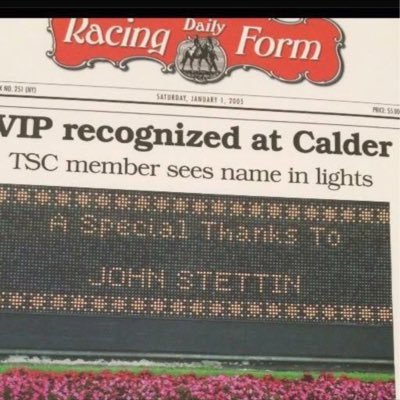

@MikeSuttN @tactical_speed Gate-to-wire times have already started to be put in all charts for free!
English

This is a welcome development. The sooner we can get it into the data feeds, the better.
Nice!
Equibase@Equibase
We are now adding gate-to-wire timing to all charts! ⏱️ The gate-to-wire time includes the run-up distance for each race and will be added to charts in addition to the official fractional and final times. Full release here: equibase.com/content/news/r…
English
@SotoSocial With turf racing moved back a couple of weeks you know that doesn't help the situation
English

People say NY will be one of the last states standing for horse racing. Really?
GhostofSwiftHitter@GhostofSwiftH
LOL
English
@lmgriffjohnson @Rennietime @ohheyitsnance @Raylemoine69 @jockeyclub Did you own a piece of Sandman before his 6 race losing streak? Because you've been hyping him up and telling the world he's going to win and he's just burning people's money who bet on him because of you. Keep up the great work!
English

@Rennietime @ohheyitsnance @Raylemoine69 @jockeyclub Right but Sandman goes off as the favorite nearly every race & flips the KY Derby odds & that happened with magic. If you guys whined less people would take you seriously 🤣
English

I’m 100% convinced the @jockeyclub is trying to end horse racing. No one can be this incompetent on so many different levels. ABR is literally gained zero new players.
The Jockey Club@jockeyclub
America's Best Racing is a multimedia fan development platform specifically designed to attract new fans to the sport of horse racing. @ABRLive provides helpful pages and articles such as how to bet on races, an explanation of common terminology associated with the industry, information on upcoming major races, and more! For more information, visit bit.ly/3M6vplF.
English
@SotoSocial Out of sight, out of mind. Somehow they need to get horse racing broadcast to as many eyeballs as possible. Everyone has an adw on their phone but if theyre at a bar and its not on one of the tvs they wont even think to bet a race.
English
Guaranteed handle takes a hit here when this shuts down. So much already working against players with takeout and CAWs.
Nick J. Hines “Sarge” 🇺🇸@Hinesite
“In 2025, about $2.24 billion was wagered through TVG.com/FanDuel Racing. That is about 19% of all the pari-mutuel handle in NA last year. Rounding up a bit, it's one out of every five pari-mutuel dollars wagered. If those ADW platforms see a decline after FanDuel TV winds down and is removed, it will impact the industry overall.” bloodhorse.com/horse-racing/a… via @BloodHorse
English
@Covers_josh Who's taking over and what happens with Berube? New guy will want his own coach I'd guess
English

An incrediblly sad CV from the Leafs GM

NHL News@PuckReportNHL
BREAKING: Toronto Maple Leafs part ways with GM Brad Treliving. #LeafsForever
English

Fucked around and qualified already for the NHC 2027. Got right back in the gym.

English

CRWS going to run rampant this weekend at Keeneland. They are not firing as much cause they chased all retail bettors out of game but people bet Keeneland so the crws will ramp up their action this weekend
They got a sweet ass deal to eat retail players left.
English

PTP: No, TVG-Fanduel TV's Demise Wasn't Inevitable pullthepocket.blogspot.com/2026/03/no-tvg…
English
@browch05 @Rennietime Good point. How about non mainstream sports bringing in something at least?
Yesterday at 1pm, through the Buffalo TV feeds, we got Women's major league volleyball all star game on CBS and bassmaster elite fishing on Fox. Horse racing cant beat that??
English

@Rennietime They’ve cried about needing revenue streams while every other mainstream sport brings in billions on TV by making it a focus versus an afterthought
English
To all the fake TVG/ FanDuel out rage people, kick rocks. I would bet 95% of people tweeting they sad about it being gone haven’t watched it in years.
I would post about watching a race on tvg. And generally the first response is- you still watch races in tvg? Use RTN.
I watch tvg on mute is the most common response over the years. But yea now everyone cares it’s gone?
Also blame the producers of the show. Zero creativity
Monday Rennie Rant coming in hot.
English
@TEAMBARBER79 He had 2 easy wins on chalk and has been dogshit the rest of the day especially on the grass. He looked like an amateur on speed shopper in the 8th
English

When you need Johnny V the most, this happens, he leaves her far behind, she finishes second by a head
English
@Cloudy_1979 @thestaggieman Ticked up from 3/1 back to ML 9/2 last flash for a last out maiden winner with highest last speed? That's as fair as it gets bud
English

Stags looking for Erik Asmussen in the programs to fade him…
English