
Tinky
11.2K posts

Tinky
@Tinky47flat
occasional uncommon insights into, and reflections on what was once the world's greatest game...
Katılım Şubat 2013
30 Takip Edilen4.4K Takipçiler
@Tinky47flat @haraspaumar Surely that was a dead-heat at Fair Hill...?
English
‡
Photo Finishes: Keeneland vs. Fair Hill
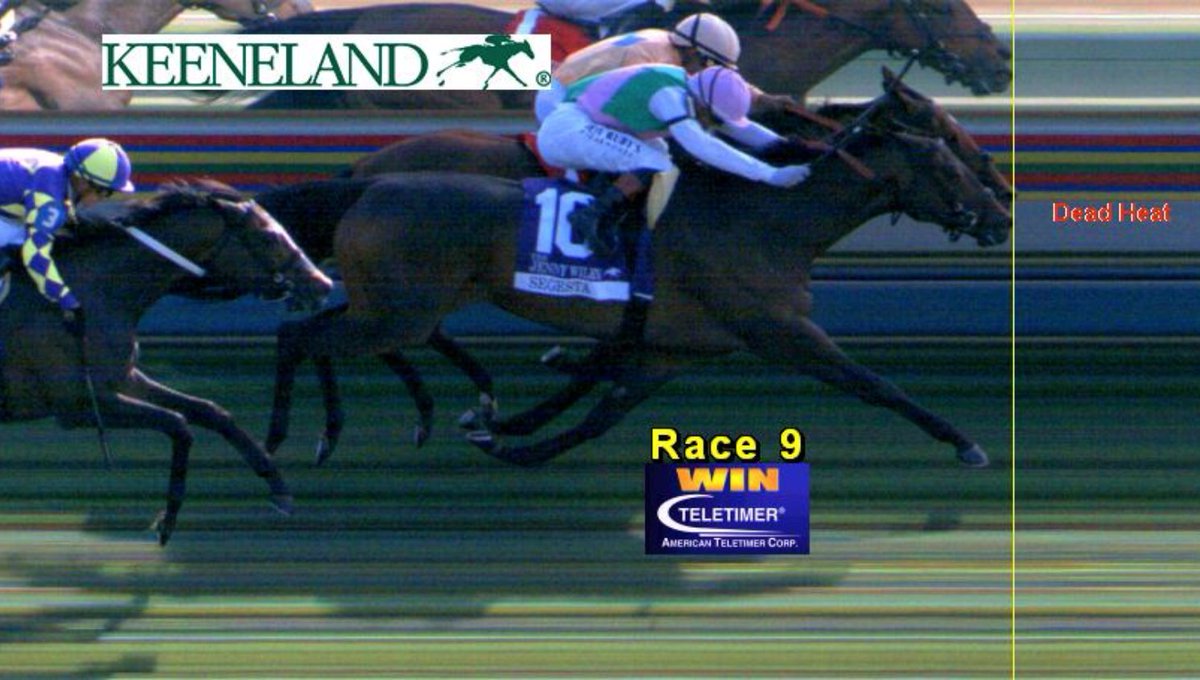
It has been six weeks since a dubious photo finish of a purported dead-heat was posted at Keeneland. The race was the Jenny Wiley, a Grade I no less. I wrote two posts on the topic, and it has now been roughly five weeks since I wrote multiple emails to Keeneland, including to Gatewood Bell, Keeneland Vice-President of Racing. I have received no responses.
You can read those two posts through the links below.
The Jenny Wiley Photo – Beyond Your Lying Eyes
x.com/Tinky47flat/st…
Keeneland's Deafening Silence
x.com/Tinky47flat/st…
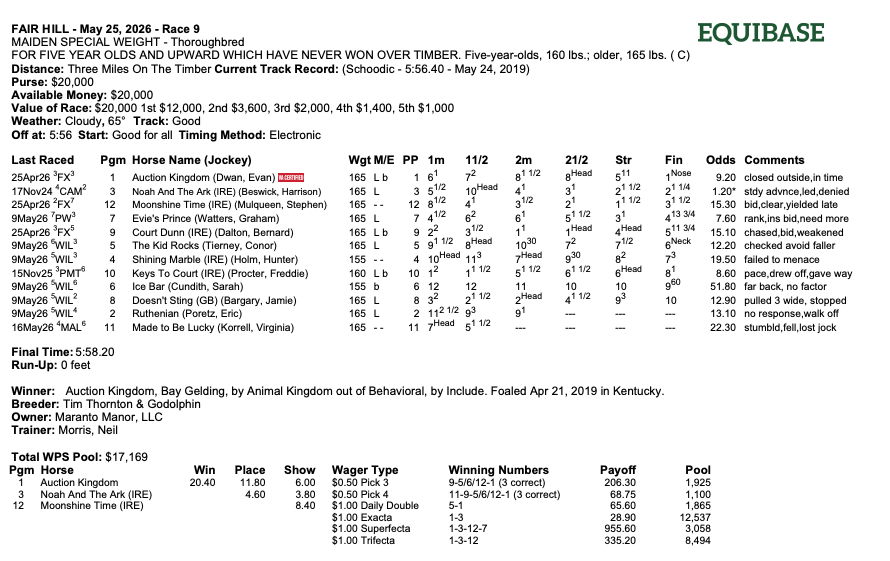
Yesterday at Fair Hill, there was a MSW race run for five-year-olds and up "which have never won over timber". It was contested over three miles.
The first two home were separated by a scant nose. The photo of that finish is the first attached image, and the photo from the above-mentioned Keeneland race is the second.
How is it possible that a photo pertaining to a Grade I flat race at Keeneland could be inferior to one associated with a three mile maiden event at Fair Hill? No disrespect meant to Fair Hill, or jump horses, and in fact the track deserves credit for being able to provide high-quality images.
And why is it that in the Fair Hill photo, along with virtually all such photos, the winner's nose does not extend beyond the superimposed wire, while in the Keeneland "dead-heat" the nose of one of the horses does?
Keeneland warrants sharp criticism for having failed utterly to explain either the poor quality, or dubious interpretation of the Jenny Wiley photo. And the longer that the "hallowed" racetrack stays silent on the latter issue in particular, the more it appears that they have chosen to sweep malfeasance by the stewards, if not corruption, under the rug.
@keenelandracing
@keeneland
@Gabby_Gaudet_
@Shanbisharv

English
@haydockraces Even setting aside the damning content of the announcement, center-justified and a difficult to read font? Really?
🙃
English

Racing cancelled at Haydock Park, Friday 29th and Saturday 30th May.

English
@paulieknep I'd ask Thibs:
Why, and especially after the DRose debacle, were you never able to make the connection between extended minutes and elevated risk of injury?
English

If you were interviewing an NBA coach past or present what are some questions you'd ask him? They could be about anything: leadership, communication, analytics, substitutions, in-game or in-between game adjustments, organizational politics, philosophy, getting over losses, etc.
English
@Cappin_Commie Thanks! I'm inclined not to let this one disappear into the memory-hole.
English

@Tinky47flat Keep up the good fight we appreciate your efforts!!
English
@deebosmall To my mind, the nose of one of the horses extending beyond the superimposed wire is the central problem, and I strongly suspect that it was improperly placed.
English

@Tinky47flat The reverse image on the keenland picture isn’t lined/timed up properly with the still that it captured normally
English
@Pirateforlife11 It's a good question, Dan. Possibly not wanting to butt heads with a powerful industry body.
English

@Tinky47flat Still wondering why the connections of the one haven’t sued for purse money..discovery of all communication related to this decision could be interesting
English
@LevAkabas @NateDuncanNBA @NBAcrazystats @TommyBeer Without adjusting for the quality of competition, how meaningful is that stat?
English

The New York Knicks just played the most dominant 10-game stretch in NBA history, and it's not even remotely close

English
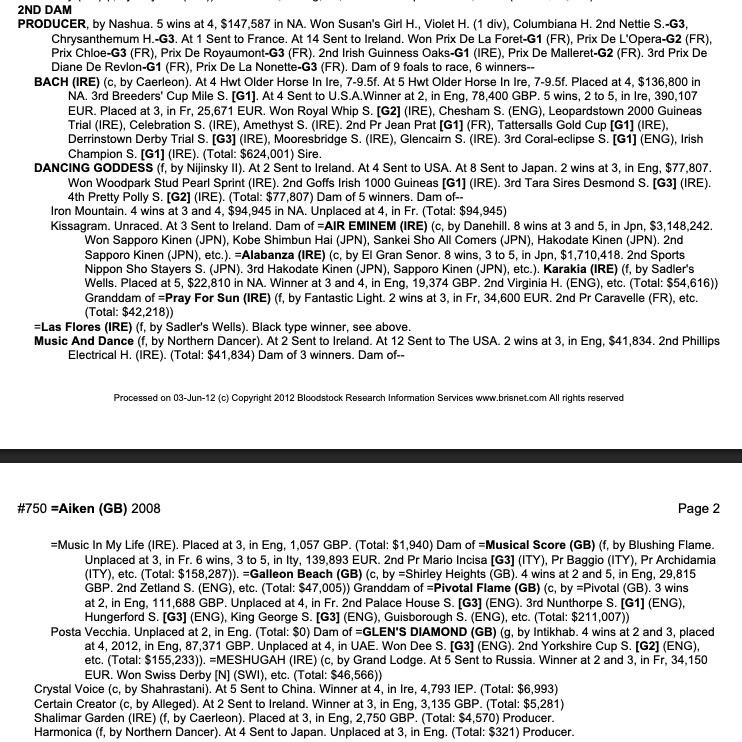
@alanmLevy1 Here's a pedigree snippet that I found fo Producer, who proved to be good at that job as well.
English
@Tinky47flat You are old Chicago guy
Did you get to see the Claiborne farm fillies that ran there like File the Trotsek filly Ribbon and the sweaty Producer
I miss those summer days
Or the tent meeting that had Saratoga type races the whole short meet
English
‡
The Further Degradation of X
Despite my having little personal interest in attracting large numbers of followers on X, I am interested in how the platform is evolving, or should I say devolving?
The first arguably damning change that I noticed was related to blocked accounts. While it remains possible to "block" other users, that originally meant that those users could neither view your posts, nor respond to them. But that changed, and they are now able to view the posts of anyone who has blocked them.
Why was that change made? To help the users of the platform? Quite obviously not. It was made in order to "juice" the metrics. More page views, more revenue. And in fact there is virtually no doubt that the choice was, or would have been opposed by the vast majority of users, who would have (logically) preferred to have essentially remained invisible to those whom they had blocked.
Recently readers may have noticed another change, namely the appearance of "auto-translated" posts on the "HOME" feed. This has, among other things, the effect of greatly diluting the content.
Arnaud Bertrand, the author of the embedded/linked post, knows the social media business well, and is a very thoughtful observer of many topics. He provides useful insights into what has been happening behind the scenes with the X algorithms, and it predictably ain't pretty.
I recommend reading the full post, especially if you find the following excerpt to be interesting.
So, putting it all together, the reach collapse comes from many forces stacking at once:
- Auto-translate makes your posts compete for attention against an order of magnitude more content
- The retrieval stage matches posts by topic, not by who follows you
- The ranking stage scores purely on predicted engagement with no weight for credibility, expertise, or track record
- The bloom filter narrows every post's window to one strong shot
- The diversity scorer penalizes prolific posting
- Reposts no longer carry much distribution power Each of these alone would dent your reach.
Combined, they amount to a complete reset: your audience that you built painstakingly over years basically doesn't matter much anymore, and it's much - much - harder to stand out even if you're a big account.
Arnaud Bertrand@RnaudBertrand
So I spent some time studying the new Twitter/X algorithm today since the latest version was published about a week ago on Github (#updates--may-15th-2026" target="_blank" rel="nofollow noopener">github.com/xai-org/x-algo…
). My goal was to answer why so many people have seemingly seen such a dramatic drop in their posts' reach. The first answer, which is actually somewhat unrelated to the ranking algorithm on Github, is the auto-translate feature, rolled out worldwide on April 7, 2026 (x.com/nikitabier/sta…). Before that date, if you wrote in English about, say, the Trump-Xi Beijing summit, you were competing for attention with maybe 5,000 other English-language accounts writing on geopolitics. After that date, your post is competing for attention with other posts on the same topic IN EVERY LANGUAGE ON EARTH. For some topics that do command global attention like geopolitics, that's a very brutal multiplier: you used to be one of 5,000, you're suddenly one of 50,000 (something of that order): MUCH more difficult to stand out. Secondly, the number of followers you have matters far less than it used to: each post now has to earn its audience reader by reader, on the predicted engagement of the post, and how its topic matches what each reader has recently been engaging with. Here is how the algorithm works, in simple terms: when you, as a reader, open your feed, the algorithm doesn't load "posts from accounts you follow." Instead it runs a 2-stage prediction of what posts you're likely to engage with in that very moment. The first stage is the retrieval stage. The system narrows billions of posts on X/Twitter that day down to roughly 1,500 candidates by matching the semantic content of each post - what it's about - against what you as a reader have recently engaged with. Some candidate posts come from accounts you follow; others are pulled from across the platform by pure topic similarity to your recent interests. You can test this retrieval stage easily: start disproportionally engaging with - say - Brad Pitt videos and you'll bit by bit see your timeline flooded with Brad Pitt content, most of it from accounts you've never followed and never heard of. Then there's the ranking stage. Each of these candidate posts for your feed is fed through a Grok-based model that tries to understand if you'll engage with the post. It looks at 15 engagement metrics: 1) P(favorite) — the reader likes the post 2) P(reply) — the reader replies to it 3) P(repost) — the reader reposts it 4) P(quote) — the reader quote-tweets it 5) P(click) — the reader clicks a link in it 6) P(profile_click) — the reader taps through to your profile 7) P(video_view) — the reader watches the video 8) P(photo_expand) — the reader expands an image 9) P(share) — the reader shares it (DM, off-platform, etc.) 10) P(dwell) — the reader stops scrolling and lingers on the post 11) P(follow_author) — the reader follows you after seeing it 12) P(not_interested) — the reader marks "not interested" 13) P(block_author) — the reader blocks you 14) P(mute_author) — the reader mutes you 15) P(report) — the reader reports the post Fifteen predicted actions, each multiplied by a weight, summed: that sum is the score that determines in which priority a post will be seen among other candidates. Please note that posting something with a video or an image can give your post an advantage as 2 actions are specifically for these: video_view and photo_expand. No video or photo and you don't get a score for these. Also, naturally, having a video maximizes the chance that a user will "dwell" on your post to watch it. Also note that 4 of these actions carry negative weights (not_interested, block_author, mute_author and report): meaning that if the model expects a post to generate a lot of negativity, it'll get de-boosted quite dramatically. But note, first and foremost, what's NOT in there: none of the things that, naively, one might think a serious information platform would weigh. There is no P(this post is true and well-sourced). No P(the author actually knows what they're talking about). No P(this person has spent a decade building a body of work that has held up). No P(this account has earned the right to be taken seriously on this topic). No P(the author has a large following from credible people). The model does not seem to care - at all - about any of that. Every post starts from zero. You could have ten years of rigorous, well-sourced analysis behind you - or you could be just an uneducated rando who registered yesterday. To this algorithm, you're both just a bag of engagement probabilities. Now, sure, to be fair, there is a "brand" effect that's not covered by the algorithm: someone who has in fact built a brand will naturally have better engagement metrics because people recognize their account. But that's an indirect, second-order effect. And crucially, it's legacy: those "brands" were built under earlier versions of the algorithm that gave followers and reputation more weight. Lastly, several other features of the new algorithm compound the dilution, none of them visible from outside but all consequential. The May 15 update added an "impression bloom filter," tightening the rule that once a reader has been served a post, the system won't serve it to them again. Before, a strong post could marinate in someone's feed across multiple refreshes and accumulate engagement on the second or third pass. Now it basically gets one shot. Also, your own posts compete with each other. An "Author Diversity Scorer" inside the ranking stage attenuates the score of every subsequent post of yours that ends up in a reader's candidate pool. In plain terms: if multiple of your posts land in a reader's candidate pool, the system shows one at full strength and dampens the others. So don't post several times consecutively on the same topic. And, last but not least, another huge impact on reach is that, in the old algorithm, when someone reposted or quote-tweeted you, your post was broadcast to their followers' timelines - a repost from an account with 100,000 followers was a huge boost. In the new algorithm, that mechanism is vastly demoted: reposts - like every post - need to go through the retrieval and ranking stage mentioned above, so a repost from a big account is a long way from the boost it used to be. This is especially brutal for low-effort quote tweets, which used to function as cheap amplification: now they often can't even clear the retrieval stage - they simply don't contain enough novel semantic content for the system to match them to anyone's interests. So, putting it all together, the reach collapse comes from many forces stacking at once: - Auto-translate makes your posts compete for attention against an order of magnitude more content - The retrieval stage matches posts by topic, not by who follows you - The ranking stage scores purely on predicted engagement with no weight for credibility, expertise, or track record - The bloom filter narrows every post's window to one strong shot - The diversity scorer penalizes prolific posting - Reposts no longer carry much distribution power Each of these alone would dent your reach. Combined, they amount to a complete reset: your audience that you built painstakingly over years basically doesn't matter much anymore, and it's much - much - harder to stand out even if you're a big account. People structurally rewarded by this algorithm are folks who: - Post visually (videos/images) - Post on globally popular topics because they clear the retrieval stage easily - Provoke strong emotional reactions - likes, replies, reposts - Don't care about accuracy or seriousness because the algorithm doesn't measure it - Don't care about their existing audience because every post is judged in isolation anyway In short this new algorithm, like so many on social media, is all about maximizing whether people will engage with something - not about whether they should. English
Hi Alan,
I remember all three, and particularly the latter two. I bet Ribbon (subsequently the dam of Risen Star) several times at Arlington, and to good effect. Good detail on producer, which I remember as well. Odd that she was by Nashua, but raced in France initially, and she never reproduced her best form in the U.S.
I'm certainly with you on missing that track, and those days!
English


I was at Ascot when Sonic Lady won the Blue Seal Stakes. First-crop Nureyev, I seem to recall. I also recall her having being long odds-on that day.
A few minutes before running, and in his distinctive, lilting voice, the late Mick O'Toole asked me "Can she be beat?". I tempered my response, given her odds, something along the lines of "I don't see how, but...", which of course did nothing to discourage Mick, who presumably proceeded to land a mortgage-sized wager.
English
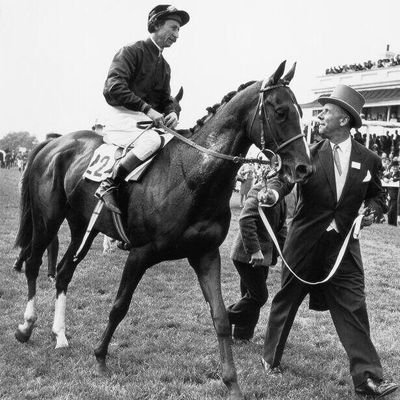
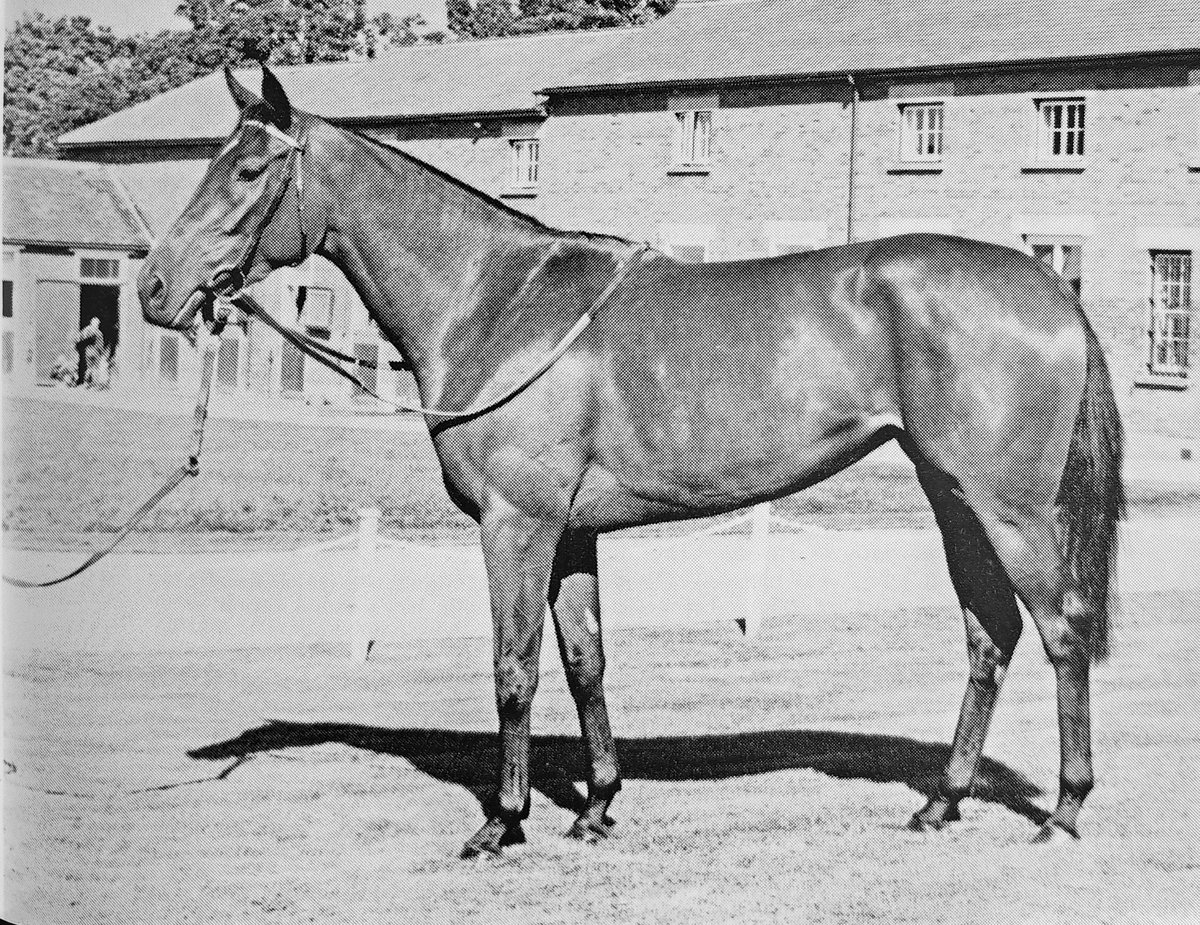
After failing to settle when third to Midway Lady and Maysoon in the 1986 1000 Guineas, Sonic Lady was fitted with a new bridle in the Irish 1000 Guineas. Far more tractable at The Curragh, she drew clear to beat Lake Champlain and Asteroid Field with the minimum of fuss.
English
...and Grand Slam Smile displayed her big heart yet again!
x.com/FanDuel_Racing…
FanDuel Racing@FanDuel_Racing
GRAND SLAM SMILE ($3.00) leads them all the way in the $100,000 Fran’s Valentine Stakes at @SantaAnitaPark with @Jockeybant in the saddle for trainer @SMcCarthyRacing and owners Mr. & Mrs. Larry D. Williams.
English
‡
In The Blood
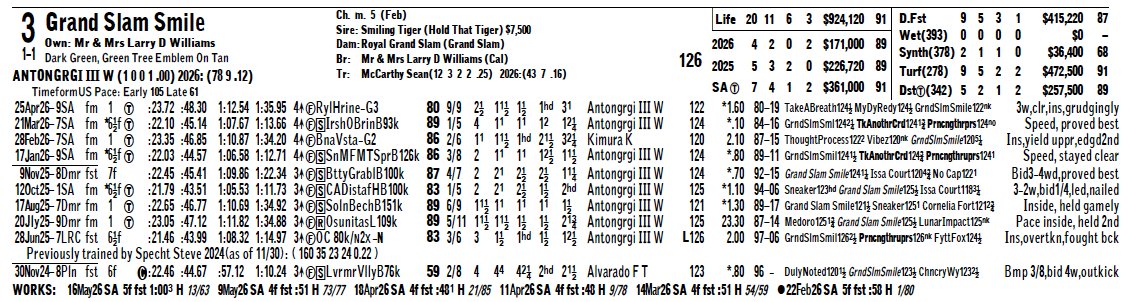
Grand Slam Smile is a California-bred 5yo mare, and is the even-money morning line favorite in today's Fran's Valentine Stakes at Santa Anita. She has competed in 20 races, has never finished unplaced, and has compiled an impressive "downhill" record of 11-6-3.
That type of admiral racing attitude is my favorite quality in a racehorse, irrespective of class level. And like physical characteristics, there can be obvious genetic links. In the case of this mare, her sire, Smiling Tiger, made 23 starts, and was in the money 19 times (9-2-8). Her dam, Royal Grand Slam, raced only five times, but won twice, and was only unplaced once.
In aggregate, this is the record (to date) of Grand Slam Smile, and her sire and dam: 48 22-9-12
48 starts, a win percentage of ~46%, and ITM in ~90% of their races.
Racehorses, all three of them.
Royal Grand Slam, the dam of the subject mare, has produced foals with the following records:
41 14-5-4
38 8-9-3
36 7-3-7
27 5-7-2
20 11-6-3
19 2-3-3
8 3-2-0
4 1-2-0
A family of tough, genuine racehorses.
It's in the blood.
English
You haven't clearly articulated any cogent points, which is part of the problem. The other, more important part, is that you haven't even attempted to address the substance of what I have written on the topic. Instead, you launched ad hominem attacks.
If you have any thoughtful disagreements, or criticisms, I'm open to hearing them. But ad hominem attacks are intrinsically dishonest, and I have little patience for those who employ them.
English


Bru breakfast (eats twice a day, total of 2 1/2 pounds): beef, green triple, South Texas antelope liver, sauerkraut, yogurt, micro greens, blueberries, and a sardine.

English
@EJXD2 @Arlington_Park @BelterraPark @ChurchillDowns @DelCountyFair @OaklawnRacing @mtrgaming @NfldPark @EldoradoScioto @JACKThistledown Hialeah, US
Del Mar, US
Keeneland, US
Saratoga, US
Arlington, US (pre and post-fire)
Sportsman’s Park, US
Newmarket, UK
Ellerslie, NZ
Sha Tin, HK
Longchamps, FR
English

Introduce yourself with 10 horse tracks you’ve seen live
@Arlington_Park
@BelterraPark
Beulah Park
@ChurchillDowns
@DelCountyFair
@OaklawnRacing
@mtrgaming
@NfldPark
@EldoradoScioto
@JACKThistledown
James@GoldColdSnow
Let's join in on the fun. Introduce yourself with 10 horse tracks you've seen live. Canterbury Park Prairie Meadows Arlington Park North Dakota Horse Park Oaklawn Park Churchill Downs Horseshoe Indianapolis Tampa Bay Downs Keeneland Assiniboia Downs
English