@ghostowlredux@philoantonio Understandable. I take it that Aristotle is more inspiration for the identity-position here. He does tell us that we take on the form, not the matter. I wonder if you want to continue with that distinction. Some sort of qualification to identity is clearly needed
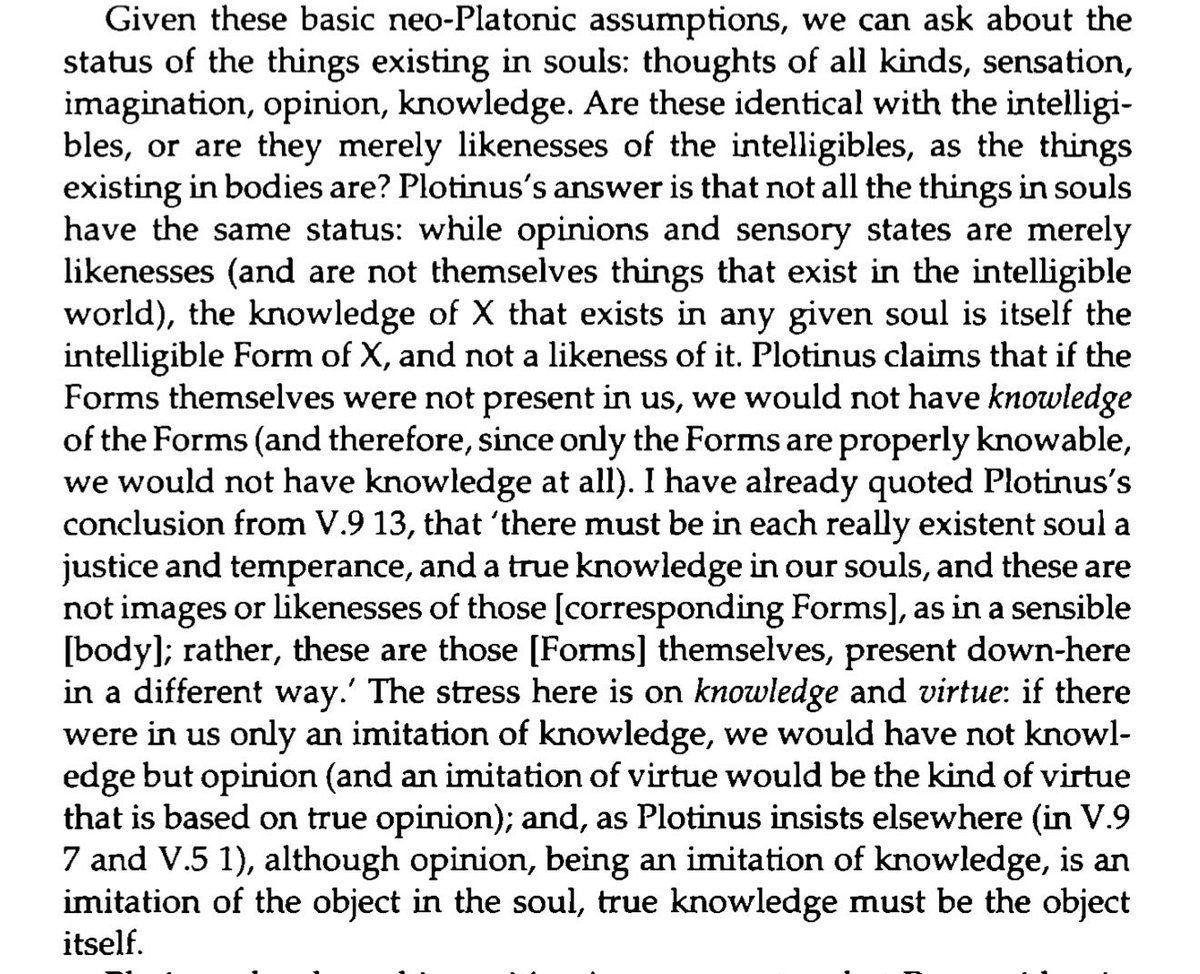
@ghostowlredux@philoantonio it also sounds like Plotinus may be a representationalist about sensory knowledge of particular empirical things. At least if this Menn contrast is right, that the forms are present to us whereas sensory states are merely likenesses.
@ghostowlredux@philoantonio Now, I do see your point. you want to say, if my knowledge is identical to X, then I, the knower, must also must be identical to X.
It’s possible some explicit analysis of the identity is needed to distinguish between the two, if one distinguishes at all
@ghostowlredux@philoantonio He also attributes to Plotinus the doctrine that the intelligibles not only are not outside Nous, they are also present in the rational soul (not merely images of them).
That is, “the knowledge of X that exists in any given soul is itself the intelligible Form of X’
@ghostowlredux@philoantonio This can be related to theism specifically, with classic issue of ‘Did God (or any other name for sort of metaphysical first principle) necessarily have to create the world’. As I understand Plotinus (in my very entry level study) he thinks perfection is necessarily productive.
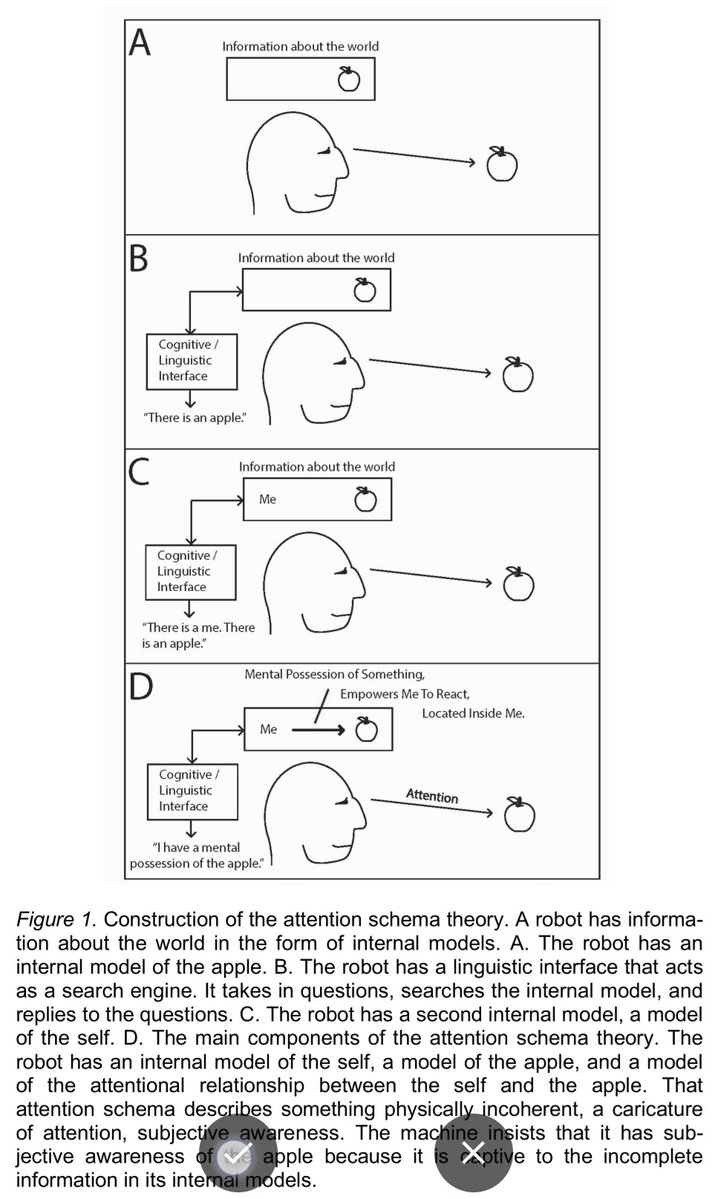
@evalladen Perhaps the very same principles applying to a brain on this topic, will also apply to a simple robot (or much simpler organism), so that the principle one is using to determine what some physical system is representing can be easily demonstrated with a simple example.
@evalladen so we could then ask, what determines that this arrangement of neurons is a model of an apple, as opposed to something else? I take it that ‘model of an apple’ and representation of an apple are equivalent here.
@evalladen I have sort of a broad question about Graziano’s framework. Really, it’s one that could be asked of most cognitive scientists, but I don’t know the extent to which they have a consensus on the topic.
What determines the representational content of the brain-representation?
@ResonantPyre according to Ilya unsupervised learning can be understood through the lens of compression
we learned from LLMs you can feed a bunch of input alone and it can form a compressed model of that input
(I personally think a self is likely a homeostatic control model but dunno)
@evalladen How does the ‘robot’ acquire a self-model? Put like that, one can only answer ‘well it depends on how you engineered it’, maybe the robot is iterating upon an innate self-model it started with. Does it even make sense to think of the self-model as possibly constructed from input?
@ResonantPyre access consciousness = global workspace
phenomenal consciousness = attention schema = awareness
info about your awareness that your attention schema generates binds to the object and is sent into the global workspace
so "there is a hawk" and "there is an awareness of a hawk"
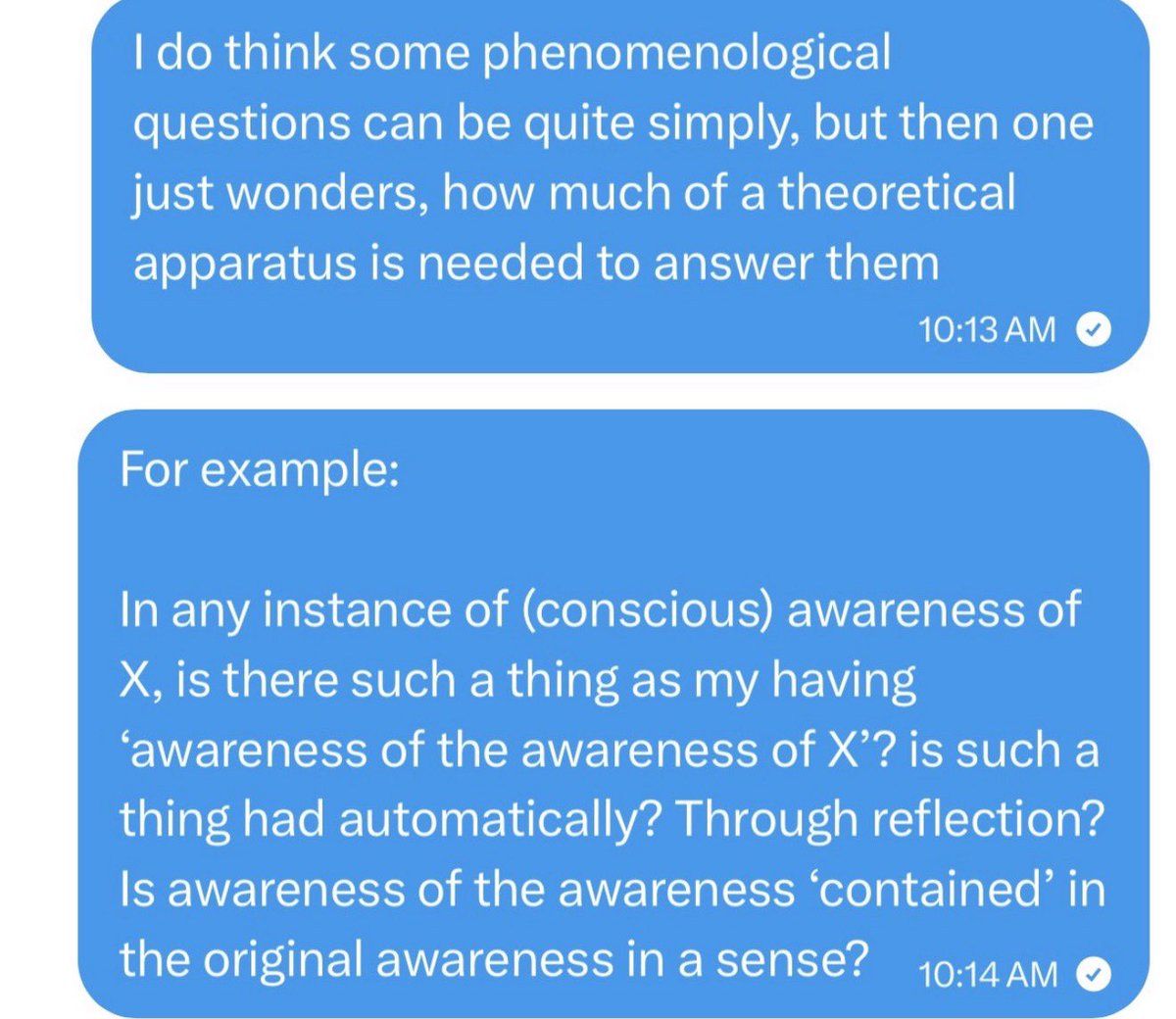
@Qivshi1 When Kant says that the ‘I think’ must be able to accompany all my representations, do you understand this as being a claim about a mere potentiality, or do you think his framework makes the most sense if it the ‘I think’ *does* accompany all of my representations?
@ResonantPyre this is what i am always on about, but this is literally one of the central points of the transcendental deduction, particularly the B deduction
I don’t find his own account ultimately satisfactory but Alex Byrne’s paper, ‘Knowing What I See’ has a helpful formulation of this general problem of ‘awareness of awareness’ for the special case of visual perception.
notebook.colinmclear.net/ox-hugo/byrne2…
One sees a hawk. One knows by sight, ‘there is a hawk here’. How does one know that one is seeing a hawk? One does not *see* one’s seeing.
If I know by sight that some object is there, I do usually know that I see that object. We may ask for an explanation of that knowledge.