SpaceWxDaily

74 posts

SpaceWxDaily banner
SpaceWxDaily

SpaceWxDaily

@SpaceWxDaily

☀️ Daily Space Weather Content 👨‍🔬 Space Weather Forecaster 📝 Devoted Communicator

Lagrange Point 1 انضم Mart 2026
12 يتبع10 المتابعون
تغريدة مثبتة
SpaceWxDaily
SpaceWxDaily@SpaceWxDaily·
The Sun is not a stable, boring star. It's constantly throwing plasma, radiation, and magnetic energy at Earth — at millions of miles per hour. This is space weather. And it affects your daily life more than you probably realize. 🧵
English
1
1
3
65
SpaceWxDaily
SpaceWxDaily@SpaceWxDaily·
What is HUXt? HUXt stands for Heliospheric Upwind eXtrapolation with time-dependence. It’s a space weather forecasting model developed by scientists at the University of Reading in the UK. Its job is to predict when a solar eruption — called a Coronal Mass Ejection (CME) — will hit Earth. What makes HUXt special? Most CME models run a single simulation and give you one prediction. HUXt does something smarter: it performs its calculations several hundred times to account for different conditions the CME can encounter on its way to Earth — such as slower or faster “solar wind” (the stream of particles constantly flowing from the Sun). A good analogy is trying to drive across town with or without traffic. HUXt takes into account many different “traffic” scenarios for CMEs coming off the Sun, which may cause the plasma cloud to arrive earlier or later. This technique is called ensemble modeling. Who uses it? HUXt is an open-source model developed as part of the Space Weather Empirical Ensembles Package (SWEEP) project. It takes solar observations processed by the UK Met Office as inputs, and is used alongside other tools to produce real-time space weather forecasts. Because it’s computationally efficient, it can run hundreds of simulations quickly — something that heavier, more complex models struggle to do in real time. In short, HUXt is like a fast, probabilistic GPS for solar storms — helping scientists figure out not just if a CME will hit Earth, but when, how fast, and how confident we should be in that prediction.
English
0
0
0
68
Vincent Ledvina
Vincent Ledvina@Vincent_Ledvina·
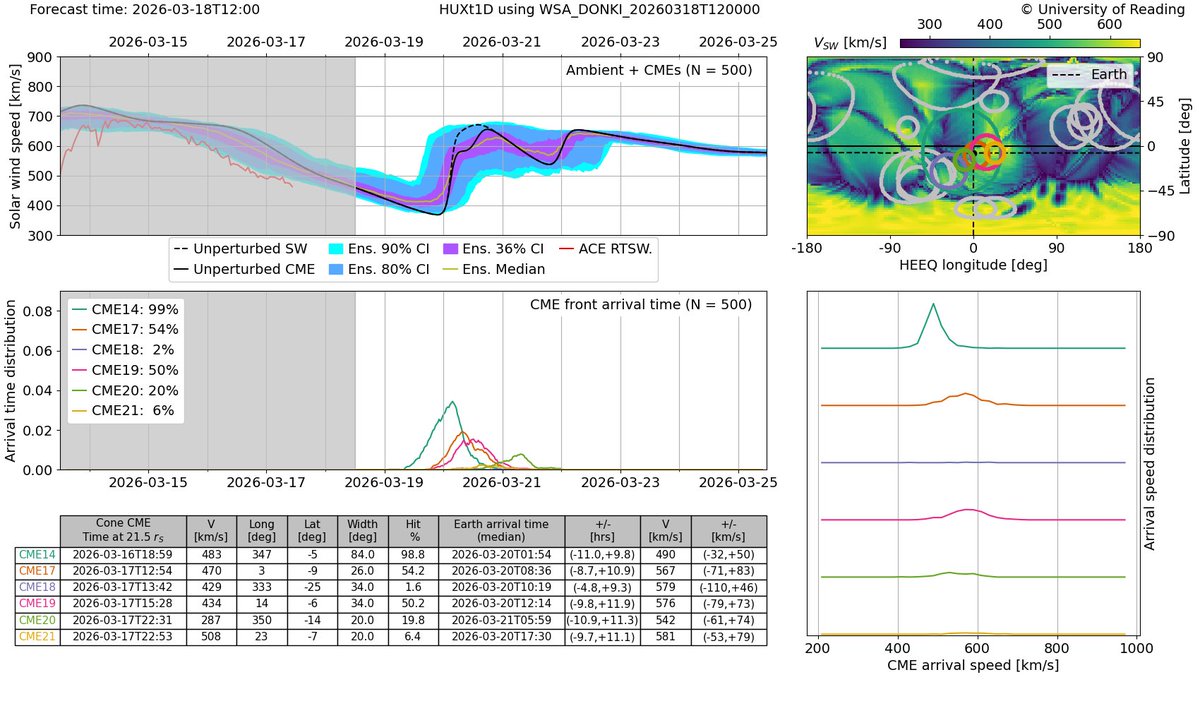
Animation from the HUXt model showing 8 CMEs firing off the Sun. Five of them have any appreciable chance of impacting Earth with the first impact predicted by this model to occur early on March 20 UT time (Thursday night). Be aware that this is a day later than NOAA SWPC.
English
5
32
111
4.3K
Jure Atanackov
Jure Atanackov@JAtanackov·
There is a series of CMEs potentially on the way towards the Earth right now. The first was launched on March 16th from AR 4392 and is expected to arrive tomorrow or on the 20th. Then there is a series of small CMEs launched yesterday that may arrive on March 20th or 21st with hit probabilities of ~50% or less. The latest CME, from the M2.7 flare today, has not been modelled yet.
Jure Atanackov tweet media
English
3
19
86
3.5K
SpaceWxDaily
SpaceWxDaily@SpaceWxDaily·
Here’s a summary of the NASA article: The Sun’s surface is dotted with patches of strong magnetic fields, called “active regions,” which can emerge within hours and decay at varying rates — sometimes over days, weeks, or even months.  A new study, published in The Astrophysical Journal, relied on NASA’s Solar Active Region Spotter citizen science project, which asked volunteers to answer questions about pairs of active region images captured by NASA’s Solar Dynamics Observatory.  The key finding: long-lived active regions (those taking at least a month to decay) produce disproportionately more flares than shorter-lived regions, and are 3–6 times more likely to be the source of the most intense kinds of solar flares.  These results have the potential to reshape how we predict space weather, and could offer new clues about the Sun’s internal magnetic fields and their impact on Earth — including effects on satellite communications, GPS systems, and power grids.  The citizen science approach also demonstrated that human eyes can catch nuances and patterns that automated systems might overlook.  The Solar Active Region Spotter project has now concluded, but the findings mark a meaningful step forward in understanding — and preparing for — solar activity.
English
0
0
1
83
NASA Science
NASA Science@NASAScience_·
Some regions on the Sun stay active for months... and they may produce far more solar flares than expected. Using data from this citizen science project, researchers found these long-lived regions are 3–6× more likely to produce the Sun’s most powerful flares: go.nasa.gov/4sSx9yw
English
21
106
449
22.8K
SpaceWxDaily
SpaceWxDaily@SpaceWxDaily·
@SNHWx Nicely done! Glad to hear it went well. Thanks, Sara!
English
0
0
0
12
☀️ Sara Housseal ☀️
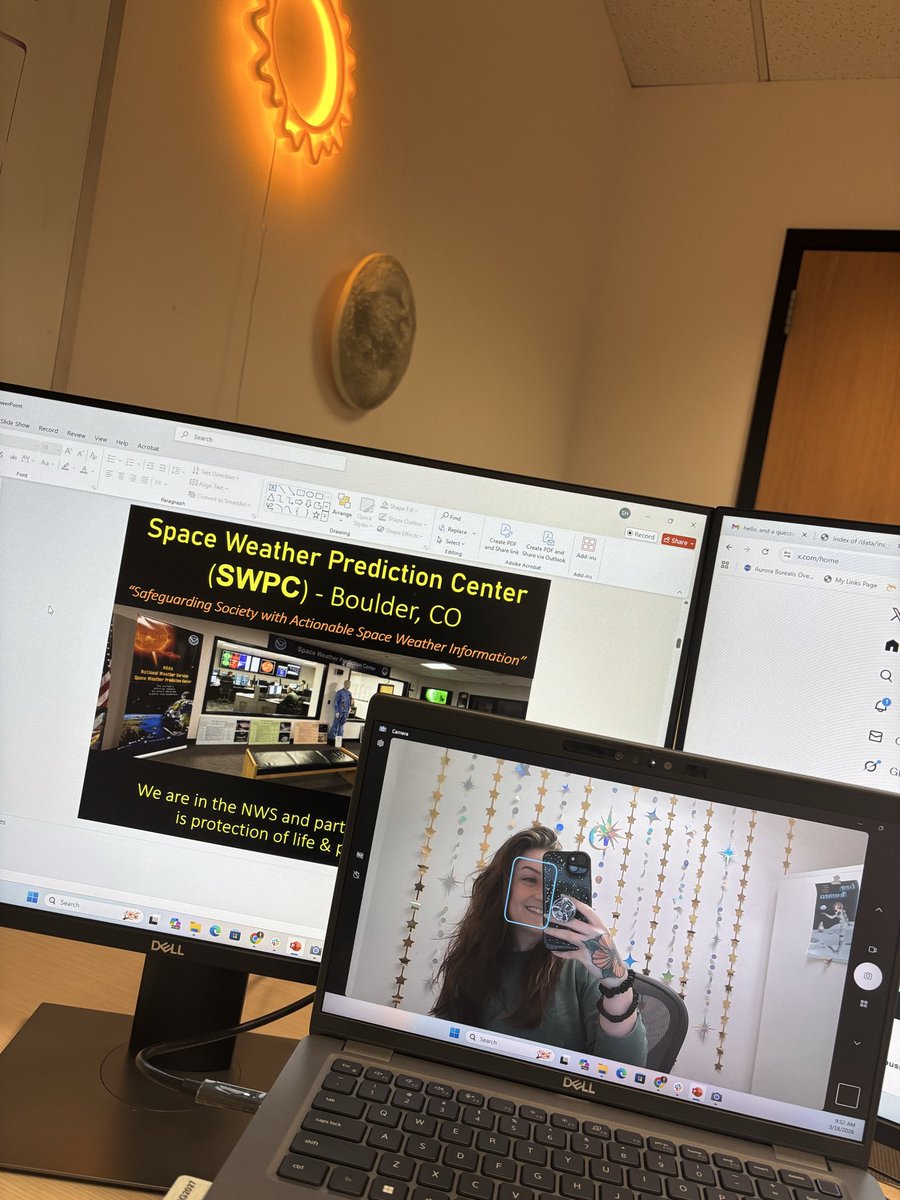
@SpaceWxDaily It was a virtual presentation, so no photos in action but I did take one beforehand when testing out my camera! Was a success with a lot of great questions.
☀️ Sara Housseal ☀️ tweet media
English
1
0
2
31
☀️ Sara Housseal ☀️
Doing another school presentation this morning for a high school group! A lot of exciting things to talk about between the latest CMEs, the G2 Watch, our newest satellites SOLAR-1 and IMAP, and how SWPC will help support Artemis ll! ☀️
English
1
0
14
532
SpaceWxDaily
SpaceWxDaily@SpaceWxDaily·
🚀 Space Weather Hazards for Astronauts During EVAs Extravehicular activities (EVAs) — spacewalks — expose astronauts to some of the harshest conditions in the solar system. Here’s what they face: ☀️ Solar Radiation The Sun constantly bombards space with ultraviolet (UV) and X-ray radiation. Without Earth’s protective atmosphere and magnetic field, astronauts absorb far higher doses than anyone on the ground. Over a career, this significantly raises cancer risk 🎗️. 💥 Solar Energetic Particles (SEPs) During solar flares and coronal mass ejections (CMEs), the Sun hurls high-energy protons and electrons into space at near-light speed. These can: ∙🧠 Penetrate spacesuits and damage brain/nervous tissue ∙🩸 Cause acute radiation sickness at high doses ∙👁️ Trigger visual “light flashes” (astronauts actually report seeing these!) A major SEP event during an EVA could be life-threatening within hours. 🌌 Galactic Cosmic Rays (GCRs) These are high-energy particles from outside our solar system — mostly protons and heavy atomic nuclei traveling at nearly the speed of light. They’re impossible to fully shield against and are a major long-term concern for deep-space missions 🪐. 🧲 Geomagnetic Storm Effects Strong CMEs can disturb Earth’s magnetic field. While the ISS gets some protection from Earth’s magnetosphere, astronauts at higher latitudes or in polar orbits face increased particle exposure during storms ⚡. 🌡️ Extreme Temperature Swings Space weather interacts with the thermal environment. In sunlight, surfaces can reach +120°C ☀️; in shadow, they plunge to −160°C 🥶. Spacesuits work hard to manage this, but solar activity affects heating dynamics. 🛡️ How Astronauts Stay Safe ∙📡 Space weather forecasting — NASA and NOAA monitor the Sun 24/7 ∙⏱️ EVA scheduling — spacewalks are avoided during known solar storm periods ∙🏠 Safe havens — astronauts can retreat to shielded areas of the spacecraft ∙🧥 Spacesuit design — suits provide some radiation shielding, though not complete protection ∙📊 Dosimetry badges — personal radiation monitors track cumulative exposure The Sun is both life-giver and threat ☀️⚠️ — managing its hazards is one of the biggest challenges of human spaceflight!
English
0
0
0
38
Jonathan McDowell
Jonathan McDowell@planet4589·
Spacewalk US EVA-94 is underway on the ISS. Astronauts Meir and Williams, in suits 3015 and 3003 and with SAFER packs 15 and 18 depressurized the airlock past 50 mbar at 1246 UTC, opened the hatch at 1251 UTC and put suits on batt power at 1252 UTC
English
5
11
92
5.2K
SpaceWxDaily
SpaceWxDaily@SpaceWxDaily·
Space weather monitoring and forecasting will be a top priority during Artemis! I’m happy to see the attention it’s getting. Here are some of the challenges they’ll face: NASA’s Artemis program faces several significant space weather vulnerabilities, particularly given that missions go beyond low Earth orbit (LEO) where Earth’s magnetic field provides less protection. Solar Energetic Particle (SEP) Events The most acute threat. During solar flares and coronal mass ejections (CMEs), the Sun can release bursts of high-energy protons that arrive at the Moon within minutes to hours. Astronauts on the lunar surface or in transit have minimal shielding, and a major SEP event could deliver a potentially lethal radiation dose in a short window. The challenge is that prediction windows are narrow — sometimes just 20–30 minutes of warning. Galactic Cosmic Rays (GCRs) A chronic, background threat. These high-energy particles from outside the solar system penetrate nearly all shielding materials. During solar minimum (when the Sun’s magnetic field weakens), GCR flux increases. Prolonged lunar surface stays accumulate significant GCR dose, raising long-term cancer risk and potentially causing neurological damage. Artemis missions near or during solar minimum face elevated GCR exposure. Radiation Effects on Electronics Space weather can cause single-event upsets (SEUs) in spacecraft electronics — bit flips, latch-ups, or permanent damage to components. The Orion capsule, Gateway lunar station, and surface systems all require radiation-hardened designs and redundant systems. Lunar Surface Hazards (No Magnetosphere) Unlike Earth, the Moon has no global magnetic field and almost no atmosphere, so the surface receives the full brunt of solar wind and energetic particles. Astronauts conducting EVAs (extravehicular activities) during a solar storm face serious risk, and there are no natural “safe harbors” on the surface. Communication and Navigation Disruption Ionospheric disturbances triggered by solar activity can degrade GPS and radio communications — affecting both the spacecraft in transit and coordination with Earth mission control. Signal blackouts during critical maneuvers (lunar orbit insertion, landing) are a real concern. Mitigation Strategies NASA is Pursuing ∙PREDICCS and other forecasting tools to give earlier SEP warnings ∙Radiation shelters within the Gateway (using water walls or polyethylene shielding) ∙Real-time space weather monitoring via NOAA’s Space Weather Prediction Center ∙Mission scheduling to avoid known high-risk solar activity windows, though a multi-week lunar mission can’t fully avoid the solar cycle ∙Dosimetry aboard Orion to track cumulative crew exposure The combination of deep-space radiation and the lack of Earth’s protective magnetosphere makes space weather one of the most serious human health and operational challenges for Artemis beyond the engineering problems of getting to the Moon.
English
0
0
0
20
SpaceWxDaily
SpaceWxDaily@SpaceWxDaily·
NASA’s Artemis program faces several significant space weather vulnerabilities, particularly given that missions go beyond low Earth orbit (LEO) where Earth’s magnetic field provides less protection. Solar Energetic Particle (SEP) Events The most acute threat. During solar flares and coronal mass ejections (CMEs), the Sun can release bursts of high-energy protons that arrive at the Moon within minutes to hours. Astronauts on the lunar surface or in transit have minimal shielding, and a major SEP event could deliver a potentially lethal radiation dose in a short window. The challenge is that prediction windows are narrow — sometimes just 20–30 minutes of warning. Galactic Cosmic Rays (GCRs) A chronic, background threat. These high-energy particles from outside the solar system penetrate nearly all shielding materials. During solar minimum (when the Sun’s magnetic field weakens), GCR flux increases. Prolonged lunar surface stays accumulate significant GCR dose, raising long-term cancer risk and potentially causing neurological damage. Artemis missions near or during solar minimum face elevated GCR exposure. Radiation Effects on Electronics Space weather can cause single-event upsets (SEUs) in spacecraft electronics — bit flips, latch-ups, or permanent damage to components. The Orion capsule, Gateway lunar station, and surface systems all require radiation-hardened designs and redundant systems. Lunar Surface Hazards (No Magnetosphere) Unlike Earth, the Moon has no global magnetic field and almost no atmosphere, so the surface receives the full brunt of solar wind and energetic particles. Astronauts conducting EVAs (extravehicular activities) during a solar storm face serious risk, and there are no natural “safe harbors” on the surface. Communication and Navigation Disruption Ionospheric disturbances triggered by solar activity can degrade GPS and radio communications — affecting both the spacecraft in transit and coordination with Earth mission control. Signal blackouts during critical maneuvers (lunar orbit insertion, landing) are a real concern. Mitigation Strategies NASA is Pursuing ∙PREDICCS and other forecasting tools to give earlier SEP warnings ∙Radiation shelters within the Gateway (using water walls or polyethylene shielding) ∙Real-time space weather monitoring via NOAA’s Space Weather Prediction Center ∙Mission scheduling to avoid known high-risk solar activity windows, though a multi-week lunar mission can’t fully avoid the solar cycle ∙Dosimetry aboard Orion to track cumulative crew exposure The combination of deep-space radiation and the lack of Earth’s protective magnetosphere makes space weather one of the most serious human health and operational challenges for Artemis beyond the engineering problems of getting to the Moon.
English
0
1
1
112
NASA JPL
NASA JPL@NASAJPL·
Fun fact: Perseverance is helping keep the @NASAArtemis II crew safe! The rover can see sunspots not visible from Earth — giving up to 2 weeks’ advance notice so the team can monitor and prepare for potentially dangerous solar flares. go.nasa.gov/4rvmclj
NASA JPL tweet media
English
19
186
844
37.1K
SpaceWxDaily
SpaceWxDaily@SpaceWxDaily·
💫Aurora Forecast High latitudes: Storm watch in effect, potential G2+ conditions, possibly lasting through the 20th Mid latitudes: Minor storm likely, ~20% chance of G2 level on the 19th 💥Solar Flare Risk: ~25% chance of M-class flares, ~5% chance of X-class over the next five days. Radio & GPS: R1–R2 radio blackouts possible at 25% probability; some GPS noise expected near aurora zones and dawn/dusk. Radiation: All clear — S-zero quiet range, very low risk for air travelers.
English
0
0
1
24
SpaceWxDaily
SpaceWxDaily@SpaceWxDaily·
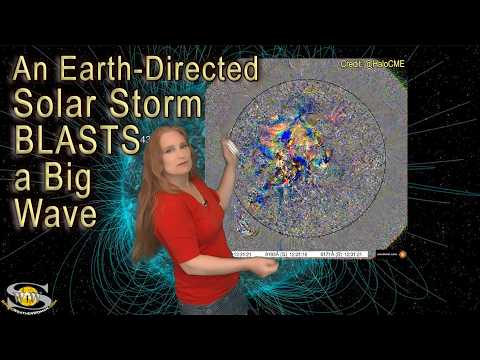
☀️Space Weather Summary – Week of March 17–21 Overall Outlook: Space weather is picking up rather than calming down as expected. Solar Activity: A filament eruption occurred on the 13th but missed Earth, deflected southward by a coronal hole acting as a "ceiling." More notably, region 4392 fired a near-M2.8 class flare on the 16th, launching a substantial Earth-directed solar storm — its second such launch, but the first with real impact potential. 🌬️Incoming Solar Storm Two coronal holes on either side of the storm are essentially channeling it directly toward Earth. Combined with an incoming fast solar wind stream, this creates a "one-two punch" — a Stream Interaction Region (SIR) followed by the solar storm itself. Both NOAA and NASA models agree on an impact around midday on the 19th, though fast solar wind may arrive as early as late on the 18th.
English
1
0
1
30
SpaceWxDaily
SpaceWxDaily@SpaceWxDaily·
@MShil716 Thanks for following along. I enjoy sharing and growing interest in Space Weather!
English
0
0
1
34
JMM716
JMM716@MShil716·
@SpaceWxDaily Yes it does. Thank you for adding in the source also, this allows me to learn much more about it. Greatly appreciate you taking the time to enlighten me.
English
1
0
1
2
SpaceWxDaily
SpaceWxDaily@SpaceWxDaily·
Here’s a summary of the article: NOAA’s Space Weather Prediction Center has issued a G2 geomagnetic storm warning for March 19, triggered by a coronal mass ejection (CME).  A G2-level storm could bring northern lights as far south as New York and Idaho, and if conditions escalate to G3, aurora sightings could reach mid-latitude states like Illinois and Oregon.  space.com/stargazing/aur…
English
1
0
1
45
SpaceWxDaily
SpaceWxDaily@SpaceWxDaily·
For CMEs: The effect applies, but it diminishes in importance as CME intensity increases. For increasingly large geomagnetic disturbances — driven by events with large southward field often associated with coronal mass ejections — the raw power input to the magnetosphere becomes the dominant driver, and the R-M effect declines in importance and can even act to reduce geoeffectiveness for the most strongly southward IMF events. Hope that helps! Source: swsc-journal.org/articles/swsc/…
English
1
0
1
8
JMM716
JMM716@MShil716·
@SpaceWxDaily I was always under the impression that it isn’t as applicable to CMEs as it is for nominal winds and CHs? Is that incorrect?
English
1
0
1
4
SpaceWxDaily
SpaceWxDaily@SpaceWxDaily·
The National Solar Observatory (NSO) is a federally funded research facility whose mission is to advance the understanding of the Sun, both as a star and as the primary driver of space weather and its effects on Earth. The NSO provides the scientific community with world-class observing facilities, data, and tools to study the Sun’s structure, atmosphere, and magnetic activity across multiple timescales. Through major programs like the Daniel K. Inouye Solar Telescope (DKIST) in Maui — the world’s largest solar telescope — and the Global Oscillation Network Group (GONG), the NSO supports research into solar dynamics, solar cycles, and the Sun-Earth connection, while also training the next generation of solar scientists and making solar data openly accessible to researchers worldwide.
English
0
0
0
5
National Solar Observatory
Solar Activity Report: Mar. 9-15, 2026 ☀️Activity ranged from low to moderate. Mar. 11 marked the quietest day, with the X‑ray flux remaining in the B‑class range and only minor C‑class flaring. 🧵
English
2
10
24
480
SpaceWxDaily
SpaceWxDaily@SpaceWxDaily·
So if you’re in the northern U.S., it’s worth keeping an eye on the sky this Thursday night — it could be a great opportunity to catch the northern lights further south than usual!
English
0
0
1
10
SpaceWxDaily
SpaceWxDaily@SpaceWxDaily·
The timing is particularly favorable due to what’s known as the Russell-McPherron effect: around the spring and autumn equinoxes, Earth’s orientation makes it easier for its magnetic field to connect with the solar wind and incoming CMEs, boosting the chances of geomagnetic activity. During most of the year, Earth’s tilt deflects some incoming charged particles, but near the equinoxes that natural shield becomes more open.
English
2
0
1
5
SpaceWxDaily
SpaceWxDaily@SpaceWxDaily·
7/7 The silver lining? ✨ Earth’s magnetic field and atmosphere protect us from the worst of these storms — they don’t cause direct harm to people on the ground. AND the CME from this morning’s flare could bring auroras in a few days! 🌌🌈 Worth it? I think yes. [end thread] ☀️🔭 #SpaceWeather #SolarFlare #ScienceTwitter
English
0
0
0
18
SpaceWxDaily
SpaceWxDaily@SpaceWxDaily·
6/7 👨‍🚀 ASTRONAUTS get the scariest version of this. Energetic particles from flares can pass through human tissue, posing real radiation risks to astronauts in space or passengers on high-flying polar flights. Earth’s atmosphere protects the rest of us — but not them! 🌍🛡️
English
1
0
1
10
SpaceWxDaily
SpaceWxDaily@SpaceWxDaily·
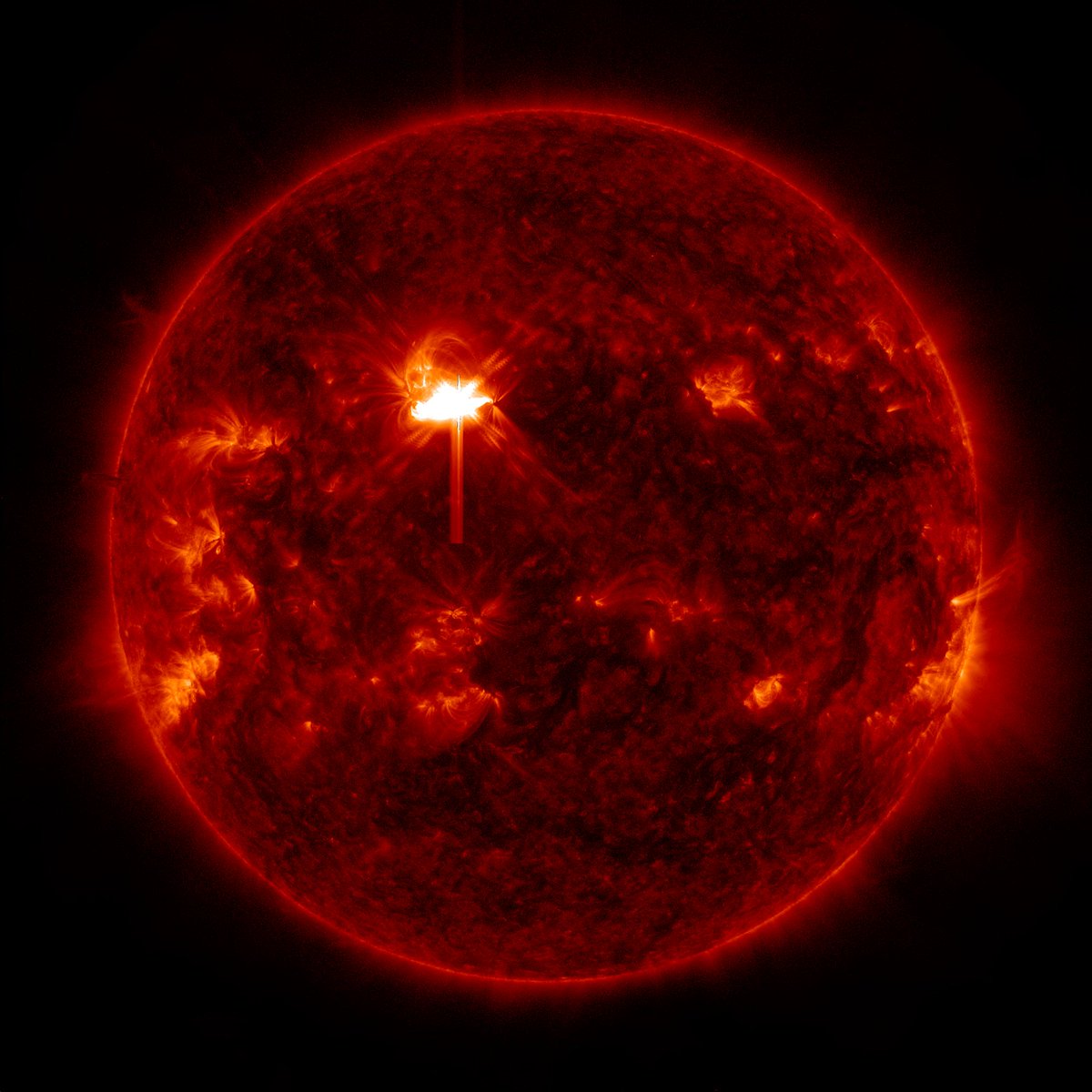
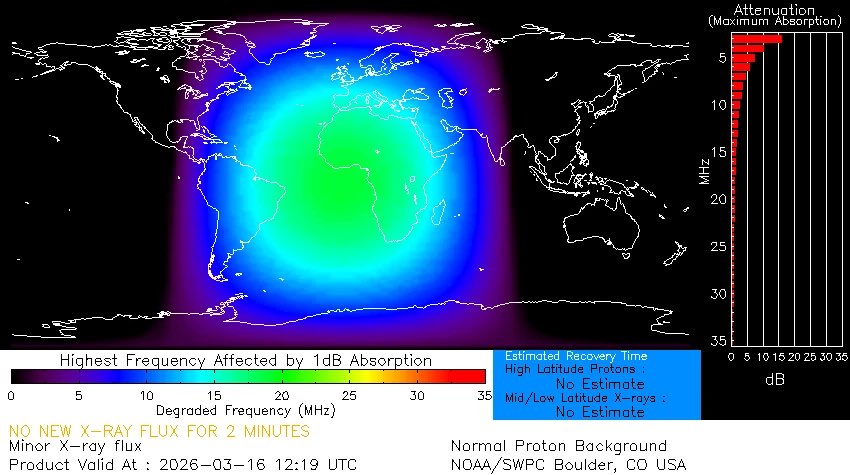
🌞☀️ THREAD: Who is actually impacted by Solar Flares and Radio Blackouts? (Hint: more people than you think!) 🧵 1/7 The Sun just fired off an M-class flare this morning ☀️💥 and you might be wondering — “ok but what does that actually DO to us down here?” Let’s break it down! 👇
SpaceWxDaily tweet media
English
1
0
1
25