I don’t know why this never came to me before… but printing the callstack from within the Vulkan validation layer callback makes it way easier to debug what’s happening. That enables automated troubleshooting and fixes for a whole class of issues.
Neat!
@TopoWeaverIO That’s awesome, I wanna make something similar but using Vulkan. Very fast movement thru a huge world, emphasis on physics based gameplay. How did you make your world, are the trees instanced?
@TsukiHyouka when it comes to games .. assets are linked to your code and you want to at maintain some version management. that's why stuff like git-lfs and perforce are there for.
Now that I have the M5 MBP my goal is to just fuckin max out my GPU. GPU driven everything. Build/cull TLAS on GPU. Cull instance/meshlet/triangle on GPU. Run ML model to approximate AO. DDGI. I want to see how far I can push it
and prioritizing making yourself uncomfortable probably. being uncomfortable is a good sign but it doesn't inherently mean you're succeeding or growing.
whether to spend time on these personal endeavours vs open source. i wrote a compiler at one point during college but i may have learned more by using that time to get involved with gcc/mesa. you have to learn a lot of cruft but your work is held to a much higher standard which
* animation
* some kinda physics
* chunked world representation with LOD
* GPU culling
* PBR slop
* RTX
* god rays 😍
I want millimeters of geometric detail up close.
But I need assets! I could try generating terrain, I am also learning how to use blender to make ugly boxes.
Things that my graphical program can now do:
* hardware capability detection
* feature fallback resolution
* settings override via CLI flags
* packaged builds for steam deck
* bindless rendering
* slang shaders
* model loading on a background thread
* imgui
* nice camera move
@ptrToLiam Yea I’ll have to triple check that I don’t have validation layers on somehow, maybe vkconfig was pointed at the wrong SDK. I obviously want this to be very fast!
@eddieprograms That is strange.
I wonder if it could be wayland I/O, or maybe just general GLFW platform-layer setup?
I don't use libwayland, so I can't say for sure how long it *should* take. I'm also not particularly familiar with GLFW's internals.
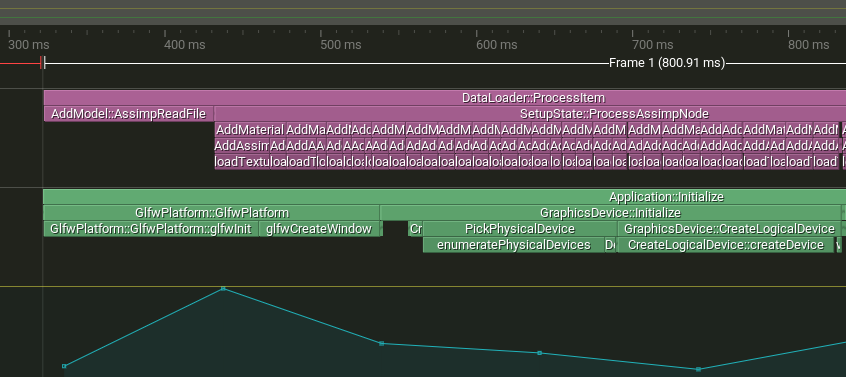
Kind of surprising how long VkDevice and GLFW window creation take! And not sure how to get around it other than maintaining some kind of background runtime that caches these
@eddieprograms It varies a little from run to run (best ~140, worst ~200, typical 155ms) and I can probably drop one or two socket writes during startup to shave a little more time off that.
It's good enough for me for now, and I hot-reload the shader on change so I don't relaunch too often.