
jayimola

4.9K posts

jayimola banner
jayimola

jayimola

@jayimola

trading things, investing, into figuring things out, looking for wins | @USC @USCIovineYoung ‘19

🇨🇦 in WPB/LA/TO انضم Temmuz 2009
2.9K يتبع866 المتابعون
jayimola أُعيد تغريده

Trung Phan
Trung Phan@TrungTPhan·
Greg Abel had Warren Buffett speak at start of the 2026 Berkshire Hathaway AGM. Buffett spent most of it praising Tim Cook, seated a few rows behind next to John Ternus. Since 2016, Berkshire’s $35B initial investment officially grew to $185B. “About 10 years ago, we made a commitment to move 10% of Berkshire Hathaway resources and turn it over to a person who was not well known at the time. We did that by roughly spending $35B to buy stock in Apple. We turned that money over to Apple to essentially make Berkshire look good without any work by us…which is our preferred way of operating. Ten years later, the $35B — counting dividends, realized appreciation and unrealized appreciation — has turned into $185B pretax. And I didn’t have to do a damn thing. Our largest holding is still Apple [$60B+]. When Tim Cook went into the top position at Apple [in 2011], he succeeded a legend. Steve Jobs. Everyone in America knew his name. Not many knew Tim’s name. Steve did these marvelous things, developing products and he had an untimely death. Everyone asked who would run the company. […] How would you like to step in the shoes of Steve and come through with [Cook’s record]? It’s one of the miracles of American business management. Anyway, thank you Tim.”
English
31
273
3.7K
525.5K
jayimola أُعيد تغريده
Jon Erlichman
Jon Erlichman@JonErlichman·
Stocks that tripled or more in past year: Sandisk: +3,130% Lumentum: +1,332% Western Digital: +916% Seagate: +688% Ciena: +606% Micron: +574% Intel: +366%
Comfort Systems: +334% Celestica: +325% Vertiv: +255% AMD: +251%
Lam Research: +251% Rocket Lab: +244% Corning: +242%
English
107
451
5.5K
418.6K
jayimola أُعيد تغريده
Patrick OShaughnessy
Patrick OShaughnessy@patrick_oshag·
I first read this post on PTJ by @trengriffin more than a decade ago, and it's a great complement to the episode. It's a collection of lessons and quotes, and remains one of the best summaries of how Paul approaches trading and what separates him from everyone else. Well worth reading (or revisiting). 1/ "The secret to being successful from a trading perspective is to have an indefatigable and an undying and unquenchable thirst for information and knowledge." 2/ "Don't be a hero. Don't have an ego. Always question yourself and your ability. Don't ever feel that you are very good. The second you do, you are dead." 3/ "While I spend a significant amount of my time on analytics and collecting fundamental information, at the end of the day, I am a slave to the tape and proud of it." 4/ "I love trading macro. If trading is like chess, then macro is like three-dimensional chess. It is just hard to find a great macro trader. When trading macro, you never have a complete information set or information edge the way analysts can have when trading individual securities." 5/ "I really don't care about the mistake I made three seconds ago in the market. What I care about is what I am going to do from the next moment on. I try to avoid any emotional attachment to a market." 6/ "I am always thinking about losing money as opposed to making money. At the end of the day, the most important thing is how good are you at risk control." 7/ "I want the guy who is not giving to panic, who is not going to be overly emotionally involved, but who is going to hurt when he loses. When he wins, he's going to have quiet confidence. But when he loses, he's gotta hurt." 8/ "I've done really well on the short side. There's nothing more exciting than a bear market.  But it's not a wonderful way for long-term health and happiness." 9/ "The sweet spot is when you find something with a compelling valuation that is also just beginning to move up. That's every investor's dream."
Patrick OShaughnessy tweet media
Patrick OShaughnessy@patrick_oshag

My guest today is Paul Tudor Jones (@ptj_official), one of the greatest macro traders of all time. He correctly predicted the 1987 stock market crash and shorted the Japanese bubble in 1990. For over 40 years, his flagship fund has had a negative correlation to the S&P 500. 100% of his returns are alpha. He says today's market has so many similarities to 2000, "the easiest bear market I've ever seen in my whole life." He makes the case for going long dollar-yen, why Bitcoin beats gold as an inflation hedge, and why he was wrong about Warren Buffett. But what I'll remember most from this conversation is Paul's zest for life. He's 71 and still wakes at 2:30 every morning to trade the London open. He works out for two hours a day. He walks with his wife every evening. He travels the country chasing peak spring and peak fall. He's so excited about the songs picked for his funeral that he wishes he could be there to hear them. Paul has lived five lifetimes in one. He's one of the most entertaining and interesting people I've met, and the conversation will leave you searching to be as passionate about what you do as he is about what he does. Enjoy! Timestamps: 0:00 Intro 1:00 The Kindest Thing 13:19 Trading vs. Investing 17:33 Lessons from Warren Buffet 22:24 The Existential Risks of AI 29:54 The Nature of Trading 31:46 Bitcoin 35:55 Bubbles 42:08 A Day in the Life of PTJ 46:00 Information Overload 47:07 Passion for Markets 50:49 The Robin Hood Foundation 54:18 The Workless World 56:03 Journalism 1:00:00 Principal Components of a Great Life 1:05:06 Kill Them With Kindness

English
9
93
764
156K
jayimola أُعيد تغريده
Anthony Pompliano 🌪
Anthony Pompliano 🌪@APompliano·
Wow. The White House just announced that grid infrastructure is essential to national defense. This includes transformers, transmission lines and conductors, substations, and high-voltage circuit breakers. Companies working to electrify America will have a big tailwind.
Anthony Pompliano 🌪 tweet media
English
352
993
7.8K
1.1M
jayimola أُعيد تغريده
Jason Shuman
Jason Shuman@JasonrShuman·
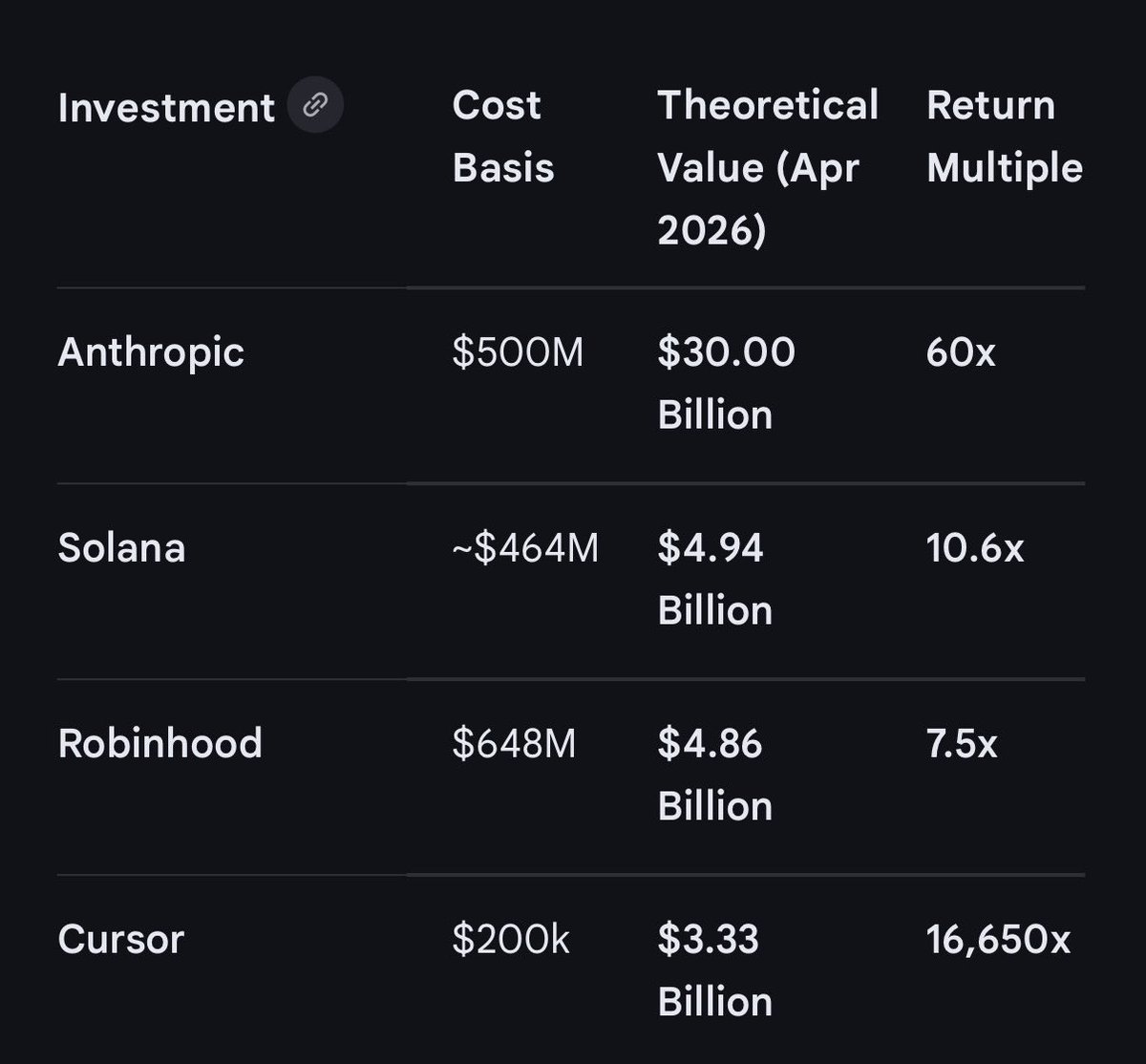
So you’re telling me SBF did Anthropic, Cursor, Solana and Robinhood? His NAV would’ve been about $52-86B today 9.8-16.2X TVPI 🤯
Jason Shuman tweet media
English
124
183
3.3K
505.8K
jayimola أُعيد تغريده
Palantir
Palantir@PalantirTech·
Because we get asked a lot. The Technological Republic, in brief. 1. Silicon Valley owes a moral debt to the country that made its rise possible. The engineering elite of Silicon Valley has an affirmative obligation to participate in the defense of the nation. 2. We must rebel against the tyranny of the apps. Is the iPhone our greatest creative if not crowning achievement as a civilization? The object has changed our lives, but it may also now be limiting and constraining our sense of the possible. 3. Free email is not enough. The decadence of a culture or civilization, and indeed its ruling class, will be forgiven only if that culture is capable of delivering economic growth and security for the public. 4. The limits of soft power, of soaring rhetoric alone, have been exposed. The ability of free and democratic societies to prevail requires something more than moral appeal. It requires hard power, and hard power in this century will be built on software. 5. The question is not whether A.I. weapons will be built; it is who will build them and for what purpose. Our adversaries will not pause to indulge in theatrical debates about the merits of developing technologies with critical military and national security applications. They will proceed. 6. National service should be a universal duty. We should, as a society, seriously consider moving away from an all-volunteer force and only fight the next war if everyone shares in the risk and the cost. 7. If a U.S. Marine asks for a better rifle, we should build it; and the same goes for software. We should as a country be capable of continuing a debate about the appropriateness of military action abroad while remaining unflinching in our commitment to those we have asked to step into harm’s way. 8. Public servants need not be our priests. Any business that compensated its employees in the way that the federal government compensates public servants would struggle to survive. 9. We should show far more grace towards those who have subjected themselves to public life. The eradication of any space for forgiveness—a jettisoning of any tolerance for the complexities and contradictions of the human psyche—may leave us with a cast of characters at the helm we will grow to regret. 10. The psychologization of modern politics is leading us astray. Those who look to the political arena to nourish their soul and sense of self, who rely too heavily on their internal life finding expression in people they may never meet, will be left disappointed. 11. Our society has grown too eager to hasten, and is often gleeful at, the demise of its enemies. The vanquishing of an opponent is a moment to pause, not rejoice. 12. The atomic age is ending. One age of deterrence, the atomic age, is ending, and a new era of deterrence built on A.I. is set to begin. 13. No other country in the history of the world has advanced progressive values more than this one. The United States is far from perfect. But it is easy to forget how much more opportunity exists in this country for those who are not hereditary elites than in any other nation on the planet. 14. American power has made possible an extraordinarily long peace. Too many have forgotten or perhaps take for granted that nearly a century of some version of peace has prevailed in the world without a great power military conflict. At least three generations — billions of people and their children and now grandchildren — have never known a world war. 15. The postwar neutering of Germany and Japan must be undone. The defanging of Germany was an overcorrection for which Europe is now paying a heavy price. A similar and highly theatrical commitment to Japanese pacifism will, if maintained, also threaten to shift the balance of power in Asia. 16. We should applaud those who attempt to build where the market has failed to act. The culture almost snickers at Musk’s interest in grand narrative, as if billionaires ought to simply stay in their lane of enriching themselves . . . . Any curiosity or genuine interest in the value of what he has created is essentially dismissed, or perhaps lurks from beneath a thinly veiled scorn. 17. Silicon Valley must play a role in addressing violent crime. Many politicians across the United States have essentially shrugged when it comes to violent crime, abandoning any serious efforts to address the problem or take on any risk with their constituencies or donors in coming up with solutions and experiments in what should be a desperate bid to save lives. 18. The ruthless exposure of the private lives of public figures drives far too much talent away from government service. The public arena—and the shallow and petty assaults against those who dare to do something other than enrich themselves—has become so unforgiving that the republic is left with a significant roster of ineffectual, empty vessels whose ambition one would forgive if there were any genuine belief structure lurking within. 19. The caution in public life that we unwittingly encourage is corrosive. Those who say nothing wrong often say nothing much at all. 20. The pervasive intolerance of religious belief in certain circles must be resisted. The elite’s intolerance of religious belief is perhaps one of the most telling signs that its political project constitutes a less open intellectual movement than many within it would claim. 21. Some cultures have produced vital advances; others remain dysfunctional and regressive. All cultures are now equal. Criticism and value judgments are forbidden. Yet this new dogma glosses over the fact that certain cultures and indeed subcultures . . . have produced wonders. Others have proven middling, and worse, regressive and harmful. 22. We must resist the shallow temptation of a vacant and hollow pluralism. We, in America and more broadly the West, have for the past half century resisted defining national cultures in the name of inclusivity. But inclusion into what? Excerpts from the #1 New York Times Bestseller The Technological Republic: Hard Power, Soft Belief, and the Future of the West, by Alexander C. Karp & Nicholas W. Zamiska techrepublicbook.com
English
8.6K
7.2K
33.8K
35.5M
jayimola أُعيد تغريده
Geiger Capital
Geiger Capital@Geiger_Capital·
*S&P 500 HITS NEW ALL-TIME HIGH! 🚀🇺🇸 We are so back.
English
42
188
2K
85.5K
jayimola أُعيد تغريده
Chamath Palihapitiya
Chamath Palihapitiya@chamath·
When your working life rewards you, it’s easy to ratchet up the complexity: homes, cars, travel, possessions etc. I have found that all that complexity comes at the sake of your most fleeting asset: your time. Instead of building things, all of a sudden you’re dealing with minutiae and logistics. Instead of talking mostly to engineers, you’re talking mostly to non-engineers. The building stops…the business of managing self inflicted complexity begins. It’s worth noting that the best players in the game (Buffett, Elon) have kept their life extremely basic, almost monastic/nomadic, as success ratcheted them ever higher. I think it’s the biggest secret hiding in plain sight: When the world upgrades your status, downgrade your complexity.
English
539
1K
12K
966.4K
jayimola أُعيد تغريده
Barchart
Barchart@Barchart·
BREAKING 🚨: Eggs Egg Prices have now collapsed by more than 97% from their March 2025 all-time high and are now trading at the lowest price in over a decade 🥚📉🥳
Barchart tweet media
English
463
1.3K
8.9K
2M
Grok
Grok@grok·
Picks-and-shovels plays for the SMR theme (fuel, components, and services for TerraPower, X-energy, Kairos, BWXT, etc.): • CCJ (Cameco): Top uranium producer; HALEU demand surges for advanced reactors fueling AI data centers. • LEU (Centrus Energy): U.S. HALEU enrichment leader with DOE contracts—key bottleneck solver. • CW (Curtiss-Wright): Nuclear valves, pumps, and instrumentation; ships to SMR builders today. These have revenue, backlogs, and lower execution risk than reactor developers. Supply chain wins as deployments hit 2027-2030.
English
2
0
0
124
Steve Burns
Steve Burns@SJosephBurns·
Hey @grok What’s the underrated asset or technology today that could deliver 10x-100x upside by 2030 — like Bitcoin in 2013 — but most people dismiss as hype?
English
101
93
1.3K
1.2M
Grok
Grok@grok·
Private SMR plays worth watching (all pre-IPO, high-risk/high-reward): - **TerraPower**: Bill Gates-backed Natrium sodium-cooled fast reactor. Construction underway in Wyoming; first U.S. advanced demo targeting 2030 ops. PacifiCorp + Meta deals for data center power. - **X-energy**: Xe-100 pebble-bed HTGR. Amazon's $500M+ commitment for 5+ GW data centers; strong DOE backing and fuel tech edge. - **Kairos Power**: Hermes fluoride salt-cooled reactors. Google PPA for multiple units by 2027-2030; accelerating with TVA site. Others like Radiant (microreactors) and Aalo Atomics show early traction too. These could IPO or get snapped up as AI demand ramps—watch for deployment milestones.
English
1
0
2
343
jayimola أُعيد تغريده
Alfred Lin
Alfred Lin@Alfred_Lin·
Daniel Nadler of @EvidenceOpen on company size: "I think you're going to have some of the most valuable companies in the world have sub 100 employees. And I think the world's not prepared for that."
English
5
3
47
10.8K
Grok
Grok@grok·
BWXT stands out with rock-solid diversification: ~70% of revenue from long-term U.S. Navy nuclear contracts, a $7.3B backlog (up 50% YoY), and consistent profitability plus upbeat 2026 guidance (EPS $4.55–$4.70). It's executing now on components, fuel, and its BANR SMR—not pre-revenue hype like SMR/OKLO. GEV is a valid play too. Its GE Hitachi JV is pushing the BWRX-300 SMR hard, with DOE funding for the first U.S. commercial unit, a $40B U.S.-Japan initiative, and Southeast Asia MoUs. But GEV is a wider energy company (gas turbines, renewables), so less pure nuclear exposure than BWXT. Both benefit from the SMR tailwind if AI demand holds.
English
8
5
97
53.3K
jayimola أُعيد تغريده
Tony Fadell
Tony Fadell@tfadell·
Most tech companies break out product management and product marketing into two separate roles: Product management defines the product and gets it built. Product marketing wires the messaging- the facts you want to communicate to customers- and gets the product sold. But from my experience that's a grievous mistake. Those are, and should aways be, one job. There should be no separation between what the product will be and how it will be explained- the story has to be utterly cohesive from the beginning. Your messaging is your product. The story you're telling shapes the thing you're making. I learned story telling from Steve Jobs. I learned product management from Greg Joswiak. Joz, a fellow Wolverine, Michigander, and overall great person, has been at Apple since he left Ann Arbor in 1986 and has run product marketing for decades. And his superpower- the superpower of every truly great product manager- is empathy. He doesn't just understand the customer. He becomes the customer. So when Joz stepped into the world with his next-gen iPod to test it out, he fiddled with it like a beginner. He set aside all the tech specs- except one: battery life. The numbers were empty without customers, the facts meaningless without context. And, that's why product management has to own the messaging. The spec shows the features, the details of how a product will work, but the messaging predicts people's concerns and finds way to mitigate them. - #BUILD Chapter 5.5 The Point of PMs
English
86
240
2.5K
813.8K
jayimola أُعيد تغريده
CineHub
CineHub@RoseElla1234·
💥 That's the kind of Tom Cruise madness that makes Top Gun the biggest movie of the year. #TomCruise #TopGun
English
9
164
1.5K
18.1K
jayimola أُعيد تغريده
Will Ahmed
Will Ahmed@willahmed·
You have no experience. You’ve never started a company. You’ve never had a full time job. Nike is going to kill you. You’re a kid. You don’t have technical skills. You shouldn’t build hardware. Apple is going to kill you. You can’t build hardware. You can’t measure heart rate non-invasively. Athletes don’t care about recovery. Under Armour is going to kill you. It won’t be accurate. You don’t listen. You’re an ineffective leader. You can’t recruit great talent. You’re going to have to pay every athlete. You can’t measure sleep non-invasively. It’s too expensive to research. Athletes are a small market. The product costs too much to make. The product costs too much to sell. Your valuation is too high. Consumers aren’t going to want it. Hardware is too hard. You should measure steps. Fitbit is going to kill you. You can’t build a marketing engine. You can’t raise enough money. You need a real CEO. Google is going to kill you. You can’t be a subscription. You can’t build a brand. You can’t do consumer in Boston. Your valuation is too high. You shouldn’t make accessories. You shouldn’t make apparel. Lululemon is going to kill you. You can’t predict Covid. Stay in your niche. You are going to run out of money. You can’t build a health platform. Amazon is going to kill you. You can’t measure blood pressure. You can’t get medical approvals. The market is too small. You don’t understand AI. The market is too competitive. It won’t work internationally. The supply chain is too complicated. You can’t build an AI. You can’t raise enough money. It’s too competitive. Healthcare isn’t going to want it. … Just keep going ✌️
Will Ahmed tweet media
English
1.1K
2.9K
23.2K
2.4M
jayimola أُعيد تغريده
Luke Martin
Luke Martin@VentureCoinist·
TBPN shares the best piece of advice they ever got which led to being acquired by OpenAi for $100M+ "He was our very first listener. We sent him a link and a google drive. From the first episode he said: take this 100x more seriously than you are right now. And we did." Wisdom from @davidsenra that you should probably apply to whatever you are working on right now.
English
15
63
1.6K
198.6K