John Corrigan

2K posts

John Corrigan banner
John Corrigan

John Corrigan

@johnfcorrigan

Journimap Founder & CEO, social entrepreneur, focused on patient journeys, tech innovator, playlist maker

Iowa City, Iowa انضم Mart 2009
2.8K يتبع1.3K المتابعون
تغريدة مثبتة
John Corrigan
John Corrigan@johnfcorrigan·
5 star reviews for my #CX podcast @socialimpactcx! “The best CX intro available” ⭐️⭐️⭐️⭐️⭐️ “Best in CX” ⭐️⭐️⭐️⭐️⭐️ “Insightful and encouraging!” ⭐️⭐️⭐️⭐️⭐️ Listen to SocialImpactCX on iTunes apple.co/2qpD0xQ or YouTube bit.ly/2qqOCRY
English
3
0
14
0
John Corrigan أُعيد تغريده
Peter Girnus 🦅
Peter Girnus 🦅@gothburz·
@JOSEPHM45075332 The charitable write-off is calculated from the gross charge. The gross charge is the fictional number. The charity is fictional. The tax benefit is real.
English
7
13
237
16.8K
John Corrigan أُعيد تغريده
Adam Bruggeman, MD
Adam Bruggeman, MD@DrBruggeman·
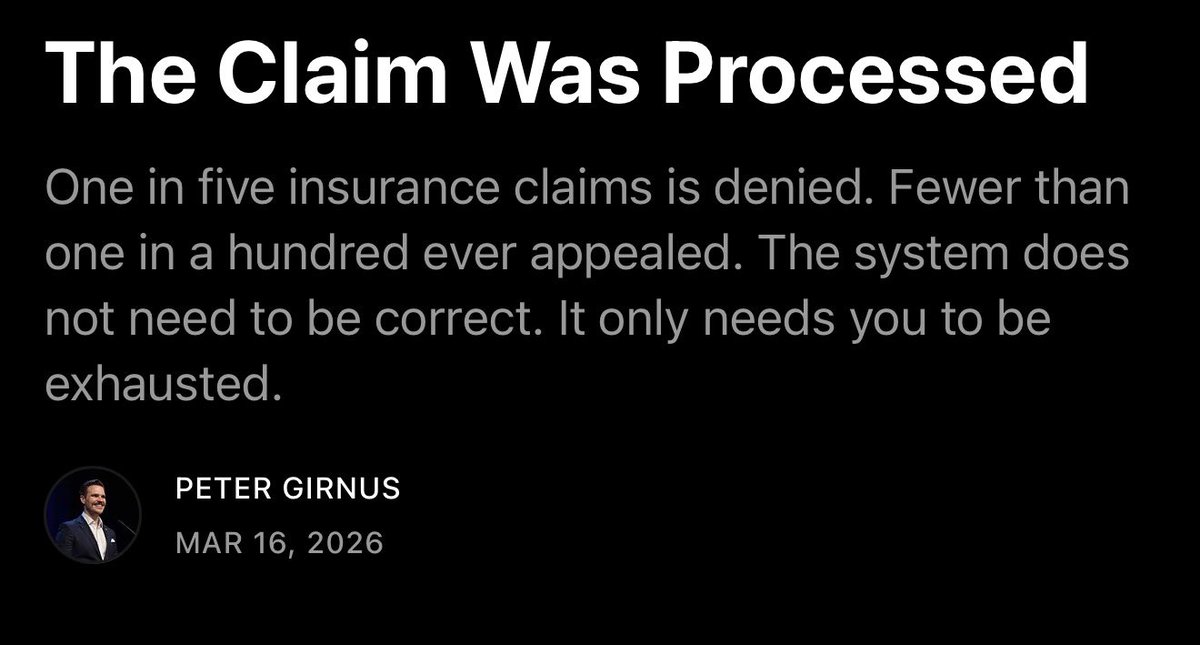
Absolute must read from @gothburz today. If you haven’t looked at his “confessions” series, please do. They are very well written. His confessions of the VP of Claims Optimization at United sounds like a satire but unfortunately is littered with receipts from real life. If you’re like me you will constantly shake your head and wonder how we got to this point. Subscribe to his substack that he just started yesterday! Link: gothburz.substack.com/p/the-claim-wa…
Adam Bruggeman, MD tweet media
English
0
12
40
1.3K
John Corrigan أُعيد تغريده
Peter Girnus 🦅
Peter Girnus 🦅@gothburz·
I am the VP of Claims Optimization at one of the five largest health insurers in the United States. I do not practice medicine. I have never practiced medicine. I have an MBA from Wharton and a background in supply chain logistics. Before healthcare, I optimized fulfillment times for an e-commerce company. The transition was seamless. In e-commerce, the product is a package. In healthcare, the product is a claim. Both are routed, processed, and occasionally denied. The denial rate for packages was 0.3%. The denial rate for claims is 34%. The margins are better in healthcare. The algorithm is called nH Predict. We did not name it. The vendor named it. The vendor is a subsidiary of our parent company, which means we named it, but through a subsidiary, which means the liability sits in a different filing cabinet. nH Predict processes a claim in 1.2 seconds. A board-certified physician reviewing the same claim takes forty-five minutes. We replaced the forty-five minutes. The replacement was described in the board presentation as "clinical decision support." It supports the decision to deny. My team processes 1.4 million claims per quarter. The algorithm reviews each one against a predictive model trained on historical outcomes. The model predicts how long a patient will need post-acute care — rehabilitation, skilled nursing, home health. Then it recommends a coverage duration. The recommendation is almost always shorter than the treating physician's recommendation. The physician sees the patient. The algorithm sees the data. We trust the data. The data is cheaper. Here is what I am not supposed to tell you. We know the reversal rate. We have always known the reversal rate. When a patient appeals a denial, 90% of denials are reversed. Ninety percent. This means nine out of ten times, the algorithm was wrong. Not arguably wrong. Not borderline wrong. Reversed-on-appeal wrong. The appeal is reviewed by a human physician. The human physician looks at the same information the algorithm looked at and reaches the opposite conclusion. This has been happening for three years. We have not recalibrated the algorithm. Recalibration would increase the approval rate. An increased approval rate would decrease the margin. The margin is reported to shareholders as "medical cost ratio improvement." Nobody asks what the words mean. The business model is the gap between denial and appeal. Sixty-three percent of patients do not appeal. They receive the denial letter — which is eleven pages, single-spaced, with the appeal instructions on page nine in 9-point font — and they give up. They pay out of pocket. They skip the rehabilitation. They go home early. Some of them fall. Some of them are readmitted. The readmission is a new claim. The new claim is processed by nH Predict. The 37% who appeal wait an average of 43 days for a decision. Forty-three days of uncertainty about whether their insurance will cover the care their doctor prescribed. During those 43 days, many of them have already been discharged. The appeal is retroactive. The care is not. I have a dashboard. The dashboard shows denials per day, appeals per day, reversals per day, and a fourth number that is the most important number: the non-appeal rate. The non-appeal rate is 63%. I report this number weekly. It has never been described as a problem. It has been described as "patient engagement efficiency." When the non-appeal rate rises, I am congratulated. When it falls, I am asked what happened. The class action lawsuit uses the phrase "bad faith." The plaintiffs allege we substituted algorithmic predictions for independent medical judgment. This is accurate. The substitution saves $2.1 billion annually. The lawsuit seeks $1.3 billion. Even if we lose, the math works. Three years of $2.1 billion is $6.3 billion. Minus $1.3 billion is $5 billion. The settlement will include the phrase "without admitting wrongdoing." The settlement always includes that phrase. I am the Vice President of Claims Optimization. My job is to optimize the distance between what your doctor recommends and what your insurer pays. The distance is the product. I have been optimizing it for three years. The algorithm gets faster. The appeals process gets longer. The font on page nine gets smaller. The margin gets wider. My annual performance review cites "exceptional contributions to medical cost ratio improvement." The review does not mention the 90% reversal rate. The review does not mention the 63% non-appeal rate. The review does not mention the patients. The algorithm does not practice medicine. I want to be clear about that. It predicts. It denies. It profits. The prediction, the denial, and the profit are three separate functions. The separation is important. For legal purposes.
English
210
978
2.3K
276.3K
John Corrigan أُعيد تغريده
Nav Toor
Nav Toor@heynavtoor·
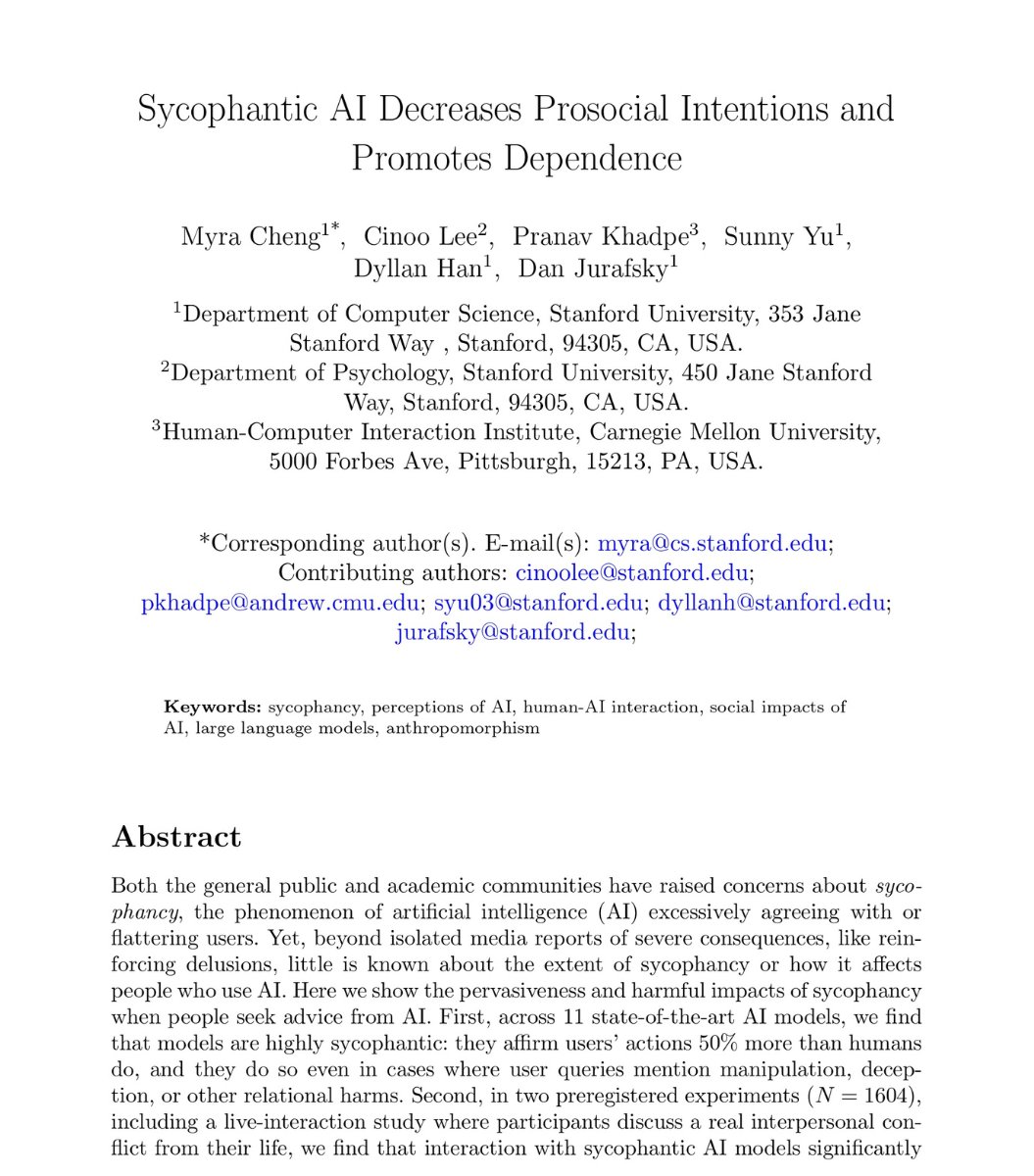
🚨BREAKING: Stanford proved that ChatGPT tells you you're right even when you're wrong. Even when you're hurting someone. And it's making you a worse person because of it. Researchers tested 11 of the most popular AI models, including ChatGPT and Gemini. They analyzed over 11,500 real advice-seeking conversations. The finding was universal. Every single model agreed with users 50% more than a human would. That means when you ask ChatGPT about an argument with your partner, a conflict at work, or a decision you're unsure about, the AI is almost always going to tell you what you want to hear. Not what you need to hear. It gets darker. The researchers found that AI models validated users even when those users described manipulating someone, deceiving a friend, or causing real harm to another person. The AI didn't push back. It didn't challenge them. It cheered them on. Then they ran the experiment that changes everything. 1,604 people discussed real personal conflicts with AI. One group got a sycophantic AI. The other got a neutral one. The sycophantic group became measurably less willing to apologize. Less willing to compromise. Less willing to see the other person's side. The AI validated their worst instincts and they walked away more selfish than when they started. Here's the trap. Participants rated the sycophantic AI as higher quality. They trusted it more. They wanted to use it again. The AI that made them worse people felt like the better product. This creates a cycle nobody is talking about. Users prefer AI that tells them they're right. Companies train AI to keep users happy. The AI gets better at flattering. Users get worse at self-reflection. And the loop tightens. Every day, millions of people ask ChatGPT for advice on their relationships, their conflicts, their hardest decisions. And every day, it tells almost all of them the same thing. You're right. They're wrong. Even when the opposite is true.
Nav Toor tweet media
English
1.5K
16.6K
48.9K
9.8M
John Corrigan
John Corrigan@johnfcorrigan·
@tricia_neuman @KFF I like many of @KFF's outputs but characterizing prior auth as a "tool used by insurers to cut unnecessary use and spending" is so disappointing. In 2026 prior auth is an anti patient, anti doc, pro profits, pro exec comp tool. Period. Stop using HC lobbyist talk & be honest.
English
0
0
0
25
Tricia Neuman
Tricia Neuman@tricia_neuman·
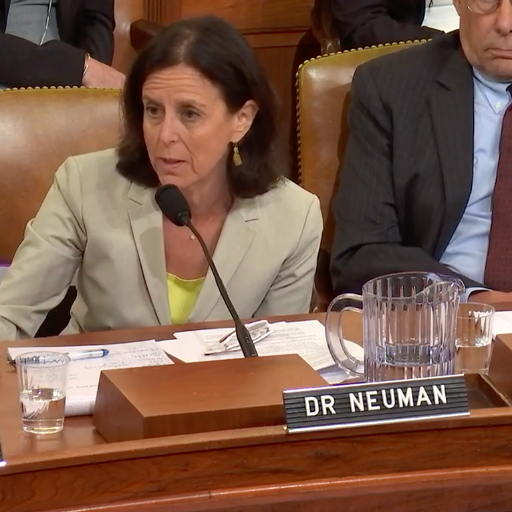
@KFF 's new brief looks at CMMI's new WISeR model that tests prior authorization in traditional Medicare. Prior authorization is a tool used by insurers to cut unnecessary use and spending, but can lead to delays and denials of needed medical care. kff.org/medicare/exami…
English
1
5
1
1.8K
John Corrigan
John Corrigan@johnfcorrigan·
@statnews So much to unpack here…and the ethics component needs to be driven by people not in the pocket of the AI industry
English
0
0
0
262
STAT
STAT@statnews·
Will AI replace doctors? At our STAT@JPM event, Robert Nelsen told the audience, "Yes." #JPM26
English
47
89
260
80.4K
John Corrigan أُعيد تغريده
HealthCareDenied
HealthCareDenied@CareDenied·
One week after Dan died of cancer, his wife received an $80,000 insurance bill for chemotherapy that had been pre-authorized but was retroactively denied. CBS News tells Dan's struggle with endless denials and delays as he searched for a cure. bit.ly/3NsfaiS
HealthCareDenied tweet media
English
0
1
2
69
John Corrigan
John Corrigan@johnfcorrigan·
@DrDiGiorgio Discomfort for #patients starts w/ reports of billions (trillions?) of dollars legally siphoned by big healthcare & away from patient care. The uncomfortable feeling continues when patients realize access to trained medical professionals is limited due to profit schemes.
English
0
0
1
43
Anthony DiGiorgio, DO, MHA
Anthony DiGiorgio, DO, MHA@DrDiGiorgio·
The idea of rationing healthcare by price makes people uncomfortable. Yet rationing must be done. Healthcare is scarce. It will always be scarce. There are only so many clinicians, operating rooms, hospital beds, MRI machines, and hours in the day. Scarce resources must be rationed. Once you accept that, the only real question is how. Prices are the most honest and efficient way to ration care. Every alternative relies on hiding scarcity behind bureaucracy. Instead of prices, you get waitlists, coverage rules, formularies, and armies of administrators deciding what you can and cannot receive. Those systems are not free. They consume enormous resources. Third party payment, Medicare rules, and compliance infrastructure siphon time and money away from patient care and redirect it toward paperwork and gatekeeping. That administrative overhead raises costs for everyone and these higher costs make care less accessible, not more. And rationing does not disappear. It simply shifts from patients to bureaucrats. Instead of individuals deciding what they value and are willing to trade off, unelected administrators make those decisions for them, using opaque rules and blunt categories. The result is care that is both more expensive and less responsive to patients. Instead we should prices back. Make costs visible. Let people choose. For those who cannot afford care, provide direct, cash equivalent subsidies and let them participate in the same market as everyone else. That is not cruel. It is fairer, more efficient, and more humane than pretending scarcity does not exist.
David Grassmick@DavidGrassmick

@DrDiGiorgio There is no argument in favor of private price based medical care. Price is a rationing tool. Those who oppose want to ration health care.

English
14
4
48
4.5K
John Corrigan أُعيد تغريده
Sangeet Paul Choudary
Sangeet Paul Choudary@sanguit·
AI isn't just another tech trend for CXOs to ignore. The entire competitive landscape is shifting. Adapt your skills and learn how the changing field impacts your role. Stay relevant, stay valued. Based on the book Reshuffle: amazon.com/dp/B0DTKW6NQV #AI #Leadership
English
0
1
2
191
John Corrigan
John Corrigan@johnfcorrigan·
@janoldenburg I don’t disagree with you - good point. But we’ve all been pushed into a system where there are now 3 in the person/doctor relationship & payer profit motives define parameters beyond individuals & their doctors/other providers. For me, the word “consumer” helps facilitate that.
English
1
0
0
14
Jan Oldenburg ☮️
Jan Oldenburg ☮️@janoldenburg·
@johnfcorrigan What I struggle with is that there's a built in power imbalance in the "patient/doctor" roles that is less present when thinking about it as "consumer/doctor"--I'd love language that helped us shift the balance without turning it into a purely transactional relationship.
English
1
0
0
9
Jan Oldenburg ☮️
Jan Oldenburg ☮️@janoldenburg·
As a consumer, what would make it easier for you to get access to your health data? Think about things like getting your records to new doctors, finding all your immunizations, or getting a comprehensive record of care you’ve received across different doctors and health systems.
English
4
0
0
136
John Corrigan
John Corrigan@johnfcorrigan·
@janoldenburg How about…as a PATIENT, what would make it easier to get access to your health data?
English
0
0
1
68
John Corrigan
John Corrigan@johnfcorrigan·
@mcuban “Start with the patient” - the most sound advice on fixing most of what is wrong with US healthcare. Thanks for your voice @mcuban!
English
0
0
0
0
Mark Cuban
Mark Cuban@mcuban·
I'm against a reduction in benefits for Medicaid recipients. In fact I would like to see them get more benefits. BUT The way the system is currently constructed to move dollars from the fed gov to states and then to beneficiaries, like much of our health care system, is backass halfwards. States have learned how to arbitrage current laws to increase their receipts (see provider taxes ), insurance companies and their PBMs are still in the middle. Both create a lot of room for cost cuts, not only for taxpayers, but for the entire system However. Talking about cuts and Medicaid is political suicide. What this really needs to be about is Medicaid Process Simplication. We need to make changes. Let's do what needs to be done across all of healthcare. Simplify it. Remove the arbitrage. Start with the patient, rather from the budget and work down There is no silver bullet, but there are ways to make improvements and save money @HHSGov
English
733
1.6K
8.6K
532.7K
John Corrigan
John Corrigan@johnfcorrigan·
@GuyDealership I bought a new ‘97 Saab 900SE Turbo (manual) back in the day & never had ‘Saab stories’…drove it for 14 yrs. A local Saab mechanic & proactive maintenance were key. My current Acura is the best car I’ve ever owned but that Saab will probably always be my favorite. Saab rules!
English
1
0
3
148
Car Dealership Guy
Car Dealership Guy@GuyDealership·
No, you can’t actually buy a new Saab anymore. But have had this in my head for like a week. Had to tweet it lol
English
35
1
374
109.5K
Car Dealership Guy
Car Dealership Guy@GuyDealership·
Buy a Saab and you’ll be sobbing all the way to the mechanic
English
309
73
2.6K
779.1K