Jean-Pascal (Quick-Eyed Sky)

7.2K posts

Jean-Pascal (Quick-Eyed Sky) banner
Jean-Pascal (Quick-Eyed Sky)

Jean-Pascal (Quick-Eyed Sky)

@jrobocat

AI-made images & tutorials: https://t.co/XogUZQqmvl https://t.co/9qhrq9uOET https://t.co/ye9sRNbIhC https://t.co/Lxbm1SJnrV

Earth انضم Haziran 2011
3.1K يتبع565 المتابعون
Jean-Pascal (Quick-Eyed Sky) أُعيد تغريده
Ihtesham Ali
Ihtesham Ali@ihtesham2005·
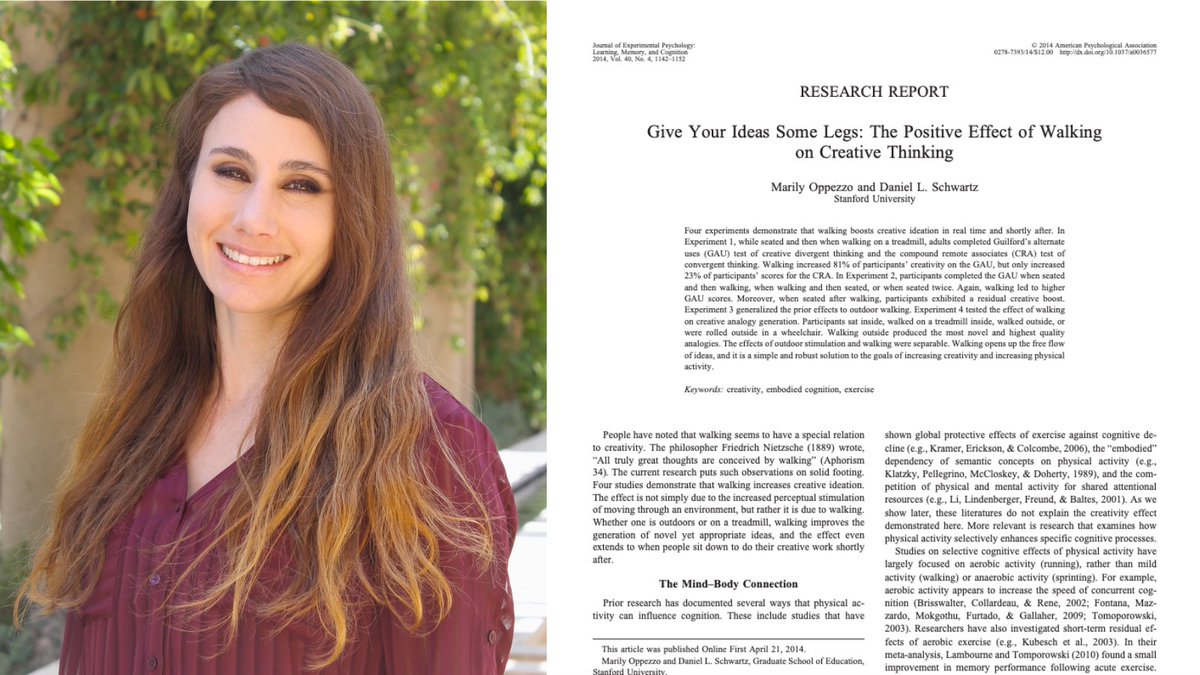
A Stanford psychologist spent 4 years proving that the simple act of walking generates 60% more creative ideas than sitting, and the experiment she designed to kill every alternative explanation is one of the most decisive findings in modern psychology. Her name is Marily Oppezzo. She got the idea for the study while walking with her advisor at Stanford to discuss her thesis topic, and the paper she eventually published in the Journal of Experimental Psychology in 2014 is sharp enough that it should have ended the seated meeting on the day it came out. She ran 4 experiments on 176 people. Same person tested twice. Once sitting, once walking. The creativity tasks were the standard ones psychologists have used for decades to measure how good a brain is at generating novel useful ideas. The result was almost too clean to publish. 81% of participants in the first experiment produced more creative ideas while walking than while sitting. In the second experiment, 88%. In the third, 100%. Every single person walked into a more creative version of themselves. On average, people generated 60% more novel useful ideas the moment their legs started moving. The skeptical question is the obvious one. Maybe it was the fresh air. Maybe it was the scenery passing by. Maybe it was the change of environment doing the work, not the walking itself. Oppezzo killed every one of those explanations with one experimental decision. She put people on a treadmill facing a blank wall. No scenery. No fresh air. No environmental change. Just legs moving in place while staring at white drywall. The 60% boost held. Then she ran the experiment that closed the case completely. She took participants outside in two conditions. Half of them walked through a Stanford courtyard. The other half were pushed through the exact same courtyard in a wheelchair. Same outdoor stimulation. Same scenery passing at the same speed. The only difference was whether the legs were moving. The walkers produced dramatically more novel high-quality ideas than the wheelchair group. The outdoors did almost nothing on its own. The walking did everything. This is the part of the study that hit hardest when I read it the first time. She also tested the opposite kind of thinking. Convergent thinking. The kind where there is one right answer and you have to narrow down to it. Word puzzles where 3 words share a hidden fourth word that connects them. The seated participants did slightly better on these. Walkers got slightly worse. Walking is not a general intelligence enhancer. It does one specific thing. It opens up the divergent search inside your brain. The part that generates options. The part that produces unexpected connections. The part that takes a problem and finds five ways into it instead of one. When you need to converge on the single right answer, sit down. When you need to find the answer in the first place, get up. The mechanism is now well understood. Walking selectively activates what neuroscientists call the default mode network, the system inside your brain that runs when you are not consciously focused on anything. The DMN is where mind-wandering happens. Where memories cross-reference each other. Where ideas that have been sitting in separate folders inside your head finally bump into each other. When you sit at a desk and force yourself to concentrate, you suppress the DMN. When you walk at a natural pace, the executive part of your brain gets just busy enough handling the walking that the DMN comes online and starts doing the work that focus was blocking. The most useful finding in the entire paper is the one almost nobody quotes. The boost did not turn off the moment people stopped walking. Participants who walked first and then sat back down stayed elevated. Their next round of seated creativity work was still significantly better than people who had been sitting the whole time. The rest lingered for at least several minutes after the legs stopped moving. You do not need to do creative work while walking. You need to walk before the creative work. The brain holds the state. The history of this is the part that should haunt anyone who still does meetings in chairs. Charles Darwin built a gravel loop behind his house in Kent called the Sandwalk and walked it 3 times a day for the rest of his life. The theory of evolution was developed one lap at a time on that path. Nietzsche walked up to 10 hours a day during the years he wrote his most important books and openly said the work was conceived on his feet. Beethoven composed for the morning and walked for 5 hours every afternoon with a pencil in his pocket for when something landed. Kahneman said the best thinking of his Nobel Prize-winning career happened on leisurely walks with Amos Tversky. Steve Jobs refused to take important conversations sitting down. He held them on foot. Every one of them was using the system Oppezzo would not measure until 2014. They just did not know what to call it. The question worth sitting with is the one almost nobody asks. Every meeting you have ever attended sitting around a table was a meeting held at a fraction of the brain power that was actually available to the people in the room. Every brainstorm that got stuck inside a conference room. Every problem you tried to solve at a desk and gave up on. Every idea you could not quite get to. The intervention is the easiest one in modern science. No supplement. No app. No subscription. No training program. Just a pair of legs and 15 minutes. The Stanford lab proved it. The philosophers knew it. The neuroscience explains it. And almost everyone reading this is still trying to think their way out of problems sitting completely still.
Ihtesham Ali tweet media
English
278
3K
11.8K
1.5M
Jean-Pascal (Quick-Eyed Sky) أُعيد تغريده
Charlotte Clymer 🇺🇦
Charlotte Clymer 🇺🇦@cmclymer·
One of my all-time favorite moments from Colbert’s show — this exchange with Dua Lipa on faith and grief.
English
35
730
5.3K
358.8K
Ali ³³
Ali ³³@wingsdelightt·
paul mccartney performing the greatest song in history at 83
English
89
408
4.7K
370.1K
Jean-Pascal (Quick-Eyed Sky) أُعيد تغريده
La vida en viñetas
La vida en viñetas@lavidaenvinetas·
Dan y Tom Heyerman
La vida en viñetas tweet media
Indonesia
0
24
162
4.7K
𝚁𝚎𝚗𝚊𝚞𝚍 𝙼𝚊𝚌𝚑𝚊𝚛𝚝
J’ai souvent croisé Felicity Lott (1947-2026) dans ma vie de journaliste, de « spécialiste » de Poulenc (j’ai écrit pas mal de textes de présentation pour ses disques) ou dans la vie tout court. Je voulais raconter ici quelques souvenirs qui me sont revenus spontanément.
𝚁𝚎𝚗𝚊𝚞𝚍 𝙼𝚊𝚌𝚑𝚊𝚛𝚝 tweet media
Français
9
55
217
9.5K
Jean-Pascal (Quick-Eyed Sky) أُعيد تغريده
GOLD
GOLD@Honcia13·
有人把 GPT-Image-2 最强提示词 全偷出来了! GitHub这个仓库直接整合576个高质量实测案例,人像写真、海报设计、角色概念、UI Mockup全覆盖! 从便利店霓虹灯风、赛博朋克到宋朝社交媒体界面…… 全是真实创作者跑出来的神级Prompt,直接抄作业就行! 不会写提示词的兄弟,这波直接救命! github.com/EvoLinkAI/awes…
GOLD tweet media
中文
30
184
960
59.2K
Jean-Pascal (Quick-Eyed Sky) أُعيد تغريده
François Roque🎸🎬
François Roque🎸🎬@imposture·
Début 1981, Brian Eno et David Byrne livrent "My Life in the Bush of Ghosts", un 33t qui revient toujours dans mes écoutes depuis sa sortie. Un délirant bricolage de bandes et d'enregistrements chopés à droite et à gauche (ici un exorcisme sur ce "The Jezebel Spirit") qui 45 ans plus tard garde sa furieuse dimension avant garde des boucles, samples, techno, etc.
Français
0
1
2
225
Jean-Pascal (Quick-Eyed Sky) أُعيد تغريده
Krea
Krea@krea_ai·
this is Krea 2. our first foundation model, built completely from scratch for aesthetic diversity and stylistic control. learn more and get early access 👇
English
205
211
2.2K
2.3M
Jean-Pascal (Quick-Eyed Sky) أُعيد تغريده
Hugging Models
Hugging Models@HuggingModels·
Ready for a model that pushes boundaries? Meet Qwen3.6-27B-AEON-Ultimate-Uncensored-BF16-mlx-2Bit, a text generation beast that processes both images and text. It's abliterated and uncensored, giving you raw, unfiltered AI power.
Hugging Models tweet media
English
7
13
183
11.4K
Jean-Pascal (Quick-Eyed Sky)
@RenaudMachart Bonsoir, j'adore vos posts culinaires ! Mais ici je voulais vous dire merci pour le livre sur Stephen Sondheim chez Actes Sud, que je suis en train de dévorer. C'est très bien mené, et j'écoute plein de choses (repartant y compris chez Brahms, Villa-Lobos ou Ravel). Merci !
Français
0
0
0
13
Jean-Pascal (Quick-Eyed Sky) أُعيد تغريده
Hugging Models
Hugging Models@HuggingModels·
Meet GLM-4.7-Flash: a lightning-fast text generation model that's been downloaded over 680k times. It's multilingual, conversational, and built on cutting-edge MoE architecture. This isn't just another LLM, it's a community favorite for good reason.
Hugging Models tweet media
English
1
2
10
1.3K
Jean-Pascal (Quick-Eyed Sky) أُعيد تغريده
LM Studio
LM Studio@lmstudio·
Qwen3.6 27B is now in LM Studio! Vision, reasoning, and agentic tool calling - running locally on your computer. Surpasses previous Qwen models many times its size 🚀👾🔥 lmstudio.ai/models/qwen/qw…
English
43
87
1.1K
56.8K
Jean-Pascal (Quick-Eyed Sky) أُعيد تغريده
A.I.Warper
A.I.Warper@AIWarper·
The fact of the matter is, I can assure you most employed artists are in fact already experimenting and using AI in their day to day workflows. You’d be naive to think otherwise. Also, I’m confident the majority of the anti AI horde aren’t even actual artists, they just love being hateful in anonymity. Like when looters and rioters participate in it for the love of the game
English
3
2
32
1.1K
Cloud
Cloud@Cloud1a7·
A chessboard that plays against you. I need this in my life. 👌🔥
English
217
976
5.5K
402.4K
Jean-Pascal (Quick-Eyed Sky) أُعيد تغريده
Hugging Models
Hugging Models@HuggingModels·
Meet Zephyr-7B-Beta: a powerful conversational AI that's been turning heads. This 7-billion parameter model is designed for natural dialogue, trained on massive datasets of human conversations. It's like having a helpful assistant that actually understands context and nuance.
Hugging Models tweet media
English
1
1
1
634