Martins S. Oderinde, Ph.D

210 posts

Martins S. Oderinde, Ph.D

Martins S. Oderinde, Ph.D

@oderinde_m

Scientific Associate Director. Discovery Chemistry. Bristol Myers Squibb. Photocatalysis Expert. IAB Member of Angewandte Chemie.

انضم Şubat 2021
597 يتبع996 المتابعون
Martins S. Oderinde, Ph.D أُعيد تغريده
Baran Lab
Baran Lab@BaranLabReads·
💊Accelerating Medicinal Chemistry💊: A C(sp3)-rich Fragment Toolbox for Redox-Neutral Cross-Coupling, appearing today in @chemrxiv: chemrxiv.org/engage/chemrxi… A great collaboration with brilliant drug hunters at BMS, Pfizer, and Biogen. Quick summary: A new toolbox of 15 sulfonyl hydrazide reagents (some of which are already commercial) enables redox-neutral, nickel-catalyzed radical cross-coupling to attach small C(sp3)-rich fragments like methyl and cyclopropyl to (hetero)arenes, streamlining the hit-to-lead phase of drug discovery. These stable, easy-to-synthesize reagents require no additional oxidants, reductants, or costly catalysts, offering mild, dump-and-stir conditions and broad substrate compatibility across over 60 (hetero)aryl halides. Compared to traditional methods like Suzuki or Kumada couplings or radical couplings wedded to redox, this unified approach significantly improves yields and simplifies synthesis, accelerating analog optimization and late-stage functionalization of drug-like molecules.
Baran Lab tweet media
English
2
41
271
48.3K
Martins S. Oderinde, Ph.D أُعيد تغريده
Baran Lab
Baran Lab@BaranLabReads·
Baran Lab@BaranLabReads

Finally, RADICAL CROSS COUPLING without the exogenous REDOX. We disclose in @ChemRxiv (chemrxiv.org/engage/chemrxi…) a broadly general platform for achieving transformations that normally required excess metallic or chemical reducing agents or photochemical setups (and their requisite catalysts) or potentiostats for electrochemistry. Now, such transformations can be accomplished with the same ease that one conducts a Suzuki coupling. You can scale up (its homogeneous) or scale down (use cheap parallel screening plates). Moisture is tolerated and base metal catalysis is used. As the best engineers like to say, "The best part is no part". Now, chemists have the option to remove the redox part from radical couplings. Quick Summary: Sulfonyl hydrazides are disclosed as versatile radical precursors as exemplified with seven new C–C bond forming, redox-neutral cross-couplings with: (1) activated olefins, (2) alkyl halides, (3) redox active esters, (4) aryl halides, (5) alkenyl halides, (6) alkynyl halides, and (7) a trifluoromethylating reagent to forge C(sp3)-C(sp3), C(sp3)-C(sp2), and C(sp3)-C(sp) bonds. Sulfonyl hydrazides are stable and usually crystalline substances that can be accessed in a variety of ways including transiently from hydrazones to achieve a net reductive arylation of carbonyl compounds. Exogenous redox (chemical, photo/electrochemical) additives are not necessary as these functional groups serve the dual role of radical precursor and electron donor. The operational simplicity (homogeneous, water tolerant, dump-and-stir) and practicality of the method are demonstrated as well as applications to streamlining synthesis and mild late-stage functionalization.

English
9
63
359
47.1K
Martins S. Oderinde, Ph.D أُعيد تغريده
Áron Péter
Áron Péter@Aron_Peter_·
@andrew_barrow Thank you very much! I must say though, it was a true team effort and wouldn't have been possible without @Jiawei1024, Jiayan, @JetTsien, Haoxiang, and our collaborators at BMS: Ben, David, @oderinde_m, Michael, and Max!
English
0
1
5
241
Martins S. Oderinde, Ph.D أُعيد تغريده
Baran Lab
Baran Lab@BaranLabReads·
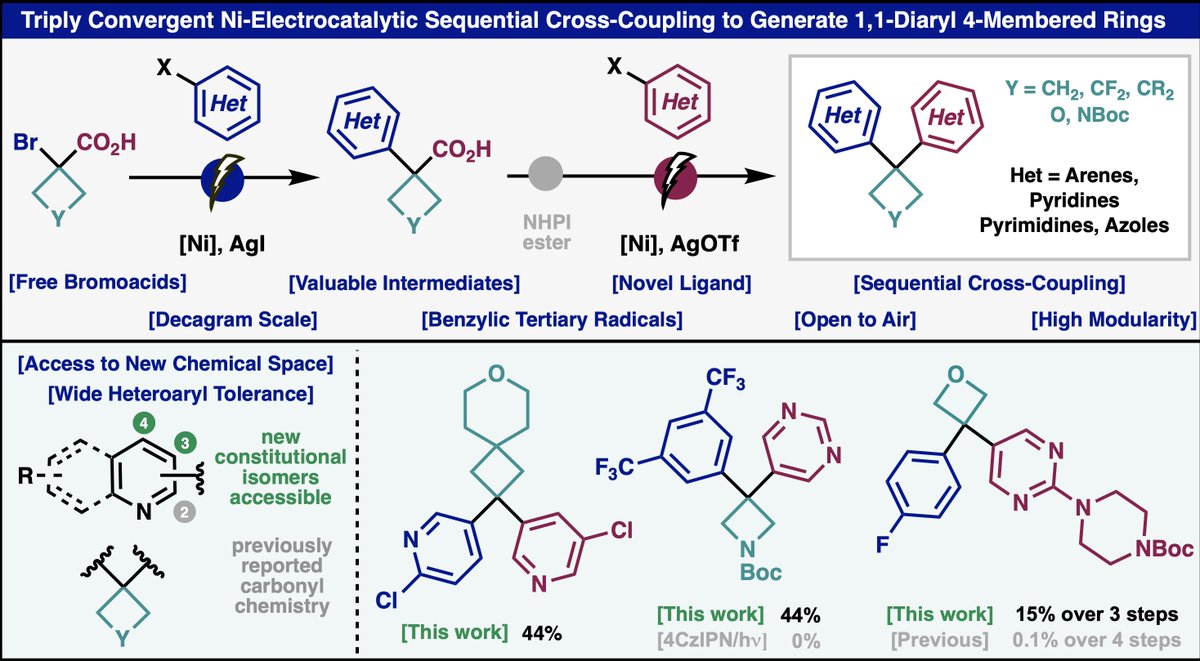
Triply Convergent Ni-Electrocatalytic Assembly of 1,1-diaryl Cyclobutanes, Azetidines, and Oxetanes, appearing today in @ChemRxiv :chemrxiv.org/engage/chemrxi… Increasingly complex, three-dimensional leads for drug discovery are testing the limits of modern organic synthesis. In this context, the need for new methods to access gem-diarylated cyclobutanes, azetidines, and oxetanes is apparent. The present study outlines a modular, scalable, chemoselective approach to solve this problem using simple alpha-bromoacids and aryl halides as intuitive starting materials. As demonstrated herein, a sequential series of Ni- electrocatalytic cross-couplings can be enlisted to enable rapid access to such structures, many of which have never been accessible before, without recourse to time-consuming polar bond disconnections that are inherently limiting in terms of accessible chemical space. The scalability of this new reaction sequence is demonstrated, alongside direct applications to known patented structures. A simple user guide is also presented to accelerate adoption of this strategy in medicinal chemistry. A super fun collaboration with BMS, Pfizer, Biogen, Enamine, and Abbvie.
Baran Lab tweet media
English
0
31
166
39.4K
Martins S. Oderinde, Ph.D أُعيد تغريده
Angewandte Chemie
Angewandte Chemie@angew_chem·
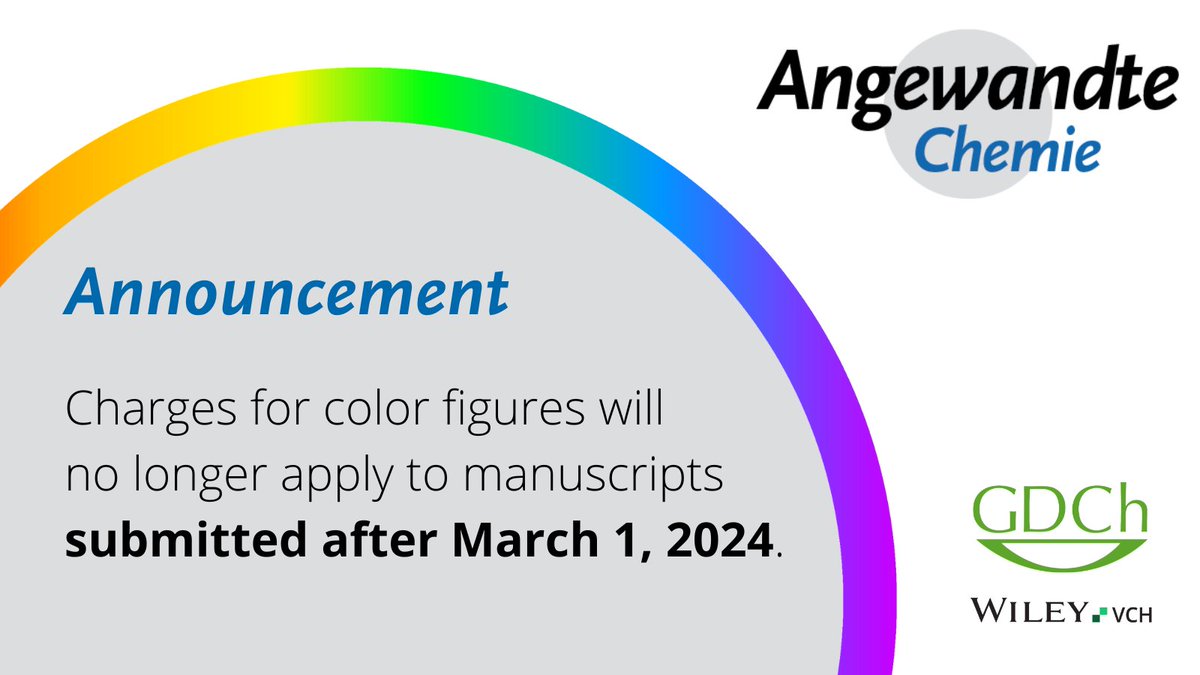
Charges for color figures will no longer apply to manuscripts submitted after March 1, 2024. For your next submission, we invite you to check out the Viewpoint Article "Coloring Chemistry—How Mindful Color Choices Improve Chemical Communication" (doi.org/10.1002/anie.2…).
Angewandte Chemie tweet media
English
14
42
231
66.1K
Martins S. Oderinde, Ph.D أُعيد تغريده
Baran Lab
Baran Lab@BaranLabReads·
Baran Lab@BaranLabReads

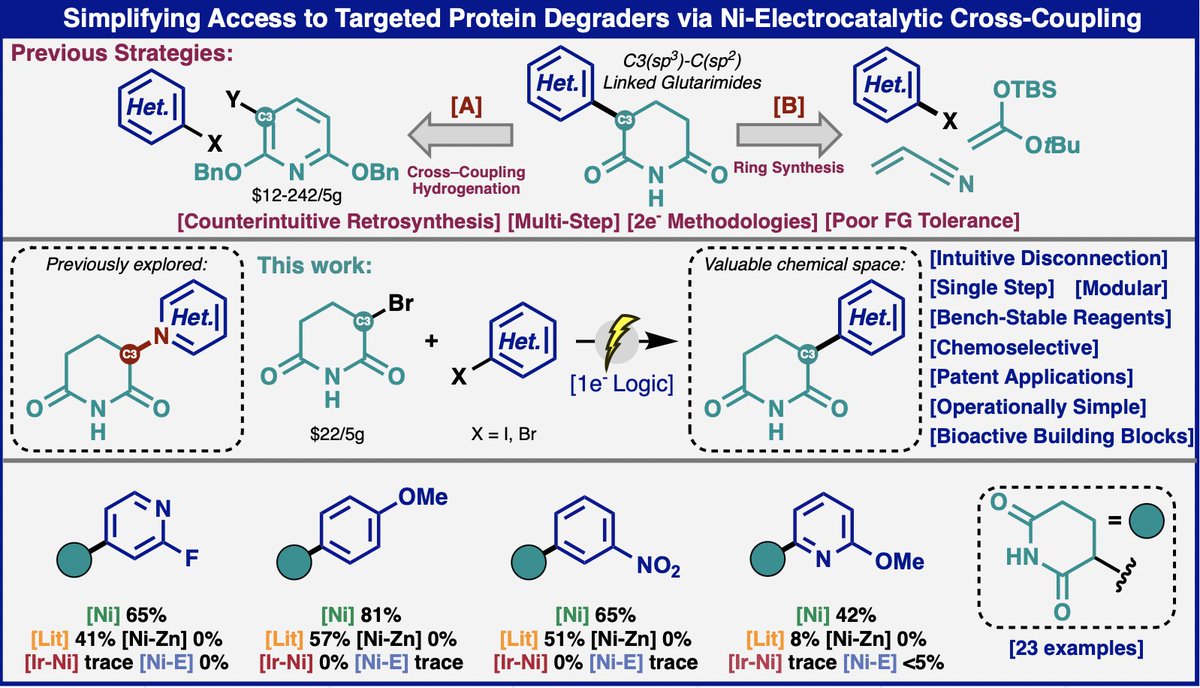
Degrade proteins, not your work schedule! A new method appearing today @ChemRxiv (chemrxiv.org/engage/chemrxi…) simplifies access to molecular glues (like PROTACS) to save medicinal chemists valuable time. One-step access from cheap commercial materials, a trivial experimental setup, and superb chemoselectivity enabled by Ni-electrocatalysis. Another fun collaboration with BMS.

English
2
20
174
19.5K
Martins S. Oderinde, Ph.D أُعيد تغريده
Philipp Neigenfind
Philipp Neigenfind@pneigenfind98·
very happy to share this work with the community, but even happier about the amazing feedback from our colleagues @bmsnews who are already using this chemistry! Thanks a million to everyone who helped solving this puzzle with lightning speed. @Aron_Peter_ @oderinde_m @chemistte
Baran Lab@BaranLabReads

Degrade proteins, not your work schedule! A new method appearing today @ChemRxiv (chemrxiv.org/engage/chemrxi…) simplifies access to molecular glues (like PROTACS) to save medicinal chemists valuable time. One-step access from cheap commercial materials, a trivial experimental setup, and superb chemoselectivity enabled by Ni-electrocatalysis. Another fun collaboration with BMS.

English
2
7
31
2.7K
Martins S. Oderinde, Ph.D أُعيد تغريده
Baran Lab
Baran Lab@BaranLabReads·
Degrade proteins, not your work schedule! A new method appearing today @ChemRxiv (chemrxiv.org/engage/chemrxi…) simplifies access to molecular glues (like PROTACS) to save medicinal chemists valuable time. One-step access from cheap commercial materials, a trivial experimental setup, and superb chemoselectivity enabled by Ni-electrocatalysis. Another fun collaboration with BMS.
Baran Lab tweet media
English
3
63
384
65.1K
Ganiyat Kehinde Oloyede
Ganiyat Kehinde Oloyede@ganiyat_oloyede·
Rejoicing as Oloyede becomes Professor. Dancing in the video are Professors Onocha, Aiyelagbe, Aboaba and Associate Professor Oyedeji
English
2
0
4
81