Raphael Pfeiffer

299 posts

Raphael Pfeiffer banner
Raphael Pfeiffer

Raphael Pfeiffer

@raphpfei

PhD Philosophy of Science (Université Paris-Cité). Associate researcher at SPHERE (CNRS). Filmmaker. Working on the foundations of AI alignment.

Paris انضم Şubat 2026
62 يتبع73 المتابعون
Raphael Pfeiffer
Raphael Pfeiffer@raphpfei·
@NidaKirmani The threat to human intellect isn't the existence of LLMs, it's the choice to stop thinking when you have one.
English
0
0
5
427
Nida Kirmani
Nida Kirmani@NidaKirmani·
There are many reasons to resist AI (e.g. environmental harm, the power it gives to states/corporations, intellectual theft), but perhaps the biggest one for me is that, despite it all, I still believe that the human intellect is miraculous, irreplicable, & worth fighting for.
English
40
2K
7.9K
72.6K
Raphael Pfeiffer
Raphael Pfeiffer@raphpfei·
@explorersofai Half agree. The real danger isn't AI or lazy humans, it's the economic incentive to replace judgment with automation wherever it's cheaper.
English
1
0
1
58
Sharon | AI wonders
Sharon | AI wonders@explorersofai·
AI doesn't threaten humanity. Humans who stop thinking do.
English
48
12
101
3.1K
Raphael Pfeiffer
Raphael Pfeiffer@raphpfei·
The parental modeling point is actually backed by solid research, so I'll give you that. But "more frightening than nuclear threat" is where you lose me. A country where kids read less is a country with weaker critical thinking and shorter attention spans. A nuclear exchange is a country with no country.
English
0
0
3
328
Soledad Francis PhD
Soledad Francis PhD@SoledadFrancis·
Children don't read because their parents don't read. We'll soon be led by an entire generation that has never cracked open a book. Not a single book in the home. This frightens me more than the idea of nuclear threat or a foreign power attacking us. We're imploding from within.
English
206
4.8K
23.5K
263K
Raphael Pfeiffer
Raphael Pfeiffer@raphpfei·
@mr_scientism Quick test: tell a room of wealthy parents your kid got into a top PhD program in sociology vs. a top PhD program in physics. Report back on which gets the bigger reaction.
English
0
0
2
144
scientism
scientism@mr_scientism·
The social sciences are by far the most prestigious and influential discipline in the modern world, far more so than the natural sciences. Since at least Mill we‘ve understood the natural sciences in terms of the social sciences, not vice versa.
English
14
12
194
7.2K
Raphael Pfeiffer
Raphael Pfeiffer@raphpfei·
What strikes me is that this applies even if you're a good writer. Writing well is cognitively expensive. Every sentence you're making micro-decisions about word choice, rhythm, clarity. I feel that often, AI doesn't remove the thinking, it frees up bandwidth and redirects it toward the actual structure of your idea.
English
1
0
4
181
Sean McClure
Sean McClure@sean_a_mcclure·
Something to consider: Those naturally better at articulating, and/or stitching things together into deterministic form, have taken credit for “discovering” a new theory or model about the world. But those given credit were unlikely to be the first to realize the thing they articulated. It would have been felt, and messily expressed, by many others prior to the articulation. With AI, perhaps those who feel the insight first, yet lack the ability to express it (maybe English isn’t native, or they’re poor writers, or don’t think in precise/articulated form) will now claim historical precedence through AI’s ability to articulate their feelings about a situation/phenomenon. Personally, I enjoy articulating my insights, but I meet many who don’t, yet obviously harbor deep insights themselves. One’s insights shouldn’t be gate-kept by speaking/writing ability, nor by one’s affinity for precision. Something to consider.
English
8
7
78
3.2K
Raphael Pfeiffer
Raphael Pfeiffer@raphpfei·
@rand_longevity the human capacity to normalize radical shifts is unmatched. We gained access to the sum of human knowledge on glass rectangles and immediately started complaining about the interface. Whatever paradigm shift is coming will feel like routine administration within six months
English
1
0
1
1.6K
Rand
Rand@rand_longevity·
most people have no idea how much the world is about to change
English
263
269
2.2K
186.7K
Raphael Pfeiffer
Raphael Pfeiffer@raphpfei·
"We don't have data, so let's read novels" is a charming epistemological move, but i feel it's also a sleight of hand. Novels give you phenomenology. What it felt like. They don't give you causal mechanisms. And causal mechanisms are exactly what you need if the goal is policy. Gaskell in Manchester won't tell you how to design a safety net for displaced knowledge workers in 2026.
English
2
0
5
2.5K
Martha Gimbel
Martha Gimbel@marthagimbel·
Many of us are trying to figure out where the AI labor market transition may be going. But that's fundamentally unknowable. So instead of trying to predict the future we can instead look back to try to figure out what may be coming...by reading 19th c english literature 1/
English
14
88
408
158.1K
Raphael Pfeiffer
Raphael Pfeiffer@raphpfei·
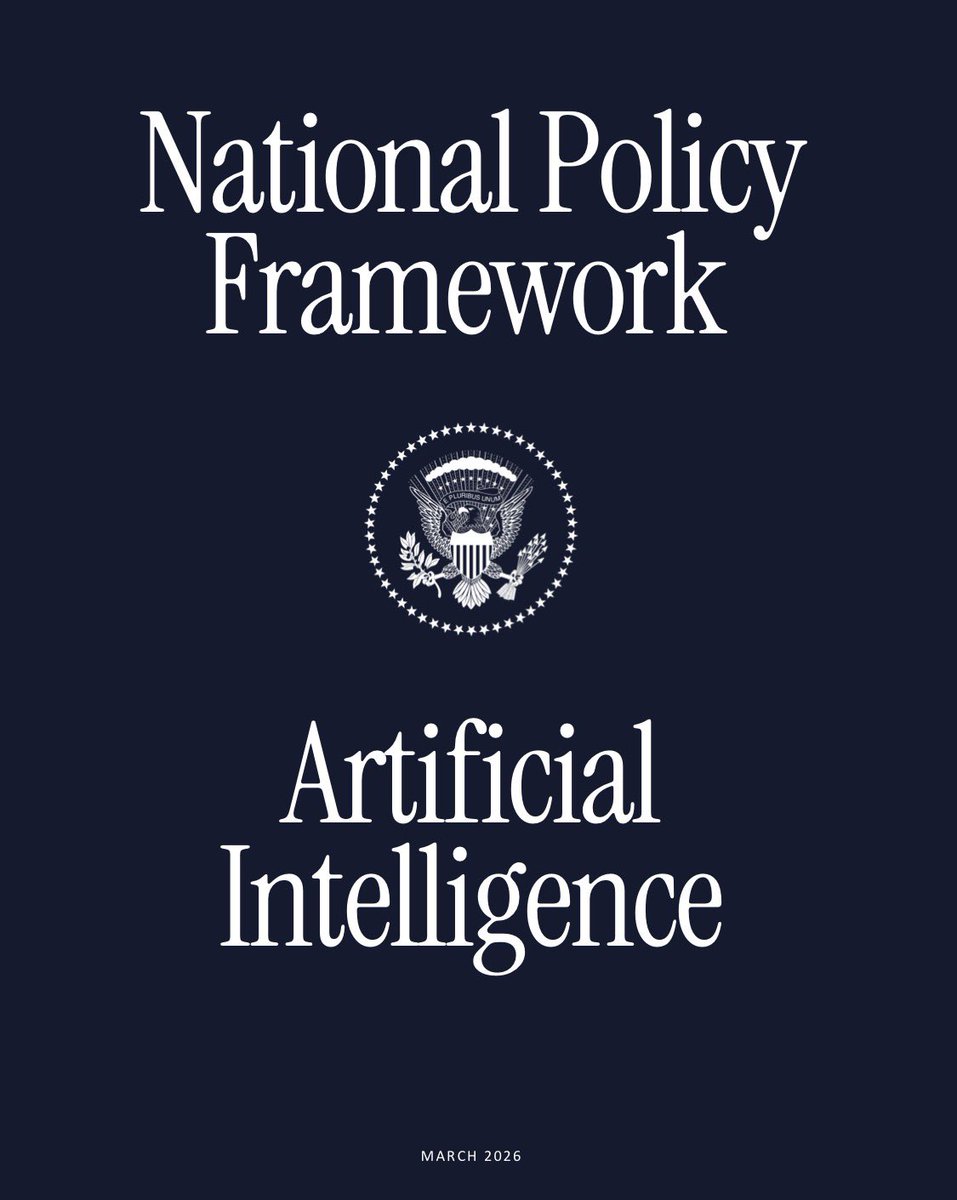
@deanwball What I find most interesting is the IP section. They're essentially trying to say "AI must be able to learn from copyrighted material" and "creators' rights must be respected" in the same breath.
English
1
0
1
387
Dean W. Ball
Dean W. Ball@deanwball·
The White House’s proposal for a nationwide AI law is a thoughtful document that will serve as an excellent foundation for the legislative work ahead. I would be happy to see these principles, if translated well into statute, become law. Congratulations to those involved!
Dean W. Ball tweet media
English
26
23
184
42.4K
Raphael Pfeiffer
Raphael Pfeiffer@raphpfei·
@prathamgrv The gap between informed and uninformed matters way less than the gap between people willing to experiment and people who aren't.
English
1
0
0
151
pdawg
pdawg@prathamgrv·
i consume more educational content now than i ever did in college. not by choice but by necessity. AI is moving so fast that the gap between people who stay informed and people who don't is going to be unfixable in coming years
English
19
14
379
6.5K
Raphael Pfeiffer
Raphael Pfeiffer@raphpfei·
@IliasAlami What nobody talks about is the feedback loop. Every hallucinated citation that makes it into a published paper becomes training data for future models. We're building a self-reinforcing ecosystem of academic fiction.
English
4
8
138
6.1K
Ilias Alami
Ilias Alami@IliasAlami·
Reviewing yet another academic paper full of hallucinated references, odd citation practices, and improperly attributed material. To all academic colleagues out there, literally ruining our profession: thanks for nothing.
English
29
137
2.1K
83.8K
Raphael Pfeiffer
Raphael Pfeiffer@raphpfei·
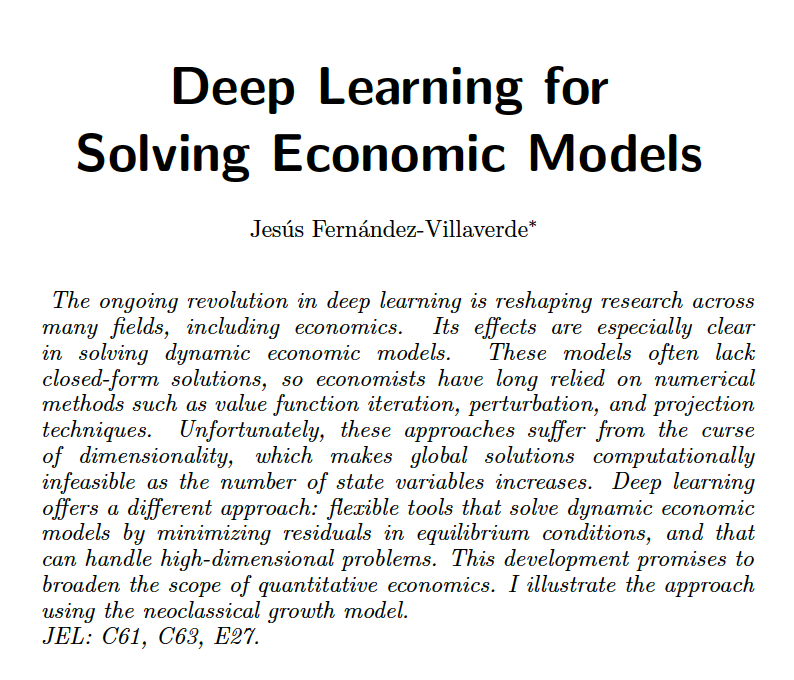
I'm genuinely sympathetic to the PhD redesign argument. But the tricky part is that doctoral training is already a compression problem. Every hour spent on deep learning architecture is an hour not spent on the micro theory or economic history that builds the judgment to know what's worth modeling. I'm not sure how you can fit both without hollowing out either side
English
1
0
11
1.2K
Jesús Fernández-Villaverde
Jesús Fernández-Villaverde@JesusFerna7026·
I am very happy that my survey paper, "Deep Learning for Solving Economic Models," is forthcoming in the Journal of Economic Literature (pending final replication checks, which should be quick). The paper benefited greatly from the editor, David Romer, five referees, and many friends who read earlier versions. I believe the result is a solid introduction to the field, though in 48 pages, there is only so much one can do. So, I created a companion webpage: sas.upenn.edu/%7Ejesusfv/dee… where you can find the paper, the code, and some slide decks with my teaching material. My plan is to expand the slides over time, adding new material and updating them as new results appear. I will probably do a thorough revision once the spring semester is over. Those who follow my feed know that I think deep learning is the most fundamental change to computational economics in the last 40 years. I am by now convinced it is more important than the development of Markov chain Monte Carlo methods in the early 1990s or the introduction of projection and perturbation methods in the 1980s. To find a comparable shift, one would probably need to go back to Richard Bellman's invention of value function iteration in 1957. More pointedly, we need to redesign the Ph.D. in economics. Not at the margin. From the ground up. Economists can either fully embrace the deep learning revolution or become irrelevant, as has already happened, I would dare say, to some fields in academia that refused to accept reality. Finally, let me apologize to everyone working in this area whom I could not cite. Space was a binding constraint. And yes, this post was written with the considerable help of AI. There is nothing I am prouder of than the fact that AI is now an integral part of every step I take in my professional life.
Jesús Fernández-Villaverde tweet media
English
20
285
1.3K
123K
Raphael Pfeiffer
Raphael Pfeiffer@raphpfei·
@WillManidis Honestly curious whether this has ever NOT been true. Victorian England was losing its mind over ankle exposure while children worked in coal mines
English
5
1
611
12.5K
Will Manidis
Will Manidis@WillManidis·
we live in age of great moral panics about things that don’t matter at all and zero moral outrage over some of the most egregious societal sins we’ve ever seen
English
122
6.6K
36.7K
619.3K
Raphael Pfeiffer
Raphael Pfeiffer@raphpfei·
@emollick do you think there's any platform design that could fix this, or is "open comment section at scale" just a dead format now?
English
1
0
1
392
Ethan Mollick
Ethan Mollick@emollick·
I know I go on about this, but comments to all of my posts, both here and on LinkedIn, are no longer worth reading at all due to AI bots. That was not the case a few months ago. (Or rather, bad/crypto comments were obvious, but now it is only meaning-shaped attention vampires)
English
152
44
963
114.5K
Raphael Pfeiffer
Raphael Pfeiffer@raphpfei·
If you mean enterprise SaaS, there's a real argument. Seat-based pricing is begging to be disrupted by AI that just does the work. But if you mean infrastructure or cloud, the incumbents are spending more than most countries' GDP on AI capex. Good luck competing with that from a garage.
English
0
0
0
77
Dr Singularity
Dr Singularity@Dr_Singularity·
The next few years will create companies that make today’s tech giants look small.
English
34
19
269
8.7K
Ben Goertzel
Ben Goertzel@bengoertzel·
I'm not usually one for metaphors, but working on tech these days with increasingly impressive AI assistance reminded me of something: I once had an ebike where you had to pedal to get started, but then after. you reached a certain speed, the motor would take over. Working on AI R&D these days feels like that to me. We've been pedaling really hard and getting some good exercise and exhausting ourselves, but now we can feel the motor starting to kick in... which means we need to pay a higher percentage of our attention to steering! But where the analogy breaks is, in this case, once the motor fully kicks in, so will the self-driving function that steers better than us -- so that once the thing is fully revved up, the only point in it ever letting us steer OR pedal would be just for the lulz...
English
25
17
184
10.1K
Raphael Pfeiffer
Raphael Pfeiffer@raphpfei·
@Left_Hegelian Agreed that's how most people use them. Though I've noticed that when an LLM comes back with something slightly off, working out exactly where it went wrong looks a lot like what Plato is describing.
English
1
0
1
82
Steven Levine
Steven Levine@Left_Hegelian·
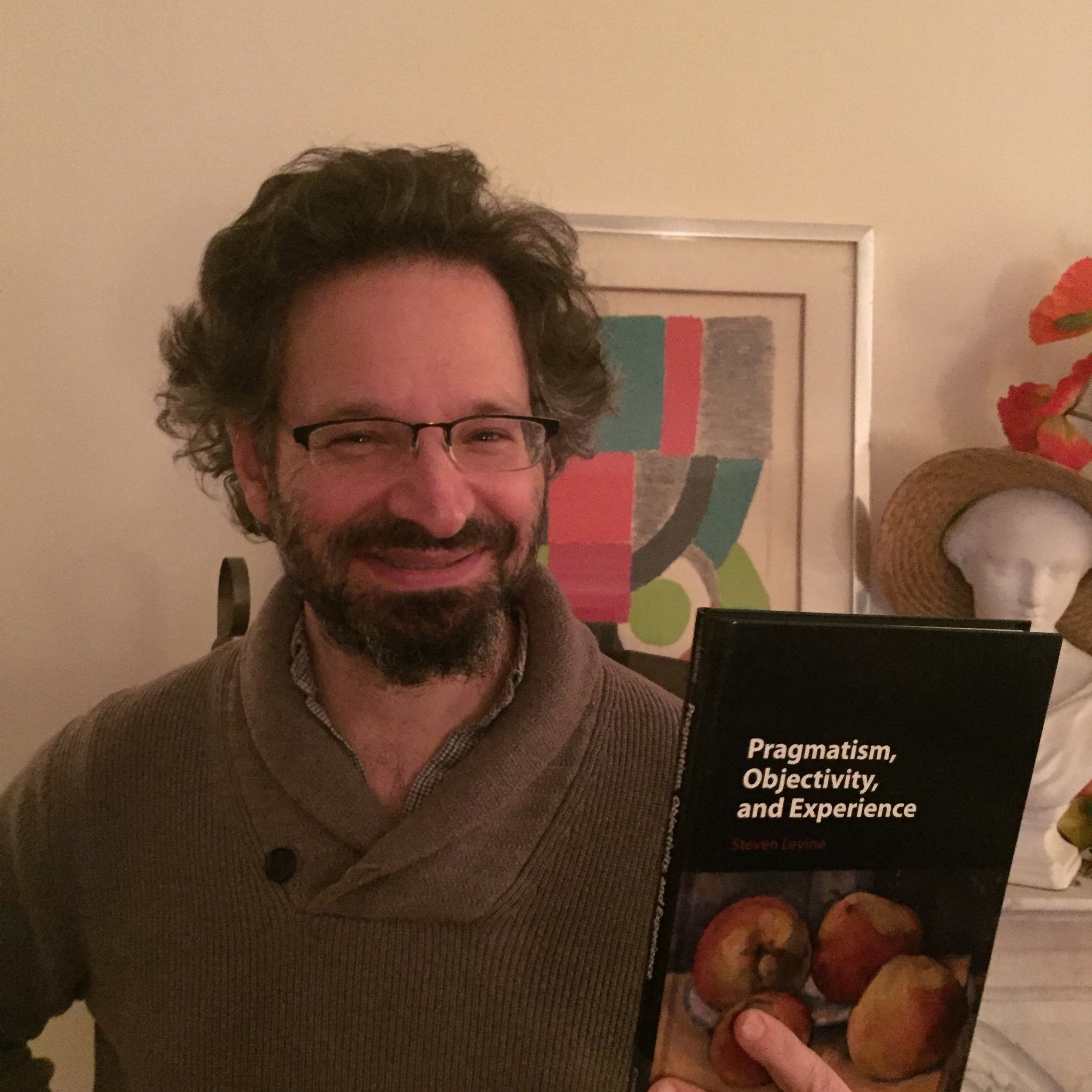
@raphpfei LLM's are used generally to give answer's not draw an answer out of you.
English
1
0
2
211
Steven Levine
Steven Levine@Left_Hegelian·
When you come to really understand what Plato means when he says that learning is recollecting, you understand why 'AI', whatever its genuine powers and uses, is disastrous for human cognition.
English
13
11
100
8.1K
Philippe-Antoine Hoyeck
Philippe-Antoine Hoyeck@PAHoyeck·
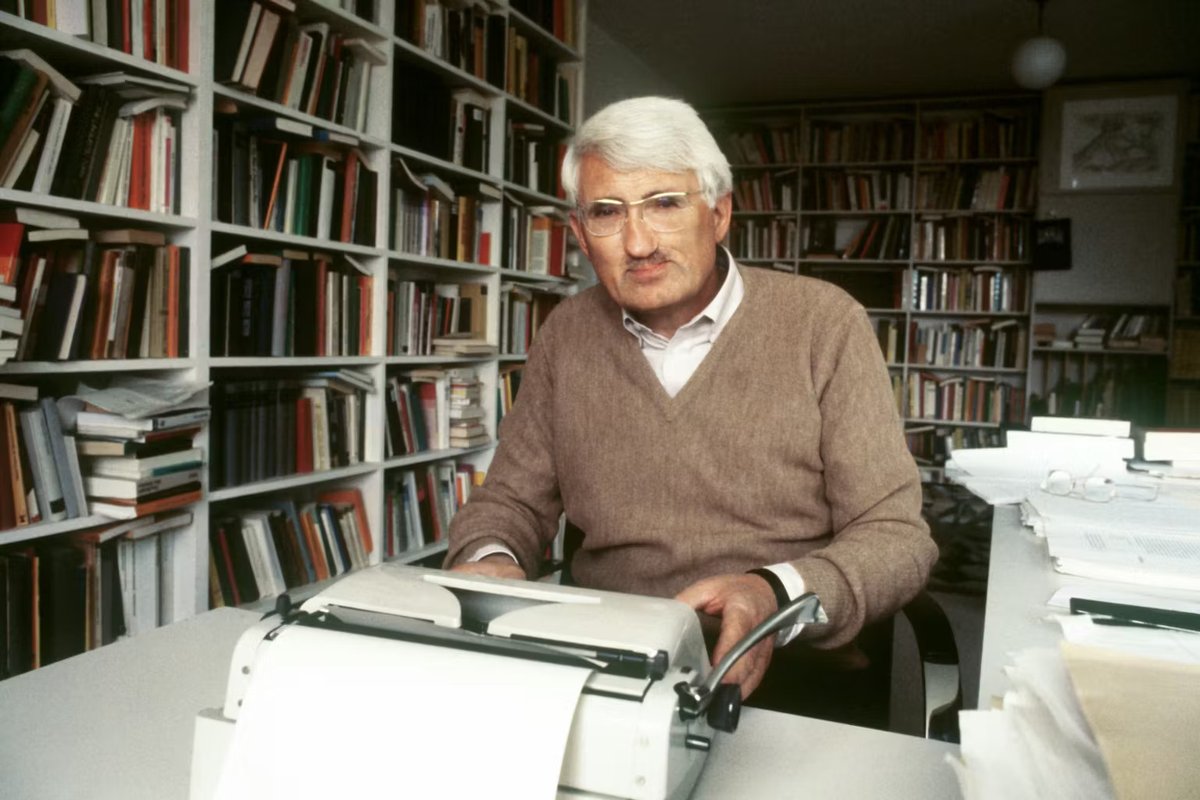
Just learned that the philosopher and sociologist Jürgen Habermas has died. His work on the philosophy of history, moral philosophy, and political theory had a huge influence on me. I don't think any single philosopher has taught me more than he has. RIP.
Philippe-Antoine Hoyeck tweet media
English
39
103
875
26.5K
Raphael Pfeiffer
Raphael Pfeiffer@raphpfei·
@PeterDiamandis Bretton Woods worked because 44 countries had just watched the world burn and were terrified enough to compromise. What's the AI equivalent of that?
English
0
0
0
80
Raphael Pfeiffer
Raphael Pfeiffer@raphpfei·
@Kaju_Nut And the frog at the global minimum is still just a frog sitting in a hole
English
0
0
1
54
Nirmalya Kajuri
Nirmalya Kajuri@Kaju_Nut·
The frog in the local minimum will never know the global minimum.
English
15
3
55
2.9K