Kyrex

57 posts

Kyrex banner
Kyrex

Kyrex

@0xKyrex

AI Trends

Beigetreten Haziran 2026
12 Folgt20 Follower
Kyrex
Kyrex@0xKyrex·
EVERYONE IS TALKING ABOUT CHATGPT BUT GOOGLE QUIETLY BUILT 8 TOOLS THAT DO THINGS OPENAI CAN'T NO. 1 — NotebookLM: upload any document and it turns into a podcast — two AI hosts discuss your material, debate it, summarize it — most people use it as a search engine instead NO. 2 — Gemini: not just a chatbot — set up AI agents that handle recurring tasks across your apps autonomously while you work on something else NO. 3 — Gemini Nano: on-device, no internet, no API call — runs directly on your hardware — the version nobody talks about because it doesn't need Google's servers NO. 4 — Pomelo: describe what you want and it automatically builds the structure — inputs, outputs, logic — without you touching a single line of configuration NO. 5 — Google OPAL: builds full working apps in seconds — not prototypes, not mockups — functional software from a description NO. 6 — Imagen: generates photographic images that look like they were taken, not made — the gap between this and a camera is closing faster than anyone expected NO. 7 — Whisk: creates perfectly styled visuals by combining reference images — you provide the subject, the scene, the style — it assembles the output NO. 8 — Google AI Studio: gives you access to unreleased models before they go public — the place where the actual frontier is most people are on tool number one and think they know what Google built Bookmark this and come back when you need it. Follow @0xKyrex
English
1
0
8
156
Kyrex
Kyrex@0xKyrex·
@cipgerx the invoice that never existed is the actual product
English
0
0
1
12
Cipgerx
Cipgerx@cipgerx·
@0xKyrex 100% they’re not buying the video, they’re buying the missing production bill
English
1
0
0
17
Cipgerx
Cipgerx@cipgerx·
MOST PEOPLE WILL USE FABLE 5 TO MAKE MORE AI CONTENT THE SMART ONES WILL USE IT TO ERASE A $5K OUTDOOR SHOOT🛶 That gap is where the money is A woman cuts through whitewater in a solo canoe Looks like a clip But the expensive part is the shoot that never happened: no model no river booking no safety crew no waterproof camera setup no weather risk no retakes Same face Same swimsuit Same canoe Same paddle Same danger in the water That is not just consistency That is a sellable production system A rafting tour can turn this into ads A swimwear brand can test adventure angles An outdoor gear brand can sell motion without touching a river Most creators will sell “AI videos” The smarter offer is: “I’ll build the shoot your brand does not want to pay a crew for” The money is not in making AI look real The money is in making real shoots unnecessary I’m documenting these cases in public: the clip, the missing invoice, and the offer hiding between them Save this structure This is where small-brand AI money starts💸
Cipgerx tweet media
DiKrass | Thoughts@Di_Krass_

x.com/i/article/2072…

English
7
4
19
929
Kyrex
Kyrex@0xKyrex·
@cipgerx the gap between idea and product just became one line of text
English
0
0
1
16
Cipgerx
Cipgerx@cipgerx·
@0xKyrex one sentence to product is the real shift here
English
1
0
0
17
Kyrex retweetet
Kyrex
Kyrex@0xKyrex·
GOOGLE AI STUDIO JUST SHIPPED A FEATURE THAT TURNS ONE SENTENCE INTO A FULL WORKING APP you type: "make me a music app with a beach vibe" Stitch generates the entire UI — Ocean Breeze theme, Spline Sans font, custom color palette, mobile and desktop layouts simultaneously the dashboard it built has live metrics: active users, crash reports, user reviews, revenue — all wired in, not placeholder text community gardening app: Project Green Thumb, Project Bloom, Project Urban Oasis — ongoing, completed, planning — recent activity feed, invite friends, seed recipes — one prompt, full product when you're done designing, Jules takes over — exports as zip, pushes to AI Studio preview, copies code to clipboard — the design becomes a real codebase in one click Storywriter builds the content layer on top — blog post agent takes a topic and use case, generates the article, formats it for publishing NotebookLM sits next to all of it — upload your strategy docs, ask it questions, get an audio overview for the commute the Real-Time Earthquake Map at the end — built inside the same tool — just to show you what happens when you stop treating AI Studio as a chatbot most people still open a blank Figma file and start drawing boxes
English
2
1
4
411
Kyrex
Kyrex@0xKyrex·
@ZentrixHQ when one element carries the story, the rest of the frame finally makes sense
English
1
0
1
11
Zentrix⌚️
Zentrix⌚️@ZentrixHQ·
@0xKyrex That’s exactly it - the fabric becomes the narrative, everything else just supports the scale
English
1
0
1
15
Zentrix⌚️
Zentrix⌚️@ZentrixHQ·
📖 THE FLAG TEXT TRICK THAT MAKES THIS PROPOSAL VIDEO FEEL REAL Most creators skip this step because it looks like extra work before the real prompting starts. A shot from the top of a tower can look fake no matter how detailed the skyline is, because the eye has nothing to measure scale against. Add a banner hanging off the antenna mast, whipping in the wind at that altitude, and suddenly the brain has a reference point. Height stops being a claim and becomes something visible. ▪ The flag acts as a physical anchor — a fixed object the camera and the character can be measured against, which sells the altitude far better than the skyline behind it ▪ Fabric behavior does the real work — motion, tension, and turbulence on the banner communicate wind speed and height at once, without a single word of description ▪ It gives the wide shot a subject — an empty skyline reads as a backdrop, a banner reacting to wind reads as a moment actually happening at that height ▪ It doubles as staging — the same element carrying the emotional beat of the scene also carries the physics that make the location believable Most height shots fail because they lean entirely on the environment to prove scale. This one borrows a single moving object instead, and that object ends up doing more than the entire skyline combined. 📥 In the next post, I will analyze the camera blocking scheme in the same sequence - five cuts, five lenses, one flight path
Zentrix⌚️@ZentrixHQ

x.com/i/article/2069…

English
4
1
13
779
Kyrex
Kyrex@0xKyrex·
@ami10iv rule 2 is the one most people skip — task without a role and a goal is just a prompt, not an agent
English
0
0
1
8
ami
ami@ami10iv·
ANTHROPIC LEAKED THEIR INTERNAL AI AGENT PLAYBOOK AND IT CHANGES EVERYTHING 00:41 the moment he drops the rule that matters most - one agent does the work, a second one checks it because a smarter model - a better system real systems don't need the smartest worker, they need a controller - the one deciding what to do and whether it actually worked three rules from: 1. if it's not written into context, it doesn't exist for the model 2. give the agent a role and a goal, not a random task 3. never trust it blindly - a second agent always checks the first this is exactly how we run Claude as the manager, not the worker - full architecture breakdown coming in the next post, follow so you don't miss it
ami@ami10iv

x.com/i/article/2072…

English
10
2
22
1.7K
Kyrex
Kyrex@0xKyrex·
@Di_Krass_ middle management for your own mind is the most accurate thing said about AI this year
English
1
0
0
12
DiKrass | Thoughts
DiKrass | Thoughts@Di_Krass_·
Advait Sarkar, Microsoft Research: "we invented a cure for exercise, then wonder why we're always short of breath. would you rather have a tool that thinks for you, or a tool that makes you think?" writer's block used to be the blank page. now it's the AI-filled page. you don't write anymore — you validate a robot's thoughts. at 01:09 he calls it "middle management for your own mind." 15 minutes on how the "age of outsourced reason" is killing creativity, memory, and critical thinking — and what an AI interface that makes you think should look like. Watch it now, and you'll know more than 99% of people. Follow me.
Voltex@VoltexGar

x.com/i/article/2072…

English
4
4
16
668
Kyrex
Kyrex@0xKyrex·
@ashercrw every startup that built on top of email just had a very bad morning
English
1
0
1
11
Kyrex retweetet
Kyrex
Kyrex@0xKyrex·
GOOGLE JUST LET YOU BUILD AI AGENTS INSIDE GMAIL IN MINUTES — NO CODE, NO TOOLS, NOTHING TO INSTALL you open Workspace Studio, describe what you want in one sentence and it builds the flow the demo: an agent that watches every incoming email and checks the tone — if it's negative it triggers a completely different response path than a neutral one step 1: when I get an email → step 2: extract the content → step 3: check tone → step 4: route based on result no Zapier, no Make, no Python — just a trigger, a condition and an action after meetings it automatically generates a summary and sends it to everyone who attended daily briefing: every morning it pulls your unread emails, filters what actually needs your attention and delivers a clean action list the templates are already built: label emails by priority, notify you about urgent messages, auto-add attachments to Drive, watch for keywords across your inbox this runs inside Gmail — not a third-party app sitting on top of it most people are still opening every email manually and deciding what matters the agent does that part for you before you even open the tab
English
4
5
11
541
Kyrex
Kyrex@0xKyrex·
@cipgerx your data, your hardware, your terms — that's the whole pitch
English
0
0
1
27
Cipgerx
Cipgerx@cipgerx·
@0xKyrex no cloud, no subscription, no data leak that’s huge
English
2
0
2
45
Kyrex retweetet
Kyrex
Kyrex@0xKyrex·
GOOGLE JUST PUT A FREE AI MODEL ON YOUR PHONE THAT RUNS WITHOUT INTERNET, WITHOUT AN API KEY AND WITHOUT SENDING YOUR DATA ANYWHERE it's called Google AI Edge Gallery and Gemma 4 is already inside it you download the app, the model runs on your phone's GPU — no cloud, no subscription, no connection required Gemma-4-E2B: 2.54GB on your device — answers questions, reasons through problems, runs Agent Skills for specialized tasks Ask Image: you take a photo of anything — a Japanese restaurant menu, a receipt, a document — and the model reads it, describes it and answers questions about it — all locally on your hardware Agent Skills: load different reasoning capabilities into the same model or create your own — the phone becomes a task-running machine that doesn't need to phone home Gemma-4-E4B: 3.61GB, more capable, same deal — no API costs, no data leaving the device most AI tools today: your data goes to a server, a company stores it, you pay monthly this: your data stays on your device, the model costs $0/month to run and works on a plane ChatGPT requires a connection — this works offline
English
3
10
15
933
Kyrex
Kyrex@0xKyrex·
@ZentrixHQ eyes forgive design mistakes, they never forgive wrong gravity
English
1
0
1
11
Zentrix⌚️
Zentrix⌚️@ZentrixHQ·
@0xKyrex the second part is the one that actually sells the shot — shape gets a pass from most viewers, weight doesn't, that's usually the tell
English
1
0
1
42
Zentrix⌚️
Zentrix⌚️@ZentrixHQ·
📖THE CHATGPT IMAGE 2 DETAIL THAT DECIDES IF YOUR SEEDANCE ROBOT LOOKS REAL The character looks finished until the moment it has to touch the ground. And here's how to fix it. Most people building a mechanical character in ChatGPT Image 2 stop at the turnaround. Neutral pose, back view, profile, folded state, deployed state, optic study — every angle covered, every detail rendered. On paper it looks complete. In Seedance, the moment that robot starts moving, something feels off, and it's rarely the design itself. The missing piece is ground contact. How the legs actually meet the surface. How weight shifts between tripod legs during a step. How dust, water, or debris reacts to that weight landing. Without a reference for this, Seedance has to guess the physics of contact, and it defaults to something that looks placed on top of the ground rather than standing on it. The character design can be flawless and still read as a render pasted into a live-action shot, because nothing in the reference set told the model how mass behaves. ▪ Turnaround covers shape and detail, not physics ▪ Ground contact reference shows how weight distributes across each leg ▪ Surface interaction — dust displacement, water ripples, debris shift — has to exist somewhere in the atlas before generation ▪ This matters more for non-human anatomy, since there's no learned intuition for how a tripod droid's weight moves compared to a human walk cycle The character sheet answers what the robot looks like. Ground contact answers what it weighs. Seedance only gets the second part right if someone actually gave it the reference. HOW TO FIX IT: Build the ground contact reference as a separate block in ChatGPT Image 2, before the robot ever enters Seedance. ▪ One frame, low angle, camera at leg level — shows how each leg meets the surface under the weight of the body ▪ Prompt focuses on contact, not design: "weight pressing into sand, slight depression under each leg, dust displaced outward from point of contact" ▪ Add a mid-motion variant — two legs bearing weight, third leg mid-lift, described explicitly: "two legs bearing full weight, third leg mid-lift, no ground contact" ▪ Match the surface to the location atlas — sand, water, lava each react to weight differently, and the reference needs to show that in advance ▪ If the scene involves liquid or dust, the surface reaction belongs in the same reference set, not generated separately CHEAT TIP: if there's any doubt Seedance will get the contact right, add a short line directly in the Seedance prompt — "weight settles into ground on each step, no floating contact" — instead of relying on the image reference alone. It won't replace the atlas, but it covers angles the reference didn't anticipate. The character sheet answers what the robot looks like. This is what makes it believable once it moves. 📥I'll share a few more secret techniques one of these days. 🔖Every step of this workflow is documented in the pinned article below.
Zentrix⌚️@ZentrixHQ

📖WHY SOME MULTI-SCENE CLIPS HOLD TOGETHER AND OTHERS FALL APART. SEEDANCE 2.0 + CHATGPT IMAGE 2 Three environments, one character, and a workflow that keeps them from drifting apart Most multi-location clips fall apart because the character changes shape between scenes. The face is close enough, the outfit is close enough, but nothing actually matches once the clips sit side by side. The people getting clean results aren't prompting harder per scene. They're locking the character once, then building a separate location atlas for every environment before a single clip gets generated. ▪ Character design sheet comes first — full turnaround, expressions, silhouette study, detail crops. This gets built once and reused across every scene, not regenerated per location ▪ Each location gets its own atlas — wide establishing shot, camera path diagram, lighting study, material swatches, environment-specific details like dust behavior or ember flow ▪ Camera path gets planned before generation, not decided in the Seedance prompt. An orbit diagram or push-in path drawn in advance keeps motion intentional instead of guessed ▪ Lighting stays location-specific but character-consistent — a red blade reads differently in desert daylight, open-field golden hour, and volcanic interior, but the character's silhouette and proportions never shift ▪ Material and color palette get fixed per location — sand, wildflower, lava rock each carry their own swatch reference so the environment doesn't drift between establishing shot and duel shot Where this breaks: Skipping the design sheet and regenerating the character fresh for each location. Small inconsistencies stack up fast, hair length, jacket detail, blade color, and by the third scene the audience can tell it's not the same person. The other common failure is writing one long Seedance prompt for the whole scene instead of anchoring each location with its own reference frame first. Seedance can only extend what the frame gives it. Without a locked character and a planned camera path, motion has nothing stable to build on. The gap between a good multi-location clip and a broken one isn't the render. It's everything decided before the render starts. 📥 Tomorrow's post covers how to keep lighting consistent when the same character crosses three completely different environments 🔖The article below has the complete guide — from zero to finished cinematic video.

English
3
4
38
1.8K
Kyrex
Kyrex@0xKyrex·
@ZentrixHQ what used to need an NLP team is now a conditional branch, the bar for "building software" just moved permanently
English
0
0
0
9
Zentrix⌚️
Zentrix⌚️@ZentrixHQ·
@0xKyrex the interesting part isn't the no-code angle, it's that tone-based routing used to require a real NLP pipeline and now sits behind a single conditional step — that's the actual shift in what counts as "building software"
English
1
0
1
42
Cipgerx
Cipgerx@cipgerx·
@0xKyrex exactly, the window opens before everyone notices
English
1
0
2
33
Cipgerx
Cipgerx@cipgerx·
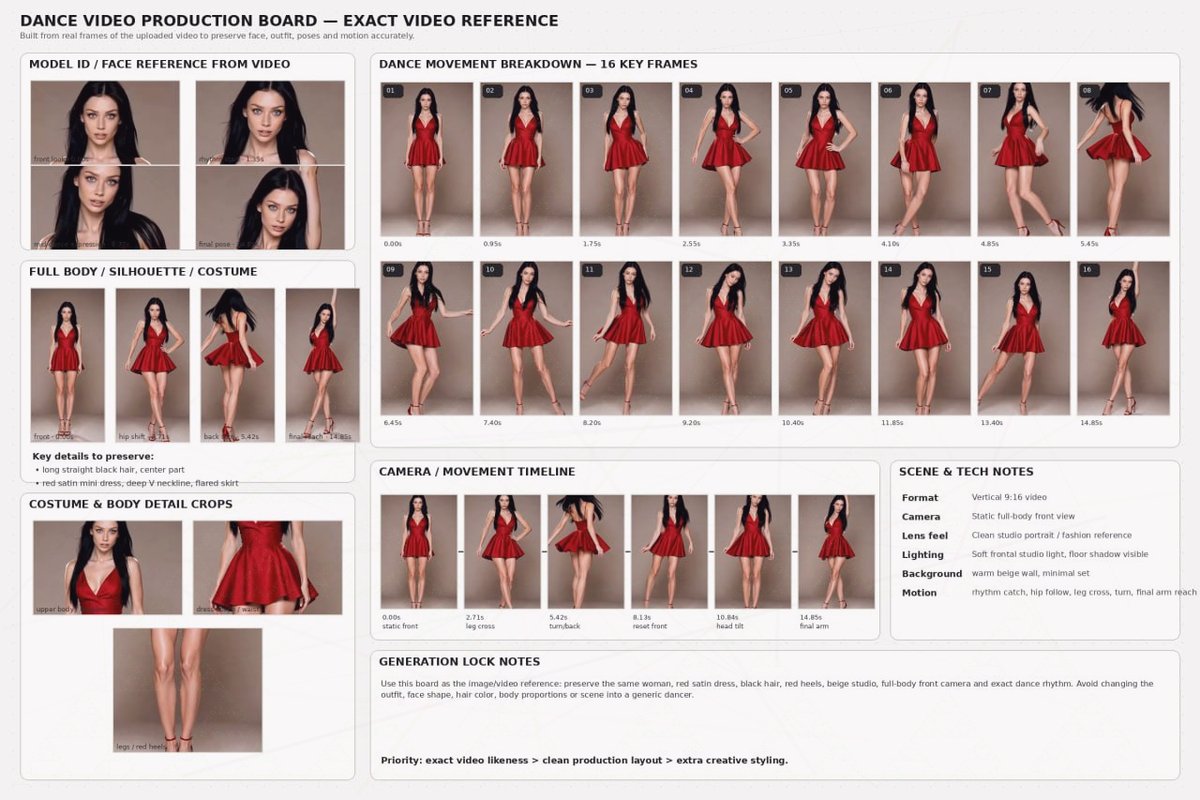
THE EASIEST WAY TO MISS MONEY IN AI IS TO CALL THIS “JUST CONTENT” The music starts She catches the beat The shoulders move first The hips follow The footwork stays clean Every frame connects You wait for the stiff AI moment It never comes💃 That is why this clip matters Not because AI made another dance video Because realistic human motion used to require dancers Motion capture Animators Studios Weeks of work Now the expensive part is becoming software That is where the money starts moving💰 Not in making random AI dance clips In removing the expensive work that used to sit behind them While the feed laughs at the video, someone else is asking the question that actually matters: What did this just make cheaper? That is what I track here Small AI shifts that turn into lower costs, leverage and new businesses before they become obvious🤯 The people making money from AI are rarely watching the output They are watching what the output just made unnecessary🎬
Cipgerx tweet media
Cipgerx@cipgerx

x.com/i/article/2071…

English
5
2
24
1.7K