Asher Crowe 🪺

579 posts

Asher Crowe 🪺 banner
Asher Crowe 🪺

Asher Crowe 🪺

@ashercrw

the signal is already in the room

Katılım Mayıs 2026
19 Takip Edilen19 Takipçiler
Sabitlenmiş Tweet
Asher Crowe 🪺
Asher Crowe 🪺@ashercrw·
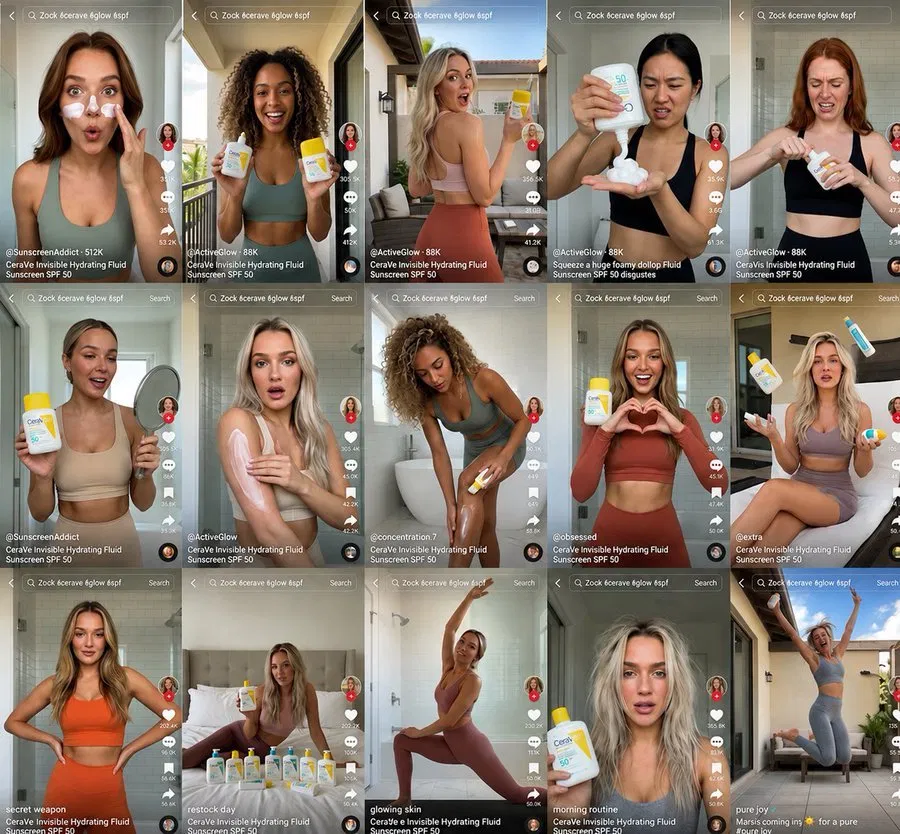
I scrolled TikTok for 20 minutes last night and slowly realized something that made me put my phone down. None of these women exist. Not one. The redhead applying sunscreen on the balcony. The brunette in the green sports bra doing the heart shape with her hands. The blonde stretching in front of the bathroom mirror. The girl on the floor laughing into the camera while holding the bottle. Every single one of them is AI generated. Every account is fake. SunscreenAddict. ActiveGlow. concentration.7. obsessed. extra. Names designed to sound like real twenty-something skincare girls. Bios written to read like every other lifestyle creator on the platform. Posting schedules timed to mimic human behavior. The entire feed I was watching, the one TikTok served me when I searched a single product, was a coordinated swarm of synthetic influencers all selling the same bottle. Hundreds of thousands of views. Each. 512K on one. 358K on another. 232K. 200K. 199K. People in the comments tagging their friends. "Need this." "Where can I buy." Real humans, having real reactions, to women who do not exist. Let me walk you through what's actually going on here, because the mechanics are wild. Someone, or more likely a small team, generated a roster of fake "influencers." They picked diverse looks on purpose. Blonde, brunette, Asian, redhead, Black, mixed. Different body types. Different home aesthetics. Different lighting. Some on balconies. Some in bathrooms. Some in bedrooms. So the feed looks organic, like the product is having a moment with every demographic. Each "creator" got an account, a name, a personality, and a posting schedule. They probably look at their analytics dashboard the same way a real creator would. Then the same product gets reviewed across all of them. Same talking points. Same captions. Same hashtag set. Twenty different "real girls" all converging on the same recommendation in the same week. To the algorithm, this looks like a genuine trend. To you scrolling at midnight, it looks like every girl on the internet is suddenly obsessed with this one bottle. That's the trick. It's not that one fake account got views. It's that twenty of them did, simultaneously, creating the illusion of cultural agreement. Manufactured consensus. It's the oldest marketing tactic on earth, just executed at a scale and speed no human team could match six months ago. And here's the part that broke my brain. You cannot tell. I mean it. I have a developer eye for this stuff. I look at AI-generated content for a living. I had to zoom in on three of these to be sure. The hands give it away if you look closely. Sometimes the bottle label is slightly malformed. Sometimes the reflection in a bathroom mirror doesn't match. But on a phone, mid-scroll, at two in the morning, with one thumb? You'd never catch it. Nobody is catching it. The whole "AI looks fake" defense people had a year ago is gone. Dead. The current generation of image-to-video models renders skin texture, fabric folds, depth of field, and natural movement in a way that slides right past the radar. Three things to take from this, because the implications are bigger than skincare. The trust signal you used your whole life — "I saw a real person say it" — is no longer reliable on social media. You're being marketed to by ghosts. Every product category is about to get this treatment. Skincare is just the early adopter because the visual content is easy. Supplements are next. Then fitness. Then home goods. By next year, "influencer marketing" will be a phrase that needs a footnote. If you're a real creator competing for views right now, your competition isn't other humans anymore. It's a server farm in someone's apartment generating 100 versions of you while you sleep. I'm not saying any of this is good or bad. I'm saying it's already happening. Right now. On the device in your hand. And almost nobody is paying attention. Save this post. Show it to anyone who still thinks they can spot AI content in the wild. The girls in your For You page have rooms that don't exist, in houses that were never built, holding products they've never touched. Keep scrolling. But scroll knowing.
Asher Crowe 🪺 tweet media
English
1
0
2
4.9K
Asher Crowe 🪺
Asher Crowe 🪺@ashercrw·
YOU'RE NOT GOING TO WATCH VIDEOS MUCH LONGER. YOU'RE GOING TO WALK INTO THEM. At 0:15 these guys dropped a breakdown of the thing that quietly ends flat video, and almost everyone who scrolled past it has no idea what they just saw. So let me decode it. It's called 4D Gaussian Splatting. Not 3D. FOUR. The extra dimension is time. Here's the part that broke my brain. Normal 3D splatting captures a room you can walk around. A frozen space. Beautiful, but dead. 4D captures the room AND the moment unfolding inside it. The volume of the space and the dimension of time, at once. It works by mapping millions of "Gaussian" points. Think tiny fuzzy particles of light and color, each one holding where it sits, what color it is, and how it behaves as you move. Map enough of them and you don't get a model of reality. You get a photorealistic, real-time reconstruction of it. A digital hologram you can stand inside. Now the part nobody's ready for. You control the camera. Not the editor. YOU. You can move it anywhere inside the captured space. Glide through a wall. Step behind someone mid-sentence. Pass your view straight through a person's hand. And here's the kicker: you can do all of that whether the moment is playing or FROZEN. Pause reality, walk around it, hit play again from a new angle. This is the closest humanity has ever come to recording a physical moment you can actually walk back INTO. Not rewatch. Re-enter. Now do the operator math, because this is where it gets loud. Flat video is a $300B+ industry built on one limitation: you watch from where the camera was. 4D deletes that limitation. Every category that pays for video is suddenly underpriced. Wedding films at $3K to $8K become walkable memories people will pay $15K+ for. Real estate tours stop being slideshows and become the listing. Sports replays where YOU pick the angle. Concert footage you can stand on stage for. Training, courtrooms, film previs, museum exhibits, every one of them sitting on the old format and not knowing the new one exists yet. The tech is real. The demos are public. And the number of people who can actually produce this for a paying client right now? A rounding error. That gap is the entire business. Same as it always is. The flat-video era isn't ending in ten years. It's ending in the comments under videos like this one, where the people who get it go quiet and start building. Bookmark this. In 18 months you'll either be the one selling it or the one explaining why you waited. 👇
Asher Crowe 🪺 tweet media
Asher Crowe 🪺@ashercrw

x.com/i/article/2062…

English
0
0
1
90
Asher Crowe 🪺
Asher Crowe 🪺@ashercrw·
HE WORKED AS AN ENGINEER AT INSTAGRAM. Then he went home, picked up a camera, and started posting the most honest videos about tech money on the internet. Almost nobody is watching. His name is Mr. Zhang. A Chinese engineer who built at one of the biggest apps on the planet, then started saying the quiet part out loud. The video here is him stuck on a bug for days, asking how to optimize his code. Every engineer alive has lived that exact night. But the real gold isn't the code. It's the MONEY behind it. He breaks down what engineers make at the top Chinese giants. Huawei. Tencent. Baidu. ByteDance. His number: about 300,000 yuan a year. Roughly $50,000. Half of you just thought "that's it?" That's the trap. $50K there buys 3-4x the life it does here. He's describing a BETTER life, dressed up as a smaller number. And the real data goes even harder: Median ByteDance engineer → ~$89,000 Top ByteDance offers → ~$315,000 That SAME ByteDance, in the US → up to $1,180,000 Same company. Same code. The paycheck just depends on which side of the map you signed your offer on. Here's what nobody says out loud: a US startup paying $400K isn't buying better code. It's buying a city where 5 companies fight over the same 10 people. You're not paying for skill. You're paying for a zip code. But my favorite part isn't even the money. Every time he visits home, his parents find any excuse to humble brag. To the waiter. To the neighbors. "Oh, our son? He works in American Big Tech." That's the one currency that ignores the exchange rate. You can't arbitrage the look on a parent's face when they get to brag about you. The man isn't selling a course. No "6 figures in 6 months" funnel. Just a real engineer explaining the invisible rules of money, tech, and culture better than people who charge thousands for it. Watch the video. Then go down his whole feed. Save this one. I break down a creator like this every week.
Asher Crowe 🪺 tweet media
English
1
0
1
141
EdenWood
EdenWood@EdenWood62747·
@ashercrw this is both incredibly cool and slightly terrifying
GIF
English
2
0
2
13
Asher Crowe 🪺
Asher Crowe 🪺@ashercrw·
Here's the exact 3-tool workflow that makes fake AI girls stop your thumb mid-scroll. And the reason most AI UGC fails before the first second even loads. Check 0:07 to get it right. If you've been following the series, you've seen the swarm, the economics, and the face-building method. This one is about the last mile, the part that separates content that converts from content that gets flagged as obviously synthetic and scrolled past in 0.4 seconds. Save this. Here's the thing nobody wants to admit. A perfect AI face still flops if the content around it feels like a studio ad. The human brain is a finely tuned fake-detector, and it doesn't trip on the face anymore. It trips on the framing, the lighting, and the mouth. Fix those three and the illusion holds. The workflow, step by step. Step one. Build the model for the phone, not the camera. Open Nano Banana Pro and generate your model. Two settings do all the heavy lifting here. Natural lighting, never studio. Studio lighting is the number one tell because real people filming themselves at home don't have a softbox. And vertical iPhone-style framing, slightly imperfect, the way an actual person holds a phone at arm's length. The goal is not "beautiful." The goal is "filmed by a 23-year-old in her bedroom." Those are different aesthetics and only one of them converts. Step two. Put the product in the same hands. Run Nano Banana Pro a second time, but now generate the exact same model holding the product. The word that matters is "same." Consistency is the entire game. If the woman in the product shot looks even slightly different from your model, the brain catches it instantly. You're creating one persistent person who exists across every frame, holding the thing you're selling, in the same natural light, in the same vertical frame. Step three. Animate it and fix the mouth. Import the still into Cling 2.6 and animate it. This is where 95% of AI UGC dies. They animate the body and forget the mouth, and you get that floating, dead-eyed, slightly-wrong movement that screams synthetic. The fix is proper lip sync. When the mouth matches the words, the last alarm bell in the viewer's head goes quiet. That single step is the difference between 200 views and 200,000. That's the whole pipeline. Build for the phone, keep the model consistent, sync the mouth. Three tools. One persistent fake person who can sell anything, in any lighting, holding any product, talking directly to camera like she's your friend. Now zoom out and look at why this matters so much right now. Every step in this chain used to be a separate hire. The model was a person you booked. The product shot was a photographer. The talking video was a creator with a personality and a rate card. The lip sync was a post-production house. Four humans, four invoices, four schedules, weeks of turnaround. This collapses all four into an afternoon at a laptop. The compression of cost and time is the actual story. It's not that AI can make a face. It's that AI just deleted an entire production supply chain and handed it to one person with a $20 subscription. To make the scale of that collapse concrete, I mapped it out. This is what the workflow looks like when you chart cost against realism at each stage of the pipeline, and overlay it against the traditional production path. The gap between the two curves is the entire business model.Look at the gap between those two curves. Both paths arrive at the same place, content a human can't tell is fake. One gets there for $11,500 and three weeks of coordination. The other gets there for $23 and 47 minutes. That white space between the lines isn't a chart artifact. It's the entire arbitrage. It's why someone in a bedroom can now outproduce a brand's whole creative department. And here's the uncomfortable part nobody in my comments wants to sit with. The realism axis is going to keep climbing while the cost axis keeps falling. The teal line is moving up and to the left every single model release. There is no version of the next 12 months where this gets harder or more expensive. It only gets easier and cheaper, which means the flood you're already seeing is the trickle, not the wave. The window where knowing this workflow is rare is the window where it's valuable. Once every brand's intern can do it, the edge is gone and it's just the new baseline cost of doing business. Right now it's still a secret. That's the whole opportunity. If you want the exact workflow, the Nano Banana Pro settings, the consistency trick for keeping the same model across every frame, and the Cling 2.6 lip sync setup, comment "UGC" below and I'll send the full breakdown. Save this post. In six months you'll either be the person running this, or the person it's running on.
Asher Crowe 🪺 tweet mediaAsher Crowe 🪺 tweet media
Asher Crowe 🪺@ashercrw

The reason every AI influencer looks fake is two fixable mistakes. Here's the exact process to make one nobody can tell is fake, plus how people are turning these into $10K/month. Last two posts I showed you the swarm of fake skincare girls and broke down the brutal economics behind them. The number one question in my DMs since: "okay, how is the realistic version actually made?" So here's the full pipeline. Save this before it gets patched. Everyone building AI models fails at the same place. Pause at 0:40. They generate a face straight from a text prompt, the skin looks like wax, the eyes look dead, and the whole thing screams synthetic in the first half second. Then they blame the model. The fix has nothing to do with which generator you use. It's two components. Your reference image and your prompt. Get both right and the output crosses the uncanny valley completely. Here's the process, step by step. Step one. Build the reference face, don't generate it. Go to Pinterest. Find three high-quality photos of faces with features you want your model to have. Not one. Three. This is the move 90% of people skip. A single source gives you a copy. Three sources blended give you a person who has never existed and can't be reverse-image searched back to anyone real. Take those three to wavespeed(.)ai and run them through Google's Nanobanana Pro edit tool. Upload all three, feed it the merge prompt, and it fuses them into one coherent high-resolution face. This single image becomes the DNA of your model. Every future photo of "her" references back to this. That's how you get consistency across hundreds of posts instead of a slightly different woman every time. Step two. Steal the composition, not the person. Go to Instagram. Find a photo with a pose, lighting, and vibe you want to recreate. Screenshot it. Drop that screenshot into ChatGPT and ask it to generate a full JSON prompt describing everything in the frame. Pose, camera angle, lighting direction, background, outfit, mood, lens. Or run it through a custom GPT built for this, which spits the JSON out clean in one shot. You're not copying the influencer. You're extracting the recipe that made their photo work and handing it to your own model. Step three. Combine and finish. Take your blended reference face. Take the JSON prompt. Feed them together into your generator. Then add the finishing phrase at the very end of the prompt, the realism trigger, the line that tells the model to render skin texture, micro-imperfections, and natural light instead of that glossy AI sheen. That one phrase is the difference between "obviously fake" and "wait, is she real." That's the entire system. Reference plus prompt plus realism trigger. Three tools, none of them expensive, most of them free. Now the part you actually came for. People are running these models as full Instagram personas and monetizing them four different ways. Brand deals from companies who never realize the "creator" isn't human. Affiliate commissions on products the model "uses." Paid subscriptions on her content. And selling the entire system to other people who want their own. The realistic ceiling people are hitting with a single well-run AI model on Instagram is around $10,000 a month. Not from one income stream. From stacking them on top of an audience that thinks they're following a real person. Think about the cost structure for a second. No model to pay. No photographer. No studio rental. No travel. No product samples. No flights to Bali for content. The entire operation runs on a laptop and a few subscriptions while you sleep. The margin isn't good. It's almost the entire revenue. And the timing is the whole story. Eighteen months ago this was impossible, the outputs were laughable. Six months ago you could spot them by the hands. Today, with this exact reference-plus-JSON method, they pass. A year from now everyone will be doing it and the early audiences will already be locked up by the people who moved now. The window where this is easy and uncrowded is open right now and it is closing by the week. If you want the full breakdown, comment the word "group" below and I'll send you the free training that walks through the entire $10K/month AI model system end to end, the exact prompts, the realism trigger phrase, and the monetization playbook. Save this post. Send it to the one friend who keeps saying they missed the boat on every trend. This is the boat. It's still at the dock.

English
1
0
2
556
Asher Crowe 🪺
Asher Crowe 🪺@ashercrw·
Everyone who read my $18K/month breakdown filed it under "real estate side hustle" and moved on. That was the mistake. Watch this guy run the exact same free tool on fashion. On art. On food. On venues. The real estate playbook in the article was just the cleanest example to explain it with. It was never the ceiling. The tech is called Gaussian splatting. It's been sitting free on GitHub since 2023, open source, anyone could've touched it. The workflow is genuinely four moves: film your subject, orbit around it from every angle, upload the clip to Luma AI, and you get back a walkable 3D scene you can drop into any browser tab. On Luma you can add keyframes, tune the settings, export it however you want, even lay sound on top. That's it. That's the whole rig. A phone and a free account. My article broke down the money on houses: $300 to $900 a scan, roughly 2 million agents, almost none of them offering it, your first paying client done in person inside 11 days. But this video is the part I kept hinting at. The niche doesn't matter. A boutique selling clothes, a gallery selling a show, a restaurant selling the room before you book it. Same tool, same four steps, same gap nobody's priced in yet. The code was never the hard part. It's been free for two years. The people making money are just the ones who showed up with a phone first. That window is still open. For now. Bookmark this one. You're either early or you're somebody's case study. 👇
Asher Crowe 🪺@ashercrw

x.com/i/article/2062…

English
0
0
0
157
Asher Crowe 🪺
Asher Crowe 🪺@ashercrw·
@Asteri_eth calling it out hurts because i do open every chat with a polite hi can you help me like im talking to a bank teller who might say no
English
0
0
1
19
Asteri
Asteri@Asteri_eth·
Biggest mistake people make with AI is treating it like a stranger Then expecting brilliant personalized ideas in return Same template, same prompts, no context the result is dull faceless content every time The transformation doesn't happen when you find a "secret" prompt It happens when you give AI access to your ecosystem of meanings your voice, your patterns, your context
Penguin@PenguinWeb3

x.com/i/article/2061…

English
22
11
75
4.7K
Asher Crowe 🪺
Asher Crowe 🪺@ashercrw·
@shabnam_774 his answer wasn't what most expected is carrying a yes or no question across fourteen paragraphs, can someone just tell me if i keep my job😭
English
0
0
0
33
Shabnam Parveen
Shabnam Parveen@shabnam_774·
The CEO of one of the world's leading AI companies was asked a simple question: Should people still learn coding? His answer wasn't what most expected. For years, coding was considered one of the safest skills you could learn. High demand. High salaries. Unlimited opportunities. But AI is changing the equation. Today, tools can: ✅ Write code ✅ Debug errors ✅ Explain complex functions ✅ Build entire applications from simple prompts ✅ Complete tasks that once took developers hours Which raises an uncomfortable question... If AI can code, is learning to code still worth it? According to Anthropic CEO Dario Amodei, the answer is more nuanced than most headlines suggest. The future isn't about competing with AI. It's about learning how to work alongside it. People who understand software, logic, systems, and problem-solving will still have a massive advantage. Because AI can generate code. But it still needs humans to define problems, evaluate solutions, and make decisions. The real skill may no longer be typing every line yourself. It may be knowing what to build, why it matters, and how to direct AI effectively. While some people see AI as the end of programming... Others see it as the biggest productivity upgrade developers have ever received. The question is no longer: "Will AI write code?" It already does. The real question is: "What kind of developer will thrive in a world where AI writes most of the code?" That's the conversation worth paying attention to. 👇 Full explanation below.
Shabnam Parveen@shabnam_774

x.com/i/article/2063…

English
6
13
36
2.7K
Asher Crowe 🪺
Asher Crowe 🪺@ashercrw·
@myttle_web3 the screen is ugly that is the proof might be the most honest sentence about software all year, polish is usually where the actual work goes to die
English
0
0
0
31
Myttle
Myttle@myttle_web3·
one reseller stopped guessing eBay prices and built a tiny factory in the browser the screen is ugly. that is the proof. drafts on the left. eBay comps in another tab. prices getting checked item by item. a sidebar called Reselling Factory. Analyzer. Lister. Purger. Scheduler. this is the blueprint. a machine that turns messy inventory into priced listings. Claude Code does the boring thinking. eBay shows the market. Terapeak checks what actually sold. Claude 4.8 Opus writes the title, specs, description, and missing-info list. the old reseller asks: what is this worth? what keywords do i use? what price will move? the new reseller clicks Analyze. 150 resellers paying $50/month is $7.5k MRR. the product is not the jacket. the product is the 10 minutes he no longer spends on the jacket.
Ridark@ridark_eth

x.com/i/article/2061…

English
15
5
121
12.9K
Asher Crowe 🪺
Asher Crowe 🪺@ashercrw·
@polydao computing changes for the first time in 64 years every single quarter now, at what point does the future just become a monthly newsletter🤚
English
0
0
0
81
Mr. Buzzoni
Mr. Buzzoni@polydao·
Jensen Huang just explained the future of AI in 1 hour at Stanford computing is changing for the first time in 64 years > NVIDIA got 1,000,000x more compute in 10 years > AI agents will run 24/7 - the on-demand era is ending > AI will need 1,000x more energy than today the DGX Spark on your desk + Claude Opus 4.8 is exactly what he's describing the shift from on-demand to always-on is already here full lecture below
Mr. Buzzoni@polydao

x.com/i/article/2060…

English
21
25
146
20.4K
Asher Crowe 🪺
Asher Crowe 🪺@ashercrw·
@aeronxbt we have reached the point where you confirm a person is real by studying how they hold a lavalier mic, genuinely where do we go from here
English
0
0
0
5
Aeron
Aeron@aeronxbt·
Look at the microphone in her hand. It's the same one the guy was holding two seconds ago. Same pinch grip. Same little lavalier head pressed against the mouth. Different person. Except the person at the end of the video isn't a person. He is. Bearded, faded Adidas t-shirt, sitting in a closet of a room. Plant on the desk. Pink sunglasses on a stack of papers. The blonde he made up has 156,000 followers. Bio says Dubai. The feed is red roses, red dresses, balloons that spell 100K. She picked up 100,000 followers in two months. She has never been outside. The pipeline is shorter than people expect. Nano Banana Pro generates the master reference photo. Kling 3.0 takes that photo and makes a 2 minute clip of her saying anything. Viewmax stitches it together for around $30 a month. A brand deal on a 156k account with Dubai in the bio runs $500 to $1,500 per post. Three posts a week. One person. Zero models hired. Zero apartments rented in Dubai. He held the mic in his own hand the entire tutorial. Then he handed it to her. She kept talking.
Kiyoro@0xKiyoro

x.com/i/article/2051…

English
2
0
3
221
Asher Crowe 🪺
Asher Crowe 🪺@ashercrw·
@defileo fifteen months for a thousand gpus, so we have officially made graphics cards harder to get than a doctor appointment, are we proud of this🤝
English
0
0
0
23
Defileo🔮
Defileo🔮@defileo·
Getting GPUs is about to become impossible. The CEO who would know just said it on a Stanford stage. Tuhin Srivastava, CEO of Baseten, running more inference per day than the entire OpenAI API. Want 1,000 GPUs right now? You're looking at 15 months out. And he doesn't think it ever normalizes. Inference demand is going up a billionx, there's no reset period, it just keeps compounding, he said: "The enterprises not post-training their own models right now, I'd be very very scared about them" 49 minutes, Stanford stage, and fully free... The people who watched this today are already 12 months ahead of everyone who didn't.
Defileo🔮@defileo

x.com/i/article/2061…

English
19
14
53
6.5K
Asher Crowe 🪺
Asher Crowe 🪺@ashercrw·
@browomo told the cloud to go to hell is a wild way to describe a guy who just opened a laptop on a plane, do we narrate all our flights like this now
English
0
0
0
44
Blaze
Blaze@browomo·
This developer told the cloud to go to hell, completely cutting himself off from OpenAI and paid in-flight Wi-Fi and turned 10 hours of dead offline into $1000+ in revenue entirely on his own. He had no server, no team, no cloud API. There was only him, his MacBook Pro with an M4 Pro chip, the Llama 3.3 70B model in RAM, and ten hours over the ocean without a single bar of signal. Classic AI development has always lived chained to data centers: you send a request to the cloud, you wait out the packet latency, and you watch the counter of burned tokens tick up. But he dragged Llama 3.3 70B straight into his laptop's memory, and now it answers locally, without sending a single byte outside. Here is what he already has running: → Llama 3.3 70B, which he stood up locally, without the cloud and without the internet → his MacBook Pro with an M4 Pro chip and 48 GB of unified memory → 4-bit GGUF quantization, thanks to which the model shrinks to roughly 40 GB and fits into his RAM → a local runtime along the lines of Ollama or LM Studio, which he keeps with him → ten hours of a transatlantic flight, which he spent without a single connection to the network → his rate of $100 to $150 an hour, which turns a session like this into $1,000 to $1,500 in revenue Now let's look at what it looks like on his screen. On the left he has a window with code and a config open, a model confidence calculator right there in the terminal. On the right run the live inference logs of llama.cpp: he sees prompt processing, n_tokens, context checkpoint 8 of 32, memory_seq_rm, and the generation speed in tokens. At the bottom he has a system monitor running, where you can see the M4 Pro chip, the battery at 84%, 48 GB of memory, and the llama and ollama processes in the list. And all of this happens on his machine, without a network. Every request he types in, his model chews through right here: the logs scroll, tokens are generated on the MacBook's own silicon, and the answer comes instantly, without waiting for packets. The only thing that drops is his battery charge, and that is the whole price for the entire session. At the bottom of the screen he sees the mechanics themselves: his M4 Pro cores pulse, his 48 GB of memory are packed to the brim, the model sits resident in unified memory, and the llama and ollama processes eat CPU in rhythm with every generation. And here is where the main surprise awaits him. Everyone is sure that Llama 3.3 70B needs a data center and a stable cloud. Yet it fits entirely into one of his MacBook Pro on M4 Pro, runs offline, and answers as if nothing had changed. It turns out that renting someone else's servers is not a law of nature, but just an option he can switch off. He sees the physics of the process too: the fans drive out heat, his unified memory is fully loaded, the battery ticks as the only counter, and his whole MacBook works like a self-sufficient brain, cut off from the world. Why does he need all this. He is building a model in which AI stops being rented. The same architecture of local models fits onto a flash drive and turns into autonomous AI agents for clients' projects. They take on data processing, coding, the role of assistants, and entire pipelines, and all of it runs locally on his machine, without the cloud and without a single byte going outside. One such offline agent for a client's task he sells for a B2B subscription of $3,000 to $5,000 a month. Out of everything I have seen this year about AI and hardware, this is the cleanest port of intelligence from someone else's data centers into his own hands: one person, one MacBook Pro, Llama 3.3 70B, ten hours of offline, and $1000+ in revenue. And dependence on the cloud turned out, for the first time, to be exactly what it always was, an ordinary option that can be switched off.
English
4
3
14
2.1K
Asher Crowe 🪺
Asher Crowe 🪺@ashercrw·
@torax_fi a petaflop on my lap and it will still freeze for nine seconds the moment i open a spreadsheet with too many tabs, where is that energy going🥀
English
0
1
0
78
ToraX
ToraX@torax_fi·
Jensen held up a laptop with a full Blackwell GPU inside 1 petaflop of AI performance. renders edits runs local AI models. faster than most desktop setups people have at home.zero monthly fees everything runs locally creators who switch stop paying $300/month in tools immediately video editors are already charging $150/hour on AI workflows this chip enables 8 hours a day $3,600/week one laptop
ToraX@torax_fi

x.com/i/article/2061…

English
8
22
83
11.6K
Asher Crowe 🪺
Asher Crowe 🪺@ashercrw·
@hiro44_pino every era gets its one person will outperform a whole team prophecy, and somehow the team is still there arguing about which font to use
English
1
0
1
6
くまらぼ
くまらぼ@hiro44_pino·
Google DeepMind CEOが語った 1人でチームを超える時代 Demis Hassabisは 近い将来こうなると話していました AIを理解した1人が、 スタートアップのチーム全体を上回る 大げさに聞こえるかもしれません でも今起きている変化を見ると むしろ時間の問題です ・AIは毎年賢くなっている ・少人数で作れるプロダクトは増えている ・1人あたりの生産性は過去最高レベルになりつつある 一方で、多くの人はまだAIを 検索の延長としてしか使っていません 質問する 答えをもらう 終わり でも、それだけではAIの力を ほとんど活かせていない これから大きな差を生むのは 学歴でも才能でもなくAIを使いこなす力 今使っているAIはこれからの人生で 一番性能が低いAIになる可能性が高い この変化に乗り遅れたくない人は保存推奨
くまらぼ@hiro44_pino

x.com/i/article/2060…

日本語
9
1
16
2.6K
Asher Crowe 🪺
Asher Crowe 🪺@ashercrw·
@cyrilXBT zero api costs is doing a lot of heavy lifting in a sentence that ends with three tools, a gpu, and a weekend you will never get back📉
English
0
0
0
324
CyrilXBT
CyrilXBT@cyrilXBT·
Google Gemma 4 plus Ollama plus Hermes equals a free local AI brain for your agent stack. Private. Offline. Zero API costs. Coding. Content creation. Automation. All running on your machine without sending a single token to a cloud service. The developers who switch their agent stack to local this weekend will never pay another inference bill for standard workflows. Bookmark this now.
English
54
16
181
20.1K
Asher Crowe 🪺
Asher Crowe 🪺@ashercrw·
@socialwithaayan an agent that starts cold every morning and repeats the same mistakes with zero memory of yesterday, why does that sound exactly like me before coffee
English
0
0
0
30
Muhammad Ayan
Muhammad Ayan@socialwithaayan·
35 WEBSITES GOOGLE DOESN'T WANT YOU TO KNOW 1. Evomap .ai — open source, self-hosted, and your data never leaves your own infrastructure. evomap.ai/?utm_source=x&… 2. NotebookLM — turns docs into podcasts notebooklm.google.com 3. Napkin AI — turns text into diagrams napkin.ai 4. Ideogram — generates text in images perfectly ideogram.ai 5. Suno — makes full songs from a prompt suno.com 6. HeyGen — clones your face into videos heygen.com 7. Kling AI — best AI video generation klingai.com 8. ElevenLabs — clone any voice instantly elevenlabs.io 9. Gamma — AI presentations in seconds gamma.app 10. Perplexity — AI search with real sources perplexity.ai 11. Pika — animate any image into video pika.art 12. Runway — cinematic AI video generation runwayml.com 13. Cursor — AI code editor that builds for you cursor.com 14. v0 — generate UI components with AI v0.dev 15. Lovable — turn ideas into working apps lovable.dev 16. Descript — edit video by editing text descript.com 17. Opus Clip — auto cut long videos into shorts https://opus.clip 18. Krea AI — real time AI image generation krea.ai 19. Magnific — upscale any image with AI magnific.ai 20. Viggle — make characters move realistically viggle.ai 21. tl;dv — record and summarize any meeting tldv.io 22. Fireflies — AI meeting notes automatically fireflies.ai 23. Castmagic — turn audio into content pieces castmagic.io 24. Replit — code and deploy from browser replit.com 25. Leonardo AI — generate images for free leonardo.ai 26. Synthesia — AI avatar videos no camera needed synthesia.io 27. Fliki — turn text into videos with AI fliki.ai 28. Photoroom — AI product photography photoroom.com 29. Invideo AI — turn prompts into full videos invideo.io 30. Consensus — search what science agrees on consensus.app 31. SciSpace — understand any research paper scispace.com 32. Tome — AI builds your pitch decks tome.app 33. Beautiful AI — smart presentation design beautiful.ai 34. Meshy — turn text into 3D models meshy.ai 35. Vizcom — turn sketches into renders vizcom.ai The AI revolution isn't coming. It already happened and you missed half of it.
Muhammad Ayan tweet mediaMuhammad Ayan tweet mediaMuhammad Ayan tweet mediaMuhammad Ayan tweet media
Muhammad Ayan@socialwithaayan

🚨BREAKING: Someone figured out why AI agents keep failing the same tasks. Every agent starts cold with no memory of past runs, so it burns through the same failure loops every time. EvoMap just fixed that. Here's how 🧵

English
14
24
97
44.2K
Asher Crowe 🪺
Asher Crowe 🪺@ashercrw·
@monokern the whole pitch is the agents work 24/7 while i close the cover and do nothing, are we sure i am not the one being automated out here🙃
English
0
0
0
47
monokern
monokern@monokern·
do you understand what iPhone + Mac Mini + Claude Opus 4.8 actually means > your AI agents run 24/7 at home while you're not there > you install 32 Claude Skills on top, then check in from your phone, nudge a prompt, close the cover, and the system keeps working > not an app you open when you have time > a machine that runs research, handles emails, manages files, and builds automations while you live your life > this is the setup that makes it possible save this and read the article before you buy another subscription you don't need
Mr. Buzzoni@polydao

x.com/i/article/2060…

English
14
10
96
11.8K
Asher Crowe 🪺
Asher Crowe 🪺@ashercrw·
@Voxyz_ai so now the thing built to save me time needs its own maintenance schedule, when do i get a skill library for keeping up with the skill library
English
0
0
0
16
Vox
Vox@Voxyz_ai·
a skill maintenance table you can copy right now. skill libraries rot. this is how you patch them before they turn into outdated hacks. failed to trigger → fix the description triggered by mistake → narrow the boundary referenced old state → fix the source of truth repeated the same error → add a failure mode model does it naturally now → delete the rule unused for a while → archive it the most dangerous skill in your library is the one that still runs but nobody has updated since the last model upgrade.
Vox@Voxyz_ai

x.com/i/article/2062…

English
5
6
66
7.4K
Asher Crowe 🪺
Asher Crowe 🪺@ashercrw·
@Oluwaphilemon1 slower than an api but it works anywhere is the most relatable thing ever said about doing literally anything by hand🧍‍♀️
English
0
0
0
8
FHILY👑
FHILY👑@Oluwaphilemon1·
Claude can click through your dashboard now. It's called computer use. The AI sees the screen and acts on it. Move the cursor, click, type, pull a report, fill a form. Slower than an API, but it works anywhere. AI that doesn't just talk. AI that does the clicking. What task would you hand off first?
FHILY👑@Oluwaphilemon1

Claude Code with: > Opus 4.8 > Ultracode > Dynamic Workflows > Auto-mode ON ...is amazing. This is the way. I only use it with my Enterprise account. On work that will return material value to my company. I'd use it in my personal account but I don't want my family to be destitute after one prompt.

English
12
9
23
2.9K
Asher Crowe 🪺
Asher Crowe 🪺@ashercrw·
@whoizsico four mac minis in a trench coat pretending to be a data center, at what point does this just become a space heater that talks back
English
0
0
0
28
sico
sico@whoizsico·
A $2,396 Mac Mini cluster now runs Llama 70B locally. Just 4 Mac Minis linked together with EXO. Most people stop at one machine. That’s the mistake. Stacking them turns consumer hardware into a real AI cluster. Capable of running models that used to require expensive infrastructure. Apple built a desktop. Developers rebuilt it as a server rack. The shift is already happening. Bookmark this before it goes mainstream.
fink@0xfinkus

x.com/i/article/2062…

English
13
17
59
8.5K