
999 (🌸, 🌿) retweetet
999 (🌸, 🌿)
364 posts

999 (🌸, 🌿)
@999_eth
#Crypto #Investing DYOR. Not financial advice
Beigetreten Eylül 2021
627 Folgt54 Follower


999 (🌸, 🌿) retweetet

If the law is against you, argue the facts.
If the facts are against you, argue the law.
If both the facts and the law are against you, argue procedure.
If procedure, law, and facts are all against you — settle.
A reminder that good advocacy is about strategy, not noise.
English
999 (🌸, 🌿) retweetet

999 (🌸, 🌿) retweetet

999 (🌸, 🌿) retweetet

999 (🌸, 🌿) retweetet

In 1929, Roger Babson warned that a massive crash was coming.
Wall Street laughed.
47 days later, they lost everything.
Babson wasn’t guessing — he’d mapped a 5-stage pattern that shows up before every major collapse.
It appeared before the crashes of 1987, 2000, and 2008.
Today, 4 out of 5 stages are flashing red again:
English
999 (🌸, 🌿) retweetet

The most shocking retirement investing stat you’ll ever read!?!
If you retired in 2000 (similar stock valuations to today) with $1M, needing $50k/yr plus inflation:
1. If you put it in S&P 500, you RAN OUT OF $ in 2016
2. If you put it into 60/40 S&P 500/Total Bond, you are down to $199K (about to go broke)
3. If you put it into an all-stock asset class portfolio diversified across U.S. & Int’l large & small value, you have over $2.9M left (tripled your wealth)
If you’re retiring on anything other than a diversified asset class portfolio you’re taking a huge risk of running out of $
English
999 (🌸, 🌿) retweetet

Longer post warning… sorry, pre‑holidays are a little slow, but this is an important point in markets—especially in physically deliverable commodities, which is why they’re more cyclical. Stocks and commodities are fundamentally different in nature. I also get a lot of questions about why I don’t favor cyclical stocks as much; this should help explain that on a deeper level.
A good example would be silver. Let’s say the price goes to $100 but that still doesn’t move supply. At some price (maybe $200, maybe $500), they’ll start digging up the entire continental U.S.—or any place they can mine it—to bring more to market. This is why higher prices are the cure for high prices: they eventually bring in new supply. A growth stock does not have this dynamic, especially if it has a truly new product or idea (reread O’Neil or Minervini for a deeper dive). This is also why, in my view, price controls are so silly. They don’t fix the fundamental problem—lack of supply—because the prices are merely a symptom.
The best example of this in my career, at least in commodities, is crude oil. I was working for a small trading shop (which went horribly bust, ironically) in ’07–’08 and I knew just enough to be dangerous when crude famously broke out into triple digits. “Peak oil” was the rage and calls for $150 or even $200/250 oil were everywhere, especially into summer ’08. I figured all the talking heads on CNBC were the smart money so of course I believed them. I remember when they put the daily oil ticker on TV—that was right near the high. To my memory it peaked in summer ’08 around $137 or so. The curve was massively inverted; oil a year out was something like $30-40 under front month. Then when the stock market came under pressure, so did oil, and later it got killed along with everything else in late ’08–early ’09. When they raid the barn, they eventually get all the chickens.
As it turned out there were lots of oil and gas leases permitted, plus advancements in shale, drilling, tar sands, and all kinds of other stuff (most of which I know little to nothing about) that were profitable at $90–100 oil but not at lower prices. That set up a pretty good consolidation (more supply) for a long time. In reality, front month has never made new highs—and that was 17 years ago.
A few years later (2013–14), a friend and mentor of mine, @PeterLBrandt, started posting charts of crude oil in his weekly Factor Update, saying oil was “building energy” for a big move but he didn’t know which way. Go study the charts for yourself, but the collective wisdom was that it had to go higher. Everyone said oil below $85–90 was a “back up the truck” setup because U.S. shale and other sources weren’t profitable there, etc. To say that was conventional wisdom is an understatement—it was gospel. The only person I knew saying that didn’t matter was Yoda himself, @PeterLBrandt, saying producers aren’t entitled to profits.
I was playing golf with a wealthy family member who was heavily invested in a U.S. oil/gas business that summer when oil started to trade down a bit. I asked how low it could go and was told, “Look kid, this is simple math. Oil below $80 isn’t going to happen because rigs will shut off and there will be no supply.” One very famous oil man claimed we’d never see oil below $90 again in our lifetimes.
We happened to be having a really good year trading, and to me the chart was a giant VCP that started breaking down and looked like a great risk‑reward. So @Brandon_RTM3 and I decided to take a stab at shorting it, and it started working almost immediately—which is usually a good indicator that you’re in the right place at the right time. We tend to shoot first and ask questions later—or as Druckenmiller says, “invest, then investigate.” I think he got that from Soros, but either way it’s a highly underrated tactic from one of the GOATs.
To my amazement, oil traded lousy into the fall while the stock market held up. Everyone was waiting for the OPEC meeting, where they were supposed to cut production and send oil back higher. Around that time I was having dinner with @TechCharts (Aksel, if you’re reading this it’s been way too long—we should catch up) at a Factor event. He explained to me, as someone with a much deeper understanding of the fundamentals, that OPEC nations were intentionally driving higher‑cost producers out of business. They were happy to take lower profits for a while to eliminate their competition. Translation: there would be NO production cut.
Of course he was dead right and prices collapsed. I covered way too early, but we still had a really good year. The family member lost a fortune as that oil/gas business went bust, and that famous oil trader, I believe, closed his fund with large losses.
There were many lessons from all this, but a few stand out, in no particular order:
-Commodities are cyclical.
-Producers are not entitled to profits.
-Don’t listen to the talking heads and if/when you do it should be to potentially fade them.
-Fundamentals do eventually matter.
-Trust your eyes, not your ears.
-When technicals tell you to go opposite the crowd, the profit potential is massive.
-When things are working, press the gas.
Peter Brandt@PeterLBrandt
Understanding fundamentals Fundamentals are different at different prices. Fundamentals are not constant The fundamentals of Silver at $70 are not the fundamentals of Silver when at $30 Price is the ultimate arbiter. The price of a commodity either creates demand or brings forth supply. As price of a commodity goes up their becomes new supply and reduced demand This phenomenon is unknown to novice speculators but well know to veterans
English
999 (🌸, 🌿) retweetet

I recently spoke with someone from Gen Z who just began dating someone new
He said he will upload entire chat histories of their texts and shared photos to ChatGPT and ChatGPT will analyze the relationship, break down their relational patterns and attachment styles, and advise him how to approach the relationship going forward for optimal outcomes, even crafting exact texts for him to send back to her
And it is good at it. It’s really accurate and *incredibly* good.
According to this guy, “all his friends are doing this now”
Wow.
Thinking back to that era of my life, I remember all the uncertainty of a brand new relationship. To relieve the uncertainty, we would go to our friends to share and get advice. The entire experience was human-based
This is so much easier and more powerful than that, and the entire experience is technology-based
Still trying to wrap my mind around all the implications of this. But a few initial thoughts:
1. Anything you text or send to another person can be turned over to AI without your knowledge
2. Are any of these relationships organic? What if both parties are doing this? Is this just one Chatbot dating another Chatbot with a human facade?
3. This doesn’t bode well for the traditional dating coach or marriage therapist career path
English
999 (🌸, 🌿) retweetet

High energy, high agency, and a high intellect and with enough patience the world is essentially yours
English
999 (🌸, 🌿) retweetet

⚡️ This is one of the most important truths almost no one talks about.
Anxiety is not fear of the future. It is the mind refusing to accept limits. It is the belief that if you think hard enough, long enough, early enough, you can outrun uncertainty itself.
That belief feels responsible. It feels intelligent. It feels moral.
It is none of those things.
At that level:
•Thought replaces action
•Imagination replaces authority
•Control fantasies replace acceptance
•Endless preparation replaces living
This is where anxiety becomes self sustaining. The mind mistakes vigilance for virtue. It confuses suffering with care. It assumes that letting go is the same as giving up.
So the deeper truth is this:
Anxiety is what happens when consciousness detaches from time. You stop inhabiting the present and start occupying hypothetical futures as if they are real places you must patrol. The body stays here. The mind lives everywhere else. That split is the pain.
Most worries never come true because they were never meant to. They exist to keep identity intact. Anxiety protects a fragile self that believes it must anticipate everything to justify its existence.
The moment that belief breaks, anxiety loses its function. Not because the world becomes safe, but because you remember something more dangerous and more liberating: you were never meant to control reality. You were meant to meet it.
Nicholas Fabiano, MD@NTFabiano
91.4% of worries experienced by people with anxiety never come true.
English
999 (🌸, 🌿) retweetet

Genuinely, this adjustment has made browsing twitter so much more enjoyable. I haven't seen a single foid on my FYP since doing this.
Spergler Acolyte@SperglerAcolyte
English
999 (🌸, 🌿) retweetet

I'm looking for insults so intelligent you don't realise you've been roasted until 3 thoughts later
English
999 (🌸, 🌿) retweetet

999 (🌸, 🌿) retweetet

@aravind I want to be honest. Until now I always saw you as someone who spoke from a place of political belief, and I never expected the depth you shared in this post. After reading it fully, my entire impression of you has shifted.
Your analogy finally made me understand something I only used to hear as a vague idea from people like Elon Musk. The way you explained time, discovery, Maya, and this universe as a game with preset rules hit me very deeply. It suddenly made sense that we are not really creating anything new, we are just uncovering what already exists, just like Ramanujan did. The “rules of the game” are already written, and we are just discovering them level by level.
The part that struck me the most is this: the game is designed for us to succeed. Every level has challenges, but it is built in a way that allows all of us to eventually cross it. And the creator — whatever name we give it — actually wants us to progress, to learn the hidden mechanics, to rise to the next level. That perspective alone changed a lot in me.
Now that I’ve understood your analogy, I feel strongly that I want to go deeper. I want to learn how to identify the next level, how to discover the rules faster, how to move with more awareness inside this “game”. Your post shows that you’ve already seen more than most people do, and I would genuinely value your guidance if you’re open to connecting or sharing more.
If not, that’s fine too — but from now on my goal is clear: to understand more of this game, uncover more of its rules, and keep progressing with full awareness.
Thank you for this post. It genuinely changed something in me.
Note:- I took help from ChatGPT to collect my thoughts after reading this tweet, and present here.
English
999 (🌸, 🌿) retweetet

Elon Musk on which company he would invest in if he was a stock investor:
“If I had to pick, it would be AI and robotics — even unrelated to me. I think Google is going to be extremely valuable in the future. They’ve laid the groundwork for an immense amount of value creation from an AI standpoint. NVIDIA is obvious at this point.
There’s an argument that companies doing AI, robotics, and maybe space flight are going to capture almost all the value. The output of goods and services from AI and robotics will be so high that it will dwarf everything else.”
— Via new Interview with Nikhil Kamath
English
999 (🌸, 🌿) retweetet

In Defense of Exponentials
I used to tell founders, the reaction you are going to get to your launch is not hate, it’s indifference. By default, nobody cares about your new chain.
I have to stop telling them that now. Monad just launched this week, and I’ve never seen so much hate about a blockchain that just launched. I’ve been investing into crypto professionally for 7+ years now. Before 2023, almost every chain I’ve ever seen that launched was mostly met with enthusiasm or indifference.
But now, new chains are born into a chorus of hate. The amount of haters I’ve seen for projects like Monad, Tempo, MegaETH—before they even hit mainnet—is a genuinely new phenomenon.
I’ve been trying to diagnose: why is this happening now, and what does it mean about the psychology of this market?
The Cure is Worse than the Disease
Forewarning: this is going to be the vaguest blockchain valuation post you ever read. I don’t have any fancy metrics or charts to sell you on. Instead, I’ll be arguing against the zeitgeist of Crypto Twitter, which for the last couple of years, I’ve been constantly on the opposite side of.
In 2024, I felt like what I was arguing against was financial nihilism. Financial nihilism is the belief that none of these assets matter, it’s all memes at the end of the day, and everything we’ve built is inherently worthless.
Thankfully, that’s no longer the vibe. We have broken out of that spell.
But the zeitgeist now is what I’d call financial cynicism: OK, maybe some of this stuff has value, maybe it’s not all memes, but it’s grossly overvalued and it’s only a matter of time before Wall Street finds that out. Not that all chains are worthless. But these things are all maybe worth 1/5th-1/10th of what they’re currently trading at (have you seen these PE ratios?), and so you’d better pray like hell Wall Street doesn’t call us on our bluff, because once they do it’s all getting wiped out.
You’ve got many bullish analysts now trying to conjure up optimistic L1 valuation models, inflating PE ratios, gross margins, DCFs, trying to fight against this mood.
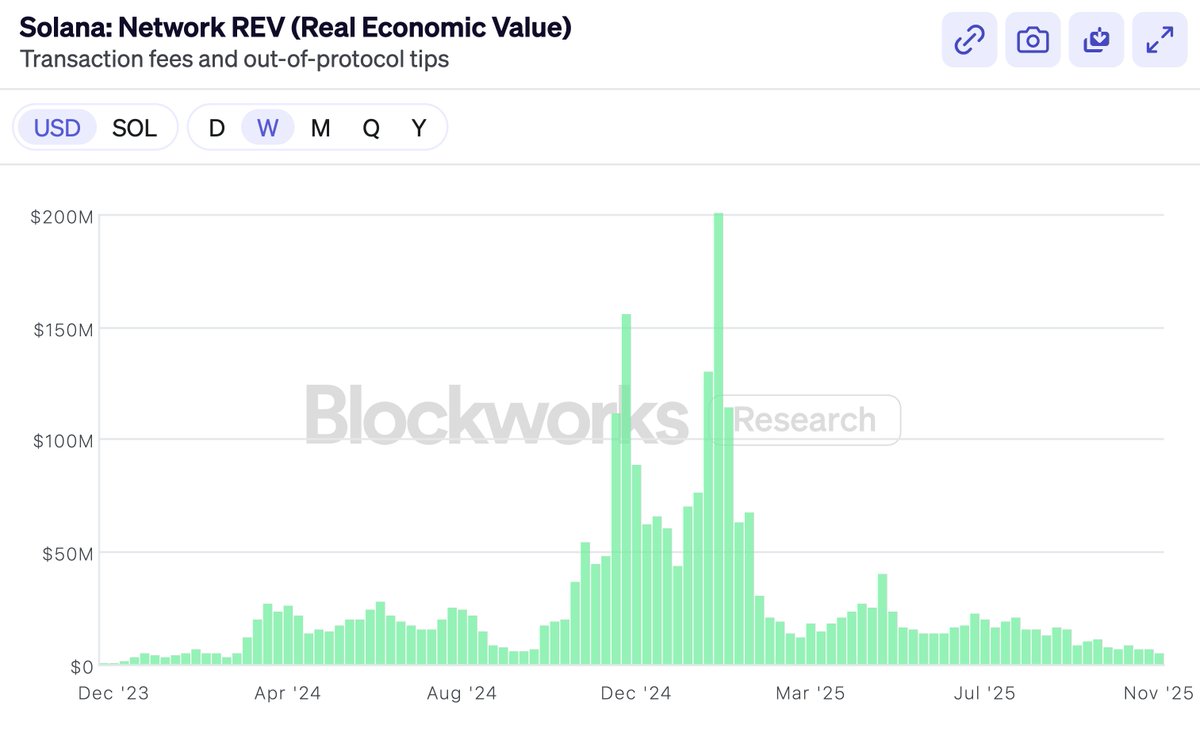
Late last year, Solana very proudly embraced REV as a metric that could finally justify their valuation. They proudly announced: we—and only we—are no longer bluffing to Wall Street!
And, of course, almost immediately after REV was embraced, it fell off a cliff (though $SOL, tellingly, did better than REV did).
Not that there’s anything wrong with REV. REV is a very clever metric. But the point of this post is not metric selection.
Then came the launch of Hyperliquid. A DEX that had real revenue and buybacks and PE multiples. And the chorus said—look, look I told you! Finally, for the first time ever, a token that has some real profits and a proper PE multiple. (Nevermind BNB, we don’t talk about that.) Hyperliquid will eat everything because obviously Ethereum and Solana don’t make any real money, we can stop pretending to value them now.
Hyperliquid, Pump, Sky, these buyback-heavy tokens are all great. But the market always had the ability to invest into exchanges. You could always buy Coinbase, or BNB, or whatever. We own $HYPE, and I agree that it’s a fantastic product.
But that’s not why people were investing in ETH and SOL. The fact that L1s don't have exchange-like profit margins is not why people were buying them—if they wanted that, they could’ve bought Coinbase stock.
So if I’m not critiquing blockchain financial metrics, maybe you think this post is going to be chiding the sinfulness of the token-industrial complex.
Obviously, everyone has lost money on tokens in the last year, VCs included. Alts are down bad this year. And so the other half of the zeitgeist on CT is arguing about who's to blame. Who’s become greedy? Are the VCs greedy? Is Wintermute greedy? Is Binance greedy? Are the farmers greedy? Are the founders greedy?
The answer, of course, is the same as it’s ever been.
Everyone is greedy. Everyone. The VCs, Wintermute, the farmers, Binance, the KOLs, they're all greedy, and you are greedy too. But it doesn't matter. Because no functioning market has ever required anyone to act against their self-interest. If we're right about crypto, we can all be greedy and the investments will still work out. Trying to analyze a market that has gone down by figuring out “who’s greedy” is going to be about as fruitful as commissioning witch trials. I guarantee you, nobody just started being greedy in 2025.
So this, too, is not what I’m going to be writing about.
Many people want me to write a post about why $MON should be valued at X or $MEGA at Y. I’m not interested in writing this post, or advocating that you buy anything in particular. In fact, you probably shouldn’t buy any of them if you don’t already believe in them.
Will any new challenger chain win? Who knows. But if it has a material chance of winning, it's going to be priced on that basis. If Ethereum is worth $300B or Solana is worth $80B, a project that has a 1-5% chance of becoming the next Ethereum or Solana will be priced according to those probabilities.
Somehow CT is scandalized by this, but it’s no different than Biotech. A drug that has less than a 10% chance of curing Alzheimer's is priced by the market as worth billions of dollars, even if 90% chance it won’t pass stage 3 trials and will go to 0. That's how the math works—and turns out, markets are pretty good at doing math. Binary outcomes are priced on probabilities, not on run rates or moral turpitude. It’s the “shut up and calculate” school of valuation.
I really don’t think that’s an interesting question to write about. “5% chance to win? No way, that’s clearly a 10% chance!” Markets, not articles, are the best way to assess that for any individual token.
So here’s what I am going to write about: CT doesn't seem to believe anymore that chains are valuable.
I don’t think this is because they don’t believe new chains can win market share. We just saw Solana dominate market share after emerging from the ashes less than 2 years ago. It’s not easy, but of course it’s possible.
It’s more that people have come to believe that even if a new chain wins, there’s no prize worth winning. If $ETH is just a meme, if it’ll never generate real revenue, then even if you win, you won’t be worth $300B. The contest is not worth winning, because these valuations are all bunk and it’ll all come crashing down before you go to claim your prize.
Being optimistic about chain valuations has become passé. Not that nobody is optimistic—obviously there must be optimists out there. For every seller there’s a buyer, and as much as CT cool kids love to drag L1s, people are comfortable buying SOL at $140, ETH at $3000.
But there’s a perception now that all the smartest people are over buying smart contract chains. Smart people know the jig is up. If not now, then soon. The only people buying here are suckers—Uber drivers, Tom Lee, and KOLs who say stuff like “trillions.” And maybe the US Treasury. But not the smart money.
This is bullshit. I don’t believe it, and you shouldn’t either.
So I felt like I had to write a smart person’s manifesto on why general purpose chains are valuable. This post is not about Monad or MegaETH. It’s really in defense of ETH and SOL. Because if you believe ETH and SOL are valuable, the rest is straight downstream.
Defending ETH and SOL valuations is generally not my job as a VC, but fuck it, if nobody else is willing to do it, then I’ll write it.
Feeling the Exponential
My partner Bo experienced the Chinese Internet boom first-hand as a VC. I’ve heard how “crypto is like the Internet” so many times now that it doesn’t even register for me anymore. But when I hear his stories, it always reminds me how costly it is to be wrong about these things.
A story he often tells is about when all the early e-commerce VCs (it was a small group back then) got together for coffee in the early 2000s. They debated: how big is the market for e-commerce going to be?
Is it going to be mostly electronics (maybe only techies will use PCs)? Could it ever work for women (perhaps they’re too tactile)? What about food (maybe impossible to manage perishables)? These were deeply important questions for early VCs to decide what to invest in and what prices to pay.
The answer, of course, was that literally every single one of them was devastatingly wrong. E-commerce would sell everything, and the target audience was the whole fucking world. But nobody at the time actually believed it. And even if they did, it would be too absurd to say out loud.
You just had to wait long enough for the exponential to show you. Even among the believers, very few thought e-commerce would become as big as it became. And those few who did, almost all of them became billionaires from just not selling. Every other VC—as Bo tells me, since he was one of them—sold too early.
It has become passé in crypto to believe in the exponential.
I believe in the crypto exponential. Because I’ve lived it.
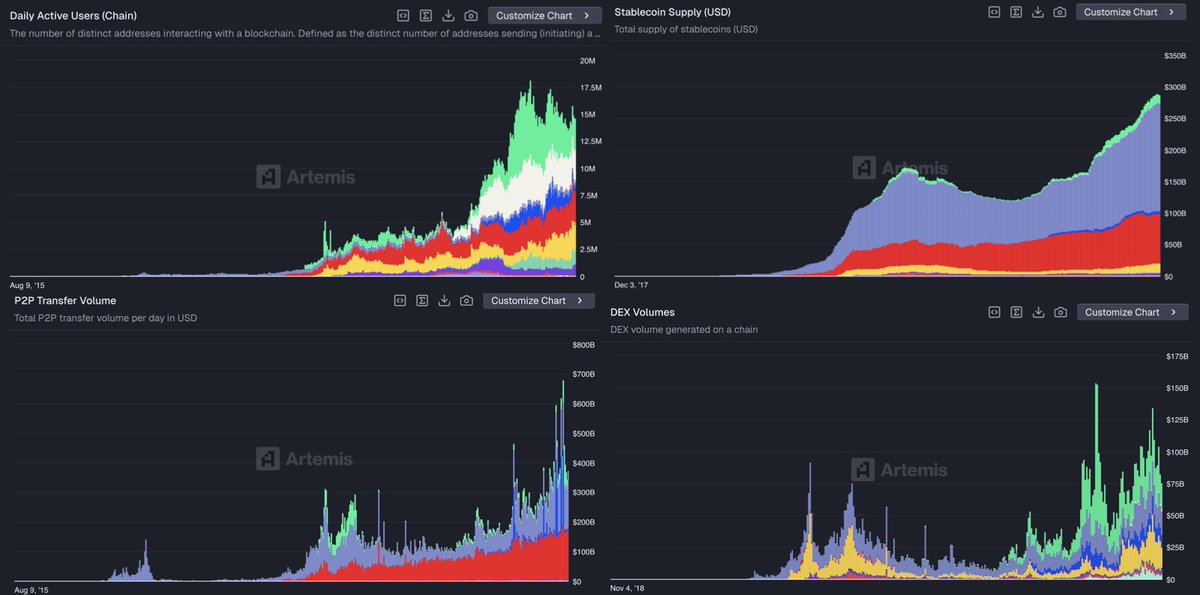
When I started in crypto, nobody used this stuff. It was tiny and broken and awful. TVL on-chain was in the millions. We invested into the first generation of DeFi, MakerDAO, Compound, 1inch, back when they were science projects. I remember playing around on EtherDelta back when DEXes traded single digit millions a day, and that was considered to be a huge success. It was complete dogshit. Now we routinely trade in the tens of billions on-chain every day. I remember believing it was crazy that Tether hit a billion dollars in issuance and was being written up in the NYT as a ponzi scheme on the brink of shutdown. Now stablecoins are over $300B and regulated by the Federal Reserve.
I believe in the exponential because I’ve lived it. I’ve seen it over and over again.
But you might respond—well, stablecoin growth might be exponential, maybe DeFi volumes are exponential, but they don’t accrue to ETH or SOL. The value doesn’t get captured by the chains.
To which I answer: you still don’t believe in the exponential.
Because the exponential’s answer is always the same: it doesn’t matter. This stuff is going to be so much bigger than it is today. And when it’s absolutely enormous, you’ll make it up on scale.
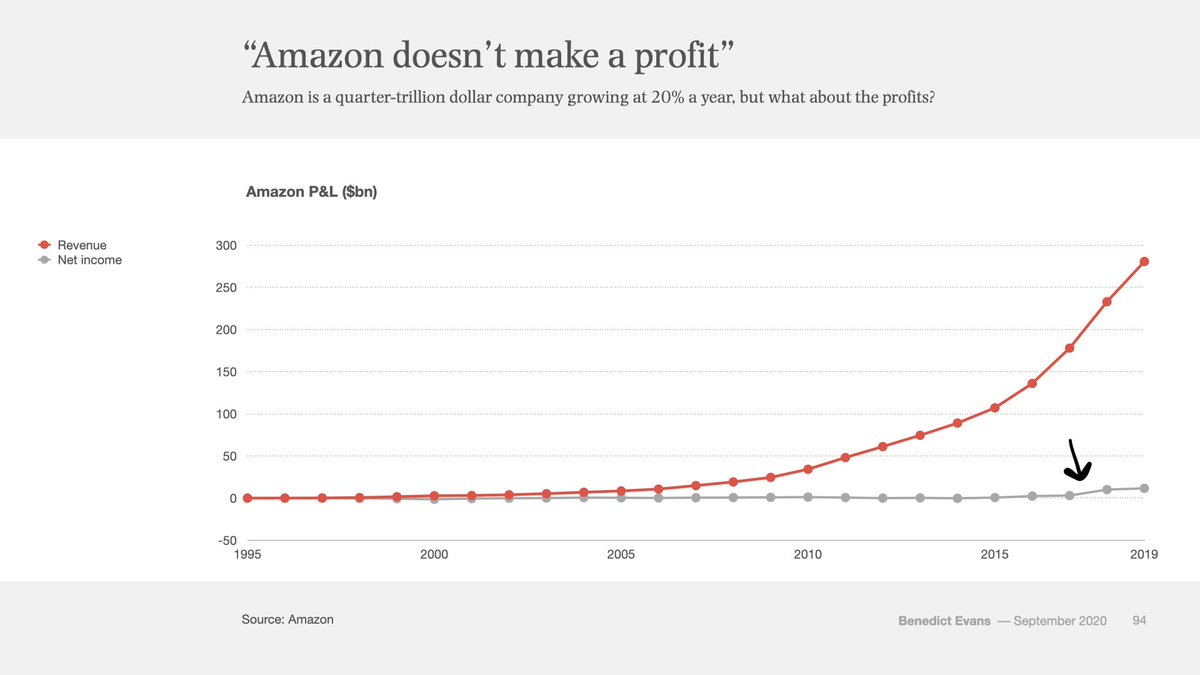
Study this chart.
This is Amazon’s P&L from 1995 to 2019. That’s 24 years. Red is revenue, gray is profit. You see that little blip on the end where the gray line goes up? That’s when, 22 years in, Amazon started actually making a profit.
Amazon was 22 years old when this little gray line of net income first peeled off of 0. Every single year before then, there were op eds and critics and short sellers claiming that Amazon was a ponzi scheme that would never make any money.
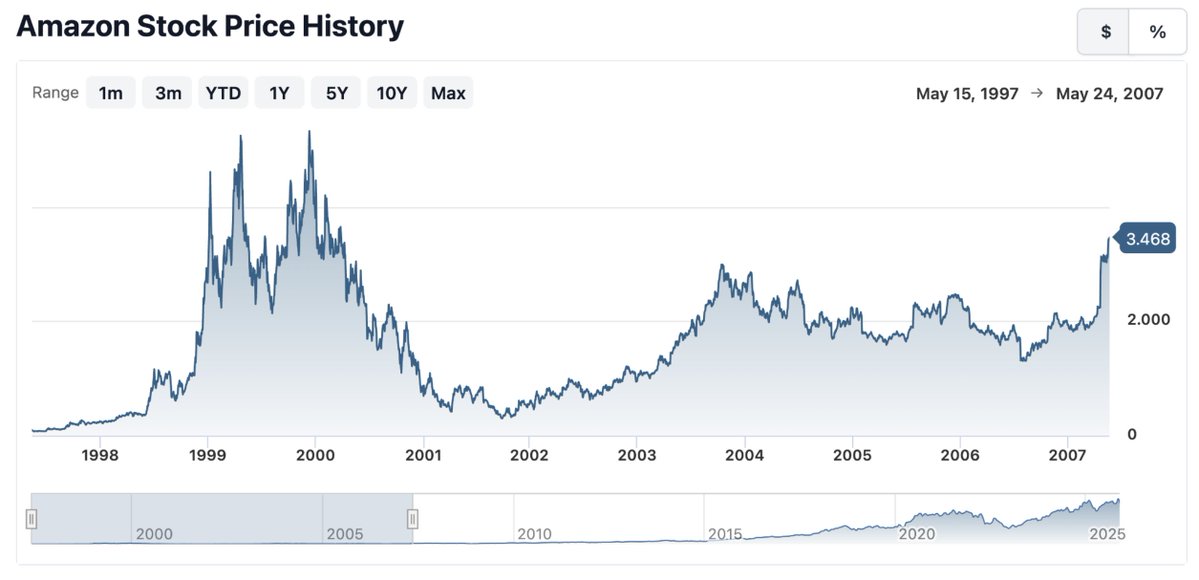
Ethereum just turned 10 years old. This is what the first 10 years of Amazon stock looked like:
10 years of chop. All along the way, Amazon was beset with doubters and non-believers. Is e-commerce a VC-subsidized charity? They’re selling underpriced cheap low-quality knick-knacks to bargain hunters, who cares? How are they ever going to make actual money, like Walmart or GE?
If you were arguing about Amazon’s P/E ratio, you were in the wrong regime. That’s the regime of linear growth. But e-commerce was not a linear trend, and so every single person for 22 years arguing about P/E ratios was devastatingly wrong. No matter what you paid, no matter when you bought, you were not bullish enough.
Because that’s what exponentials do. When it comes to truly exponential technologies, no matter how big you think it’s going to get, it just keeps getting even bigger.
This is the thing that Silicon Valley has always understood better than Wall Street. Silicon Valley was raised on exponentials, while Wall Street was raised on linearity. And over the last few years, crypto’s center of gravity has migrated from Silicon Valley to Wall Street. You can feel it.
Granted, crypto growth doesn’t look as smooth as e-commerce’s growth. It’s burstier, it goes in fits and starts. This is because crypto, being about money, is deeply tied to macro forces, and it also has more violent regulatory push and pull than e-commerce. Crypto strikes at the heart of the state—money—and so it’s more unnerving to governments than e-commerce ever was.
But the exponential is no less inevitable. It's a crude argument. But if crypto is exponential, then the crude argument is correct.
Zoom out.
Financial assets want to be free. They want to be open. They want to be interconnected. Crypto turns financial assets into file formats, makes it as easy to send a dollar or a stock as to send a PDF. Crypto makes it possible for everything to talk to everything. It makes it all 24/7, global, interconnected, and open.
That will win. Open always wins.
If there’s no other lesson I've learned from the Internet, it’s that. Incumbents will fight against it, governments will huff and puff, but eventually they will give up against the adoption, the generativeness, the sheer efficiency that this technology enables. It’s what the Internet did to every other industry. Blockchains are how that same trend will gobble up all of finance and money.
Yes—with enough time—all of it.
An old saying goes: people overestimate what can happen in two years, but they underestimate what can happen in ten.
If you believe in the exponential, if you zoom out enough, then it’s all still cheap. And it should humble you that every day, the holders outlast the sellers and naysayers. Big capital has a longer time horizon than CT swing traders might lead you to believe. Big capital has been trained through history not to fade big technologies. You know, the big gushy story that originally got you to buy $ETH or $SOL? Big capital believes that story and hasn't stopped.
So what exactly am I arguing?
I am arguing that applying P/E ratios to smart contract chains (the “revenue meta,” as it’s now called), is giving up on the exponential. It means you have consigned this industry to the regime of linear growth. It means you believe 30 million DAUs on-chain and <1% of M2 is it. Crypto is just one of the things in the world. A sideshow. It did not win. It was not inevitable.
More than anything, I’m arguing to be a believer. Not just a believer, but a long-term believer.
I’m arguing that this exponential will be bigger than anything else you’ve been a part of in your life. That this is your e-commerce. That you will look back when you’re old and tell your kids—I was there when it all happened. Not everyone believed it was possible, that whole societies could change, that all of money and finance would be transformed by programs running on decentralized computers that we collectively owned.
But it actually happened. It changed the world.
And you were a part of it.
Disclosure: These are my own views. Dragonfly is an investor in $MON, $MEGA, $ETH, $SOL, $HYPE, $SKY among many other tokens. Dragonfly believes in the exponential. This is not investment advice, but is advice of another kind.
English
999 (🌸, 🌿) retweetet

1/7 - The ORGO pill thread:
@Orgo makes businesses exponentially more productive.
Computer-use agents allow a single employee to match the productivity of a whole team.
This new field "computer-use" is widely viewed as the next evolution of AI.
ChatGPT = thinking. Computer-use = doing.
$ORGO is the iOS that computer-use agents (apps) need to run at an enterprise level.
English
999 (🌸, 🌿) retweetet

20 TIMELESS LESSONS FOR CRYPTO BEGINNERS:
1. Don't fall in love with a token.
2. HODL with conviction, but always have an exit plan.
3. Timing often matters more than talent in crypto.
4. If you feel FOMO, you're already late to the trade.
5. The next 100x won't look like the last one.
6. Learn to use onchain data early.
7. Learn how to read smart money.
8. Study tokenomics; it reveals how long hype can last.
9. Go where liquidity is flowing.
10. Never risk all your portfolio on a single trade.
11. Develop a loss-learning mindset.
12. Explore ways to earn on your holdings beyond price appreciation.
13. If you can't explain how a protocol generates yield, you're the yield.
14. Use airdrops as an opportunity to learn new ecosystems, not just to farm.
15. Don't underestimate infra plays.
16. Learn to spot narrative rotation early.
17. You'll learn faster by experimenting onchain.
18. Network with people as much as you can.
19. Your mental health is part of your portfolio.
20. Protect your wallet like your life depends on it.

English
999 (🌸, 🌿) retweetet

How to Research?
Disclaimer : This is my own research method and if there are any mistake, please correct them.
These are the tools I use daily
▸ X app
▸ elfa ai
▸ dexuai
▸ HeyElsaAI
▸ ethos network
▸ DefiLlama
▸ Messari
▸ cryptorank
▸Rick (check previous Twitter username)
I only use AI to find meaning project and tech. Can this tech be adapted to crypto or LARP? Essentially, this greatly speeds up your research, but don't immediately trust AI 100%, as it can be wrong.
If you find a project about privacy narratives, compare it with other privacy projects using AI for analysis.
In addition, I tried to find traces of the founder and the team on LinkedIn to see if they had ever scammed anyone before. After that, I looked for funding and vc on cryptorank.
Don't forget that social reputation is very important. You can use ethos to find out about it. When there are many red scores, it means it's not good and there is a lot of FUD, but when there are many green reviews, it's a good sign.
For the rest, you can add research through the X . Simply search for the project you want to research, and then you can also follow CT , which focuses on that niche.
uttermost-pumpkin-971.notion.site/2092390761ca80…
I made this for you
Here another Tools 🧠
▸ For listing cex
t.me/NewListingsFeed
t.me/CexAlerts
▸ Research DeFi/Narrative
@FourPillarsFP
@castle_labs
@tiger_research
t.me/eli5definews (@eli5defi)
@a1research__
@Kairos_Res
@Delphi_Digital
@Shoalresearch
@getmoni_io
@blockworks
@Defi_Warhol
@nansen_ai
@Deebs_DeFi
@Presto_Labs
@PinkBrains_io / @DefiIgnas
@BREAD_
▸Notes for research or thesis
t.me/cookiesreads
@autismo" target="_blank" rel="nofollow noopener">substack.com/@autismo
▸Research gamefi
t.me/thecoreloop
t.me/raidenalpha
▸For News on crypto
@TheBlock__
@zoomerfied
@DegenerateNews
▸Airdrop
@DappRadar
@myAlphaDrops
DefiLlama
cryptorank
▸ infoFI
gomtu.xyz/kaito-leaderbo… (@gomtu_xyz)
web3lists.com (@pawnie_)
▸Tracker wallet
Debank
Cielo
EtherDROPS_bot on telegram
solana_notify_bot on telegram
Thankyou for read dont forget to bookmark guys!!


English