All Pakistan Textile Mills Association

1.8K posts
All Pakistan Textile Mills Association banner
All Pakistan Textile Mills Association

All Pakistan Textile Mills Association

@APTMAofficial

Premier Association of the Textile Sector of Pakistan.
Islamabad, Pakistan Beigetreten Ocak 2020
354 Folgt13K Follower
All Pakistan Textile Mills Association
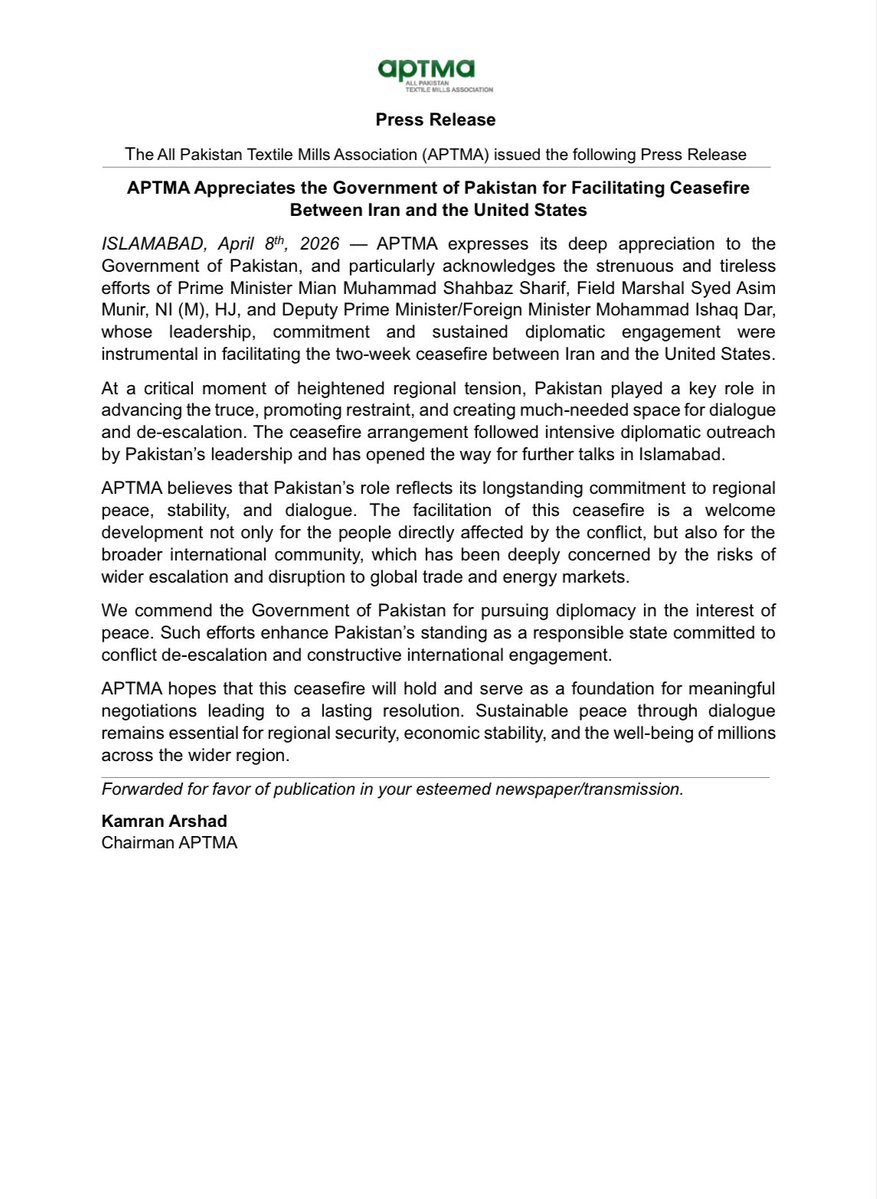
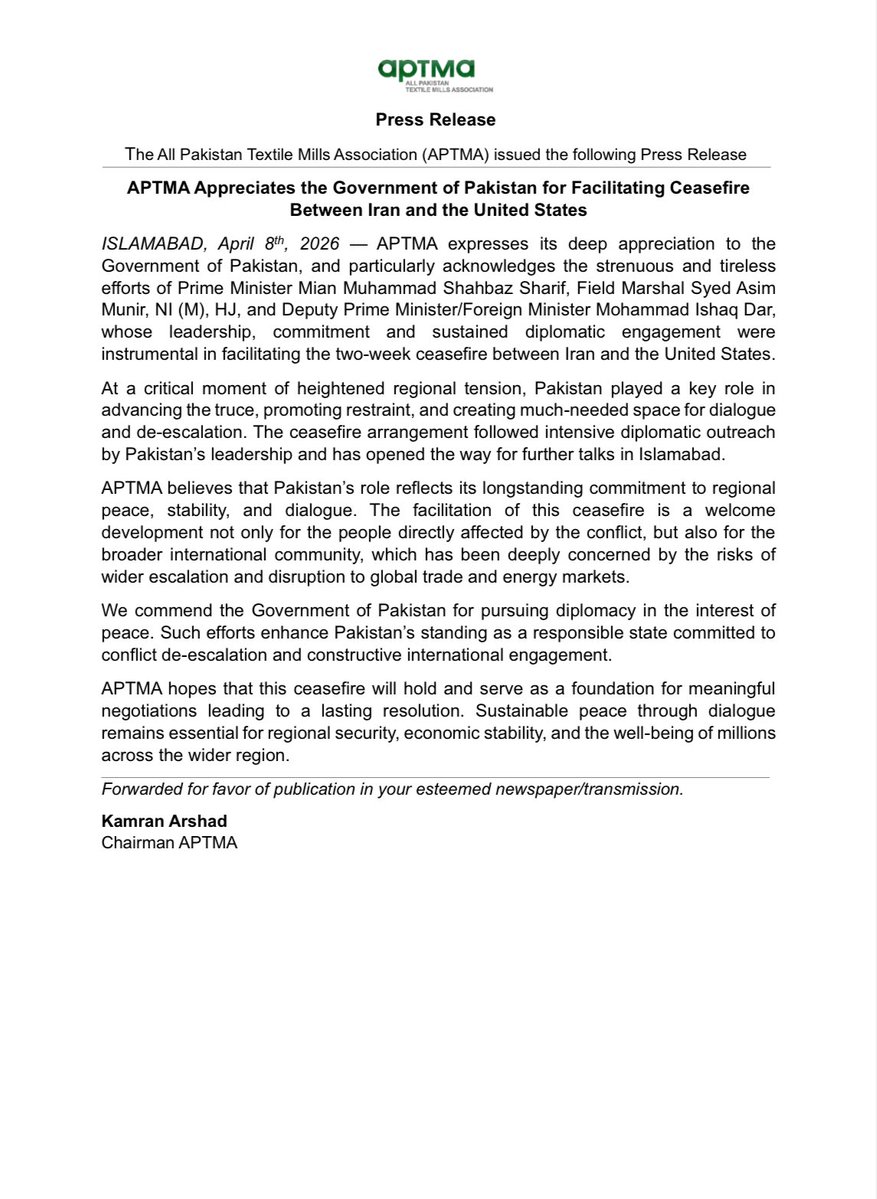
APTMA appreciates the Government of Pakistan for its diplomatic efforts in facilitating the recent ceasefire, contributing to regional de-escalation and stability. At a time of heightened tensions, such leadership reinforces Pakistan’s constructive role in promoting dialogue, safeguarding economic interests, and supporting global trade continuity. Sustainable peace remains essential for regional security and economic resilience.
All Pakistan Textile Mills Association tweet media
English
0
2
5
358
All Pakistan Textile Mills Association
GSP+ has been a cornerstone of Pakistan’s export growth — particularly for the textile sector — enabling scale, employment and foreign exchange stability. Preserving this status is critical for sustaining momentum in key export markets and supporting the broader economy. #GSPPlus #PakistanExports #TextileIndustry
AptmaUncut@AptmaUncut

GSP+ is not a privilege — it’s Pakistan’s economic lifeline. APTMA & FPCCI leadership highlight what’s at stake: • Exports to EU surged from < $2bn (2014) → ~$10bn • ~$7.7bn driven by textiles • Millions of jobs, FX & industrial growth linked Undermining GSP+ = risking Pakistan’s export backbone. #APTMAUncut #PakistanTextiles #GSPPlus #JobsAtRisk #ExportCrisis Source: APTMA Chairman joint presser with FPCCI leadership

English
0
0
3
292
All Pakistan Textile Mills Association retweetet
AptmaUncut
AptmaUncut@AptmaUncut·
Important this is now in the mainstream — but the signal hasn’t changed. APTMA flagged EFS misuse. The data now validates it. *Bleached fabric imports: 23 → 1,911 tonnes (+8,200%) *Mis-declaration still enabling duty-free entry *Domestic inputs continue facing 18% GST Appreciate the coverage. Now the focus must shift to fixing the loophole. #APTMAUncut #TextileCrisis #PakistanTextiles #EFS #PolicyFailure Source: Business Recorder brecorder.com/news/amp/40413…
English
0
1
0
256
All Pakistan Textile Mills Association
APTMA has raised serious concerns over misuse of the Export Facilitation Scheme (EFS), highlighting a sharp and abnormal rise in fabric imports despite prior exclusions. Imports of bleached fabric under EFS increased from 23 tonnes (Feb 2025) to 1,911 tonnes (Feb 2026), raising concerns of misdeclaration and systemic leakage. While EFS imports remain sales tax exempt, locally supplied inputs for exports continue to be taxed — creating a clear disadvantage for domestic industry. APTMA has urged the government to rationalize the scheme to prevent abuse, protect local manufacturing, and safeguard revenue. Source: APTMA submission to Ministry of Finance (March 26, 2026) #APTMA #PakistanTextiles #Exports #EFS
All Pakistan Textile Mills Association tweet mediaAll Pakistan Textile Mills Association tweet mediaAll Pakistan Textile Mills Association tweet media
English
0
3
7
1.2K
All Pakistan Textile Mills Association retweetet
Profit
Profit@Profitpk·
Nepra clears 800MW auction framework, sets transparency rules and conditions for market transition under CTBCM; first auction to take place around June or July 2026 Read: profit.pakistantoday.com.pk/2026/03/25/pak…
Profit tweet media
English
1
2
12
1K
All Pakistan Textile Mills Association
Eid Mubarak & Pakistan Day 🇵🇰 On this 23rd March, we celebrate the spirit of unity, resilience, and progress that defines our nation. May this Eid bring peace, prosperity, and renewed strength to our people and our economy. Together, let’s continue building a stronger Pakistan. #EidMubarak #PakistanDay #APTMA
All Pakistan Textile Mills Association tweet media
English
1
2
6
189
All Pakistan Textile Mills Association
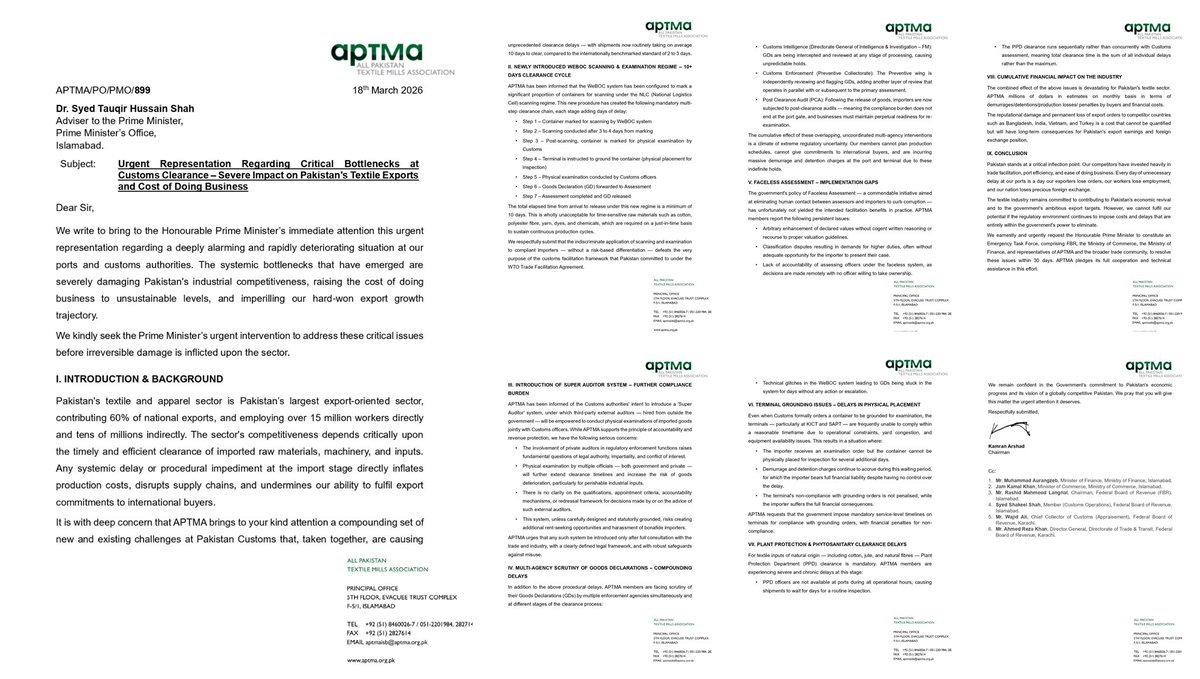
APTMA has raised urgent concerns with the Prime Minister’s Office regarding critical bottlenecks in customs clearance impacting Pakistan’s textile exports. Key issues include: • Prolonged clearance delays beyond international benchmarks • Increased cost of doing business • Disruptions in supply chains and export commitments These challenges are undermining the competitiveness of Pakistan’s largest export sector. APTMA has requested immediate intervention to streamline processes and prevent further damage to export growth.
All Pakistan Textile Mills Association tweet media
English
0
0
0
501
All Pakistan Textile Mills Association
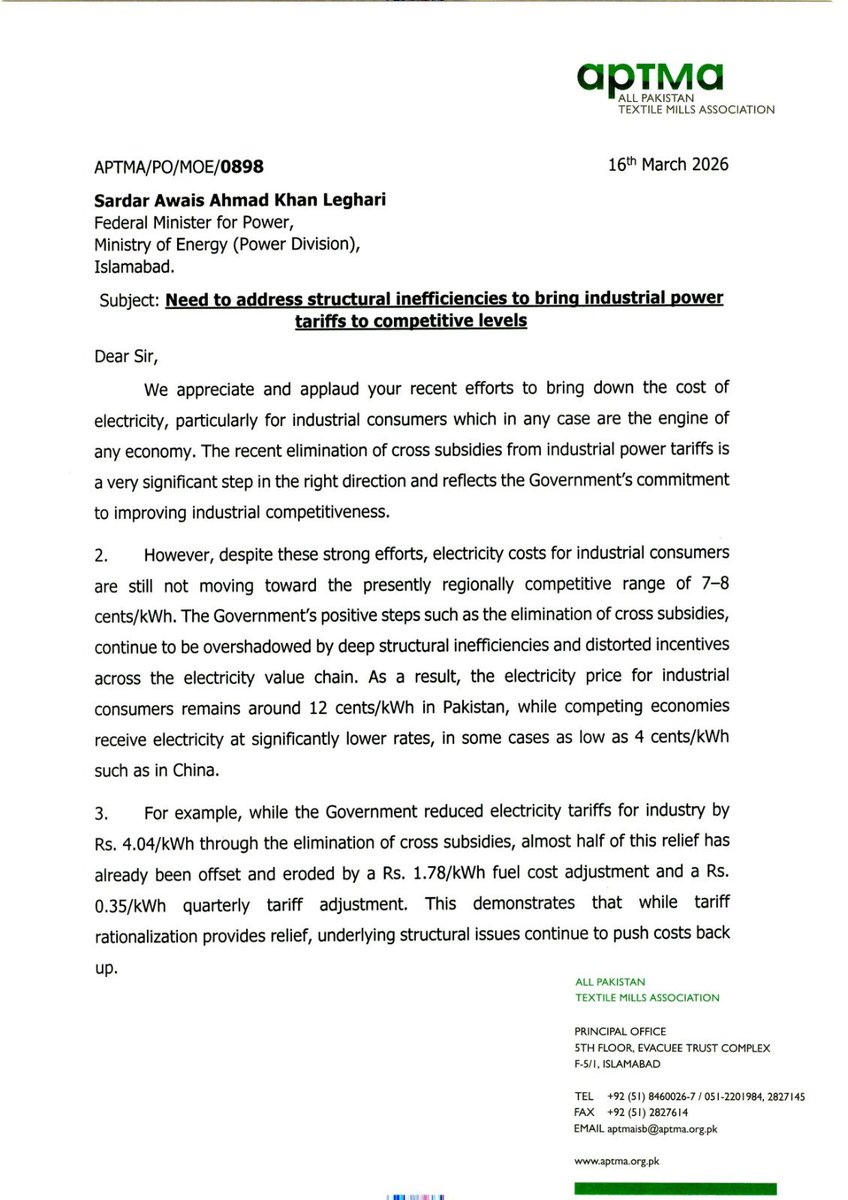
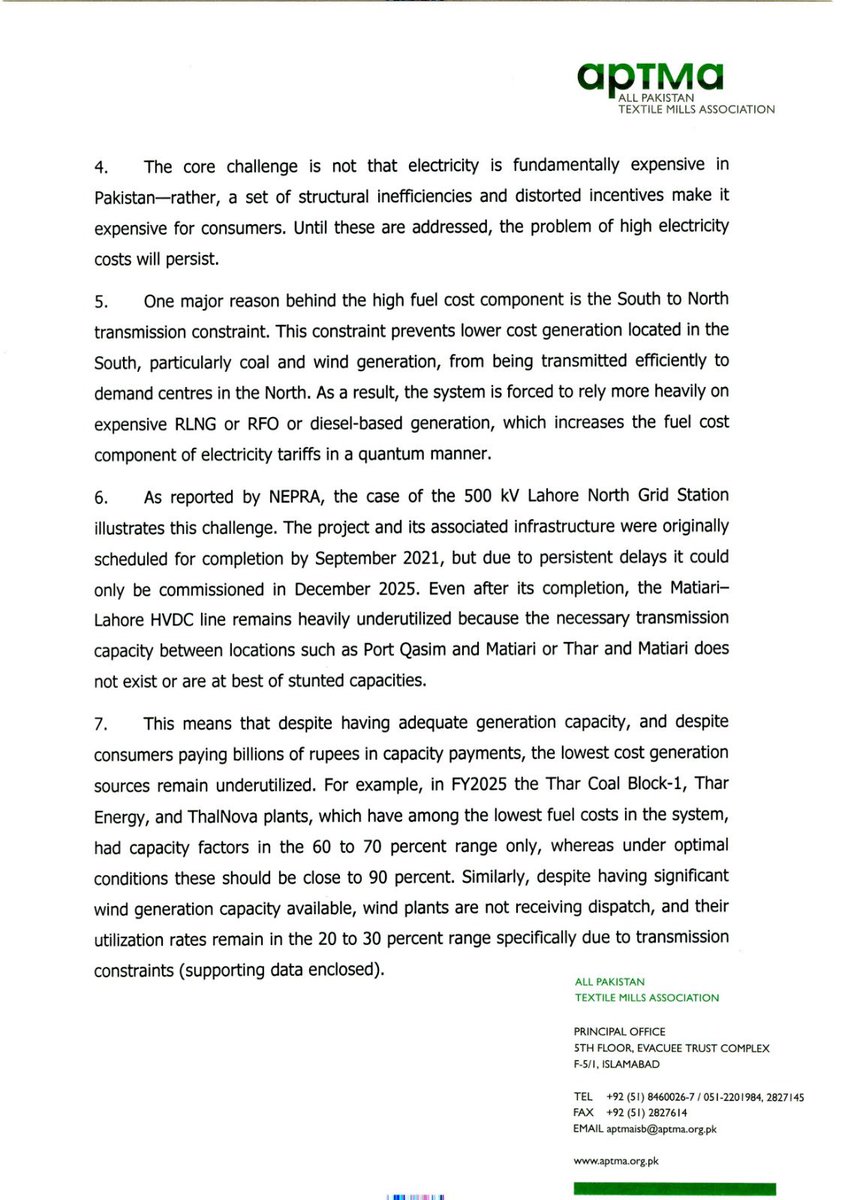
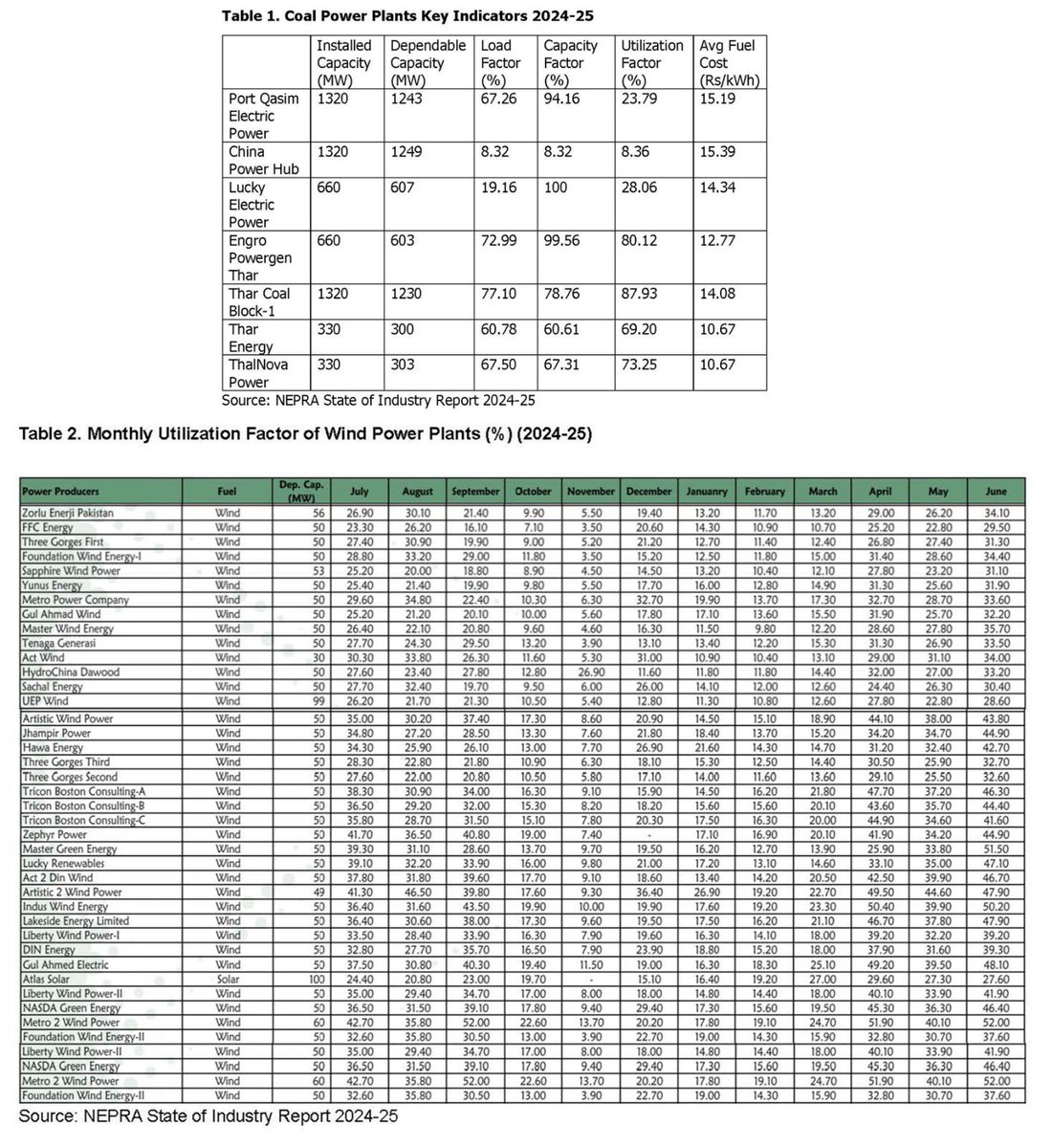
APTMA has written to the Honourable Federal Minister for Power highlighting structural inefficiencies in the power sector that continue to keep industrial electricity tariffs above regionally competitive levels. Key concerns include: • Industrial electricity ~12¢/kWh vs regional benchmark 7–8¢/kWh • Underutilization of low-cost generation, including Thar coal and wind power • Transmission constraints limiting dispatch of cheaper southern generation to northern demand centres Despite adequate generation capacity, these structural constraints are raising fuel costs and electricity tariffs for consumers and industry. APTMA has requested urgent policy attention to address these inefficiencies so that industrial power tariffs can move toward competitive levels and support export growth. #PakistanTextiles #IndustrialCompetitiveness #EnergyPolicy
All Pakistan Textile Mills Association tweet mediaAll Pakistan Textile Mills Association tweet mediaAll Pakistan Textile Mills Association tweet mediaAll Pakistan Textile Mills Association tweet media
English
1
0
0
336
All Pakistan Textile Mills Association
Pakistan’s textile sector operates in an extremely competitive global market. Policy stability in energy pricing, taxation and raw material supply is critical for sustaining export manufacturing and jobs. The industry has consistently asked for continuity of agreed energy tariffs and rationalization of the tax framework to remain regionally competitive.
AptmaUncut@AptmaUncut

Pakistan’s textile industry is entering a dangerous cost squeeze. Even after recent adjustments, industrial power is ~Rs30/unit, while regional competitors operate significantly lower. At the same time: • Highest effective taxation in the region • Cotton output ~5.5–5.6m bales, far below industry needs • Mills forced to import 6–7m bales from US, Brazil, Africa & Australia • Rising fuel prices → higher freight, energy and financing costs Competing with India, Bangladesh, Vietnam and Sri Lanka under these conditions is becoming increasingly difficult. What industry is asking for is not subsidies — but policy stability: • Continuation of agreed energy tariffs and fuel supply • Rationalized taxation and expansion of the tax net • Protection of the country’s export manufacturing base Without urgent policy alignment, Pakistan risks eroding the industrial foundation that generates ~60% of national exports and millions of jobs. Source: Chairman APTMA Kamran Arshad interview (News One) #APTMAUncut #PakistanTextiles #TextileCrisis #EnergyCosts #ExportCompetitiveness
English
0
3
6
681
All Pakistan Textile Mills Association
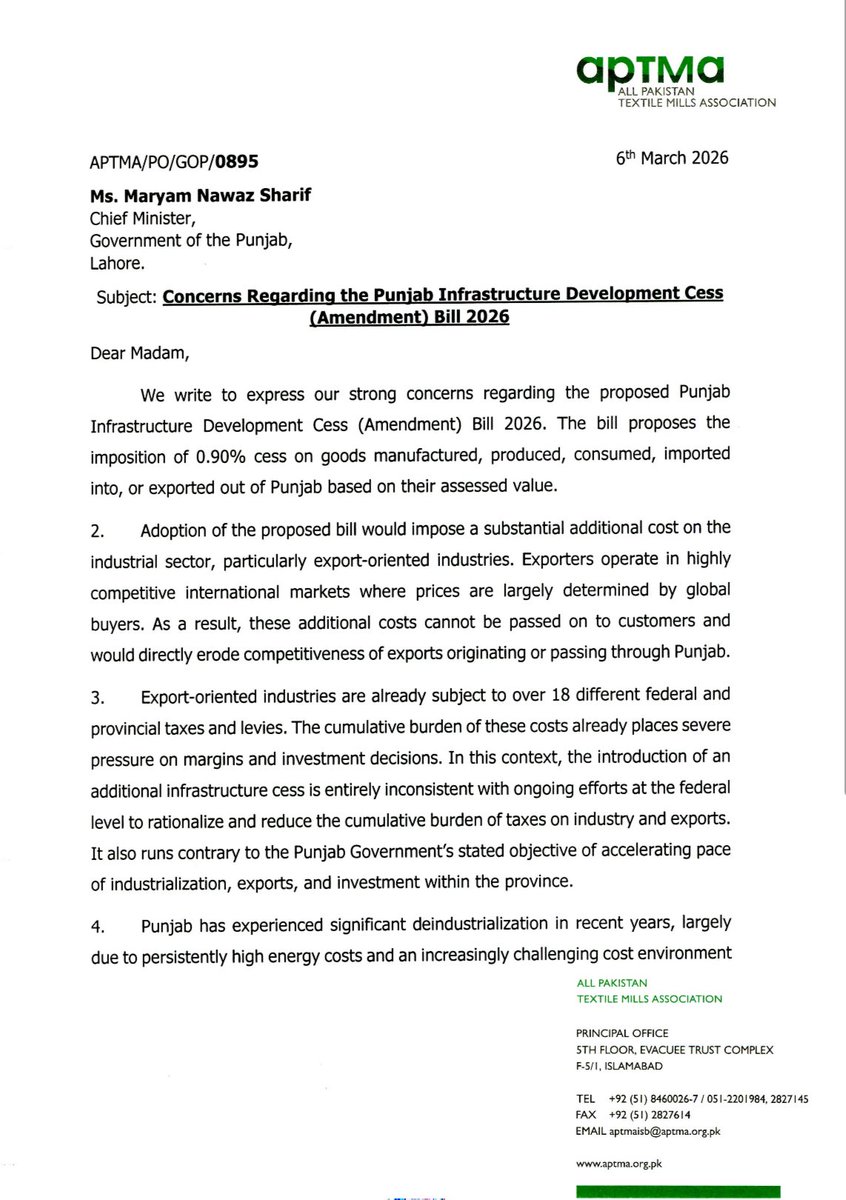
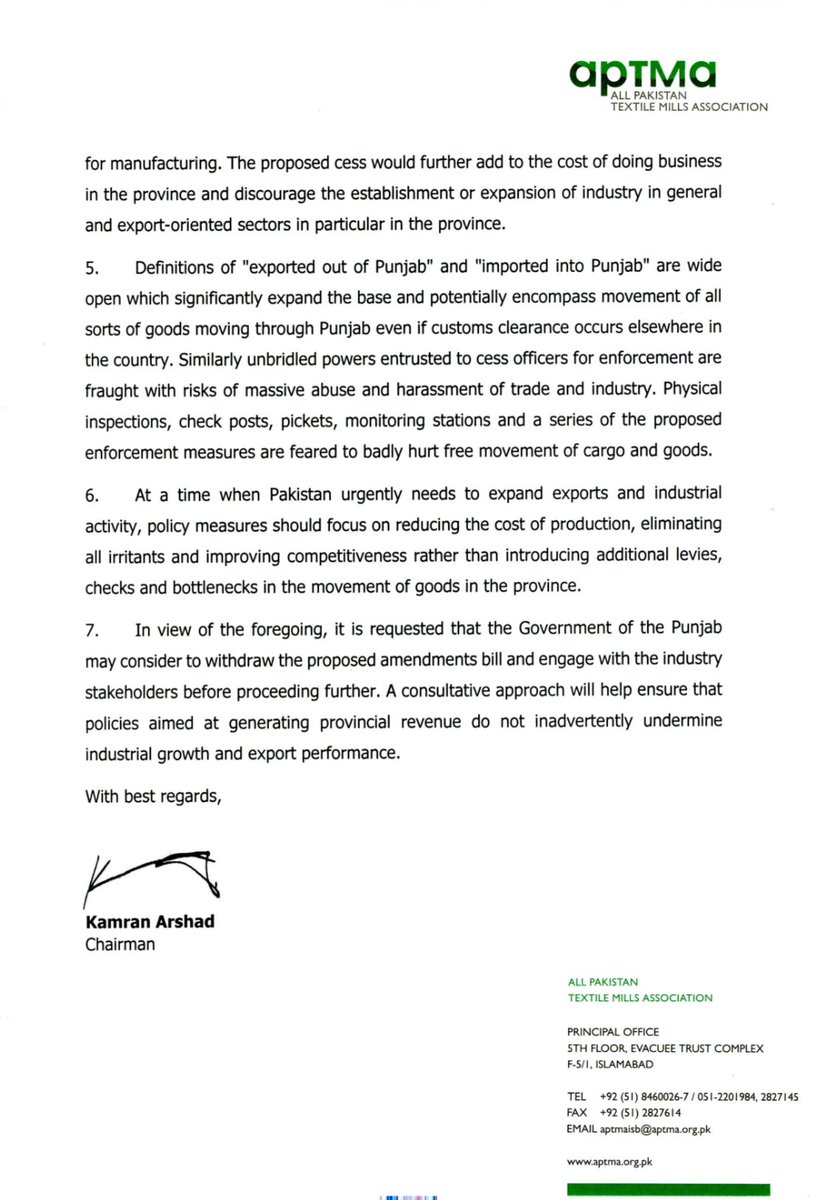
APTMA has written to the Government of Punjab expressing serious concerns regarding the proposed Punjab Infrastructure Development Cess (Amendment) Bill 2026. The proposed 0.9% cess on goods manufactured, imported, consumed, or exported in Punjab would significantly increase the cost of doing business for export-oriented industries. At a time when Pakistan urgently needs to expand exports and industrial activity, additional levies risk further eroding competitiveness and discouraging investment. APTMA has requested the Government of Punjab to reconsider the proposed amendments and engage with industry stakeholders to ensure policies support industrial growth and export expansion.
All Pakistan Textile Mills Association tweet mediaAll Pakistan Textile Mills Association tweet mediaAll Pakistan Textile Mills Association tweet media
English
0
4
7
847
All Pakistan Textile Mills Association
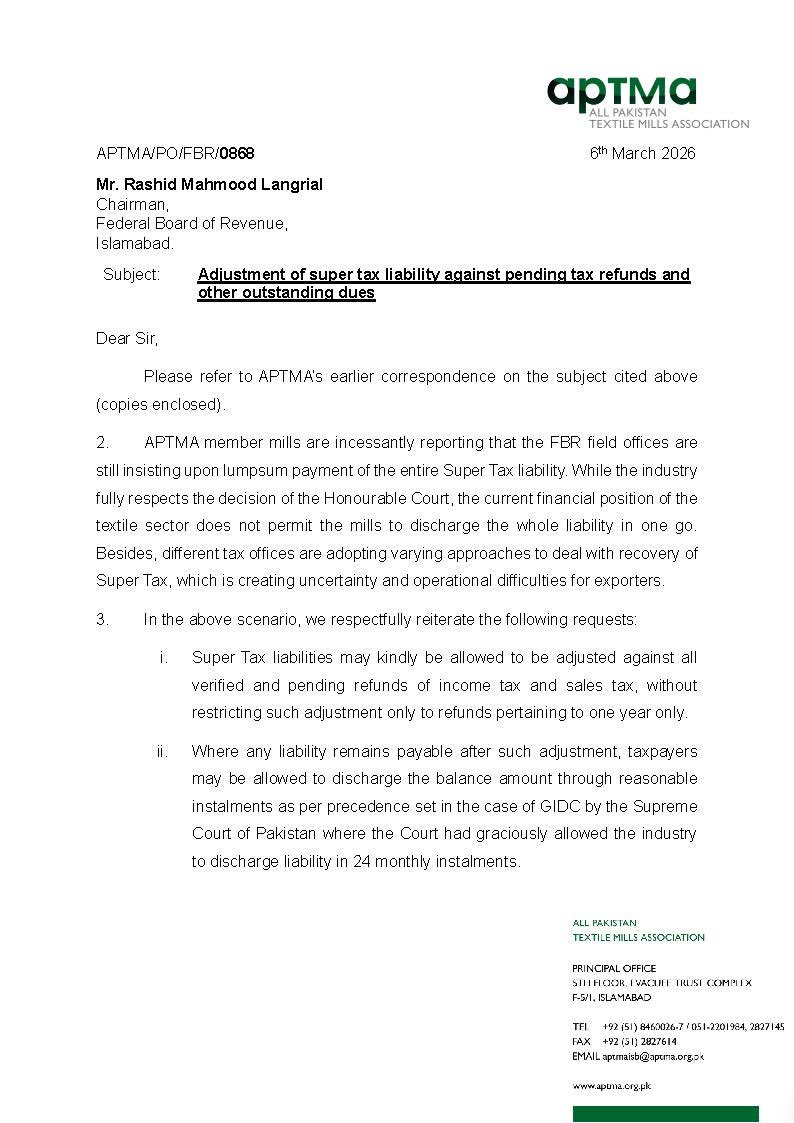
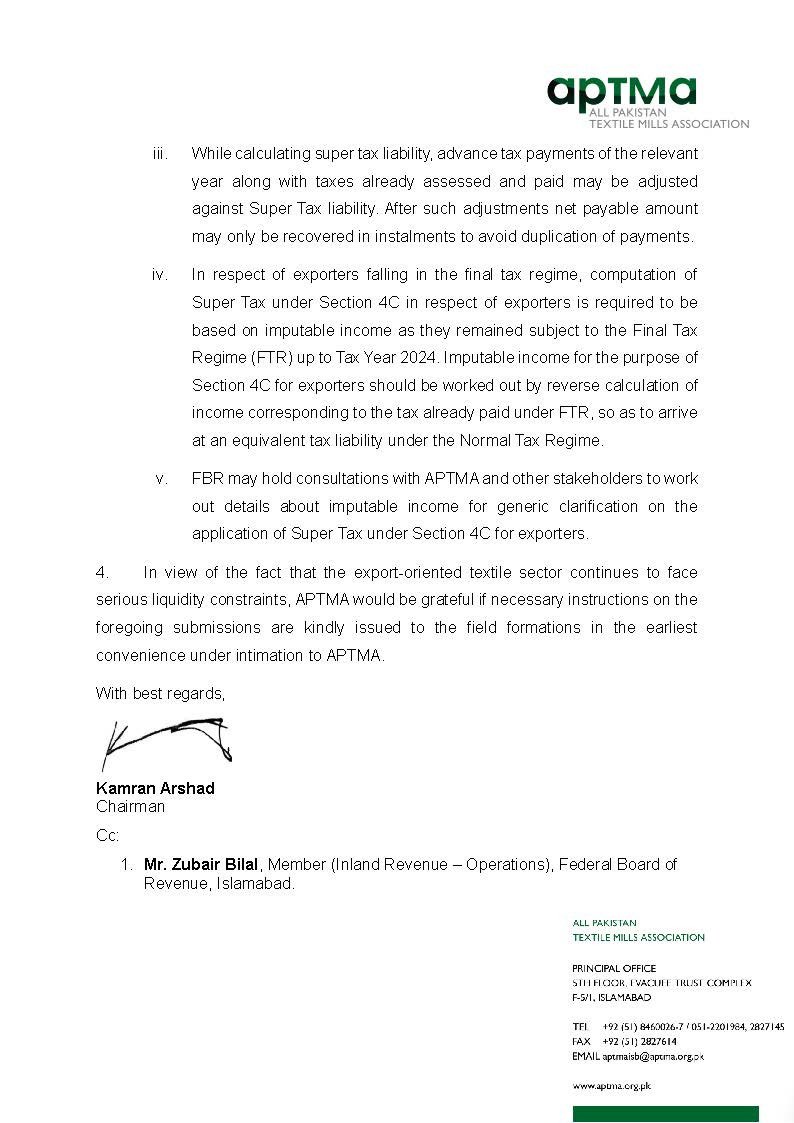
APTMA has written to the Chairman FBR requesting adjustment of Super Tax liabilities against pending income tax & sales tax refunds, and allowing reasonable instalments for any remaining balance, given the severe liquidity constraints facing export-oriented textile mills. The industry has also requested clarity in the calculation of Super Tax for exporters under Section 4C, particularly for those previously under the Final Tax Regime. Timely guidance to field formations is essential to ensure uniform implementation and avoid operational uncertainty for exporters. Letter attached. @FBRSpokesperson @Financegovpk @GovtofPakistan
All Pakistan Textile Mills Association tweet mediaAll Pakistan Textile Mills Association tweet media
English
0
0
0
601
All Pakistan Textile Mills Association
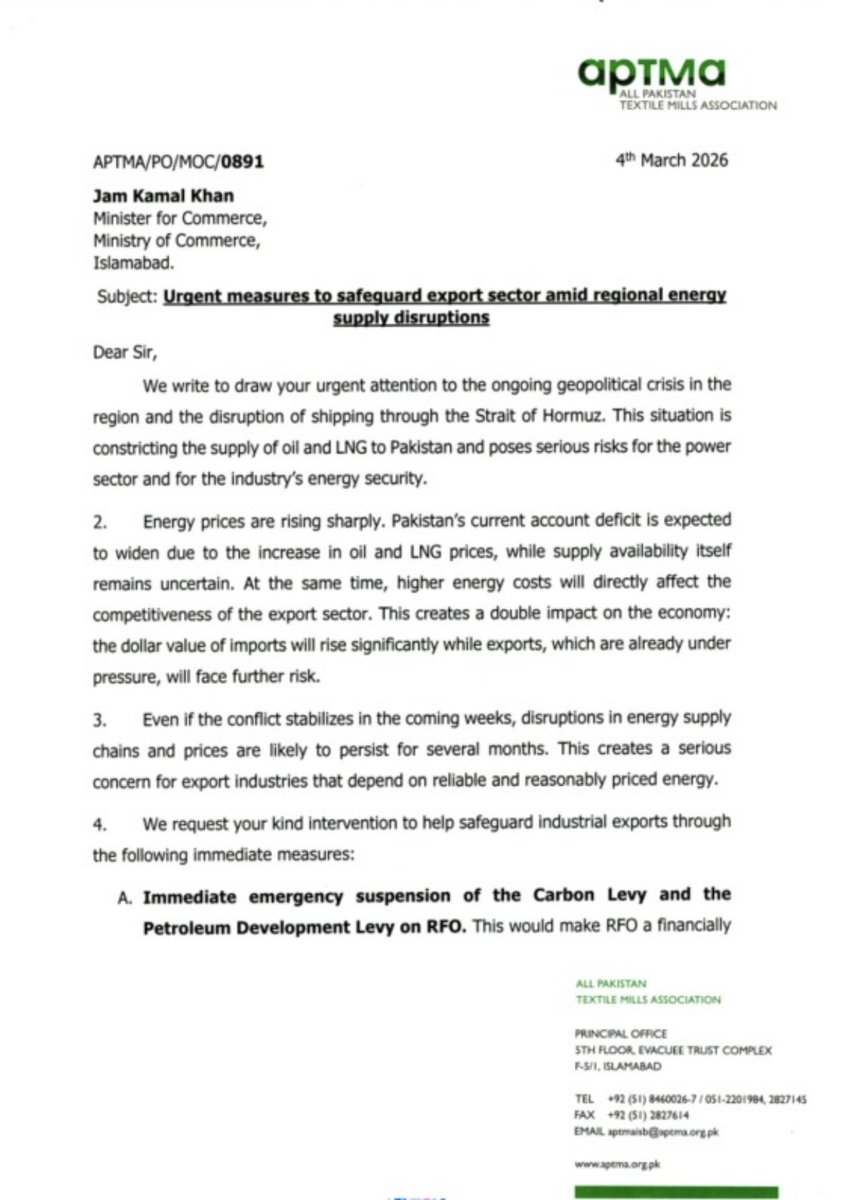
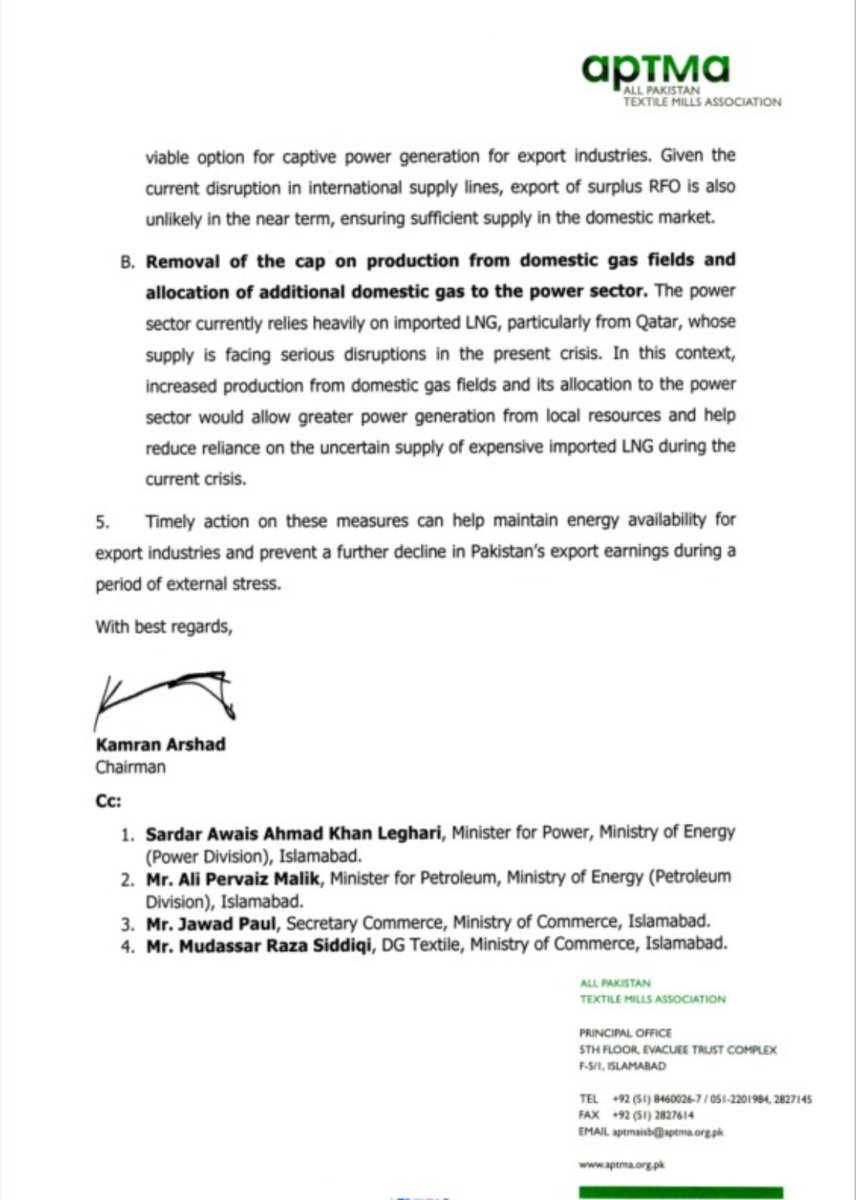
APTMA has formally written to the Federal Government highlighting urgent risks to Pakistan’s export sector due to regional energy supply disruptions, particularly potential oil and LNG constraints. APTMA has proposed immediate measures: • Suspend Carbon Levy & Petroleum Development Levy on RFO to enable viable captive power for export industries. • Remove caps on domestic gas production and allocate additional gas to the power sector to reduce reliance on imported LNG. Timely action is critical to protect export competitiveness and ensure energy availability for industry. Letter addressed to: @jam_kamal @PakPMO #APTMA #PakistanExports #EnergySecurity
All Pakistan Textile Mills Association tweet mediaAll Pakistan Textile Mills Association tweet media
English
0
2
8
692
All Pakistan Textile Mills Association
Global tensions are once again pushing energy and freight markets into uncertainty. For export-led economies like Pakistan, volatility in oil, gas, and shipping costs directly impacts industrial competitiveness. Pakistan’s textile sector operates in a highly price-sensitive global market. Even small increases in: • RLNG and fuel costs • Freight & insurance premiums • Working capital pressures ...can materially affect export margins. At a time when domestic industry is already navigating high input costs, policy stability and competitive energy pricing become even more critical. External shocks are beyond our control. Domestic cost structure is not. Ensuring predictable and competitive industrial energy tariffs must remain a national priority to safeguard exports and employment. Note: This image is AI-generated and intended for illustrative purposes only.
All Pakistan Textile Mills Association tweet media
English
0
3
5
661
All Pakistan Textile Mills Association
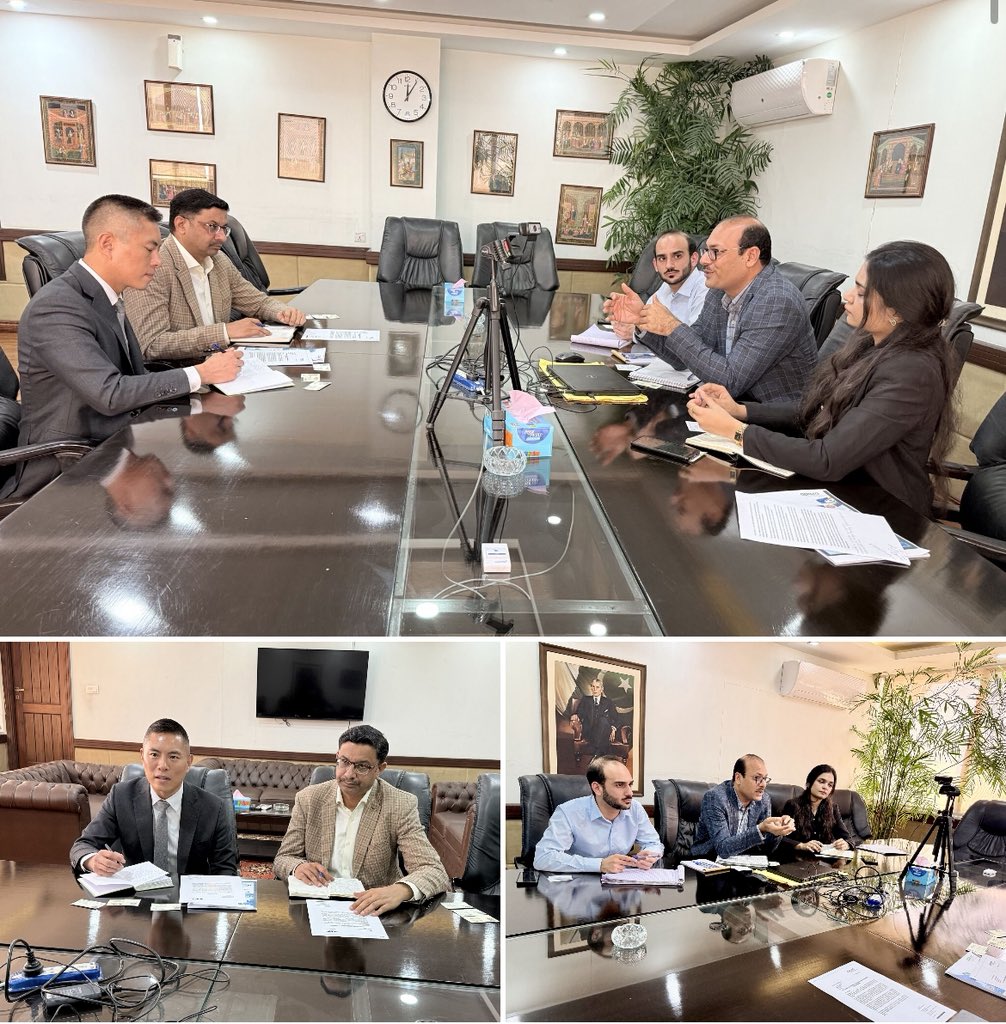
Strengthening Pakistan–U.S. Cotton & Textile Partnership 🇵🇰🇺🇸 APTMA was pleased to host Mr. Jay Kim, Economic Officer, and Mr. Mubashar Sajjad Gondal, Economic Specialist, from the U.S. Embassy Islamabad at APTMA House for a constructive engagement with our R&D and policy team. The meeting was attended by: • Dr. Javed Hassan, Cotton Advisor, APTMA • Syed Absar Ali, Senior Economist & Manager Research/Strategy, APTMA • Sarah Javaid, Trade Economist, APTMA Discussions centered on strengthening Pakistan–U.S. trade in cotton and textiles. As one of the leading buyers of U.S. cotton, Pakistan highlighted the importance of exploring tariff facilitation mechanisms — including frameworks similar to recent arrangements extended to Bangladesh — to enhance the competitiveness of Pakistan’s textile exports to the U.S. market. A key focus was technology transfer for agricultural transformation, particularly advanced seed technologies, improved varieties, modern breeding systems, and innovation partnerships aimed at improving yields, climate resilience, and farmer profitability. The meeting also referenced the recent visit of the Cotton Council International (CCI) USA delegation to MNFSR, facilitated by APTMA, where support was expressed for removal of mandatory fumigation on U.S. cotton imports — an important step toward reducing avoidable costs and improving trade efficiency. Key areas discussed included: • Tariff facilitation for Pakistan’s textile exports • R&D collaboration for sustainable cotton production • Expanding agricultural export opportunities • Strengthening overall Pakistan–U.S. trade cooperation APTMA remains committed to fostering constructive international partnerships that enhance trade competitiveness, strengthen the cotton value chain, and support sustainable industrial growth.
All Pakistan Textile Mills Association tweet media
English
0
0
1
771