Liberté Académique

21.9K posts

Liberté Académique banner
Liberté Académique

Liberté Académique

@AcadFreedom

Podcast Sciences Esprit Critique & Liberté -- 'Partners In Thought Crime'

Europe Beigetreten Mart 2017
1.5K Folgt1.9K Follower
Angehefteter Tweet
Liberté Académique
Liberté Académique@AcadFreedom·
B10 Valentin parle de sa lecture du livre Pour l’intersectionnalité d'Éléonore Lépinard et Sarah Mazouz Les autrices y défendent la pertinence de l’outil d’analyse intersectionnel en sciences sociales youtu.be/-c4fgK_OiJA?si…

YouTube video
YouTube
Français
1
1
1
1.5K
Liberté Académique retweetet
Our World in Data
Our World in Data@OurWorldInData·
Coal power has effectively died in the United Kingdom— (This Data Insight was written by @_HannahRitchie, with data work by @parriagadap.) The United Kingdom was the birthplace of coal. It has now, effectively, died there. As shown in the chart, in the late 1980s, around two-thirds of the UK’s electricity came from coal. By the time I was born in the 1990s, this had dropped to just over half. The use of coal has plummeted in my lifetime. It now makes up around 0.1% of the UK’s electricity. Coal was first replaced by gas, but is now being pushed out by wind, solar, and biomass.
Our World in Data tweet media
English
28
83
263
11.4K
Liberté Académique retweetet
Anup Malani
Anup Malani@anup_malani·
The standard story for the rise of Hitler: economic crisis. But when a major German bank failed in 1931, not all affected towns saw Nazism surge. Voth & coauthors found the missing link: anti-Jewish pogroms centuries earlier. The combination of culture & crisis, not either alone.
English
3
6
61
4.4K
Liberté Académique retweetet
Human Progress
Human Progress@HumanProgress·
"Since 1990, the world has made remarkable progress: the under five mortality rate has fallen by about 60 per cent, and neonatal mortality by 45 per cent, saving millions of young lives." humanprogress.org/the-worlds-gre…
English
1
9
25
2.5K
Liberté Académique retweetet
Steve Stewart-Williams
Steve Stewart-Williams@SteveStuWill·
“Conservatives and liberals are equally likely to interpret ambiguous data in ways consistent with their political beliefs - and they’re equally likely to engage in science denial when their beliefs part ways with the science.” stevestewartwilliams.com/p/who-engages-…
English
7
28
84
5.5K
Liberté Académique retweetet
Johan Norberg
Johan Norberg@johanknorberg·
New data from UNICEF show that progress in reducing child mortality has slowed, but it has still declined by an incredible 60% since 1990. In 2024, 8 million fewer children died than in 1990.
Johan Norberg tweet media
English
3
14
30
2.8K
Liberté Académique retweetet
Steve Stewart-Williams
Steve Stewart-Williams@SteveStuWill·
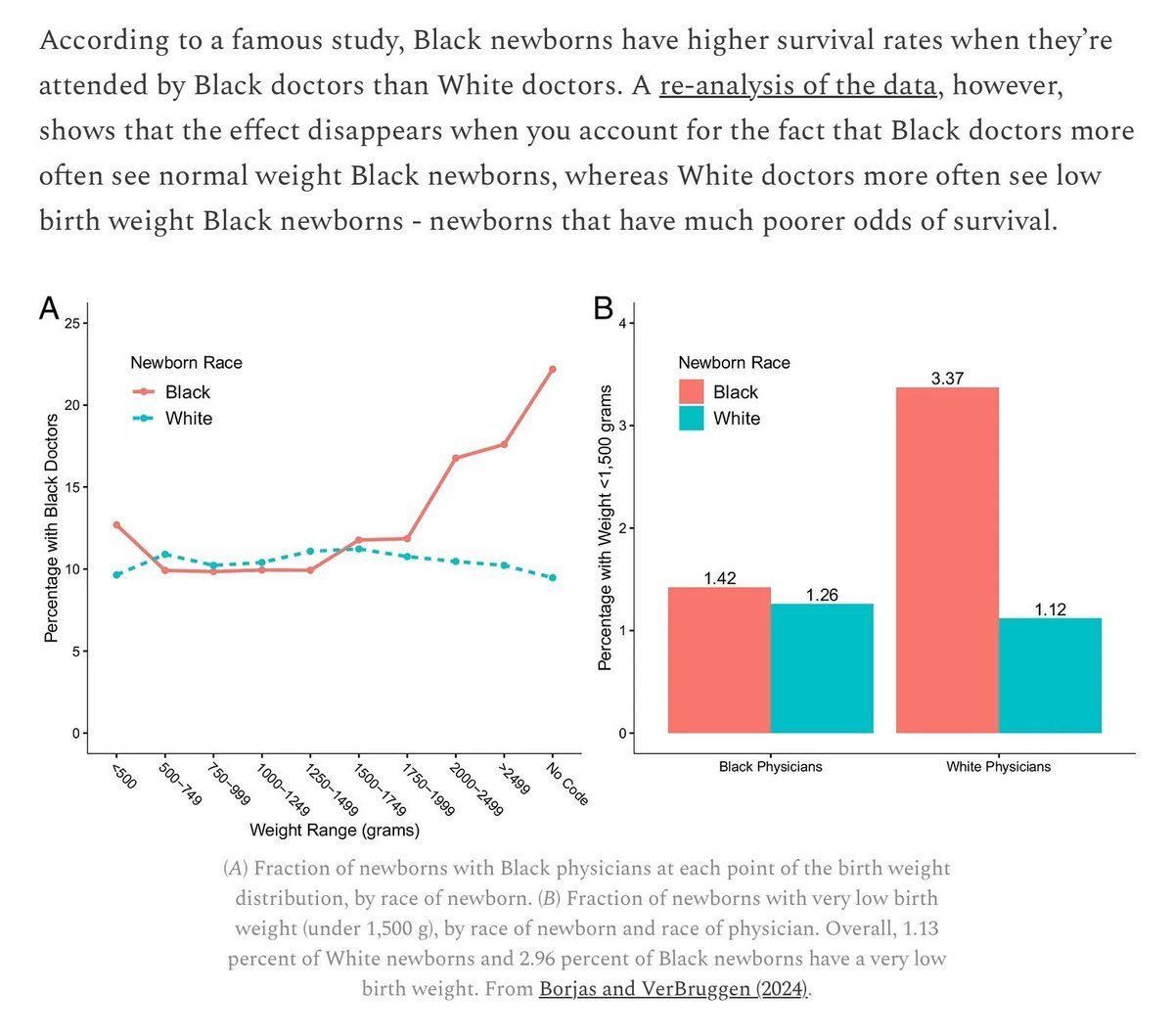
A famous study found that Black babies have higher survival rates if attended by Black than White doctors. But a re-analysis of the data shows the effect disappears after accounting for the fact that low birth weight babies more often see White doctors. [Link below.]
Steve Stewart-Williams tweet media
English
69
410
3.5K
820.2K
Liberté Académique retweetet
sleguilFR
sleguilFR@sleguilFR·
🌱On parle beaucoup de l'"empreinte carbone" et de ses composantes (transport, énergie, alimentation...) mais quid de notre empreinte biodiversité ? Voilà le tout premier rapport à s'intéresser à ce sujet, publié par l'institut de recherche Hot or Cool 👇 hotorcool.org/publications/n…
sleguilFR tweet media
Français
4
21
37
1.6K
Liberté Académique retweetet
Maarten Boudry
Maarten Boudry@mboudry·
Many moral disagreements boil down to one question: who's the REAL victim? A new study shows that people across the political spectrum care deeply about victimization. But for liberals, victimhood is group-based (vulnerable victims vs. invulnerable oppressors), while conservatives see victimhood as more individual and evenly distributed. “Assumptions of victimhood” strongly predict moral judgments across issues: "Liberals and conservatives all care about victimization but disagree about who is most at risk of being victimized. Assumptions of Victimhood predict moral judgment across issues, appear in implicit cognition, guide real behavior, and can be experimentally shifted to change moral evaluations." journals.sagepub.com/doi/epdf/10.11…
English
3
5
44
2.9K
Liberté Académique retweetet
William Costello
William Costello@CostelloWilliam·
Why isn't there more incel violence? New commentary paper from @ProfDavidBuss and I. We pose a puzzling question. Given what we know about the Young Male Syndrome (the dangers associated with sexless young men), why isn't there more incel violence? link.springer.com/epdf/10.1007/s…
English
26
48
208
72.2K
Liberté Académique retweetet
Dr. Catharine Young
Dr. Catharine Young@DrCatharineY·
The pipeline that drives discovery - new knowledge and treatments for diseases that affect us all - is collapsing in the United States. New NIH funding opportunities are down 91% this fiscal year.
Dr. Catharine Young tweet media
English
59
779
1.5K
214.5K
Liberté Académique retweetet
Steve Stewart-Williams
Steve Stewart-Williams@SteveStuWill·
“In all such cases, the differences appear long before children are exposed to TV, movies, or media, and long before they even know their own sex.” [Link below.]
Steve Stewart-Williams tweet media
English
3
10
55
3.8K
Liberté Académique retweetet
Niko McCarty.
Niko McCarty.@NikoMcCarty·
A non-hyped explainer of the “cell simulation” paper. The recent study about the “4D” simulation of a minimal cell has been getting a lot of attention on social media. Unfortunately, most posts about it have serious errors. I’ve seen people claim that the model simulates every chemical reaction in the cell, for example, which is not true. Some biomolecules and reactions *are* tracked individually in the simulation, including proteins and RNA (and ribosomes), and the chromosome. But the simulation does not track individual metabolites (like ATP or glucose), water, nucleotide precursors, lipds, and so on. These "other" molecules are represented, instead, as concentrations (using ordinary differential equations). But anyway, here goes my quick explanation: Researchers built a computational model that simulates roughly 100 minutes of biological time, or one cell division, for a single bacterial cell. Each simulation takes 4–6 days to run on two NVIDIA A100 GPUs, and the authors ran it 50 times in replicate. The cell simulation includes some elements of randomness, so each replication attempt leads to a slightly different outcome. When they plotted out these replicates and averaged results, they found that the model could predict a few things without being fitted to experimental data: The simulated cells “divided” every 105 minutes, on average, which matches experimental results; and the mRNA molecules had an average half-life of 3.63 minutes, which is roughly what we’d expect from experiments, too. The cell they are modeling is called JCVI-syn3A, and it is not a naturally-occurring organism. It’s a bacterium that has been engineered, over many years, to have a small genome. It only has 493 genes (compared to 4,000+ for E. coli), all of which are housed on a single chromosome. The Syn3A cell was made by taking a natural organism, called Mycoplasma mycoides, and then slashing out non-essential genes. Its entire proteome, transcriptome, and metabolism have been studied in depth, which is why it’s being used to build these whole-cell simulations. The actual *simulation*, though, is not a single thing! Instead, the authors wrote down all the “stuff” that happens inside a cell (transcription! translation! metabolism! lipid biosynthesis!) and decided which type of mathematical model would be best-suited to describe each thing. Some cell processes were modelled deterministically, others had “spatial” elements, and other parts were relatively random. More specifically, they used four different types of models to build this simulation: 1. A Reaction-Diffusion Master Equation, which was used to model the individual proteins, RNAs, and ribosomes. 2. A Chemical Master Equation, which was used to model things where spatial location doesn’t matter as much (it basically treats the whole cell as one mixed entity); including tRNA charging. 3. Ordinary Differential Equations, which you may be familiar with from Calculus class, were used to model changes in ATP concentration, lipids, and so on. 4. Brownian Dynamics, which simulated the chromosome as a physical chain of beads, where each bead represents 10 base pairs of DNA. The Reaction-Diffusion Equation works like this: Basically, they chopped up the entire digital cell into a 3D grid of cubes. Each cube measures 10 nanometers on each side. The whole cell is about 500 nanometers across, so there are tens of thousands of cubes in the cell's interior. (This is a useful way to coarse grain the simulation; if the cubes were smaller, the simulation would take much longer to run.) Each cube is a little box that contains some number of molecules. At every “step” in the simulation, only one of two things can happen to the molecules in each box: Either they react with a molecule in the same box, or they diffuse (“hop”) to an adjacent box. That’s it; the model is just rolling a die for each molecule at each time step in each box, and using those results to decide how each molecule changes over time. (The reason this spatial model is important is because biology only works if molecules physically bump into each other. And so this spatial grid means that, unlike simpler models, a protein actually has to “diffuse” across boxes in the cell to encounter its reaction partner; only then can it react and do something useful.) So anyway, each of these models is used to represent a different type of molecule. It’s not like there is a single, all-powerful simulation that they are running here; instead, they’re running these four models together, using a script that synchronizes their results with each other. The Reaction-Diffusion equation is the main part of the simulation. It takes time steps of 50 microseconds of biological time. Every 12.5 milliseconds of biological time — meaning every 250 RDME steps — the simulation pauses so that the other models can synchronize based on the latest state of the simulation. The Brownian Dynamics part runs on a completely separate GPU, and only updates every four seconds of biological time. So that's the gist here. But let's also be honest about what this simulation does NOT do: - It does not include polysomes, which are a cluster of ribosomes that all latch onto a single mRNA and translate at the same time. Polysomes are really common inside of cells, but this simulation assumes that each mRNA can only be translated by one ribosome at a time. - It does not include polycistronic transcription. In bacteria, genes are often grouped next to each other on the chromosome and thus “transcribed” (or turned into mRNA) all at once, together. The majority of genes in E. coli, for example, are arranged in these operons, and the authors of this paper acknowledge that many Syn3A genes are likely co-transcribed the same way. But the simulation doesn't capture it. - The authors manually tuned many parameters to get the model to make predictions that more closely resemble experiments. Earlier simulations were waaaayyyyy off from experimental results. For example, they adjusted the ratio of mRNA binding rates to ribosomes versus degradosomes because, in earlier simulations, mRNA was being degraded too quickly, before ribosomes could translate it, causing most proteins to be severely underproduced. - In the Brownian Dynamics model, the authors added a “fake” 12 pN physical force to push the two daughter chromosomes apart during division, because the real biological mechanism for chromosome partitioning in Syn3A is not known. - And some other things. That being said: This model is really cool! I love papers like this! I'm enamored by scientists who choose really difficult problems (like simulating an entire cell) and actually go after it and make progress! This paper is amazing because it shows us what we are able to simulate well, and what we don't yet understand, and to figure out which experiments we ought to perform to reconcile the two. So instead of framing this paper as "OH MY GOSH SCIENTISTS FIGURED OUT HOW TO SIMULATE AN ENTIRE CELL!" we should frame it as proof that there is still plenty of room at the bottom, many measurements to be made, and many avenues to explore as we seek to understand biology better.
Niko McCarty. tweet media
English
17
126
508
31.9K
Liberté Académique retweetet
Anish Moonka
Anish Moonka@AnishA_Moonka·
Humans invented writing to track debts. The world's first writing system, cuneiform, emerged in Mesopotamia around 3200 BC to record who owed what to whom. Clay tokens for accounting date back as far as 8000 BC. Debt isn't some corruption of a golden age. It's so fundamental to human cooperation that we created literacy because of it. War is even older. At Jebel Sahaba in Sudan, archaeologists found a cemetery dating to 13,000 years ago where half the people buried had been killed by arrows, spears, and clubs. That's thousands of years before the first city, the first farm, or the first written law. And about that beautiful planet of trees and sunshine: for most of human history, roughly half of all children died before age 15. Researchers who studied 17 hunter-gatherer societies found an average child mortality rate of 49%. Even in Sweden in the 1750s, 40% of children didn't survive to 15. Today globally, it's about 4%. In Japan and Iceland, 0.4%. The systems the tweet mourns are the same ones that changed those numbers. In 1820, roughly 84% of all humans lived in extreme poverty (per economic historians at the University of Paris). Today it's about 10%. Between 1990 and 2025, roughly 118,000 people escaped extreme poverty every single day. None of this means that debt or capitalism are without serious flaws. They obviously are. But the "paradise ruined" framing gets the history backwards. The planet was a place where burying your children was normal, and violence was a constant threat. Everything that makes modern life livable was built, imperfectly, by humans figuring out how to cooperate at scale.
le.hl@0xleegenz

I can't believe human were gifted a planet with full of trees, fruit, water, animals and sunshine and then they invented debt, capitalism and war

English
119
1.1K
7.7K
433.4K
Liberté Académique retweetet
Our World in Data
Our World in Data@OurWorldInData·
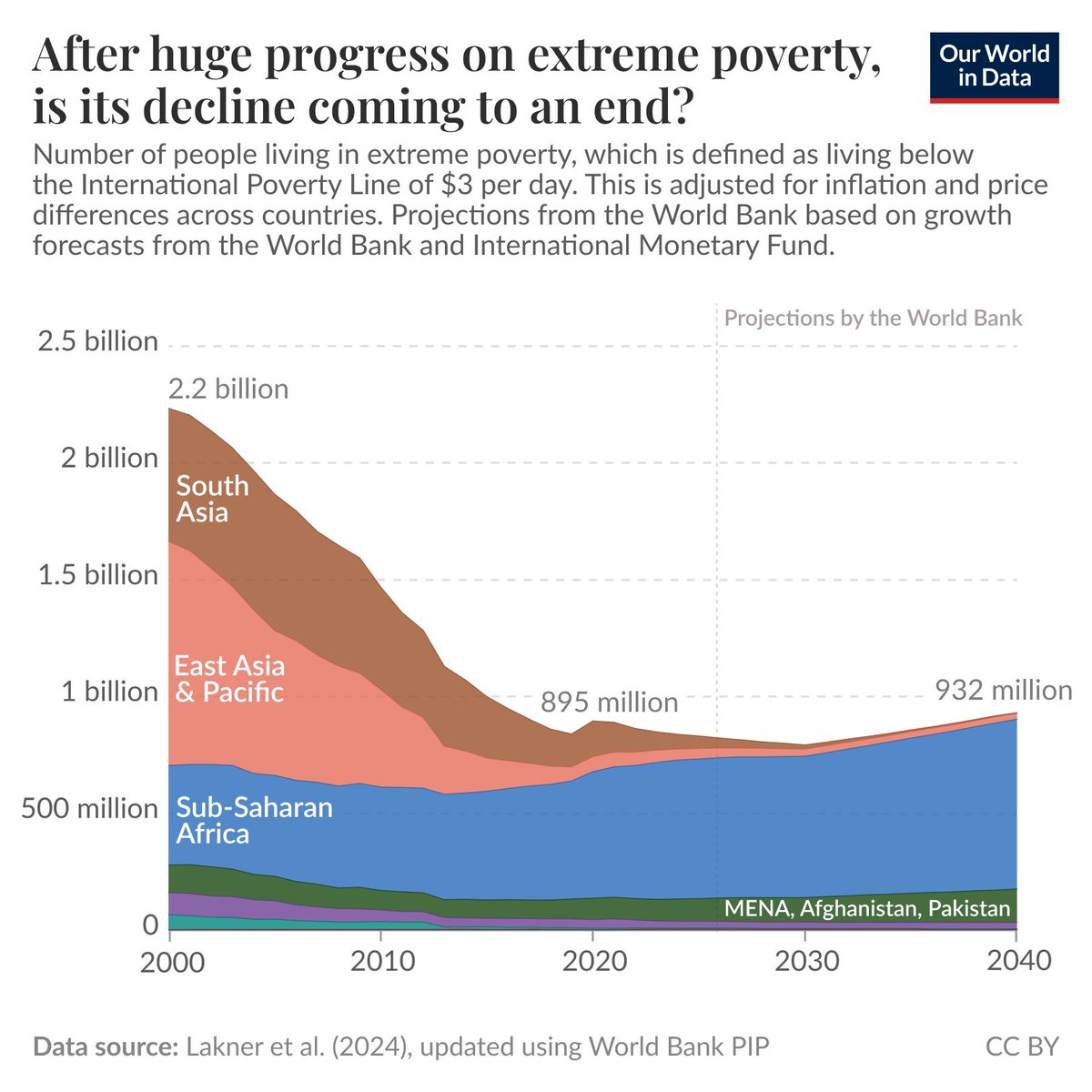
At the turn of the millennium, 2.2 billion people in the world lived in extreme poverty. In international statistics, this means they survived on less than $3 per day (in today’s money). In the two decades that followed, this number more than halved. You can see this decline in the chart. This huge reduction was driven by rising incomes and poverty alleviation across East and South Asia. In Sub-Saharan Africa, the opposite happened: while the share living in extreme poverty declined, the total number increased. Looking ahead, based on the latest available projections from researchers at the World Bank, this reduction in global extreme poverty is expected to end. In fact, numbers in 2040 might be higher than they are today. This is because most of the extremely poor today live in countries with stagnant economies. If these do not see much stronger economic growth, the world will have nearly one billion living in dire poverty for decades to come. Note that these projections are based on the latest growth projections from the World Bank and the IMF. From 2031 onward, poverty projections are based on the average growth rates observed from 2015 to 2024. (This Data Insight was written by @_HannahRitchie)
Our World in Data tweet media
English
10
65
212
29.5K
Liberté Académique retweetet
Human Progress
Human Progress@HumanProgress·
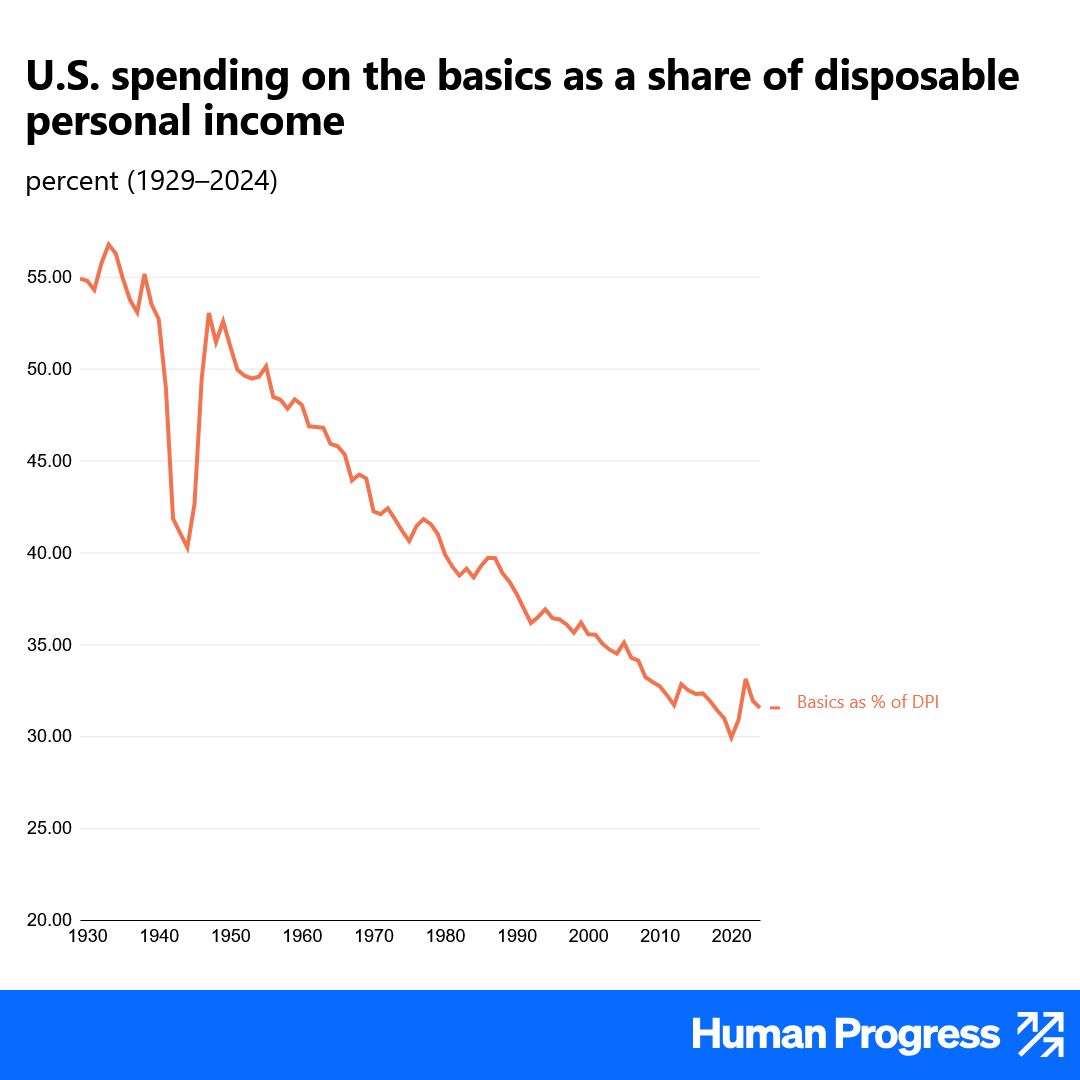
Economic progress isn't just about earning more; it's about how much of your income is left over after covering the basics. In 1929: the average American spent 55% of disposable income on food, clothing, housing & other essentials. In 2024, that was 32%.
Human Progress tweet media
English
7
49
274
15.1K
Liberté Académique retweetet
Bo Wang
Bo Wang@BoWang87·
This is really cool (and wild): Scientists simulated a complete living cell for the first time. Every molecule, every reaction, from DNA replication to cell division. The paper (Luthey-Schulten et al., Cell 2026, doi.org/10.1016/j.cell…), just out today, used JCVI-Syn3A — a synthetic minimal bacterium with fewer than 500 genes. A 3D+time simulation of the full 105-minute cell cycle: DNA replication, protein translation, metabolism, division. Every gene, protein, RNA, and chemical reaction tracked through physical space. It took years to build. Multiple GPUs. Six days of compute time per run. And this is the simplest possible cell. A human cell has ~20,000 genes. It lives in tissue. It interacts with neighbors. It differentiates. It responds to drugs in ways that depend on context we haven't fully measured. Mechanistic simulation of the minimal cell costs 6 GPU-days for 105 minutes of biology. You cannot scale that to human cells. The complexity isn't 40x harder. It's exponentially harder. This is why the field pivoted to data-driven models. You can't hand-encode the regulatory wiring of a human hepatocyte. But you can learn it — if you have the right perturbation data collected across enough diverse biological contexts. The two approaches aren't competing. Papers like this generate the ground truth that future ML models need for validation. But the path to a clinically useful virtual cell runs through foundation models, not through scaling up mechanistic simulation. Amazing work!
English
72
528
2.2K
284.9K
Liberté Académique retweetet
Steven Pinker
Steven Pinker@sapinker·
The Grim Truth About the “Good Old Days” by Chelsea Follett @chellivia (one of the best essays debunking pristine antiquity). "A popular saying holds that “the past is a foreign country,” and based on recorded accounts, it is not one where you would wish to vacation. If you could visit the preindustrial past, you would likely give the experience a zero-star rating." open.substack.com/pub/humanprogr…
English
0
53
283
38.2K