@adamfinley.bsky.social

884 posts

@adamfinley.bsky.social banner
@adamfinley.bsky.social

@adamfinley.bsky.social

@AdamF_Astro

ESA Research Fellow at ESTEC. Investigating the Sun's magnetic activity, solar wind connection science, and the spin-down of Sun-like stars. Prev. CEA, Exeter.

Noordwijk, Netherlands Beigetreten Haziran 2012
620 Folgt1.9K Follower
Angehefteter Tweet
@adamfinley.bsky.social
@adamfinley.bsky.social@AdamF_Astro·
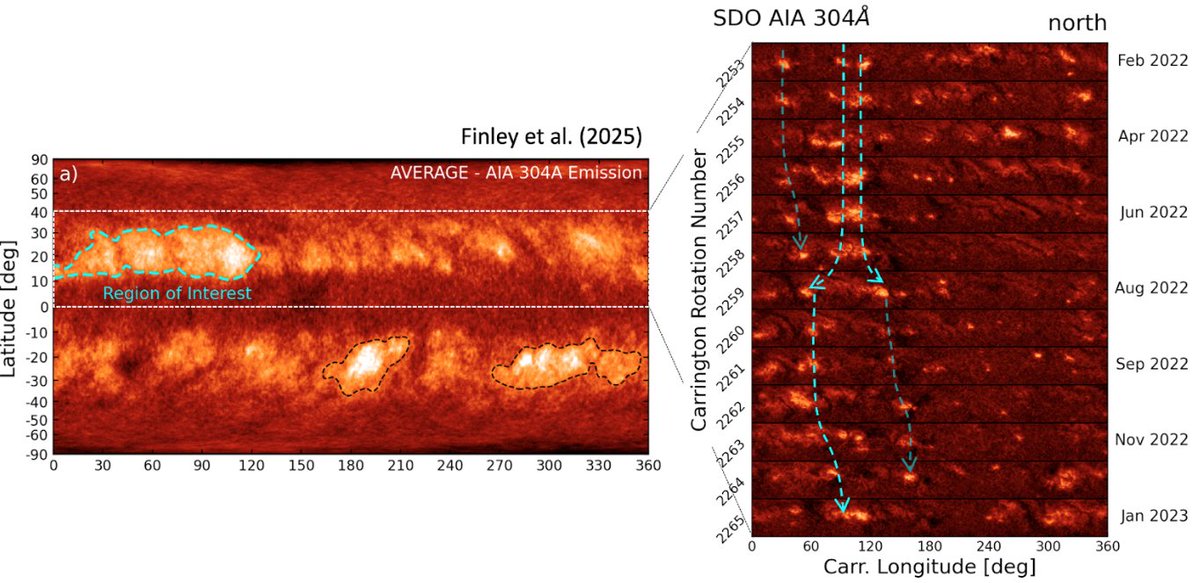
Solar Orbiter Nugget @esascience about our recent active region nest study. We used Solar Orbiter as a far side observer from April to October 2022 to survey magnetic activity over the entire solar surface. This shed light on the nesting of active regions: cosmos.esa.int/web/solar-orbi…
@adamfinley.bsky.social tweet media
English
0
2
13
673
@adamfinley.bsky.social retweetet
European Space Agency
3️⃣ solar prominence eruptions captured by Proba-3️⃣ This animation resulted from ASPIICS observing the Sun during an active period on 21 September 2025, with one image taken every five minutes, capturing three prominence eruptions in five hours. 🔗 esa.int/ESA_Multimedia… @esascience @esaoperations @isro @NASA
GIF
English
22
193
672
29.8K
@adamfinley.bsky.social
@adamfinley.bsky.social@AdamF_Astro·
Are you (or do you know of) an undergrad with an interest in solar physics? Check out the Leiden/ESA Astrophysics Program for Summer Students. Myself, Andy To and Henrik Eklund invite you to come work with us at ESTEC on "Catching the Solar Wind in Action" #none" target="_blank" rel="nofollow noopener">leaps.strw.leidenuniv.nl/#none
English
0
0
1
198
@adamfinley.bsky.social
@adamfinley.bsky.social@AdamF_Astro·
New paper day! 🔥 George Cherry et al. use the Most Significant Frequency decomposition to investigate shocks, jets, and swirls in the Sun's atmosphere. The contribution of 3.5 and 5 mHz signals is up to 50% of the overall wave power. Published in A&A: aanda.org/articles/aa/fu…
@adamfinley.bsky.social tweet media
English
0
1
3
155
@adamfinley.bsky.social retweetet
@travis-metcalfe.bsky.social
@travis-metcalfe.bsky.social@travis_metcalfe·
It took 10 years to trace Weakened Magnetic Braking back to it's root cause (the collapse of the global stellar dynamo), but next week at #AAS247 you can hear me explain how we did it in less than 10 minutes! Thursday, January 8th at 10:10am in room 222C. submissions.mirasmart.com/AAS247/Itinera…
@travis-metcalfe.bsky.social tweet media
English
1
3
8
338
@adamfinley.bsky.social retweetet
European Space Agency
🔭 Until now, observing the inner regions of the Sun’s enigmatic atmosphere – the corona – was close to impossible. 🛰️🛰️☀️ The satellite duo making up our Proba-3 mission fills this observation gap by creating artificial solar eclipses in orbit. 🔗esa.int/Enabling_Suppo…
GIF
English
8
56
239
19.1K
@adamfinley.bsky.social
@adamfinley.bsky.social@AdamF_Astro·
The Alfvén radius is linked to the solar wind mass and magnetic flux. The wind magnetisation parameter (~ratio of mag/mass flux), is used to understand this scaling. Our results follow the trends from MHD wind simulations, but had an offset due to 3D effects and turbulence. (5/5)
@adamfinley.bsky.social tweet media
English
0
0
3
133
@adamfinley.bsky.social
@adamfinley.bsky.social@AdamF_Astro·
The evolution of the coronal magnetic field during the solar cycle, strongly influenced the magnetic connectivity of PSP. Near minimum, the wind measured by PSP originated closer to the Sun's poles. Towards maximum activity, wind sources moved towards the active latitudes. (4/5)
English
1
1
7
165
@adamfinley.bsky.social
@adamfinley.bsky.social@AdamF_Astro·
Side project day! NASA's Parker Solar Probe (PSP) has been exploring the near-Sun enviroment since the start of solar cycle 25. Now passing maximum activity, how has the shape and size of the Sun's Alfvén surface evolved since? arxiv.org/abs/2509.07088 (1/5)
@adamfinley.bsky.social tweet media
English
1
2
8
464
@adamfinley.bsky.social
@adamfinley.bsky.social@AdamF_Astro·
New paper day! Metcalfe et al. review the evidence for weakened magnetic braking by homogenizing the stellar parameters from previous studies that constrained the wind braking of stars with observed magnetic fields and x-ray fluxes (proxy for mass-loss): arxiv.org/pdf/2509.03717
@adamfinley.bsky.social tweet media
English
0
0
10
266
@adamfinley.bsky.social
@adamfinley.bsky.social@AdamF_Astro·
Looking at this swirling feature in the solar atmosphere, revealed that the viscous heating along the swirl boundary was linked with the breakdown of coherent oscillations in the swirl. This method provides a new pathway to investigate wave activity in the solar atmosphere. (4/4)
@adamfinley.bsky.social tweet media
English
0
0
2
92
@adamfinley.bsky.social
@adamfinley.bsky.social@AdamF_Astro·
Using this approach, horizontal slices of a realistic solar atmosphere were decomposed into their most significant frequencies. A biproduct of this method, the highest frequency bin highlights dissipation/shocks. This is especially clear at swirl boundaries. (3/4)
@adamfinley.bsky.social tweet media
English
1
0
3
105
@adamfinley.bsky.social
@adamfinley.bsky.social@AdamF_Astro·
New paper day! 🔥 George Cherry et al. develop the Most Significant Frequency/Wavenumber method for detecting wave activity in realistic magnetohydrodynamic simulations of the Sun's atmosphere. Published in A&A: aanda.org/articles/aa/fu… (1/4)
@adamfinley.bsky.social tweet media
English
1
0
4
163
@adamfinley.bsky.social retweetet
Halo CME
Halo CME@halocme·
A gorgeous prominence eruption that took place this morning. This animation shows the benefit of EUV imagers with larger fields of view. SUVI on GOES was designed and built by the team I belong to.
English
6
141
425
38.6K
@adamfinley.bsky.social
@adamfinley.bsky.social@AdamF_Astro·
Solar Orbiter Hackathon, 17–21 November 2025 at ESA/ESTEC (Noordwijk, NL). 20 ECRs (PhD and postdoc) will form 5 teams lead by mentors. This is a great chance to connect and collaborate on Solar Orbiter science! For more information: cosmos.esa.int/web/solar-orbi… Deadline: 5th Sept.
English
0
4
6
553
@adamfinley.bsky.social
@adamfinley.bsky.social@AdamF_Astro·
Here's a comparison of the coronal magnetic field from solar minimum (Dec 2019) and now at solar maximum. The dipole component of the Sun's magnetic field is visibly inclined to the rotation axis.
English
0
4
10
302
@adamfinley.bsky.social
@adamfinley.bsky.social@AdamF_Astro·
Observe the stability of the positive-negative sectors over the last five rotations, with two nested active regions (black contours) anchoring the heliospheric current sheet. Solar flares are shown with coloured markers. The dipole axis just started to move away from the equator.
@adamfinley.bsky.social tweet media
English
1
0
7
191
@adamfinley.bsky.social
@adamfinley.bsky.social@AdamF_Astro·
What might we expect to see during @ESASolarOrbiter's upcoming remote-sensing windows; now with an inclined orbit. Here's the PFSS connectivity during the remote-sensing window of spring 2026 (17th Feb to 6th Mar), using the current coronal magnetic field and in-situ wind speeds.
English
1
5
18
544