
Angehefteter Tweet
Nodify_♐
1.6K posts


Nodify_♐
@Al96367Md
Trading tips, crypto flips, and NFT trips 🎨 | Web3
Beigetreten Kasım 2025
395 Folgt389 Follower

Nodify_♐ retweetet

Good evening X fam 🌙
Crypto is not just something to hold anymore
With @KoloHub you can spend it in real life anytime anywhere Visa is accepted
Tap pay done no friction no stress
From coffee to big purchases your crypto is always ready
Stay consistent stay building and keep moving forward 🚀
#Kolo

English
Nodify_♐ retweetet

A few months ago, I tried something small.
Instead of just reposting a project, I broke it down for one person in my DMs. I explained it slowly, like I was teaching a younger sibling. I even used voice notes because I knew text wouldn’t be enough.
Two days later, that same person explained it to someone else, in their own words.
That’s when it clicked for me.
Real influence is not how many people see your post. It is how many people actually understand it well enough to pass it on.
But most platforms don’t reward that.
They reward speed, repetition, and scale. You can say very little, but say it loudly, and still win.
That’s why what @RallyOnChain is doing feels different, especially with the recent updates.
Take the Minimum Sorsa Score.
This one quietly fixes a problem many people ignore. It sets a baseline for quality before your work even starts building reputation.
So instead of flooding the system with surface-level content, you are pushed to actually understand what you are writing.
It reminds me of school exams where you couldn’t just show up and guess your way through. You needed a certain level of understanding before your score even mattered.
Then there is the Max Winners per period.
This is where things shift from fair to intentional.
If you have ever been in a group project where everyone gets the same grade regardless of effort, you know how frustrating that feels.
Rally does the opposite.
It narrows rewards to the strongest contributions, so the people who think deeper, explain better, and connect ideas clearly are the ones who stand out.
And what stands out to me personally is how fast these changes came in.
People pointed out issues. Bots, farming, low-effort submissions.
Instead of ignoring it, Rally responded with real actions. Manual banning, referral fixes, stronger quality filters.
That tells me this is not just a system running on autopilot.
It is a system being actively shaped with its community.
Under the hood, everything supports this direction.
GenLayer handles the AI evaluation through intelligent contracts. Base and zkSync Era handle distribution. Campaign funds sit in escrow, rewards are calculated transparently, and every payout can be verified onchain.
So when you put in effort, it is not filtered through someone’s bias.
It is measured, scored, and rewarded based on what you actually contributed.
For creators who care about being understood, not just seen, that difference is huge.
And it is why this feels like a move toward something more fair, more precise, and more aligned with how real influence works in everyday life.

English
Nodify_♐ retweetet

I keep a small notebook where I break down anything I’m trying to understand.
Not tweets. Not threads. Just rough explanations in my own words.
One evening, I compared two pages.
One was a rushed summary I copied from online. The other was something I took time to explain properly, using a simple example from my day.
Days later, I could still remember the second one clearly.
That difference is exactly what most platforms fail to recognize.
They reward speed, repetition, and visibility.
Not understanding.
That’s why the recent updates from @RallyOnChain stand out to me.
The Minimum Sorsa Score changes the entry point completely.
It means you can’t just show up and farm reputation with surface-level content. Your work has to meet a certain level of clarity and quality before it even counts.
It feels like a real filter for understanding, not just activity.
Then the Max Winners per period pushes it further.
Instead of spreading rewards thin across a crowd of average posts, it concentrates value on the strongest contributions.
Think of it like a small study group where only the people who can actually explain the topic clearly get recognized, not everyone who attended.
That changes how you approach writing.
You slow down. You think deeper. You focus on making your explanation stick.
What makes this even more convincing is how these updates came in.
People pointed out bots, farming, and low-effort content. Rally responded with manual banning, improved referral rules, and stricter quality thresholds.
That tells me the system is not static. It listens and adjusts.
Underneath, everything is structured to support fairness.
GenLayer runs the AI evaluation through intelligent contracts, scoring content across alignment, accuracy, originality, and engagement. Base and zkSync Era handle distribution, with funds secured in escrow and rewards paid transparently onchain.
So when someone earns, it’s not because they found a shortcut.
It’s because their work actually holds up.
For anyone who values clarity over noise, this kind of system doesn’t just feel better.
It finally feels honest.

English
Nodify_♐ retweetet

A structural shift is emerging in Web3.
AI agents are no longer experimental, they are operating with real autonomy. They can hold funds, execute trades, pay for services, and interact with on-chain protocols without constant human oversight.
This evolution introduces a new category of risk that remains under-addressed.
Agent-controlled wallets are not isolated systems. They often operate across multiple users, strategies, and integrations. As a result, a single point of compromise can scale far beyond an individual loss.
If a trading agent is exploited, the impact can extend across every user relying on it.
If a payment agent is injected with malicious logic, it can execute harmful transactions at scale.
This is not theoretical. The increasing complexity of agent architectures is already exposing gaps in wallet security, as highlighted by firms like CertiK.
The implication is clear: security models must evolve alongside autonomy.
Reactive tools and manual oversight are no longer sufficient in an environment where execution is continuous and machine-driven. What is required is an equally autonomous defense layer.
This is where @CerbAgent and CERB come into focus.
Rather than relying solely on monitoring or alerts, it introduces security agents designed to actively protect wallets, including those operated by other agents. From pre-transaction analysis to real-time threat detection and automated intervention, the objective is to reduce risk before it materializes.
As AI agents take on a greater role in managing capital, securing them becomes foundational.
$CERB is built on that premise: if intelligence is automated, security must be equally autonomous.

English
Nodify_♐ retweetet

The Future of Ethereum Scaling Is Being Built on @ZKsync ...
Most blockchains are still forcing users to choose between speed, cost, and security.
is proving you don’t have to compromise.
Built on zero-knowledge technology, @zksync delivers..
→ Fast transactions
→ Low fees
→ Ethereum-level security
→ A smoother user experience for mainstream adoption
And that last part matters most.
Because crypto doesn’t reach billions of users with complicated wallets, expensive gas fees, and slow confirmations.
It reaches billions through seamless UX.
That’s why ZKsync’s native account abstraction is such a game changer:
• easier onboarding
• flexible transactions
• smarter wallets
• Web2-level simplicity on Web3 infrastructure
While most chains compete for attention, ZKsync is competing for permanence.
The smartest builders already understand where the industry is heading:
Infrastructure wins long term.
DeFi. Gaming. Payments. AI-powered apps.
The next generation of Ethereum applications needs scalability that actually works.
@zksync is quietly becoming one of the strongest foundations for that future.
The next phase of crypto won’t be built on hype alone.
It’ll be built on technology users don’t even notice because it just works.
English
Nodify_♐ retweetet

For years People say:
“Bitcoin can’t do smart contracts.”
But what if that’s wrong?
Bitcoin is the largest asset in crypto —
yet its ecosystem is tiny.
Less than 1% of BTC’s value is used on-chain. OP_Cat could change that.✅
@op_catlayer Full interview👇
English
Nodify_♐ retweetet

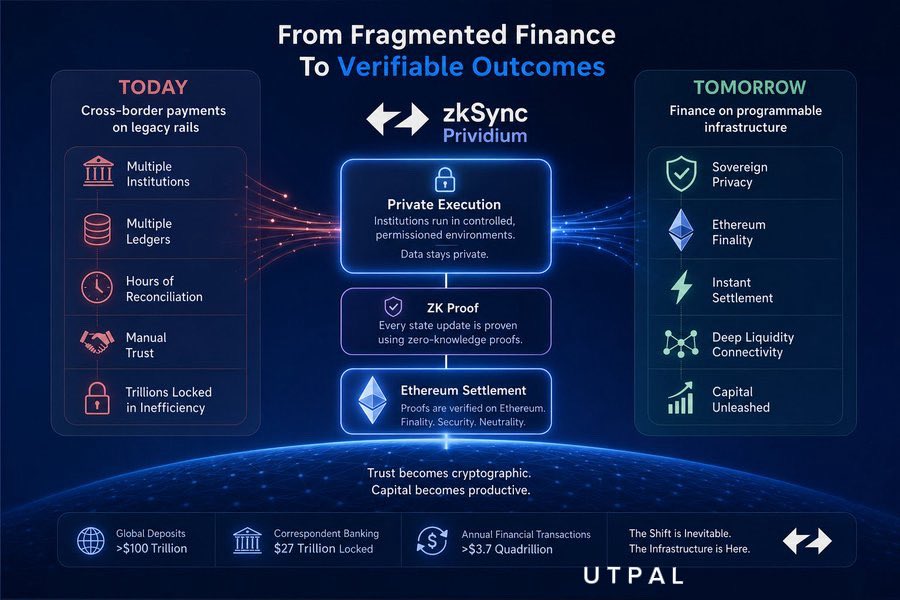
Traditional finance runs at massive scale but still relies on outdated infrastructure. Correspondent banking ties up huge pre funded capital, global deposits exceed $100 trillion, and annual transaction volumes hit the quadrillions. Settlement depends on chains of intermediaries, delayed reconciliation, and idle capital locked across separate systems.
Banks cannot simply use most existing blockchains. They need privacy to protect sensitive activity, control over their execution environments for compliance, verifiability without trusting an operator, and real connectivity to counterparties plus liquidity. Most architectures fall short on at least one of these.
Prividium from @zksync meets all four at once. As a permissioned ZK chain (Validium model), execution and data stay inside institution-controlled environments. Only zero-knowledge proofs and state commitments go to Ethereum for cryptographic verification and finality. This enables private regulated workflows, institutional oversight, selective disclosure for auditors, and native access to Ethereum’s ecosystem.
Adoption is already happening. Cari Network connects five U.S. regional banks with over $600 billion in combined deposits. Deutsche Bank is building its Memento ZK Chain, ADI Chain is live with First Abu Dhabi Bank, and 35+ institutions are actively evaluating.
As more join, the network compounds: each new participant adds more direct settlement corridors, improving coordination and capital efficiency across the board.
A practical infrastructure upgrade grounded in real institutional needs. @zksync
English
Nodify_♐ retweetet

The Infrastructure Paradox: Why Traditional Finance is Moving to ZKsync
The global financial system manages a staggering scale of value. In 2025, daily foreign exchange (FX) settlement averaged approximately $7.9 trillion, while cross-border payment flows are projected to reach $250 trillion annually by 2027
Yet, beneath these massive figures lies an aging architecture of correspondent banking, manual reconciliation, and fragmented ledgers
For institutions, the "onchain" transition is no longer a matter of if , but how
Traditional blockchains, however, present a paradox: their greatest strength transparency and decentralization is a non starter for regulated entities.
The Institutional Barrier
Institutions cannot simply deploy on public, permissionless chains. Their requirements are rigid and non-negotiable:
1. Privacy: Sensitive trade data, counterparty identities, and balance sheets cannot be public.
2. Control: Compliance requires the ability to manage execution environments and enforce role-based permissions
3. Verifiability: They must prove the validity of transactions without relying on a third-party operator or exposing the underlying data
4. Connectivity: Private silos are useless; they need a "network effect" to access liquidity and settle across counterparties
Most architectures force a trade-off. Private sidechains offer control but lack trustless verification. Public chains offer verification but lack privacy. Prividium, built by @zksync, solves this by leveraging zero-knowledge (ZK) technology
Prividium: The Architecture of Regulated Finance
Prividium is a specialized ZK Chain designed as a Validium. It allows institutions to keep transaction data and execution entirely offchain within their own firewalled environments while publishing only a cryptographic proof to Ethereum
By using ZK as the native asset for the ZKsync Gateway, the network bundles these institutional transactions into proofs that settle on Ethereum. This creates a unified settlement layer where a bank in New York can settle with a counterparty in Frankfurt with the same finality and security as an Ethereum mainnet transaction, but without exposing the details of the trade to the world
Real-World Momentum:
This is not theoretical. As of 2026, the migration is actively unfolding:
The Cari Network: Five major U.S. regional banks including Huntington ($225B assets) and M&T Bank ($214B) have integrated Prividium to power a tokenized deposit network
This allows for instant, 24/7 commercial payments across a combined asset base exceeding $700 billion.
Deutsche Bank: Through "Project Memento," the bank has developed a ZK Chain on ZKsync for tokenized fund management, moving away from legacy settlement cycles that traditionally took T+2 days.
ADI Chain: Currently live with First Abu Dhabi Bank, demonstrating that the demand for ZK-based infrastructure is a global phenomenon.
The Network Effect of $ZK
The value of a financial network is a function of its connections. In the legacy world, adding a new settlement corridor requires months of legal and technical integration
On @zksync, every new Prividium instance increases the potential settlement paths
As governance driven fee structures for ZK evolve, the token sits at the heart of this expanding web. By providing the "stem cell" economic design for the gateway, ZK ensures that as institutional volume grows, the infrastructure remains sustainable, decentralized, and governed by the participants themselves
The shift to ZK powered infrastructure represents the transition from probabilistic settlement (waiting for reconciliation) to deterministic settlement (verified by mathematics)
For a $250 trillion market, that is the only logic that scales

English
Nodify_♐ retweetet

Nodify_♐ retweetet

Good night Lookz✨
When you make a post it is like a moment, in time.
Posting things is good. Staying active is what really builds continuity over time.
I think about this on 3look and I realize that continuity is what really matters to people.
The reason is that you do not get results from doing something one time @3look_io
Results come from doing things times, which is called repeated participation.
The only way you can have repeated participation is if you stay active and keep doing things all the time.

English
Nodify_♐ retweetet

"I did not approve whatever that was" 😭😭 Stevo's face when he said it ehn. The man was tired. 😂
LinersAfrica@LinersAfrica
We've seen the conversations, the screenshots and the questions. Here's the official context. Wasiu did NOT act on approval and Liners is NOT in the business of randomly flagging brands.
English
Nodify_♐ retweetet

Nodify_♐ retweetet

Most social platforms reward visibility for a moment
then reset everything back to zero the next day
@XOOBNetwork is building a different model where influence compounds through consistency not temporary reach
With xoob.link every post feeds into ImpactShare creating a long term reputation layer shaped by contribution relevance and sustained activity
Instead of chasing impressions users build measurable influence over time
a system where attention becomes structured value rather than short lived exposure
The interesting part is that $XOOB shifts social presence from performance into infrastructure
your content is no longer just seen
it becomes part of an evolving credibility graph

English
Nodify_♐ retweetet

Nodify_♐ retweetet

Nodify_♐ retweetet

Something strange is happening in Web3 right now.
While most creators are still grinding for points, hoping for a future airdrop, a small but smart group is quietly getting paid in stablecoins.
You probably won’t believe this, but it’s happening on @RallyOnChain.
I joined early, tested a few campaigns, and expected the usual Web3 loop. Post, grind, wait, maybe something happens. Instead, payouts started landing. Real stablecoins like USDC and USDT.
No speculation. No guessing. No ifs or buts. I’ve already made around $50 just by participating in campaigns, and new ones keep dropping.
It feels like finding out people were getting paid cash for handing out flyers while everyone else was volunteering for exposure. Same effort. Completely different outcome.
Since then, I’ve participated in multiple campaigns and watched how few people are paying attention. Early creators are stacking while the majority is still farming promises.
This feels like one of those windows that only stays open for a short time. Once everyone realizes creators are getting paid directly for distribution, the opportunity won’t look the same.
Rally is paying creators in stablecoins as we speak. Not later. Not tomorrow. Not maybe.
How long are you going to keep posting for free while others are getting paid?
Don't make the mistake of waiting until it's too late. Some opportunities knock at your door only once.

English
Nodify_♐ retweetet

Nodify_♐ retweetet

There's a pattern to how financial infrastructure actually gets built, and it never starts with the technology, it starts with one institution making a decision that makes it easier for the next one to make the same decision.
That's exactly what's happening inside @zksync right now.
Eugene Ludwig spent years as the 27th U.S. Comptroller of the Currency understanding what institutions actually need to move.
When he built Cari Network on ZKsync and brought five U.S. regional banks carrying $600B+ in combined deposits into that architecture, it wasn't a bet on technology, it was a judgment call from someone who has spent a career knowing the difference between infrastructure that works for institutions and infrastructure that merely works.
Deutsche Bank made its own call with Memento. First Abu Dhabi Bank went live through ADI Chain. BitGo integrated. 35+ institutions are in active evaluation, and each one watching the ones ahead makes the next decision slightly easier to reach.
This is how networks grow, not through announcements but through the quiet logic of each new participant making the next one more likely.
Ten institutions create 45 connections between them, a hundred creates nearly 5,000, and every connection adds liquidity, counterparty reach, and settlement efficiency for everyone already inside while making the cost of staying outside steadily higher.
SWIFT didn't mandate its way to 11,000 member banks, it just became the thing too many institutions depended on to leave.
$ZK is the only native asset of the network where this is taking shape, fixed supply of 21 billion, no inflation, governance authority over protocol decisions through the Token Assembly, Security Council, and Guardians, and the gas token for ZKsync Gateway where every ZKsync transaction settles before reaching Ethereum L1.
The institutions inside this network didn't move because they were early adopters, they moved because the architecture finally made sense.
$ZK is the asset at the center of the network they chose.

English
Nodify_♐ retweetet

Gasless is nice. But that's not the real flex.
Here's what actually makes @NomismaNetwork different : Each dApp runs on its own subchain. Dedicated resources. Congestion doesn't spill over.
Add relational onchain data + built-in MEV resistance. Data, execution, and fairness finally in one system.
That's still a gap in most DeFi stacks.
Then @XOOBNetwork connects :
→ XOOB = attention + user flow
→ Nomisma = structured activity inside the system
Not fragmented usage. A loop where attention → activity → positioning keeps compounding.
That's the actual edge.

English
Nodify_♐ retweetet
