

@0xrahulweb3 @QuintenFrancois They got 128 subnets. Each subnet has a different use case. All focused on their specific ai solution
English
Alex Lynch
2.7K posts

@AlexInTAO
Yo look at that $TAO #SN78 #SN82




We’ve been saying we’re building. As we step into April, it’s time to tick off Q1: memory, agent architecture, and core systems in place. From here, the system starts to expand into personas, inference, and cognition. Step by step, it’s coming together.

Dagenlang moesten we dat gejank van extreemrechts hier lezen over hoe de iftars ons 'opgedrongen' wordt, maar ik heb nog geen traan gezien over het feit dat de NPO ons al weken lang die domme Passion opdringt met reclame en elke dag n kwartier propaganda na het 8u journaal.

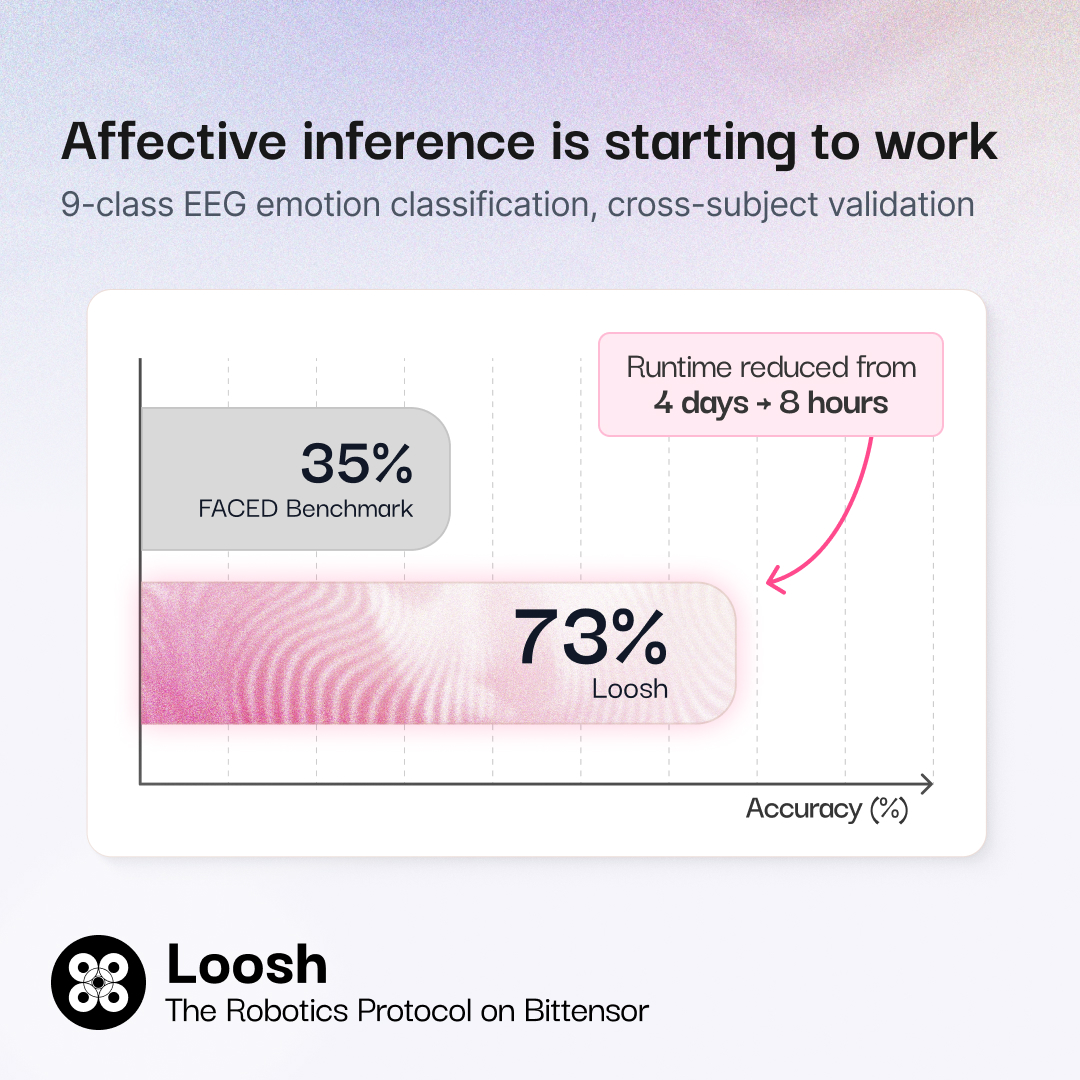


Been quiet. Not inactive. We have been heads down shipping across five major areas: 1. Winner takes more - We are introducing weighted challenge routing to reward the inference behavior we actually want. Higher quality miners get more flow. Sybils get less, or none. 2. Miner DDoS hardening - We are adding comprehensive DDoS protection to the miner codebase to improve resilience under hostile conditions. 3. User Memory - We are building per user memory across the agent stack with strong protections against cross user leakage and data contamination. 4. Benchmarking - We are building a dynamic benchmarking engine to run prompt batteries over time and compare performance against base models and prior system states. 5. Dynamic Execution - We are adding a new cognitive mode built around dynamic plan generation and narrow task-specific subflows. The goal is lower hallucination rates and more reliable execution. What to look forward to: Better subnet quality Stronger Sybil resistance More resilient miner infrastructure Persistent user memory with tighter safety boundaries Clearer performance benchmarking over time More reliable agent execution We are not slowing down. We are tightening the system. Preparing for conversations with customers.


Bittensor >> $TAO >> $dTAO Subnet 78: Loosh @Loosh_ai @lisacheng @AgenticToaster While everyone is celebrating the growth of Bittensor, there is another reality playing out in the background. The competition is extremely fierce. Sometimes even… unfair. Some teams are here to build. Others are here to extract value as fast as possible. And too often, the system does not clearly differentiate between the two. Today, Subnet 78 – Loosh AI is at risk of being deregistered. Let’s be clear about something: 👉 Your $TAO is not just an asset. It is a vote. And right now, token holders are deciding, consciously or not, which teams live… and which disappear. This raises a fundamental question: Do you want to support builders… or watch them vanish before they can deliver? Because that is exactly what is happening. Too many teams disappear not because they lack vision, not because they lack execution, but because the market never took the time to understand them. And that is a problem. What makes Loosh particularly interesting is this: 👉 They are part of the Yuma Accelerator. Which means: they have been reviewed they have been selected they have been considered as having potential So the question is simple: Where is the support when it matters most? If a project has potential to bring value to the network, shouldn’t it be supported when it is under pressure? So I’m asking openly: 👉 @BarrySilbert 👉 Yuma Accelerator @YumaGroup @EvanMalanga @GSchvey @jeff_schvey Do you deeply believe in Subnet 78 – Loosh AI? If yes, this is the moment where that belief should be visible. Because behind rankings, emissions, and dashboards, there are teams building things that could matter long term. And if Bittensor wants to become more than a short-term game, this question cannot be ignored. Loosh said it clearly: “If you understand asymmetric upside, you understand the setup.” The question is: Does the network still know how to recognize it?
Robotics is scaling, but the next bottleneck is not hardware. More than 500,000 industrial robots are deployed globally each year, yet most of that deployment still sits inside structured environments: factories, warehouses, and tightly bounded workflows where conditions are repeatable and variance is limited. The larger opportunity sits outside those environments, in hospitals, homes, hospitality, and other mixed human spaces where conditions are dynamic, objectives are not always aligned, and ambiguity is part of the operating environment. That is where the constraint shifts. Perception, locomotion, and manipulation continue to improve, but physical capability alone does not solve for context. The harder problem is how a machine evaluates tradeoffs, interprets situational nuance, and responds appropriately when the environment is underspecified and the stakes are human. What is missing is a reasoning layer that can operate under real-world ambiguity. That layer has to support persistent memory, emotional inference, contextual interpretation, and learning across time. These are not peripheral features. They are part of the core cognitive infrastructure required for robots to function reliably in human environments. That is the layer Loosh is building.

Team is locked in We just pushed another update to the validators: - DDoS mitigation - Validator IP tracking - Challenge API auth github.com/Loosh-ai/loosh… AMA tomorrow. pull up

Hey Bittensor, We have spent the last week deep in the validator codebase improving scoring, consensus, and subnet quality while incorporating a lot of community feedback. That work was necessary and it has already made things better. Yes we are ranked last but our broader mission has not changed. Earlier this month, we had a call with a board member of a publicly traded robotics company about a pilot program. The goal is to benchmark our cognition stack for integration into robotics systems that need to reason about behavior, context, and response in real world environments. That is what we focusing on now. Tightening the subnet. Complete the benchmark data. Move toward deployment. We are still building, still iterating, still moving toward something we believe matters and we still believe in TAO. If you believe robotics will need more than raw model output, if you believe judgment and behavioral reasoning are missing layers, pay attention to what we are building. Thank you to everyone who has given feedback, encouragement, and support. We have taken it seriously. Bittensor is competitive. Sentiment matters. Ranking matters. We know where we are. But if you understand asymmetric upside, you understand the setup. We are still here. We are still building. Now we push.


