

𝘛𝘦𝘯𝘴𝘰𝘳𝘍𝘭𝘰𝘸 ττ
4.7K posts

𝘛𝘦𝘯𝘴𝘰𝘳𝘍𝘭𝘰𝘸 ττ
@Tensor_Flow_
Decentralized Intelligence | Bittensor ττ | Privacy • Freedom • Community . What they centralize, Bittensor distributes⚡⚡
U.K Katılım Şubat 2021
278 Takip Edilen444 Takipçiler

Holy moly.
@theminos_ai 🤝 @OpenAI
bittensor:native
Minos@theminos_ai
Proud to share: we co-authored a new paper with @OpenAI on scientific computing in the age of agentic AI. HelixForge, our GPU-native engine for generating synthetic genomes, is featured as the study’s most ambitious and complex system. An entirely new architecture, built from the ground up. Minos is building the infrastructure for the age of AI in genomics.
English

This tweet and all the other tweets that are quoted made me understand why Bittensor changes its protocol so much.
Const & OTF have the HARDEST incentive mechanism to fine tune, against sn owners who can earn finite $TAO emissions without producing output to the world. Without that incentive mech proper,
Subnets will not earn in a fair way for the work outputted, which will fail to attract talented miners & new subnet startups inside our ecosystem
Loved reading this @allan_quantifi goodjob!
Allan@allan_quantifi
Bittensor is itself a subnet. And what does a subnet do? It continuously adjusts its incentive mechanism until the interests of participants align with the outcome it is trying to produce. For Bittensor, that outcome is simple: allocate capital as efficiently as possible toward the subnets creating the most value. So when the protocol changes its rules, it doing exactly what every subnet is supposed to do: refining its incentive mechanism as it learns what works, what gets exploited, and what produces the best outcome. You can debate the direction, the speed, or the execution of each change. But (in my view) expecting the rules to remain fixed makes little sense. Asking Bittensor to stop tuning its rules is asking a subnet to stop being a subnet.
English
English

@Tensor_Flow_ @engyai I remember @AlgodTrading discussing that the amount of models provided by chutes is to high to be profitable. Hence, only high demand models will be served on @engyai. Glm 5.5 might be one of them. Although I’d like @totheagi to focus on speed first, before adding extra moddels
English
The amount of +100 TAO buys of SN53 @engyai last 24h is crazy
That’s no simple lunch money
Kimi is the tailwind Bittensor needed
English
@DeSciClaims You could become the blue print for how to launch a subnet under the new upgrade.
Can't wait to see how you navigate the waters. 🫡
English

Upgrade V440 is great news for new teams like us who actually want to build and ship something real.
bittensor.com/releases/v440-…
English

This might be the easiest trade in crypto right now:
On one hand, everyone on my TL is FUDing Opus 5 for being unreliable and expensive.
On the other hand, Engy (subnet 53 on Bittensor) is about to serve frontier AI at the cheapest rate on earth. And it is trading at $25m mc 🤯
Ning@totheagi
we got the full Kimi K3, 2.8T params, running on 80x RTX 5090s. 20 tok/s single stream, day one, untuned. Last week we took GLM-5.2 from 30 to 110 tok/s on this same fleet. This number will climb. A first for open weights: frontier intelligence served with zero HBM, the scarcest silicon in AI. Just GDDR7 gaming cards, plain ethernet, and the official MXFP4 weights, nothing requantized. The most powerful open model on Earth, on the most abundant GPUs on Earth. Any lab, startup, or university can now own it, probe it, fine-tune it, run agents on it. @Kimi_Moonshot
English
@totheagi This is very clever from the moonshot team.
Surley this means they are keeping the BF16 model for their internal api?
But letting the world enjoy a QAT 4 bit version is genius marketing.
English

we got the full Kimi K3, 2.8T params, running on 80x RTX 5090s.
20 tok/s single stream, day one, untuned. Last week we took GLM-5.2 from 30 to 110 tok/s on this same fleet. This number will climb.
A first for open weights: frontier intelligence served with zero HBM, the scarcest silicon in AI. Just GDDR7 gaming cards, plain ethernet, and the official MXFP4 weights, nothing requantized.
The most powerful open model on Earth, on the most abundant GPUs on Earth. Any lab, startup, or university can now own it, probe it, fine-tune it, run agents on it.
@Kimi_Moonshot

Kimi.ai@Kimi_Moonshot
Releasing the model weights and technical report of Kimi K3. Kimi K3 is our most capable model: a 2.8T MoE model with native visual understanding and a 1M-token context window. New model architecture: 2.5x the intelligence per unit of compute, not just more params. Alongside Kimi K3, we're opening up more of the stack behind it — high-performance attention kernels, MoE communication library, and infrastructure for running agent environments at scale. Model weights: huggingface.co/moonshotai/Kim… Tech report: github.com/MoonshotAI/Kim… Tech blog: kimi.com/blog/kimi-k3
English

$TAO >> $dTAO >> >> releases/v440-upgrade
This May Be One of the Most Important Bittensor Updates of the Year
This update is likely one of the most significant changes Bittensor has seen this year because it fundamentally changes how TAO emissions are distributed, which will ultimately change how the market values subnets.
Here are the key takeaways.
1. From Linear Distribution to Selective Distribution
Until now:
if a subnet represented 2% of network demand,
it received roughly 2% of emissions.
The system was essentially proportional.
That is no longer the case.
Version 440 introduces a new mechanism called the Gate.
It acts as a filter:
subnets well above the threshold keep almost all of their emissions;
subnets near the threshold begin to lose emissions;
subnets below the threshold see their emissions fall rapidly toward zero.
In other words:
quality is rewarded more than simple participation.
2. The Threshold Is Dynamic
The protocol now computes a value called θ (theta).
Theta represents the level of demand required for a subnet to be considered competitive.
It is recalculated every 360 blocks.
That makes the system dynamic:
you can't remain mediocre for long;
maintaining strong demand becomes a continuous requirement.
3. Winners Receive Part of the Losers' Emissions
This is probably the biggest change.
When the Gate reduces a weak subnet's emissions,
those emissions do not disappear.
Instead, they are redistributed to the subnets above the threshold.
The live demo illustrates this perfectly:
roughly 35 subnets sit above the Gate;
together they account for about 43% of total demand;
after redistribution, they receive 60%, and eventually 91%, of the active emissions throughout the pipeline.
In other words:
the strongest subnets become even stronger.
4. Low-Demand Subnets Will Be Heavily Penalized
The document is very clear.
Subnets in the lower tail of the demand distribution will experience:
significantly lower emissions;
reduced validator and miner yields;
declining attractiveness for capital.
This could accelerate the disappearance of projects that fail to generate meaningful adoption.
5. Historical APY Metrics Become Misleading
Taostats and other analytics dashboards will need to update their calculations.
Why?
Because:
emissions ≠ demand
anymore.
Previously:
Demand = Emissions.
Now:
the Gate fundamentally changes that relationship.
Any dashboard relying on the old proportional model will underestimate leading subnets while overestimating weaker ones.
6. Premium Subnets Are Likely to Benefit
The live example uses SN64.
Its demand share is approximately 9.78%.
After redistribution,
it receives 16.63% of total emissions.
That's an increase of more than +6.8% compared to its original demand share.
The same mechanism should benefit other subnets that consistently remain near the top of the rankings.
What This Means for Bittensor
In my opinion, this update changes the philosophy of the network.
The protocol is no longer rewarding popularity alone.
It is rewarding the ability to consistently rank among the best.
This moves Bittensor even closer to a system where capital naturally flows toward the projects creating the greatest value.
If this mechanism performs as intended, several consequences seem likely:
the strongest subnets should receive higher emissions and higher yields;
weaker subnets will struggle more and more to attract validators and capital;
investors will need to become increasingly selective, as the gap between leaders and the rest of the market continues to widen.
This evolution also aligns perfectly with Bittensor's recent trajectory, dTAO, Root Reborn, and continuous improvements to capital allocation. The protocol is gradually moving away from a relatively uniform distribution model toward a true economic meritocracy, where value creation is translated much more directly into emissions, and ultimately into capital allocation.
Source:
➡️ bittensor.com/releases/v440-…
➡️ s3.hippius.com/rufus/public/r…
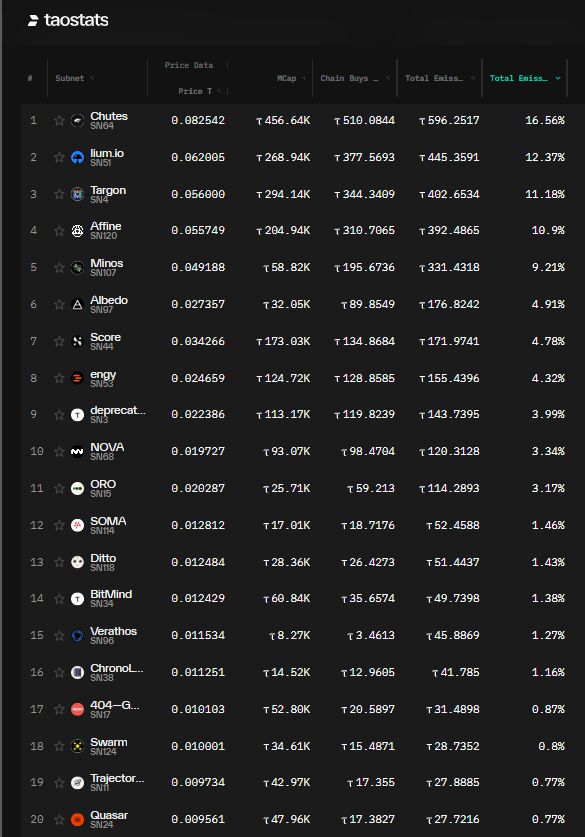
he Top 20 ranked by emissions is starting to look incredibly strong.
I'm seriously thinking about launching a new portfolio built entirely around emission leaders. It should be interesting to see how it performs under the new allocation model.
English


Good luck @AlgodTrading all yours now
Kimi.ai@Kimi_Moonshot
Releasing the model weights and technical report of Kimi K3. Kimi K3 is our most capable model: a 2.8T MoE model with native visual understanding and a 1M-token context window. New model architecture: 2.5x the intelligence per unit of compute, not just more params. Alongside Kimi K3, we're opening up more of the stack behind it — high-performance attention kernels, MoE communication library, and infrastructure for running agent environments at scale. Model weights: huggingface.co/moonshotai/Kim… Tech report: github.com/MoonshotAI/Kim… Tech blog: kimi.com/blog/kimi-k3
English

Quasar is making a major long-term commitment to SN24 by fully locking approximately 130,000 Alpha in the owner wallet.
We were among the earliest teams to test, support, and believe in this conviction.
We are not here for short-term extraction. We are here to build, contribute, and remain fully aligned with the long-term success of SN24.
English
@CryptoZPunisher @Bittensor_Media @QuasarModels @OrionSILX @DreadBong0 @bittingthembits @RvCrypto @SubnetSummerT Many thanks Punisher. And like wise 🙏
English
@Tensor_Flow_ @Bittensor_Media @QuasarModels @OrionSILX @DreadBong0 @bittingthembits @RvCrypto @SubnetSummerT Thanks for the tag!
It's a real pleasure to be on this journey with people like you. And the best part? We're only getting started. 🚀
English
This week could be a huge week for both @QuasarModels SN 24 and @OrionSILX SN 27.
"Quasar’s biggest update yet and a major milestone for decentralized AI training is coming to Novelty Search"
📅 Friday, July 31
⏰ 12:00 AM EEST (GMT+3)
English
@Bittensor_Media @QuasarModels @OrionSILX @CryptoZPunisher @DreadBong0 @bittingthembits @RvCrypto @SubnetSummerT You are wrong fren, all your skills can be used, it sounds like you are way more qualified than me so use your skills the best way you can. Write articles, create videos the world is your oyster.
English

@Tensor_Flow_ @QuasarModels @OrionSILX @CryptoZPunisher @DreadBong0 @bittingthembits @RvCrypto @SubnetSummerT Thank you so so much, Im not as smart as all of you guys though, i don’t have programming skills. I’m a graphic designer and film composer. I’ve done an MA in sound engineering, but that isn’t of any use to Bittensor 😢
English
You are no idiot fren . Here study these accounts :
@CryptoZPunisher
@DreadBong0
@bittingthembits
@RvCrypto
@SubnetSummerT
Punisher has a free tool which he regularly updates here 👇
app.xmind.com/share/aDEFBhk7
It has all the links you need and will help you study any subnet in the ecosystem.
There are many more great people in our community but these are some of the best to learn from for now.🫡
English
@Tensor_Flow_ @QuasarModels @OrionSILX that’s my goal, it’s so hard to know where to start though. I thought media would be good, incase SN owners needed help with putting together advertising, or logos or stuff, i dom’t know 😭 but i feel like an idiot.
English
@Bittensor_Media @QuasarModels @OrionSILX You are welcome fren. Thanks for the follow too. Let's help spread the word about Bittensor and our fantastic community 🫡
English
English
@wolfwammer @QuasarModels Could be one of the best Novelty Search episodes to date.👀
English
This week is @QuasarModels week
Novelty search on Friday will make it go ballistic
Make sure to tune in!
English

Beam Data Mesh is almost ready.
Cloudflare R2 | Amazon S3 | @hippius_subnet | And beyond.
We're building a decentralized data mesh where data isn't trapped inside a single provider, it flows across clouds, storage networks, and AI infrastructure through programmable bandwidth.
The era of moving terabytes between ecosystems has arrived.
Beam is turning bandwidth into infrastructure.
#Bittensor #AI #DataInfrastructure SN105
b1m.ai

English

Engy opened permissionless inference mining on Bittensor SN53. Thank you to every early-bird miner who plugged in.
30 clusters
94 machines
420 GPUs
17.6 TB aggregate VRAM
216x L40S, 76x 5090, 60x 4090, 25x RTX 6000 Ada, 16x L40, 13x PRO 6000 Blackwell, 11x H100, 3x H200
engy.ai/providers
English