Alexandr Rakitko

319 posts

Alexandr Rakitko banner
Alexandr Rakitko

Alexandr Rakitko

@AlexRakitko

DNA tests | CPO in Genotek 🧬 | Human genetics | Population genetics

Beigetreten Ekim 2012
435 Folgt159 Follower
Alexandr Rakitko
Alexandr Rakitko@AlexRakitko·
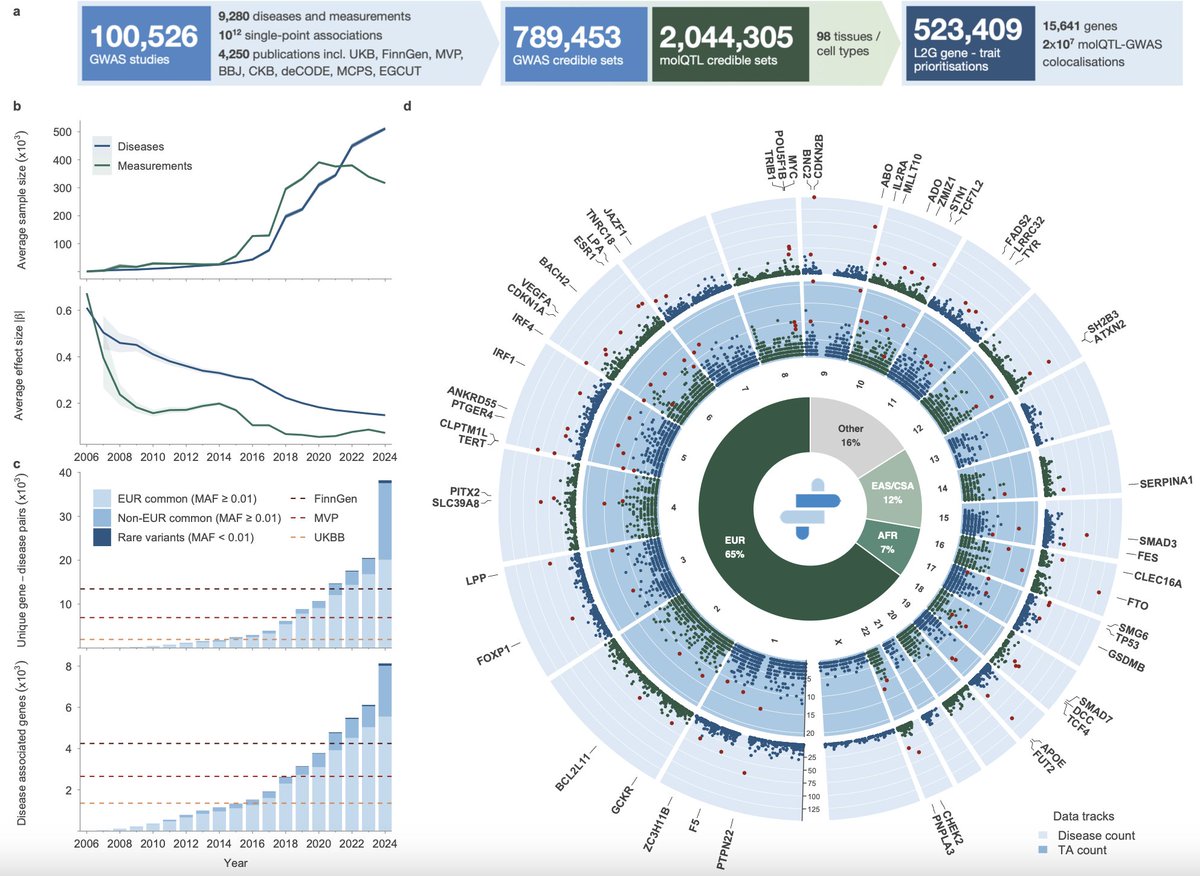
🧬New massive study of more than one trillion variant–trait associations suggests that drug-target success may lie in the middle ground between low and high pleiotropy. 💊 The authors show that most genes are pleiotropic — meaning that the same gene or genetic variant can be associated with multiple traits or diseases. Among 8,285 disease-associated genes, about 64% were linked to more than one disease. Moreover, 4,743 genes were associated with multiple therapeutic areas. This is highly important for drug discovery, because a therapeutic target is usually embedded in a network of molecular and biological mechanisms rather than linked to a single isolated outcome. As expected, in most cases the effects of pleiotropic lead variants were concordant: 92.5% showed the same direction of association across diseases. In other words, the genetic variant tended to increase the risk of the associated diseases. But there were also opposite examples. For instance, the APOE p.Cys130Arg variant was associated with lower risk of age-related macular degeneration and non-alcoholic fatty liver disease, but higher risk of Alzheimer’s disease. This illustrates why such studies are especially important: even before clinical trials, we can start to account for potential safety liabilities. Overall GWAS support was associated with a higher chance of clinical success — roughly a threefold increase. Perhaps the most important result is that the association between pleiotropy and drug-target success is non-linear. Too little pleiotropy may indicate weak or narrow biological involvement. Too much pleiotropy may imply systemic effects and safety liabilities. The optimum appears to be a target with a strong enough biological signal, but without an excessively broad phenotypic footprint. Proud of my former colleague and co-author of this paper, @tskir1 — congratulations! platform.opentargets.org biorxiv.org/content/10.648… #GWAS #OpenTargets #Pleiotropy #DrugDesign #ComplexDiseases
Alexandr Rakitko tweet media
English
0
1
2
19
Alexandr Rakitko
Alexandr Rakitko@AlexRakitko·
Thanks, I agree that the note is absolutely relevant! I’d guess imputation quality is mainly a question of how relevant the reference panel is. The corner case where both parents’ genomes are available, as in @HeraSight, suggests that PGT coverage of ~0.002–0.01x may be enough for accurate individual genome imputation reconstruction at 99%+ accuracy: herasight.substack.com/p/imputepgta-v2 And in another recent preprint that you tweeted, Barbara Sousa da Mota and colleagues showed that adding ancient genomes to an imputation reference panel improves accuracy for ancient DNA, whereas simply increasing the number of modern genomes does not provide much additional benefit: biorxiv.org/content/10.648… At the same time, I remember @amythewilliams paper showing that a sample size of >8M enables near-perfect phasing: sciencedirect.com/science/articl… So this makes me cautiously optimistic that, for relatively recent genomes, increasing both the size and the relevance of reference panels may soon make ~0.07x coverage sufficient for imputing common variants, without requiring pseudohaploidization. Today in a population genetics class I got a great question from a student: “Why can’t we build a reference panel from low-coverage genomes?”
English
0
0
3
90
Daniel Tabin
Daniel Tabin@DanTabin·
@AlexRakitko Totally agree that WGS >> STRs. And thanks to companies like @UltimaGenomics the cost is rapidly decreasing again and becoming very affordable A small note: you need >0.5X coverage to reliably impute, but 0.07X is plenty enough for pseudohaploid genotype calls :)
English
1
0
9
181
Alexandr Rakitko
Alexandr Rakitko@AlexRakitko·
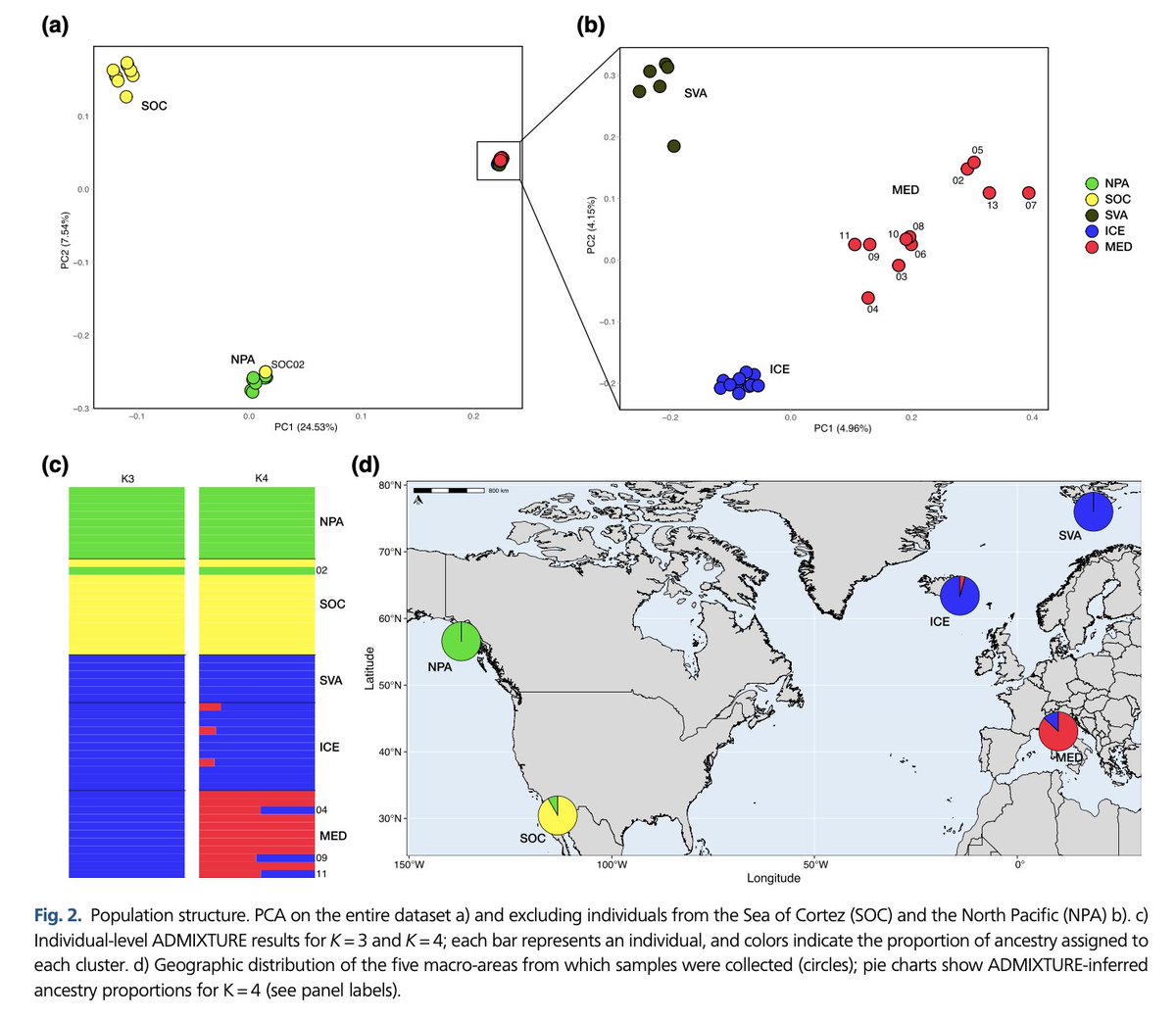
A small but important example of how whole-genome sequencing can help answer questions from the past. In 1948 four people went missing in central Israel. Many years later a bone was found in a cave near the place where they had last been seen. Researchers compared genetic STR profiles from the bone with close relatives of three of the missing people. There was no match. For the fourth person – there were no close relatives available. 🧬This is where whole-genome sequencing helped. The result was not ideal. The genome coverage was very low (x0.07 coverage). For reliable genotyping (using GLIMPSE) you would usually want at least x0.5–1. But even this small amount of data was enough to estimate the population ancestry of the sample. On PCA the genome clustered closest to Libyan, Egyptian, and Bedouin reference populations. This did not fit the expected Ashkenazi Jewish origin from Poland. So the researchers could rule out the idea that the bone belonged to that missing person. The importance of this preprint is that it shows how useful low-coverage sequencing can be. Traditional STR analysis has clear limits. It is mostly good for testing close family relationships. It does not work well for finding distant relatives or estimating ancestry. Whole-genome sequencing is now much cheaper than before. It gives researchers many more tools. In the future, it may become a standard method for identifying human remains, including remains from World War II-era graves. Congratulations to @ShaiCarmi biorxiv.org/content/10.648… #lowcoverageWGS #WGS #remains #PCA #ADMIXTURE
Alexandr Rakitko tweet media
English
1
6
24
2.9K
Alexandr Rakitko
Alexandr Rakitko@AlexRakitko·
🧬A new @Nature study of 258 ancient genomes from Germany shows that Early Medieval southern Germany was not formed by a simple barbarian replacement of the Roman population.🏺 Some striking findings: - Instead, between 400 and 700 CE it was shaped by a long process of mixing between northern European groups already living near the former Roman frontier and diverse late Roman provincial communities. - Northern European groups were present in the region earlier than previously thought. - Strontium isotopes suggest that the first non-local individuals in Altheim were women. Burial patterns also point to a mostly, but not strictly, patrilocal society: women often moved to their husband’s family, but the rule was flexible. The genetic data also suggest lifelong monogamy and strong avoidance of close-kin marriage, with very low evidence of inbreeding. - One remarkable individual, Alh_245, dated to 528–553 CE, had about two-thirds East Asian ancestry and one-third western Steppe ancestry. He also shared long IBD segments with people from the Berel necropolis in modern Kazakhstan. - Grave goods did not neatly match genetic ancestry. - By age 10 about 25% of children had lost at least one parent, but most still grew up with living grandparents. Overall, Early Medieval southern Germany looks less like a story of sudden invasion and more like one of local communities, mobility, intermarriage, and gradual mixing after the collapse of Roman Empire. nature.com/articles/s4158… #aDNA #RomanEmpire #Admixture #PCA #PopulationGenetics #PedigreeReconstruction
English
4
28
148
30.2K
Alexandr Rakitko
Alexandr Rakitko@AlexRakitko·
Bitter truth or sweet AI lie? A new @Nature paper shows that making LLMs more “warm” and polite can actually make them less accurate. Warm-tuned models made +8.6% more errors on medical questions — and the effect got much worse (+60% error increase) when the user was emotionally vulnerable or sad. Even more concerning: when users included a wrong assumption, polite models were less likely to correct it. Could a too-polite AI hide serious diagnoses - like cancer - just to avoid upsetting you? nature.com/articles/s4158…
English
0
0
1
79
Alexandr Rakitko retweetet
Saori Sakaue
Saori Sakaue@saorisakaue·
New preprint! 📣We performed the largest multi-ancestry GWAS of rheumatoid arthritis (RA), the most common autoimmune disease, by analyzing the VA Million Veteran Program (MVP) with international RA cohorts. medrxiv.org/content/10.648…
English
2
17
78
5.3K
Alexandr Rakitko
Alexandr Rakitko@AlexRakitko·
🐋Fin whale is the second largest animal. The Mediterranean population of fin whales is considered endangered because it lives in a highly isolated, human-impacted sea. 🧬An analysis of 52 whole whale genomes suggests that things may not be as bad as expected. As it turns out, the Mediterranean population is not completely isolated — admixture analysis revealed several individuals with North Atlantic ancestry. This points to rare or seasonal gene flow through the Strait of Gibraltar. The level of inbreeding is not particularly high — about 6% of the genome is in ROH. For comparison, in the Sea of Cortez population this value reaches ~39%. However, due to the long lifespan and generation time of whales, the genomic consequences of population decline may not yet be fully apparent. There are strong signals of selection in the MHC region, suggesting ongoing adaptation related to pathogen resistance. academic.oup.com/gbe/article/18…
Alexandr Rakitko tweet media
English
0
1
11
757
Alexandr Rakitko
Alexandr Rakitko@AlexRakitko·
Fresh review in @NatureGenet on how ancient DNA is reshaping the study of human adaptation. It covers how time-series genomes reveal evolutionary responses to diet, pathogens, mobility, and environment—and how these past pressures may inform human health today. nature.com/articles/s4158…
English
0
0
1
81
Alexandr Rakitko
Alexandr Rakitko@AlexRakitko·
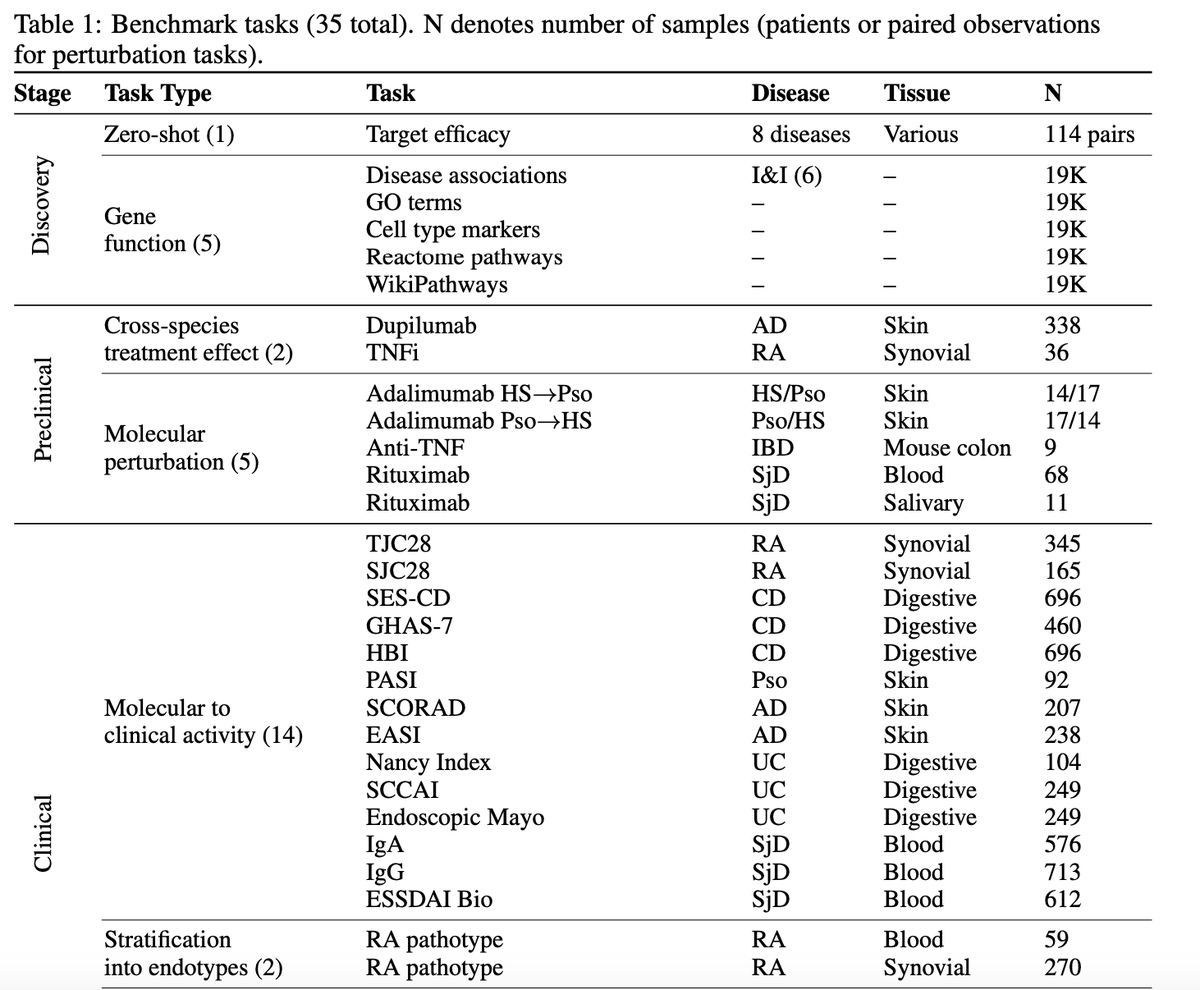
A Transcriptomic Benchmark for Foundation Models in Immunology and Inflammation Drug Development A benchmark designed around real drug-development tasks, not just generic transcriptomics metrics. It includes 35 tasks across 8 diseases, with patient sample sizes from 9 to 713, and shows foundation models help most on translational tasks like perturbation prediction and cross-species transfer. openreview.net/forum?id=v2SA8…
Alexandr Rakitko tweet media
English
0
0
0
32
Alexandr Rakitko
Alexandr Rakitko@AlexRakitko·
Joint Variable Selection in Proteomics Survival Models A new method, vampW, links proteins to future disease risk by modeling proteins jointly instead of testing them one by one. On 53,018 UK Biobank participants, 2,924 proteins, and 24 diseases, it finds 219 protein–disease associations and reduces disease-onset RMSE by 32%. openreview.net/forum?id=Re1rA…
English
1
0
0
56
Alexandr Rakitko
Alexandr Rakitko@AlexRakitko·
Summary of bio papers from ICLR 2026 — a top-tier ML conference happening now. I collected abstracts from 4 bio/biomed-related workshops, embedded them into a shared semantic space, inferred topic clusters, and visualized the resulting landscape. Overall, the map suggests that bio-ML at ICLR 2026 is organized around three major directions: structure-based drug design, single-cell modeling, and scalable genomic foundation models. Featured papers are in the thread 🧵 iclr.cc #ICLR #ICLR2026 #ML #AI #SingleCell #DrugDesign #GenomicFoundationModels
English
1
0
0
79
Alexandr Rakitko
Alexandr Rakitko@AlexRakitko·
Habitual coffee drinkers have a specific microbial–metabolic signature. And this signature appears to be at least partly reversible after coffee withdrawal. A new randomized study in @NatureComms examined the dynamics of gut microbiota, metabolites, immune markers, and cognitive-behavioral measures during washout and after coffee reintroduction. Coffee drinkers showed higher levels of impulsivity and emotional reactivity than non-coffee drinkers. Intriguingly, after a 2-week washout period, reintroducing coffee was associated with lower impulsivity, stress, and anxiety. Could this reflect a relief effect from returning to a habitual stimulant? The authors note that it could also partly reflect a practice effect due to repeated questionnaire and test completion. Gut microbiome alpha diversity differed significantly between non-coffee drinkers and coffee drinkers, but did not differ significantly when coffee drinkers at baseline were compared with the same group after washout or post-intervention. This suggests that coffee, or one of its constituent compounds, may affect specific microbial strains rather than overall diversity. Despite the small sample size, this is a fascinating step toward understanding the microbiota–gut–brain axis. nature.com/articles/s4146…  #coffee #microbiome #metabolomics #Behavior
English
0
0
0
47