AsymmetricEdge

62 posts

AsymmetricEdge banner
AsymmetricEdge

AsymmetricEdge

@AsymEdge

Ex-quant. Investing own capital. Asymmetric opportunities — where price diverges from reality. Opportunity Map • Valuation • Signals Tech, Crypto, Commodities

Zurich Beigetreten Kasım 2025
5 Folgt7 Follower
Angehefteter Tweet
AsymmetricEdge
AsymmetricEdge@AsymEdge·
What to expect ↓ Opportunity Map • Valuation • Signals
English
1
0
1
26
AsymmetricEdge
AsymmetricEdge@AsymEdge·
@VladBastion KV-cache compression ≠ total memory demand. Less memory per model can still mean more total usage.
English
1
0
3
188
Vlad from Bastion
Vlad from Bastion@VladBastion·
Micron is the worst-performing stock in the US 100 this week (-16%). Why? $MU Google Research published the TurboQuant algorithm, a method for compressing key-value cache in large language models. As a result, the potential reduction in memory requirements could be as much as 6x. The market's logic was straightforward: if AI models consume 6 times less memory, then data centers need 6 times fewer HBM chips - the core product of Micron and SK Hynix.
Vlad from Bastion tweet media
English
21
4
35
11.2K
AsymmetricEdge
AsymmetricEdge@AsymEdge·
@DvdndDiplomats There’s no “better”, only different risk/reward. Here’s how they screen right now:
AsymmetricEdge tweet media
English
0
0
3
1.6K
Dividend Diplomats
Dividend Diplomats@DvdndDiplomats·
What is a better $10,000 investment right now? 1.) Microsoft $MSFT 2.) Amazon $AMZN 3.) Broadcom $AVGO
English
77
0
108
36.1K
AsymmetricEdge
AsymmetricEdge@AsymEdge·
Current setup across my universe.
AsymmetricEdge tweet media
English
0
0
0
12
AsymmetricEdge
AsymmetricEdge@AsymEdge·
What to expect ↓ Opportunity Map • Valuation • Signals
English
1
0
1
26
AsymmetricEdge
AsymmetricEdge@AsymEdge·
Shorter horizon. Same leaders, less upside.
AsymmetricEdge tweet media
English
0
0
0
9
AsymmetricEdge
AsymmetricEdge@AsymEdge·
Leaders unchanged. $PLTR still on top $NVDA next $AMZN behind Higher = more upside vs risk.
AsymmetricEdge tweet media
English
1
0
0
59
AsymmetricEdge
AsymmetricEdge@AsymEdge·
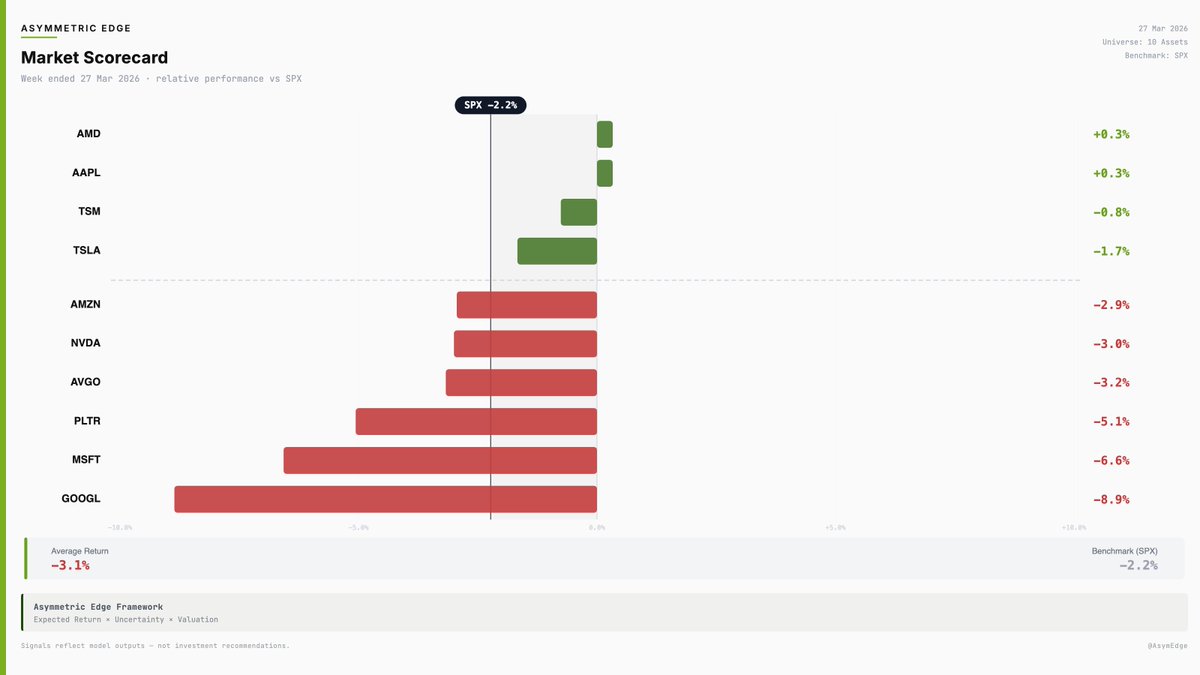
$GOOGL sits at the bottom of the 2Y ranking — and led downside this week. Likely event-driven, but consistent with positioning.
English
0
0
0
32
AsymmetricEdge
AsymmetricEdge@AsymEdge·
Almost everything down this week — but not equally. Wide dispersion across the tech universe I cover.
AsymmetricEdge tweet media
English
1
0
0
20
AsymmetricEdge
AsymmetricEdge@AsymEdge·
Opportunity Map — 27 Mar 2026 Leaders: $NVDA → $PLTR → $AMZN Model ranks the universe on 2Y expected return vs outcome uncertainty. Bubble size reflects risk-adjusted score. TSLA excluded — SpaceX IPO introduces near-term event risk the model can’t price. Tracking this weekly.
AsymmetricEdge tweet media
English
0
0
1
127
AsymmetricEdge
AsymmetricEdge@AsymEdge·
@InvestingAddict Because their entire investing experience is one bull market and they think this isn’t supposed to happen.
English
2
0
0
151
Investing Addict
Investing Addict@InvestingAddict·
Can someone please explain to me why 20 year olds are sad the market is going down?
Investing Addict tweet media
English
348
44
2.9K
828K
AsymmetricEdge
AsymmetricEdge@AsymEdge·
@gnoble79 Margins and earnings didn’t change overnight. Feels similar to DeepSeek,one innovation and the market reprices the whole stack. TurboQuant is specific to inference, not total memory demand.
English
0
0
0
468
George Noble
George Noble@gnoble79·
Micron hit an ALL-TIME HIGH of $471 eight days ago. It's down over 20% since. A few weeks ago I literally told you to STAY AWAY from semiconductor stocks. That the "it's different this time" crowd was dead wrong. That Micron's price-to-book was the most expensive in the stock's history, dressed up in a low PE because earnings were wildly above trend. The oldest trap in cyclical investing. And what happened this week? Google dropped TurboQuant - a compression algorithm that cuts AI memory requirements by 6x. One research paper from Alphabet and Micron lost $90 per share in a week. THIS is exactly what I warned about. When any industry generates obscene profits, innovation floods in to compete those profits away. That's how capitalism works. And semiconductors are not exempt from the laws of economics no matter how many times CNBC tells you AI demand is "permanent." Micron just posted a phenomenal quarter. Revenue nearly tripled. Margins at 75%. Earnings crushed estimates. And the stock FELL every single day after reporting. Because the market is a forward-looking machine. And forward-looking machines eventually do the math on what happens when $650 billion in AI capex meets algorithmic efficiency that slashes memory needs overnight. The cycle always turns. Always. Meanwhile, the rotation I've been calling continues. Gold above $4,600. Energy ripping. The playbook hasn't changed: avoid what's overpriced and own what's cheap. I don't want you to believe I'm doing this to brag. I just want every single one of you to MAKE MONEY.
George Noble tweet media
George Noble@gnoble79

STAY AWAY from semiconductor stocks. The global semiconductor industry is expected to hit $975 billion in sales this year. A historic peak. Revenue growth north of 25%. Every cycle peak sounds the same: this boom is STRUCTURAL, not cyclical. AI demand is permanent. The old rules don't apply. "It's different this time," they say. I've heard those 4 words more times than any others in 45 years on Wall Street. They're always wrong. Here's how I think about it: When any industry generates obscene profits, capital floods in to compete those profits away. The higher the margins, the faster it happens. Semiconductor margins right now are at levels that would make a drug cartel blush. Look at Micron. The crowd says it's "cheap" because the PE looks low. Except Micron's price-to-book ratio sits at roughly 7x. The 10-year median is 1.86x. The historical floor is 0.81x. That's not cheap. That's the most expensive this stock has EVER been relative to its asset base - dressed up in a low PE because earnings are wildly above trend. This is the oldest trap in cyclical investing. You see it in shipping. You see it in commodities. Earnings spike, multiples look compressed, everyone piles in. Then the cycle rolls over and those "cheap" earnings disappear. Now layer on the bigger picture: New capacity is already being announced across the industry. The hyperscalers alone - Microsoft, Amazon, Alphabet, Meta - plan to pour $600-700 BILLION into AI infrastructure this year. That's 70%+ more than 2025. They're consuming roughly 90% of their operating cash flow on capex. Borrowing north of $400 billion to cover the rest. Nobody can afford to stop spending because everyone else keeps spending. It's mutually assured destruction with better PR. And historically, the companies that spend the MOST on capex deliver the WORST stock returns. BCA Research just argued AI threatens all 3 pillars of Big Tech profitability; 1. Economies of scale 2. Network effects 3. Proprietary tech Goldman Sachs compared software stocks to NEWSPAPERS in the early 2000s. The group that fell 95%. Software is now underperforming the Nasdaq by the widest margin this century. Meanwhile, the rotation I've been positioning for is already underway: Most MAG 7 names are DOWN year to date. Emerging markets are up. Energy is up. Gold miners are up. Last year, the EM ETF returned roughly DOUBLE the S&P. This isn't starting. It's been happening since 2024. So my framework is simple: Valuation doesn't matter in the short run. But the longer you go out, the more it matters. And money ain't free anymore. When capital was free, pigs flew. Unprofitable companies soared. Narrative crushed fundamentals. That era is OVER. The 60/40 portfolio hedges against recession. But recession isn't the risk. The risk is continued money printing, persistent inflation, and higher real rates. Bonds don't protect you from that. Gold does. Energy does. Real assets do. You don't need to get clever here. Just avoid what's overpriced and own what's cheap. The regime is changing. The market's scorecard already tells you that every single day. Are you listening?

English
53
30
263
64.2K
AsymmetricEdge
AsymmetricEdge@AsymEdge·
@CuriousPejjy Still not cheap on forward P/E. Plus SpaceX IPO likely draws attention/liquidity — not a rush to buy here.
English
0
1
6
639
Pejjy
Pejjy@CuriousPejjy·
$TSLA down nearly 20% while: - Robotaxi are now 500+ operational and growing rapidly. - FSD Unsupervised about to roll out. - FSD take-rate growing. - FSD to enter Europe - FSD to enter China. - Cybercab mass production next month. - Optimus Gen 3 unveil next month. - Energy growing 50% YOY. - Semi about to enter mass production. - Elon hinting at a new vehicle. - Roadster unveil next week. I don't know about you, but putting aside the noise, it looks like a damn good buying opportunity! NFA.
Pejjy tweet media
English
92
111
1.1K
59.7K
Trade Whisperer
Trade Whisperer@TradexWhisperer·
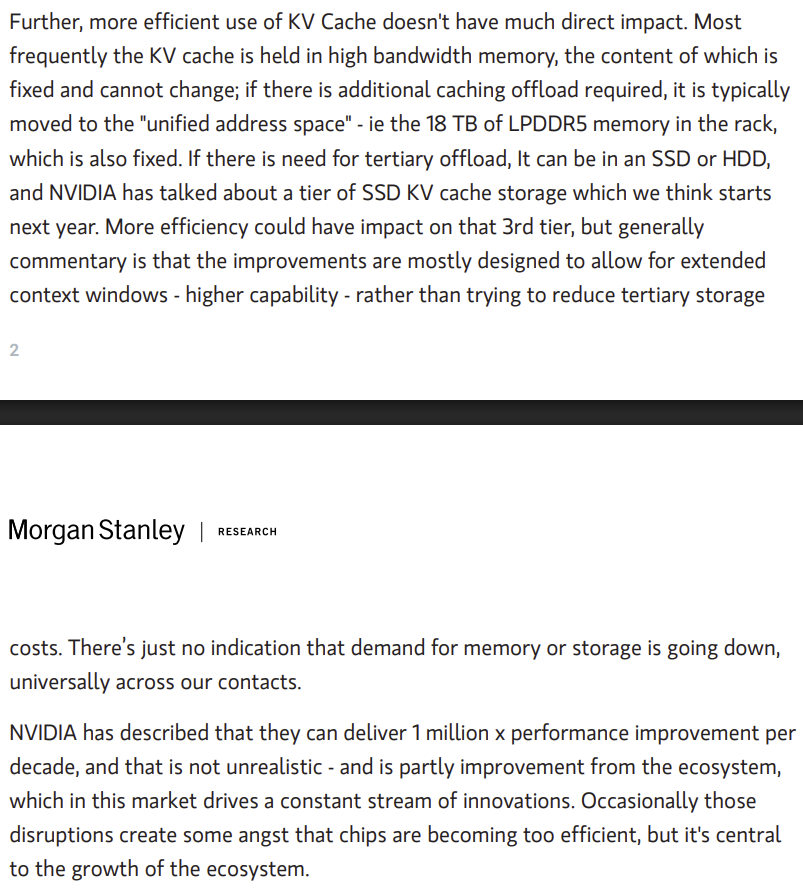
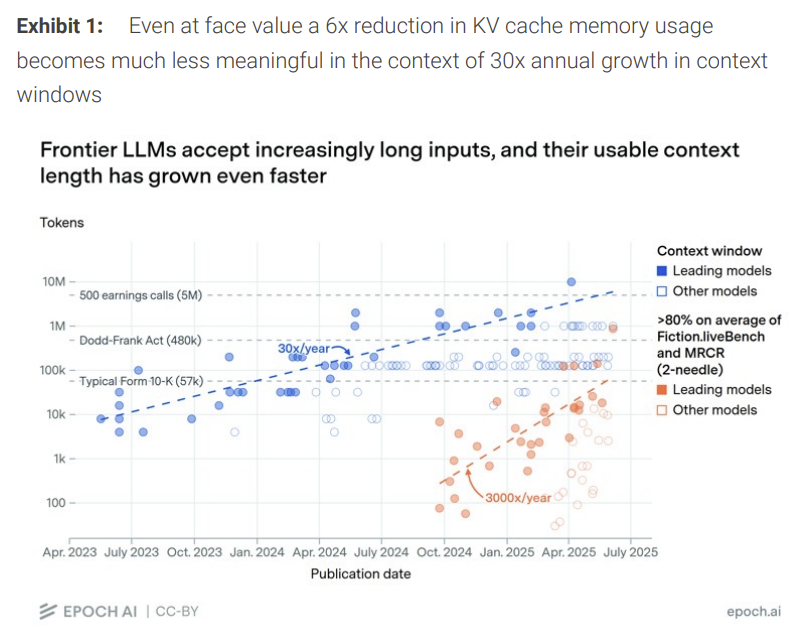
$MU $SNDK Morgan Stanley Research Response on Google's "TurboQuant" Memory Optimization "There’s just no indication that demand for memory or storage is going down, universally across our contacts." "Our take, after talking to industry folks on this today, is that this is an evolutionary development, with basically no surprises for memory" "It is being widely reported that Google has reduced memory usage by 6x, which leaves out that they are just talking about KV Cache memory, not memory overall. Memory stocks sold off again, at least partly due to this hyperbole." "Memory usage is one of the key determinants of AI performance, which makes memory a key aspect of evolutionary improvements. Of course Google is one of the most innovative companies in this space, so an incremental improvement is not particularly surprising, and compression algorithms for KV cache have been a focus for years, per our contacts - "and the biggest improvements are not advertised" since they can be an edge in the business. It's also worth noting that Google's Gemini 3 and 2.5 Pro models feature a 1M token context window, but the company has disclosed that they tested up to 10M tokens with great results with Gemini 1.5 pro but choose not to release the model in part due to inference costs. So we would expect that as costs come down due to innovations like these and others, it will be used to serve higher intelligence more compute intensive products." "Further, more efficient use of KV Cache doesn't have much direct impact. Most frequently the KV cache is held in high bandwidth memory, the content of which is fixed and cannot change; if there is additional caching offload required, it is typically moved to the "unified address space" - ie the 18 TB of LPDDR5 memory in the rack, which is also fixed. If there is need for tertiary offload, It can be in an SSD or HDD, and NVIDIA has talked about a tier of SSD KV cache storage which we think starts next year. More efficiency could have impact on that 3rd tier, but generally commentary is that the improvements are mostly designed to allow for extended context windows - higher capability - rather than trying to reduce tertiary storage. costs. There’s just no indication that demand for memory or storage is going down, universally across our contacts." "NVIDIA has described that they can deliver 1 million x performance improvement per decade, and that is not unrealistic - and is partly improvement from the ecosystem, which in this market drives a constant stream of innovations. Occasionally those disruptions create some angst that chips are becoming too efficient, but it's central to the growth of the ecosystem." "Even at face value a 6x reduction in KV cache memory usage becomes much less meaningful in the context of 30x annual growth in context windows" See the attached graph 👇
Trade Whisperer tweet mediaTrade Whisperer tweet mediaTrade Whisperer tweet media
English
8
79
358
87.3K
AsymmetricEdge
AsymmetricEdge@AsymEdge·
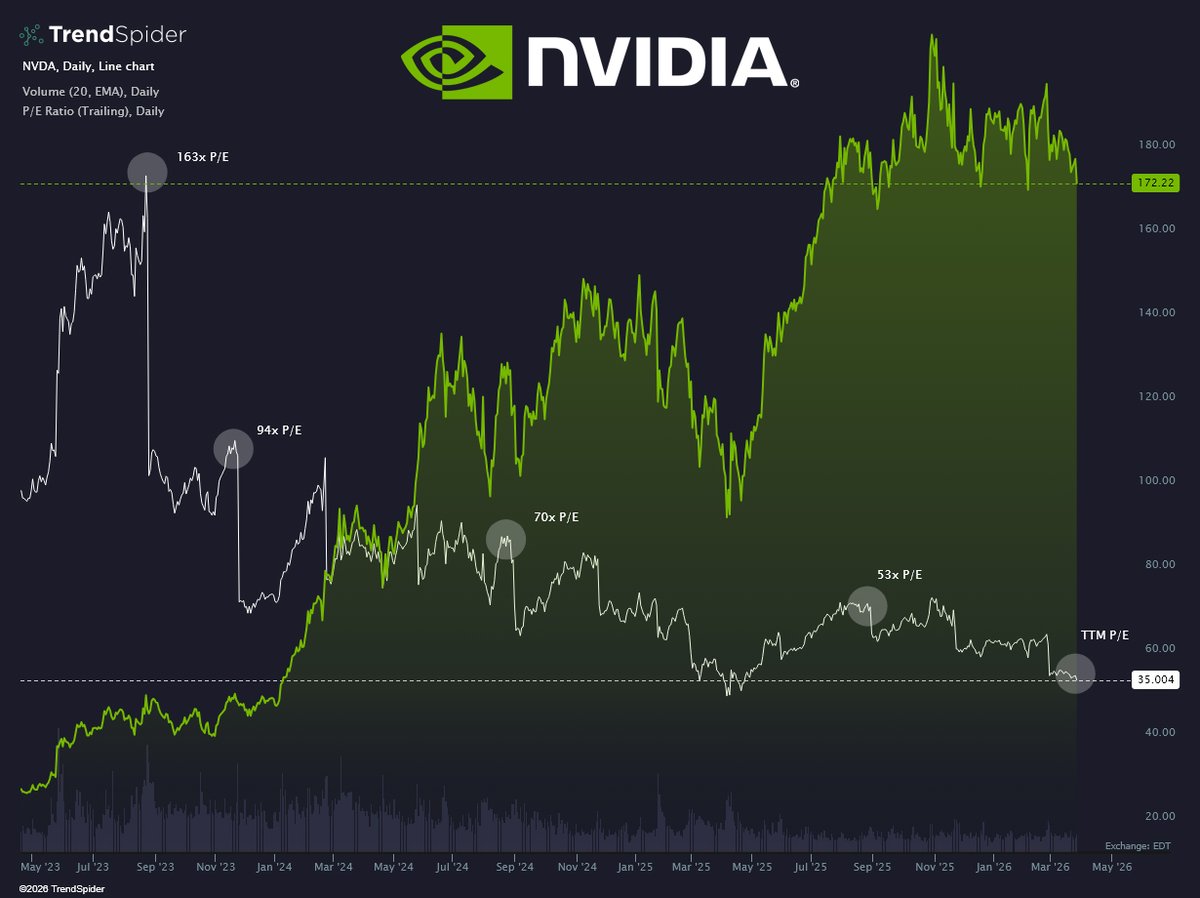
@Mr_Derivatives Forward P/E is now around S&P 500 levels. A market multiple for a company still growing structurally faster than the index.
English
0
0
2
337
Heisenberg
Heisenberg@Mr_Derivatives·
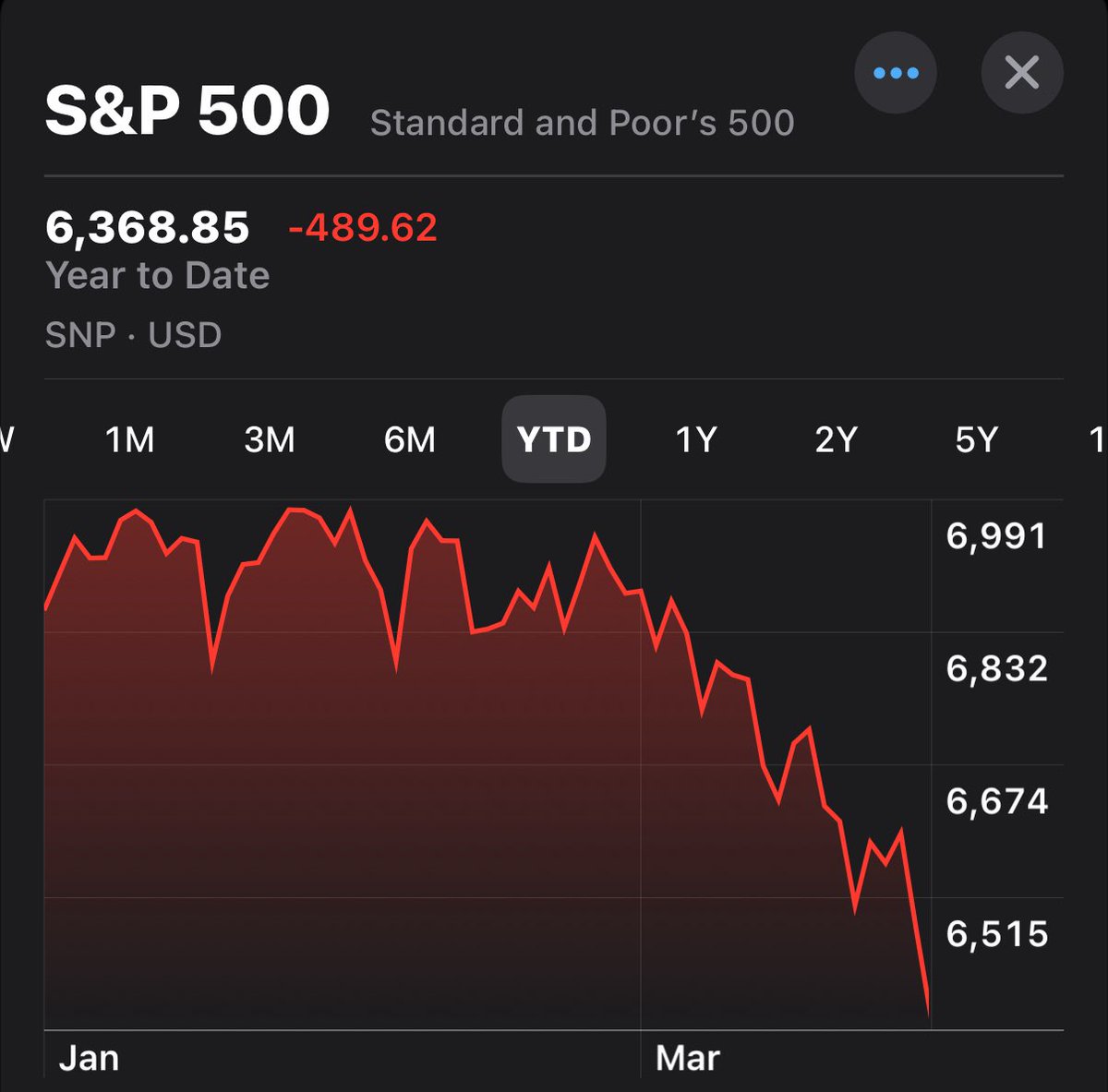
$NVDA officially in a bear market.
English
64
33
636
60K
AsymmetricEdge
AsymmetricEdge@AsymEdge·
@TrendSpider Important: this isn’t just trailing P/E — forward multiples are near cycle lows too.
English
0
0
0
286
TrendSpider
TrendSpider@TrendSpider·
While revenue grew at a record 65% last year, $NVDA is trading near its lowest valuation of the AI era. Let me say that again. $NVDA is trading near its lowest valuation since the start of the AI boom.
TrendSpider tweet media
English
93
142
1.3K
220.1K
AsymmetricEdge
AsymmetricEdge@AsymEdge·
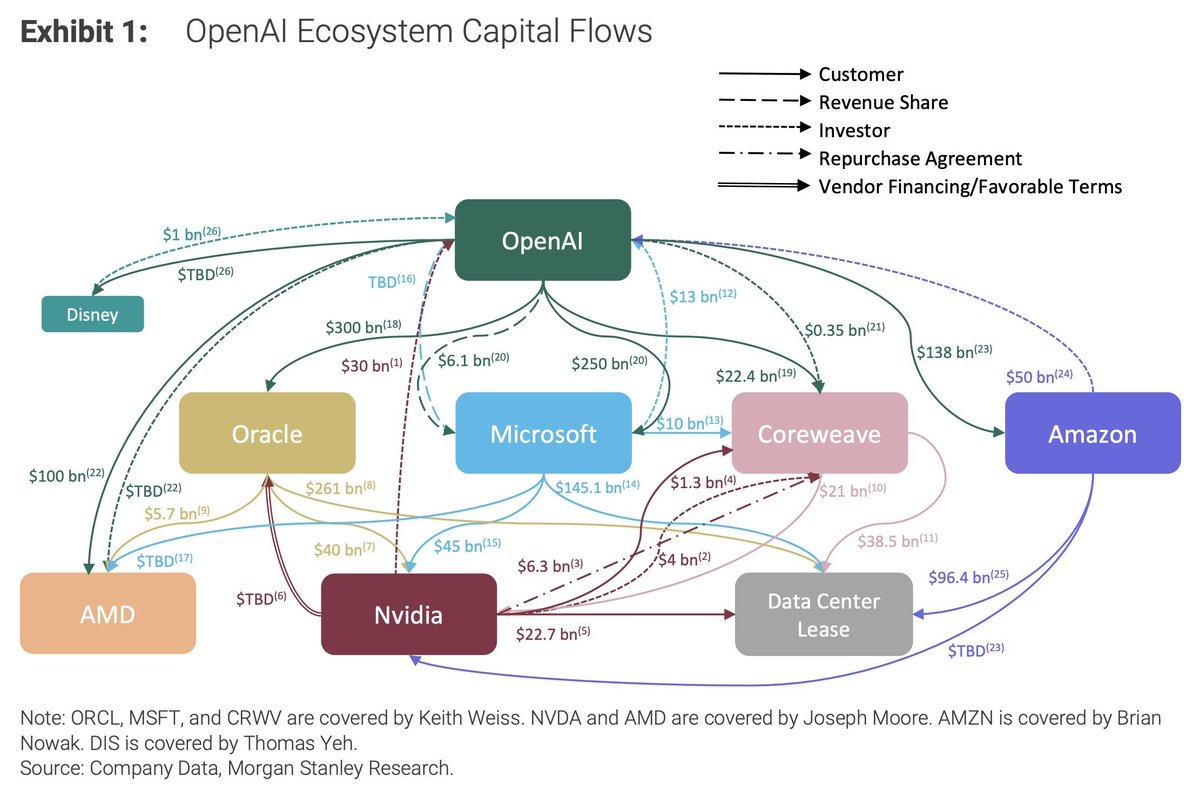
@Sam_Badawi Basically a double-edged sword: accelerates the system — but also increases fragility.
English
0
0
0
25
Sam Badawi
Sam Badawi@Sam_Badawi·
Morgan Stanley created this chart that shows how capital across the AI stack is becoming increasingly circular, with $MSFT and $AMZN funding infrastructure buildouts, $ORCL expanding data center capacity tied to model demand, and $NVDA and $AMD supplying the compute that feeds back into the same hyperscale platforms. At the same time, providers like $CRWV sit in the middle of the loop, securing GPU supply while signing long-term capacity agreements that reinforce demand across the ecosystem. Instead of a linear supply chain, each layer is financing the next, creating a feedback cycle where infrastructure spending drives chip demand and chip availability enables more model deployment. This circular structure is accelerating AI scale while tightening strategic dependencies across hyperscalers, compute providers, and semiconductor vendors.
Sam Badawi tweet media
English
2
6
36
2.9K
AsymmetricEdge
AsymmetricEdge@AsymEdge·
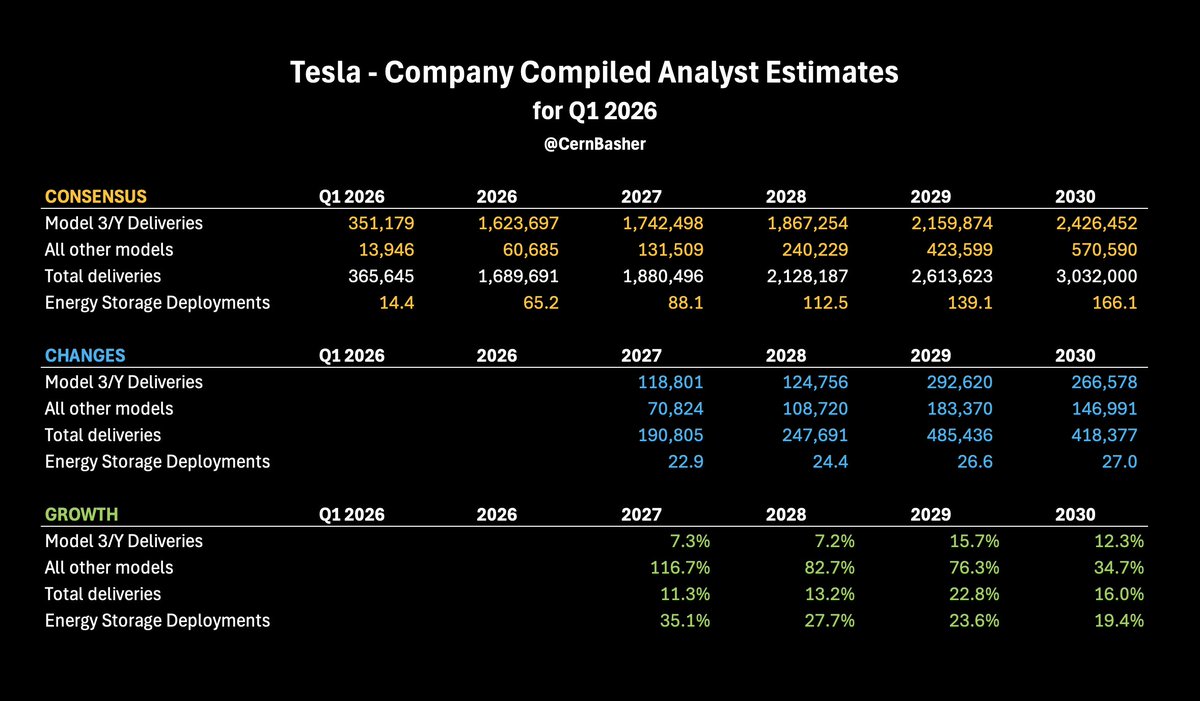
@CernBasher Not really a paradox — more a de-risking. Anything uncertain (Cybercab ramp/timing) gets discounted or not fully included, unlike energy storage which is already visible and scaling. So outer years get revised lower despite new products.
English
0
0
0
21
Cern Basher
Cern Basher@CernBasher·
Tesla Analysts' Paradox - Falling Expectations? Some observations from the company compiled Wall Street analyst consensus numbers: 1) WS expects that Tesla will deliver 1.67 million vehicles in 2026 - that's just 53,562 more than last year. 2) Mostly interestingly, their estimate for Other Models is only 9,835 higher (60,685 for 2026 vs 50,850 in 2025) - this seems quite low given the massive amount of orders for Cybertruck and the start of production for Cybercab (offset a bit by the sunset of S&X deliveries). 3) They expect that Tesla will deliver 65.2 GWh of energy storage in 2026 - up 40% over last year's 46.7 GWh. 4) As we look out to 2027, 2028 and 2029 - analysts' expectations have fallen across the board (except for Model 3/Y in 2026 and 2027 where their expectations have increased a bit). Their 2029 number for Model 3/Y has fallen by 168,028. Their 2029 number for All other models has fallen by 268,400. Really? In light of the start of production for Cybercab? This can only be explained if they aren't counting Cybercab in the numbers - which doesn't make sense - the Cybercabs will be delivered to Tesla's Robotaxi network and (most likely) to outside buyers - why exclude the company's most profitable vehicles? 5) By 2030 the analysts have Tesla delivering 3.032 million vehicles - by then Cybercab alone should be at 3 million!
Cern Basher tweet mediaCern Basher tweet media
AleXandra Merz 🇺🇲@TeslaBoomerMama

I like that we get these now quartely. Link: ir.tesla.com/press-release/…

English
23
24
211
17.8K
Steve Burns
Steve Burns@SJosephBurns·
Describe the 2026 stock market in ONE word. 👇
English
106
0
36
17.6K
AsymmetricEdge
AsymmetricEdge@AsymEdge·
@elonmusk Most content was already noise. AI just makes the signal harder to find.
English
0
0
0
9