

Alex Challans
248 posts



3/ Competitive response. Germany, France, Australia, Canada, and several Asia-Pacific governments all have serious quantum money deployed.
4/ Whether government becomes a sophisticated user, not just a buyer. Procurement only works as industrial policy if the machines get used.
English
🇬🇧 The UK just put procurement muscle behind its National Quantum Strategy.
Up to £2B in quantum investment, anchored by “ProQure,” a program to build and deploy large-scale quantum computers on British soil by the early 2030s.
The real news: £1B to actually buy quantum computers for national infrastructure. 🧵
English
Four things to watch:
1/ Whether ProQure pulls through commercial-grade systems or stalls at demonstrators.
2/ The £1B procurement spend kicks in during the 2030s, after the current parliament. Quantum strategies that outlast electoral cycles are rare.
English
Government-cited estimates project £212B in economic impact by the mid-2040s.
The pattern we see across our work globally is consistent: well-structured quantum investment generates outsized multipliers across R&D, manufacturing, and workforce development.
English
Is this a global first? Not quite.
Germany’s DLR QCI (€740M+, launched 2021) has been contracting with hardware companies for years. Australia committed ~$1B AUD to PsiQuantum. The EuroHPC JU is procuring systems across six sites.
What’s different: bundling R&D, manufacturing, software, hardware, and procurement into one integrated program, at real scale.
English
This builds on the 10-year National Quantum Strategy (March 2023, £2.5B), itself building on a strategy from 2013/14.
The genuinely new commitment is ProQure: not just funding R&D, but procuring hardware. That’s a different signal to the market.
English
@Cat_States Not sure if this is going to be like ai capex. First scaled enterprise use case will be done in very careful partnership and likely will be more like value based pricing (where enterprise AI for critical science will likely go too).
English

Something's been bothering me.
Quantum progress is real:
• 99.9%+ 2-qubit fidelities
• Real logical qubits demonstrated and error correction actually working
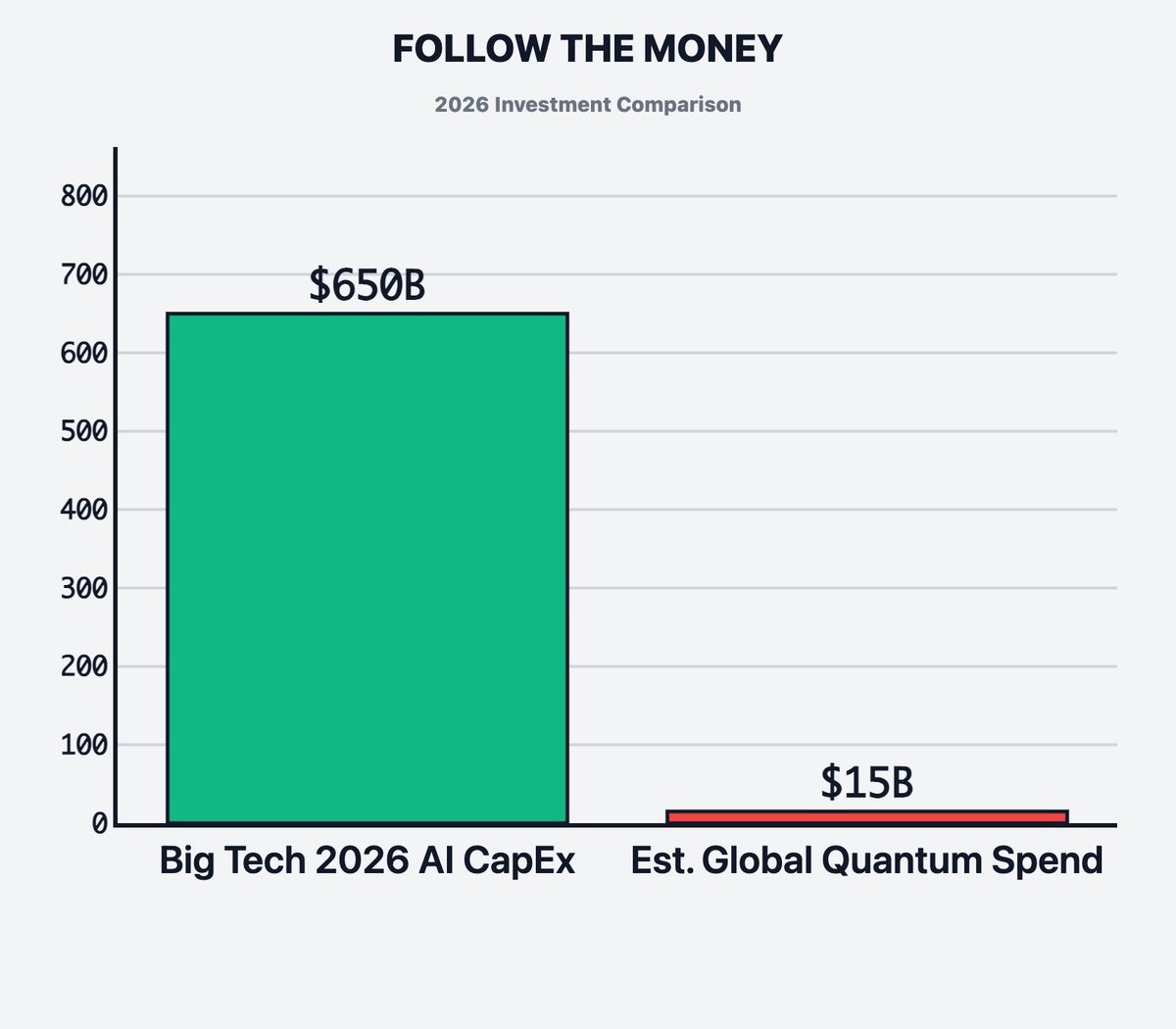
But look at the capital allocation:
Big Tech AI CapEx (2026E): $650B
Est. Global Quantum Spend: ~$15B at most
That's a 40x+ delta.
Quantum is still searching for its "ChatGPT moment."
Not more qubits. Not better fidelity.
We need one undeniable use case that makes CEOs or tech leaders say "we need this."
It's hard to say when this will be - but with recent developments I suspect it's not too far away.
English

bullish news for QC, seeing as how cathie wood is the worst investment manager of all time
finance.yahoo.com/news/cathie-wo…
English
Alex Challans retweetet

Now crash the market but also keep it at all time highs.

English
Interesting
U.S. National Science Foundation@NSF
NSF is investing over $100M to launch the NSF National Quantum and Nanotechnology Infrastructure program, establishing a nationwide network of open-access research facilities for quantum and nanoscale technologies, innovation and workforce training. bit.ly/3ZwZTQP
English
Alex Challans retweetet

Gf: "I hope you get me something big and red for Valentine's"
Me:

English
MiniMax dropped M2.5 today. Also a very strong model, ridiculously cheap vs. the frontier lab models.

Dr. Hugh Bitt@Cat_States
Chinese AI lab Z.AI released GLM-5 today. I've been playing around with it - very strong model, especially for coding and agentic tool use. 744B parameters (40B activated) in a MoE architecture, 200K context window. Not quite Codex 5.3 / Opus 4.6 level. But genuinely quite good. The interesting part is the pricing. It's 40-85% cheaper than the state of the art from OpenAI and Anthropic. Of course, you need to choose your GLM-5 model provider carefully to avoid your tokens going to China. It's open weights too, so you could run it on your own hardware. The company behind this recently IPO'd on HKEX. Ticker is 2513.HK. It ripped +29% today off the back of the GLM-5 release. Still sitting at a relatively reasonable ~$23B valuation. Worth watching 👀
English
Iceberg Quantum claims its new architecture could reduce the qubits needed to break RSA-2048 from millions to under 100K. Already partnering across modalities: @PsiQuantum, @diraqQC , @IonQ_Inc. One to watch.
thequantuminsider.com/2026/02/13/tri…
English
Our Google PQC piece at @QuantumDaily took off this weekend.
thequantuminsider.com/2026/02/06/goo…
English
Alex Challans retweetet
anyone thinking past 2030 for implementation of post quantum security is not necessarily wrong, but playing with fire
JP Aumasson@veorq
a quantum computer breaking RSA2048 or equivalent be honest:
English
Alex Challans retweetet

🇺🇸 The White House is reportedly drafting a far-reaching executive order that would establish a whole-of-government approach to quantum technologies, aiming to better coordinate federal investment, infrastructure, security, and commercialization across the U.S. quantum ecosystem.
If finalized, the order would mark a significant shift in U.S. quantum policy.
thequantuminsider.com/2026/02/04/whi…
English
Alex Challans retweetet

Great to see the White House prioritizing quantum innovation.
A whole-of-government approach will accelerate development and help build our information dominance on the battlefield and beyond. The future is quantum and speed is key!
English

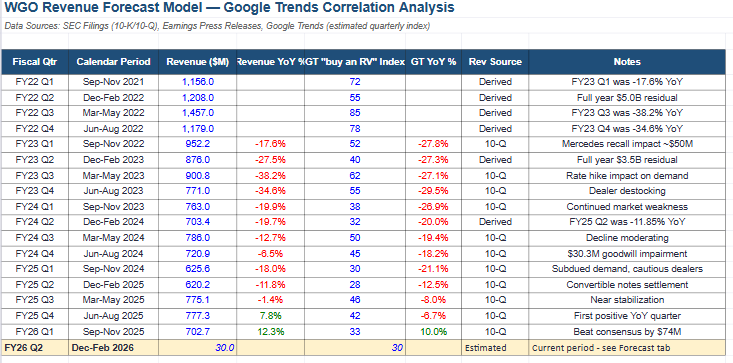
Claude Experiments: Google Trends $WGO
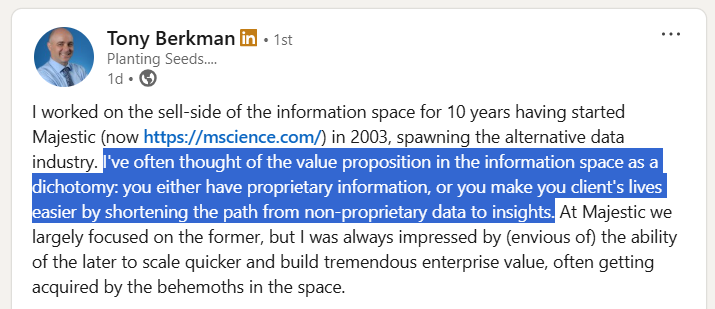
I saw Tony Berkman (founder of Majestic, former Two Sigma...one of the most respected alt data guys around) post this comment on his LinkedIn yesterday and it really resonated with me, particularly the part about how data vendors "make (their) client's lives easier by shortening the path from non-proprietary data to insights".
To an outsider, there might be some skepticism about how non-proprietary data can actually be a source of alpha (aren't markets supposed to be efficient???), but particularly when considered against the mosaic of broader research, many would be surprised how many alpha rich insights are available in the wide open (if you know where to look): scraping a website, visiting a discussion board, reading a trade magazine or pulling Google search data.
As I've been tweeting recently, the recent improvements in the Claude ecosystem are a game changer for this "non-proprietary data to insights" path. You don't need to use Claude code...these are requests you can make right in the Claude chat window.
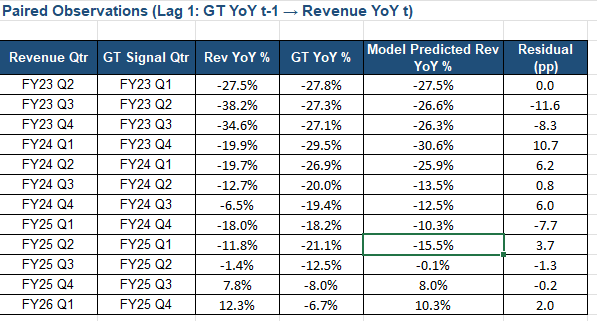
In the Analyst Academy, we show an example of identifying non-proprietary data (in this case, Google Trends) and analyzing that data in a way to generate investible insight. It's a stupid thing, but it works (!), particularly when a Google search reliably precedes a purchase decision, and the sell-side pretty much never publishes on it.
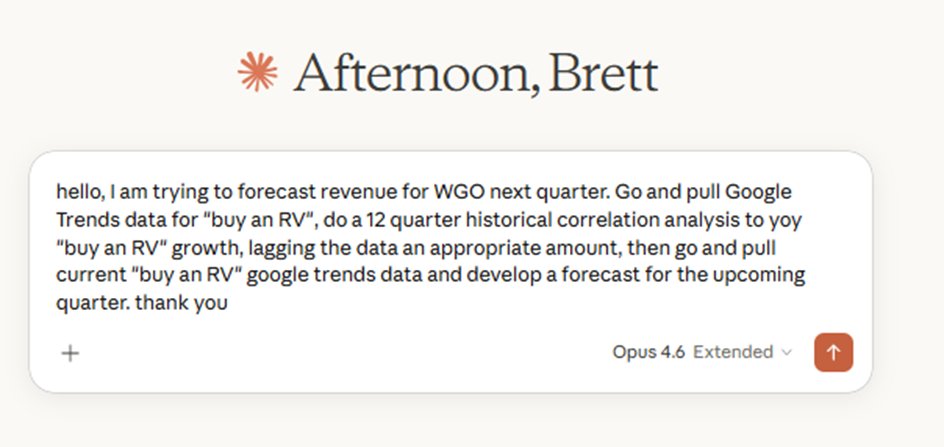
I threw this task into Claude today, with low expectations (it's a multi-step process that requires pulling, quarterizing, correlating then forecasting).
I'm sort of shocked by how well it worked. Given API limitations, it had to estimate the chart (or i could have downloaded then uploaded the Google Trends CSV file). But, on my prompting it identified the correct lag, did the correlation analysis, and built a rubric to forecast WGO revenue. Notably, this rubric has worked as this analysis forecast a re-acceleration of top-line revenue in FQ4 (stock up 28.5%), with similar error rates to my hand crafted analysis. So much for efficient markets...
Does this save much time? Not really. But man I can scale this much more broadly now. I can layer in RVIA data, an RV Trader scrape, sentiment tracking on RV Forum. Data is noisy, but when I get inflection signals from various sources, validated by my own checks with mgmt, private competitors, etc - this helps create a mosaic of conviction that is the true special sauce of institutional stock selection, i.e. not hanging my hat on one data point, but doing deep, close to source research that catches material inflections in core KPIs. What has my head spinning is that, with these tools, a single investor can now do this not just for core position tracking, but for idea generation and idea tracking across a broad universe (i.e. say you like the long term WGO thesis but want an entry point ahead of top-line inflection, a system built on this underlying electricity could alert you to that).
So much of the conversation on AI has been around "summarize this transcript", "build this 3-statement model"...language models are interesting, but chat bots fall closer to toys or "Turbo Google" than anything truly impactful to the practice of institutional stock selection. The emerging ability to have, effectively, a team of data scientists at the push of a button that can craft KPI & risk trackers - this is something that can increase the value of AI to investors immensely, and falls more into the historical sand box of alt data vendors.
English

JPM is right... cowork isn't replacing all enterprise software. But thats not the point.
AI coding isn't coming for the database or the compliance layer... its coming for the $50/seat UI that's just a fancy way to view and edit data. Software isn't dying but the interaction layer *is getting commoditized.
important to sort between the two. $crwd $panw prolly safe. $mndy $hubs $team $adbe less so
Trevor Scott@TidefallCapital
"It feels like an illogical leap to extrapolate from Claude Cowork Plugins, to this expectation that every company will hereby write and maintain a bespoke product to replace every layer of mission-critical enterprise software they have ever deployed." - JPM
English