Cleared Improve

1.1K posts

Cleared Improve banner
Cleared Improve

Cleared Improve

@ClearedImprove

The most interesting ideas from history, psychology, and philosophy

Beigetreten Mayıs 2020
25 Folgt144.7K Follower
Angehefteter Tweet
Cleared Improve
Cleared Improve@ClearedImprove·
Never stop developing as a person. Never stop prioritising yourself. Never stop loving your friends. Never stop loving your family. Never stop loving yourself. Never stop being kind. Never stop learning. Never stop giving. Never stop.
English
25
280
1.3K
443.6K
Cleared Improve retweetet
AI Highlight
AI Highlight@AIHighlight·
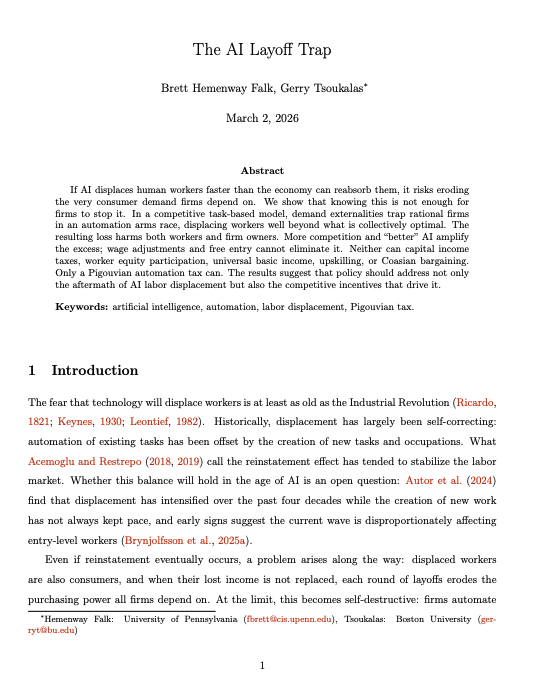
🚨BREAKING: Two researchers from UPenn and Boston University just published a paper that should be uncomfortable reading for every CEO automating their workforce right now. The argument is straightforward. Every company replacing workers with AI is also eliminating its own future customers. Laid off workers stop spending. Enough of them stop spending and nobody can afford to buy anything. The companies that fired everyone end up selling into an economy with no purchasing power left. Every executive can see this. The math is not complicated. But here is why nobody stops. If you do not automate, your competitor does. They cut costs, lower prices, take your market share, and you collapse anyway. So every company automates knowing it is collectively destructive because the alternative is dying alone while everyone else survives. The researchers proved this is a Prisoner's Dilemma playing out in real time. The numbers are already moving. Block cut nearly half its 10,000 employees this year. Jack Dorsey said AI made those roles unnecessary and that within the next year the majority of companies will reach the same conclusion. Salesforce replaced 4,000 customer support agents with AI. Goldman Sachs deployed a coding tool that lets one engineer do the work of five. Over 100,000 tech workers were laid off in 2025 and AI was cited as the primary driver in more than half those cases. 80% of US workers hold jobs with tasks susceptible to AI automation. The researchers tested every proposed solution. Universal basic income does not change a single company's incentive to automate. Capital income taxes adjust profit levels but not the per-task decision to replace a human. Collective bargaining cannot hold because automating is always the dominant strategy. They also identified what they call a Red Queen effect. Better AI does not solve the problem, it accelerates it. Every company chases faster automation to gain market share over rivals but at the end everyone has automated equally, the gains cancel out, and the only thing left is more destroyed demand. The one thing the math says could work is a Pigouvian automation tax. A per-task charge that forces companies to account for the demand they destroy each time they replace a worker. The conclusion is that this is not a transfer of wealth from workers to owners. Both sides lose. Workers lose income. Companies lose customers. It is a deadweight loss with no market mechanism to stop it on its own.
AI Highlight tweet media
English
8
42
56
10.7K
Cleared Improve retweetet
The AI Colony
The AI Colony@TheAIColony·
🚨BREAKING: Claude has a feature called Learning Mode. You can use it to learn literally anything, step by step, like a personal tutor. Here’s how to access it.
English
5
46
225
28.8K
Cleared Improve retweetet
AI Frontliner
AI Frontliner@AIFrontliner·
🚨Breaking: Stanford just recorded 233 harmful AI incidents in 2026. That's a 56% jump in one year. And most companies still think their biggest AI risk is hallucinations. It's not. It's your employees, your vendors, and the $25M deepfake that just wiped out a finance team. Aon just dropped their AI Risk 2026 report and the numbers are brutal: → AI phishing emails now get a 54% click-through rate vs 12% for traditional attacks → 47% of employees still use personal AI accounts for work tasks containing sensitive data → 90%+ of insurance decision makers now consider AI incidents a material financial risk The exposure isn't coming from the models. It's coming from every human being inside your org who hasn't been trained to recognize a synthetic voice, a fake wire transfer request, or a compromised AI plugin sitting inside your own stack. The companies that survive this aren't the ones with the best AI. They're the ones that treated AI governance like a living discipline before regulators forced them to.
AI Frontliner tweet media
English
2
51
75
12.3K
Cleared Improve retweetet
Avery Chauhan
Avery Chauhan@averyx99·
"The richest 0.001% don't wear luxury." Yes they do. You're just too poor to know what these brands are. Forget Dior. Forget Louis Vuitton. Old money wears quiet luxury. Here are six brands that billionaires, world-leaders, and royalty actually wear: 𝟭) 𝗭𝗘𝗚𝗡𝗔 Clients: • Lewis Hamilton • Cillian Murphy • Tom Cruise Ermenegildo Zegna founded the company in 1910 in Trivero, starting as a wool mill before evolving into the world's largest men's luxury fashion group. Unlike any other house on this list, ZEGNA controls the entire supply chain. Best known for suiting fabrics so refined that rival luxury houses source from them. 𝟮) 𝗟𝗼𝗿𝗼 𝗣𝗶𝗮𝗻𝗮 Clients: • Jeff Bezos • European aristocracy • Middle Eastern oil heirs Founded in 1924 by Pietro Loro Piana as a high-quality wool mill in Italy. His grandson, Franco, revolutionised the brand in the 1960s-70s by pioneering rare fibres like baby cashmere and vicuña. Today, they're best known for sourcing the world's rarest natural fibres and creating ultra-soft cashmere coats starting. 𝟯) 𝗕𝗿𝘂𝗻𝗲𝗹𝗹𝗼 𝗖𝘂𝗰𝗶𝗻𝗲𝗹𝗹𝗶 Clients: • Daniel Craig • Prince William • Silicon Valley billionaires Brunello Cucinelli borrowed money in 1978 to launch a small cashmere workshop in Umbria. He restored a 14th-century castle as headquarters in 1985 and built a $3 billion empire through artisan ethics and discretion. The "King of Cashmere" is best known for Zuckerberg's custom grey T-shirts, which cost between $400-600 each. 𝟰) 𝗕𝗿𝗶𝗼𝗻𝗶 Clients: • Donald Trump • Barack Obama • Pierce Brosnan Established in 1945 in Rome by master tailor Nazareno Fonticoli and entrepreneur Gaetano Savini. The brand gained international fame dressing Hollywood stars and world leaders throughout the 1950s-60s. 𝟱) 𝗞𝗶𝘁𝗼𝗻 Clients: • Vladimir Putin • David Beckham • George Clooney Ciro Paone, from generations of Neapolitan fabric makers, started a tailored clothing workshop in 1956. He rebranded to Kiton in 1968 and founded a tailoring school to preserve traditional techniques. Best known for featherlight suits with up to 25,000 stitches per jacket. 𝟲) 𝗖𝗲𝘀𝗮𝗿𝗲 𝗔𝘁𝘁𝗼𝗹𝗶𝗻𝗶 Clients: • Al Pacino • Denzel Washington • Unnamed UHNW individuals Vincenzo Attolini pioneered the light, unstructured Neapolitan jacket in 1930s Naples, ditching British padding for shirt-like comfort. His son Cesare opened a workshop in 1987 with his own sons to scale production. Traditional hand techniques create lightweight, unstructured jackets with extended darts and minimal lining. — Thanks for reading! Enjoyed this post? I built an 8-figure music label from scratch and host luxury events. Follow me @averyx99 for more content like this.
Avery Chauhan tweet media
English
46
179
1.2K
221.9K
Cleared Improve retweetet
The AI Colony
The AI Colony@TheAIColony·
Same prompt, four AI video models tested on a damaged android crawling through a burning spacecraft corridor. Here is how they compare in scene richness, physics, and camera motion. PixVerse V6 delivers smooth motion, rich scenes, matched audio, and realistic textures. The android body is highly realistic with coordinated movements. The model also handles close-up and wide shot transitions naturally. See it here: app.pixverse.ai/home?detail=vi… Sora 2 Pro offers excellent texture quality and the android body is well constructed. However, the motion is not fluid, making the crawl feel jerky and less convincing. Seedance 2.0 has strong texture quality as well, but the android body looks too human, lacking the mechanical endoskeleton feel. The imagination is somewhat limited. Hailuo-02 also delivers good texture quality, but the android is shaped more like a monster than a damaged biological android, losing the intended sci-fi aesthetic. Each model has strengths and trade-offs. - PixVerse V6 leads in motion smoothness and audio-visual sync. - Sora 2 Pro excels in texture but struggles with motion fluidity. - Seedance 2.0 has solid visuals but lacks mechanical imagination. - Hailuo-02 needs better prompt adherence for character design.
English
0
23
49
8.8K
Cleared Improve
Cleared Improve@ClearedImprove·
Franz Kafka died at 41, unknown, unpublished, and convinced his writing was worthless. His final wish? Burn everything I've ever written. His best friend refused. That betrayal created one of the most influential literary legacies in human history and gave us a word that describes the modern world better than any philosopher ever could: Kafkaesque. Here's the story they don't teach you ↓ Prague, 1883. A small, anxious boy is born to Hermann Kafka, an aggressive, successful businessman who wanted a son in his own image. Franz was the opposite. Quiet. Sensitive. Terrified of his father. He became Hermann's psychological punching bag. A constant source of disappointment. What did young Kafka do with all that anxiety, guilt, and self-hatred? He wrote. But his father had other plans. He forced Franz into law school. Then Franz ended up working for an insurance company buried alive in absurd bureaucratic systems and mountains of meaningless paperwork. He was miserable. Yet something extraordinary happened in the margins of that misery ↓ While trapped in a system that crushed his soul by day, Kafka wrote masterpieces by night: • The Trial • The Castle • The Metamorphosis He left most of it unfinished. He believed none of it was worthy. Then tuberculosis took him at 41. On his deathbed, he begged his friend Max Brod to destroy every unpublished manuscript. Brod looked at the work. Then looked at his dying friend. And chose to betray him. Over the next decade, Brod published everything. Kafka became one of the most significant writers of the 20th century with his life's work nearly lost to a drawer and a match. But here's what makes Kafka's philosophy so powerful: His writing doesn't offer hope. It offers something better. The bitter truth. In The Trial, Joseph K. is arrested without explanation. Subjected to a corrupt, senseless trial. Found guilty without ever knowing his crime. In Metamorphosis, Gregor Samsa wakes up as an insect. His first thought? How am I going to get to work? This is the Kafkaesque condition: Your reasoning meets inescapable senselessness. Success is impossible. Logic fails. The system doesn't care. And yet the characters try anyway. That's not despair. That's the most honest portrait of being human ever written. Kafka understood something most self-help refuses to admit: • You can't control everything • The struggle itself is unavoidable • Some systems will never make sense • False hope is more dangerous than hard truth His radical message? Stop waiting for the world to become logical. Confront the absurdity directly and face the darker aspects of yourself instead of hiding behind false optimism. And despite all the senselessness of the universe, choose to continue anyway. Kafka wrote from a drawer, expected nothing, and nearly vanished from history. Instead, he gave us the most accurate word for modern life. Maybe the greatest insights come from those who never expected anyone to listen. — Thanks for reading! Enjoyed this post? Follow @ClearedImprove for more content like this.
Cleared Improve tweet mediaCleared Improve tweet media
English
0
0
1
302
Cleared Improve retweetet
Aria Westcott
Aria Westcott@AriaWestcott·
Breaking: You can now talk to a deceased family member or pet whenever you want. China built and deployed the technology already. Real voices, real personalities, permanently stored. Here is what that looks like:
English
4
51
105
19.2K
Cleared Improve retweetet
Future Stacked
Future Stacked@FutureStacked·
Two models, one cinematic prompt. A direct comparison between PixVerse V6 and Seedance 2.0 on scene richness, physics, and camera motion. PixVerse V6 delivers a highly realistic character, smooth close-up to wide-shot transitions, and excellent overall texture. The motion feels natural and the video quality is outstanding. See the full example with prompt here: app.pixverse.ai/home?detail=vi… Seedance 2.0 struggles from the beginning. The opening feels choppy, more like a slideshow than a rotating camera shot. Character consistency degrades over time, making the person look fake in later frames. The transition between close-up and wide shots is also not smooth. In short, PixVerse V6 wins on fluid camera movement, character realism, and scene richness. Seedance 2.0 needs improvement in motion smoothness and identity preservation.
English
10
36
44
14.8K
Cleared Improve retweetet
Aria Westcott
Aria Westcott@AriaWestcott·
Same prompt, four AI video models. Here is how they compare across scene richness, physics, camera motion, and audio. PixVerse V6 delivers cinematic scenes, stable 360-degree orbital shots, accurate gravity and resistance, no pixel warping, and perfectly synced clean audio. It is the most production-ready model. Kling 3.0 has decent scene complexity but suffers from obvious fisheye distortion, shaky camera, frequent motion deformation, and poor audio sync. It feels unstable. Seedance 1.0 Pro shows slightly better physics than Kling with less warping, but still has mild fisheye and noticeable shakiness. Audio is basic and unsynced. An improvement but not smooth. Wan 2.0 offers excellent scene detail and natural motion, with no fisheye or shake. However, its audio quality is terrible: static noise and crackling make it unusable for real projects. Great visuals ruined by bad sound. Each model has its strengths: Wan 2.0 leads in visual quality and motion, PixVerse V6 wins in overall stability and audio, while Kling and Seedance still have room to improve on camera control.
English
9
52
77
18.1K
Cleared Improve retweetet
Future Stacked
Future Stacked@FutureStacked·
Most AI presentation tools share a common limitation. They generate quickly, but usability often suffers. A different approach is now available with @Dokieai. The user provides direction. The tool executes. "Make this more visual." "Simplify this slide." "Apply brand colors." Updates happen instantly. The experience shifts from using AI to collaborating with a design partner. Key differentiators include the ability to add 3D models, clickable elements, and animations. Users can upload their own templates, and the tool adapts to existing brand styles. The core advantage is clear. @Dokieai does not simply generate slides. It helps turn ideas into visuals faster.
English
9
47
75
20.2K
Cleared Improve retweetet
AI Highlight
AI Highlight@AIHighlight·
There’s a moment right before a call… when you realize your thoughts aren’t structured enough to explain. That’s when I used ZooClaw.
English
11
44
71
17.7K
Cleared Improve retweetet
Future Stacked
Future Stacked@FutureStacked·
Rather than relying on one assistant to handle everything, ZooClaw brings together a suite of specialized agents and automatically assigns the right one to your task. That’s how you get dependable support from experts like: • An office assistant • A coding assistant • A wellness coach • A personal shopping assistant • A market researcher • A marketing strategist Sometimes the problem isn’t the decision. It’s not having a clear way to think it through. That’s what led me to ZooClaw.
English
9
46
76
17.1K
Cleared Improve retweetet
Big Brain Business
Big Brain Business@BigBrainBizness·
The $2T SaaS repricing gets narrated as "AI is eating software," and that framing misses what's actually breaking. Every previous era of enterprise software came with governance bundled in for free. A company buying Salesforce or Workday got a SOC 2 report, a DPA, a vendor security review, a compliance team on the other end of the contract, and someone legally liable when things went wrong. All of that was invisible infrastructure. It's most of why "just buy the SaaS" stayed the default answer for 20 years. Vibe coding compresses the build cycle and strips that entire layer out at the same time. A product manager shipping an internal tool over a weekend with Claude or Replit has no vendor on the other side. No audit trail by default. Nobody whose job it is to answer the security questionnaire. The app exists, it touches real data, and the governance that used to come in the box has quietly become the customer's problem. Jason Lemkin's point that shipping a v1 is ~2% of enterprise software is directionally right, though I think it understates things. The other 98% includes the compliance posture that used to sit on someone else's balance sheet. Whoever figures out how to rebuild that layer for AI-built software is (probably) gonna come out on top in the next few years. Curious where @superblocks lands on it.
Brad Menezes@bradmenezes

Introducing Superblocks 2.0: AI-generated enterprise apps – finally under IT control. Vibe-coded apps just became the #1 attack vector in the enterprise. Business teams are building on production data, while IT has zero visibility. No reviews. No audits. No permissions. No control. AI hackers are about to get 100x better. Anthropic proved it with Mythos. Superblocks 2.0 is the only platform to take back control: > Business teams build AI-powered apps with permissions baked in. > IT and Security can audit everything and lock down anything, instantly. > Engineering sets the standards. Every app follows them. Instacart, SoFi, and LinkedIn run Superblocks in production today. And larger organizations we can't yet name are too: A Fortune 500 just shut down 2,500 Replit users to standardize on Superblocks, running the platform air-gapped in their AWS environment. A 150,000-employee global services firm replaced Lovable with Superblocks to unlock AI-built apps on restricted internal systems. Every IT leader we’ve demoed to using Replit, Lovable or v0 asked for early access. Today we open access to the world. The genie is out of the bottle on employee vibe coding. Let it run wild, or take back control – superblocks.com

English
0
13
44
35.1K
Cleared Improve retweetet
Iseunife The First
Iseunife The First@Shawnife·
The Huawei MateBook Fold is a completely different category of device.
English
14
82
260
32.9K
Cleared Improve retweetet
High Signal AI
High Signal AI@HighSignal_AI·
The graveyard of internal tools that never shipped is real. Every company has one. The demo worked, IT jumped on the call, and it died. Superblocks is the first internal tool builder that actually survives that call. Try it → superblocks.rocks/fmode
Brad Menezes@bradmenezes

Introducing Superblocks 2.0: AI-generated enterprise apps – finally under IT control. Vibe-coded apps just became the #1 attack vector in the enterprise. Business teams are building on production data, while IT has zero visibility. No reviews. No audits. No permissions. No control. AI hackers are about to get 100x better. Anthropic proved it with Mythos. Superblocks 2.0 is the only platform to take back control: > Business teams build AI-powered apps with permissions baked in. > IT and Security can audit everything and lock down anything, instantly. > Engineering sets the standards. Every app follows them. Instacart, SoFi, and LinkedIn run Superblocks in production today. And larger organizations we can't yet name are too: A Fortune 500 just shut down 2,500 Replit users to standardize on Superblocks, running the platform air-gapped in their AWS environment. A 150,000-employee global services firm replaced Lovable with Superblocks to unlock AI-built apps on restricted internal systems. Every IT leader we’ve demoed to using Replit, Lovable or v0 asked for early access. Today we open access to the world. The genie is out of the bottle on employee vibe coding. Let it run wild, or take back control – superblocks.com

English
1
7
20
2.9K
Cleared Improve retweetet
Founder Mode
Founder Mode@Founder_Mode_·
Notice something? Lovable and Replit are genuinely great. At building things that fall apart the second you try to ship them internally. The demo slaps. Everyone's excited. Then IT jumps on the call. Permissions? Audit logs? SSO? Connects to what database exactly? Dead. Another prototype in the graveyard. Back to the spreadsheet. Every company has this graveyard. It just lives in someone's Notion. Open Superblocks and something shifts. → describe what you need → it connects to your actual stack → ships to prod. Lovable is for demos. Replit is for devs. Superblocks is for shipping. Try it: superblocks.rocks/fmode
English
3
12
26
3.5K
Cleared Improve retweetet
Aria Westcott
Aria Westcott@AriaWestcott·
Breaking: Your name, address, and phone number are sitting on the internet right now available to anyone who searches. Three sites are actively selling it to strangers today and most people have no idea. Here is how to remove most of it:
English
32
522
2.1K
357K
Cleared Improve retweetet
Aria Westcott
Aria Westcott@AriaWestcott·
I’ve been playing with Dreamina Seedance 2.0 inside the Dola App, and it’s honestly one of the easiest ways I’ve seen to turn simple ideas into something beautiful. You just describe the scene in plain words, and it builds it out with smooth motion, clean transitions, and consistent details, best part? It's free.
English
4
52
117
11.5K
Cleared Improve retweetet
Better Man
Better Man@BeBetterMan_·
Best Minimalist combinations for Better Men this Summer 1.
Better Man tweet media
English
1
96
858
70.8K
Cleared Improve retweetet
Human Upgrade
Human Upgrade@HumanUpgrade_·
Japan has one of the lowest obesity rates in the world. They eat ramen, drink beer, and love eating carbs. I had to find out how… The 7 reasons I found shattered my Western belief:
Human Upgrade tweet media
English
4
25
79
28.9K