
Ry Guy retweetet
Ry Guy
1.2K posts

Ry Guy retweetet

Ry Guy retweetet
Ry Guy retweetet

Since ETHLend in 2017, our mission has been to bring DeFi to the masses, powered by the Aave protocol and an application layer that now provides access to a $50B+ liquidity network.
Today, we’re proposing a new framework where Aave Labs becomes fully token-centric and redirects 100% of product-level revenue to the Aave DAO. This formalizes alignment between Aave Labs and the Aave DAO in service of token holders.
The Aave Will Win Framework expands Aave DAO’s revenue base beyond protocol revenue established by AIP-1 to include non-protocol and offchain revenue, materially increasing the DAO’s capacity to grow its treasury. This would position the DAO to fund growth, increase buybacks, and pursue other opportunities as it sees fit.
We believe Aave will serve as the backbone of global finance, a market measured in the hundreds of trillions. Building at the product layer creates new revenue for the DAO and helps scale Aave to mainstream adoption and bring DeFi to everyone.
Our goal is to achieve all of this with value accruing to one place: the $AAVE token.
Aave@aave
Today we are proposing the Aave Will Win Framework, a new alignment framework that directs 100% of product revenue to the Aave DAO treasury under a token-centric model.
English
Ry Guy retweetet

Now that ZKEVMs are at alpha stage (production-quality performance, remaining work is safety) and PeerDAS is live on mainnet, it's time to talk more about what this combination means for Ethereum.
These are not minor improvements; they are shifting Ethereum into being a fundamentally new and more powerful kind of decentralized network.
To see why, let's look at the two major types of p2p network so far:
BitTorrent (2000): huge total bandwidth, highly decentralized, no consensus
Bitcoin (2009): highly decentralized, consensus, but low bandwidth - because it’s not “distributed” in the sense of work being split up, it’s *replicated*
Now, Ethereum with PeerDAS (2025) and ZK-EVMs (expect small portions of the network using it in 2026), we get: decentralized, consensus and high bandwidth
The trilemma has been solved - not on paper, but with live running code, of which one half (data availability sampling) is *on mainnet today*, and the other half (ZK-EVMs) is *production-quality on performance today* - safety is what remains.
This was a 10-year journey (see the first commit of my original post on DAS here: github.com/ethereum/resea… , and ZK-EVM attempts started in ~2020), but it's finally here.
Over the next ~4 years, expect to see the full extent of this vision roll out:
* In 2026, large non-ZKEVM-dependent gas limit increases due to BALs and ePBS, and we'll see the first opportunities to run a ZKEVM node
* In 2026-28, gas repricings, changes to state structure, exec payload going into blobs, and other adjustments to make higher gas limits safe
* In 2027-30, large further gas limit increases, as ZKEVM becomes the primary way to validate blocks on the network
A third piece of this is distributed block building.
A long-term ideal holy grail is to get to a future where the full block is *never* constituted in one single place. This will not be necessary for a long time, but IMO it is worth striving for us at least have the capability to do that.
Even before that point, we want the meaningful authority in block building to be as distributed as possible. This can be done either in-protocol (eg. maybe we figure out how to expand FOCIL to make it a primary channel for txs), or out-of-protocol with distributed builder marketplaces. This reduces risk of centralized interference with real-time transaction inclusion, AND it creates a better environment for geographical fairness.
Onward.
English
Ry Guy retweetet

Big Aave news @StaniKulechov posts on the DAO forum ... nothing formal yet but an olive branch has been extended and it sounds like they are looking to continue working together
governance.aave.com/t/how-aave-wil…
"Alignment
That said, growing application-layer products directly increases protocol usage and protocol revenue. Products built on top of Aave taking their own fees does not exclude the protocol from making money. A self-sustaining company building on top of Aave Protocol can lead to the protocol making far more than it would otherwise.
Given the recent conversations in the community, at Aave Labs we are committed to sharing revenue generated outside the protocol with token holders. Alignment is important for us and for AAVE holders, and we’ll follow up soon with a formal proposal that will include specific structures for how this works.
Last, but not least, with respect to branding, we will work toward a structure in our upcoming proposal that supports this long-term vision with sufficient guardrails for the DAO and Aave token holders.
We all want Aave, including the token, to win and we’ll continue building out a comprehensive vision to make that happen."
English
Ry Guy retweetet
The recent DAO vote has wrapped up, and it has raised important questions about the relationship between Aave Labs and $AAVE token holders. This is a productive discussion that’s essential for the long-term health of Aave.
While it's been a bit hectic, debate and disagreement are features of decentralized governance.
I want to state clearly: I am committed to making the economic alignment between Aave Labs and $AAVE token holders more clear. We haven't done a great job explaining this and will do so going forward. Another thing that’s gotten lost in this conversation is that the DAO has earned $140M this year, more than the past three years combined, and $AAVE token holders have control over this treasury.
In the future, we'll be more explicit about how products built by Aave Labs create value for the DAO and $AAVE token holders.
I also want to address my recent $15 million purchase of $AAVE. These tokens were not used to vote on the recent proposal and that was never my intention. This is my life's work, and I am putting my own capital behind my conviction.
Lastly, the Aave ecosystem is large enough for many service providers to succeed, and we will continue to support and collaborate with teams building on the protocol. I am confident that by working together, we will build a stronger and more aligned future.
$AAVE will win.
English
Ry Guy retweetet

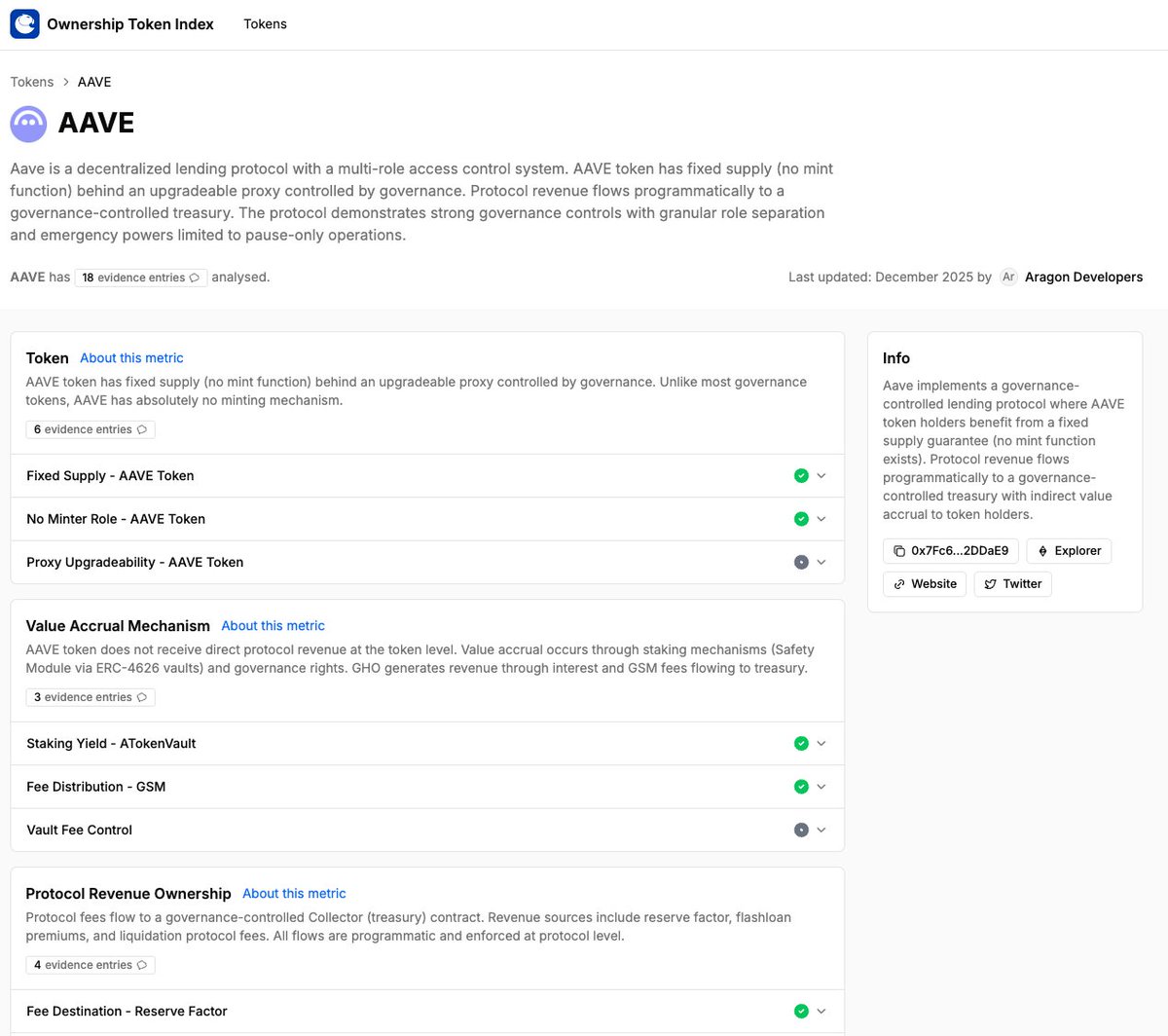
Sneak peak: The Ownership Token Index launching in January will breakdown what a token controls and verify that claim with onchain code.
Investors will have the transparency to clearly determine the value of what they are buying. Separating the best tokens from the worst.
Aragon.eth 🦅@AragonProject
Tokens won’t be treated as valuable assets until ownership is clear and enforceable. Today we’re introducing the Ownership Token Index, a new framework (and upcoming dashboard) that makes tokenholder rights, value flows, and control explicit, verifiable, and comparable.
English
Ry Guy retweetet

Aave v3.6 is basically a green light for $wstLINK to level up.
The new controls make collateral design way sharper, and suddenly $wstLINK isn’t just “eligible”, it’s being sculpted into a high-performance asset with custom eModes and top risk teams tuning every parameter.
Silent now, massive unlock later.
@aave and @chainlink are loading something big.
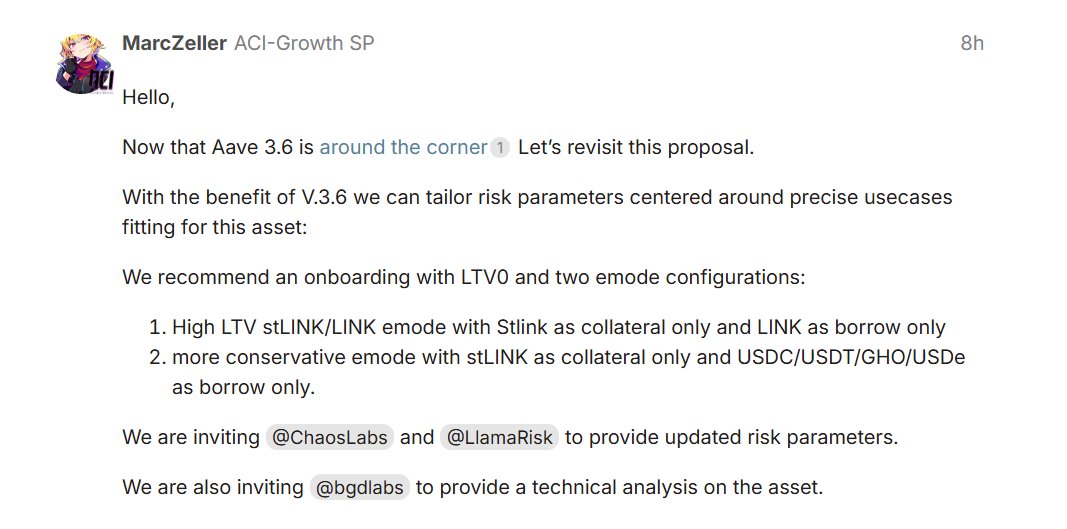
bgdlabs@bgdlabs
Aave v3.6 is almost ready to be proposed to the Aave governance, and we have published all the details about it on the Aave DAO forum governance.aave.com/t/arfc-bgd-aav…
English
Ry Guy retweetet

Been building something using both @Polymarket + @aave == PolyAave
still need to work on some more details but highlevel idea is:
-- PolyAave lets Polymarket outcome tokens earn Aave yield
- Deposit a complete set (Yes + No), we redeem to USDC, deposit into Aave v3, and remint your outcome tokens on withdrawal.
- Yield is distributed via a time-weighted index per market.
- uses the Polymarket CTF adapter (`splitPosition`/`mergePositions`) and Aave v3 Pool.
- Open vault contract: `PolyAaveVault.sol` with per-market reward indices and public `accrue`.
- single-sided matching layer, resolution-aware pausing, Polygon fork tests + UI.
Am I missing something important?
thoughts? @shayne_coplan and @StaniKulechov ?

English
Ry Guy retweetet

For a closer look at how native Bitcoin collateral will work on @aave V4, we’ve put together a full breakdown.
No wrappers, no custodians, just native BTC.
More details here 👇
babylonlabs.io/blog/babylon-l…

English

Scouting for more swing set ups tomorrow.
Which charts have the best set ups or are sitting at key levels?
English
Ry Guy retweetet
Ry Guy retweetet
Ry Guy retweetet


Ry Guy retweetet

Ry Guy retweetet

Ry Guy retweetet

Ry Guy retweetet
Day 15 of tweeting about @Aave until $aave hits $1K.
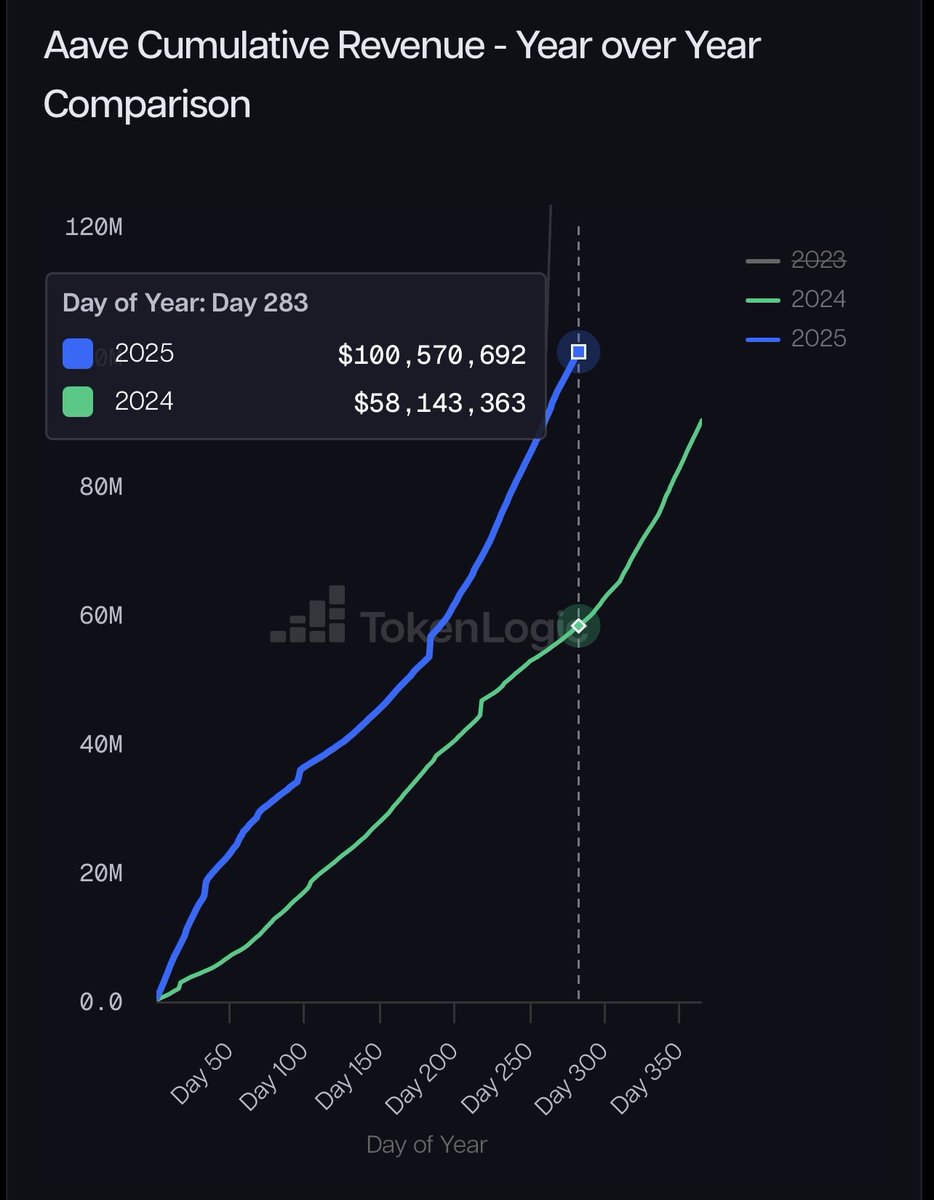
Huge milestone achieved:
Aave has already generated $100 million in revenue in 2025.
For comparison, at this point in 2024 it was only $58 million — a 73% increase.
V4 coming soon. We are only getting started.
Higher
English
Ry Guy retweetet

@pendle_fi (every possible PT)
@capmoney_ (stcUSD or PT-stcUSD on Pendle)
@infinifi (siUSD or liUSD or the PT on Pendle)
@0xfluid (Multiply looping or just lending)
@ethena (use sUSDe across every farm)
@maplefinance (syrupUSDC and syrupUSDT)
@MorphoLabs (mainly for PT looping)
@aave (old faithful, near zero-risk lending)
@kamino (love their Multiply product)
@GearboxProtocol (easy 10x loops + gud lending APYs)
@ether_fi USD Liquid vault (9.1-10% APY consistently)
A few newer ones:
@solsticefi 10% APY (Ethena-like trade on Solana)
@neutrl (public deposits soon but printing 30%)
English