Honglin (虹霖) Bao

1.6K posts

Honglin (虹霖) Bao banner
Honglin (虹霖) Bao

Honglin (虹霖) Bao

@HonglinB

#AI4Innovation I use AI to study the drivers of innovation and discovery @KnowLab @DSI_UChicago

Beigetreten Mart 2020
458 Folgt552 Follower
Honglin (虹霖) Bao retweetet
Data Science Institute
Data Science Institute@DSI_UChicago·
We're excited to welcome prospective PhD in Data Science students visiting DSI today! Our visitors will be exploring the interdisciplinary UChicago community, new opportunities for data science and AI research, and much more We hope you have a great day at DSI!
Data Science Institute tweet mediaData Science Institute tweet mediaData Science Institute tweet media
English
0
1
3
73
Honglin (虹霖) Bao
@dashunwang we will have survey evidence supporting you soon (full automation is kinda pure CS hype at least so far)
English
1
0
2
57
Honglin (虹霖) Bao retweetet
Dashun Wang
Dashun Wang@dashunwang·
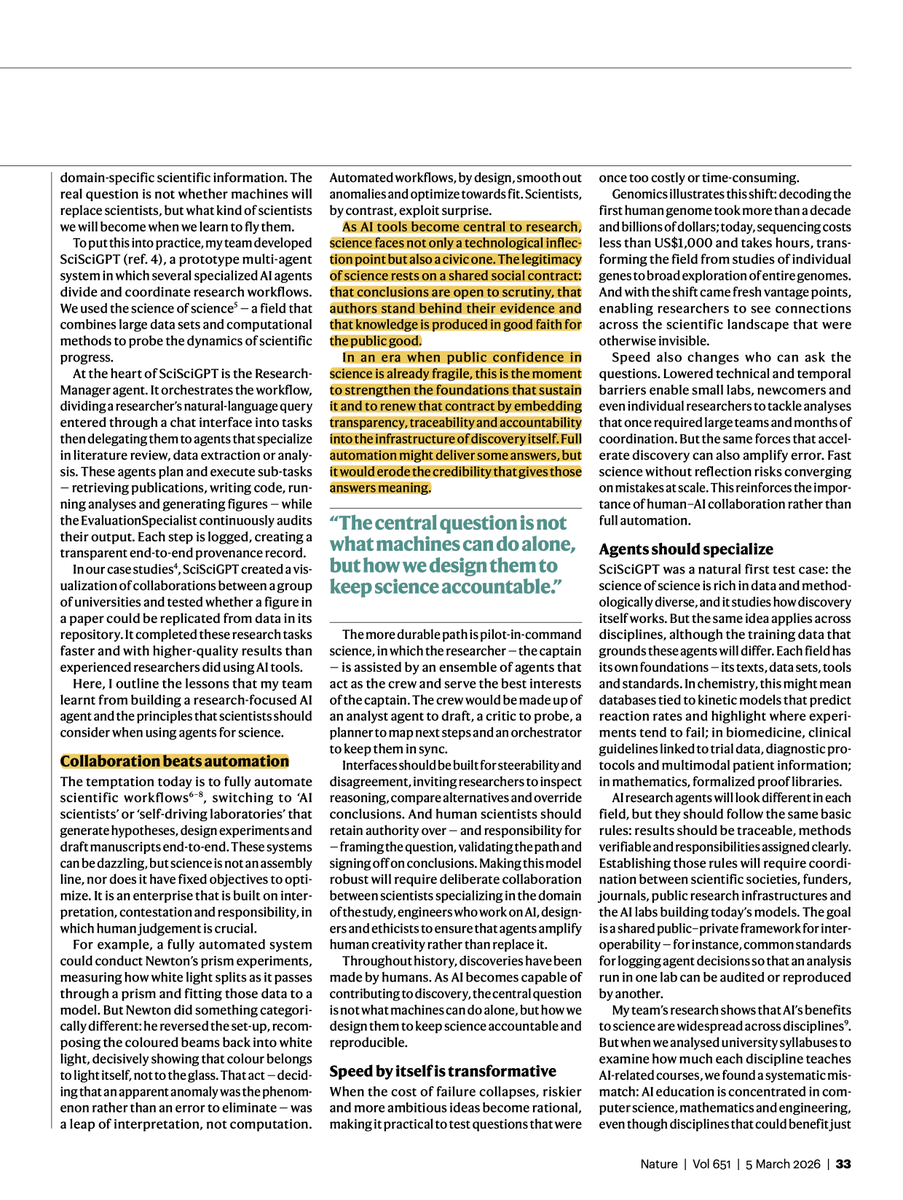
There's been a lot of discussions about how research should change with the rise of AI agents, and many advances in fully autonomous systems. What seems missing in these discussions is that, as AI tools become central to research, science faces not only a technological inflection point but also a civic one. The legitimacy of science rests on a shared social contract: that conclusions are open to scrutiny, that authors stand behind their evidence and that knowledge is produced in good faith for the public good. In an era when public confidence in science is already fragile, this is the moment to strengthen the foundations that sustain it and to renew that contract by embedding transparency, traceability and accountability into the infrastructure of discovery itself. Full automation might deliver some answers, but it would erode the credibility that gives those answers meaning. In my "Airplanes for the mind" essay, I outlined five principles for working with AI agents. And this is the first one: Collaboration beats automation. Check out the essay in @Nature and let me know what you think! nature.com/articles/d4158…
Dashun Wang tweet media
English
4
8
25
1.5K
Honglin (虹霖) Bao
@MishaTeplitskiy prob worth testing the strength of the committee (i.e., who pays the first year, dummy variable), the stronger the committee the bigger the penalty
English
0
0
1
379
Honglin (虹霖) Bao retweetet
Misha Teplitskiy | Science of Science
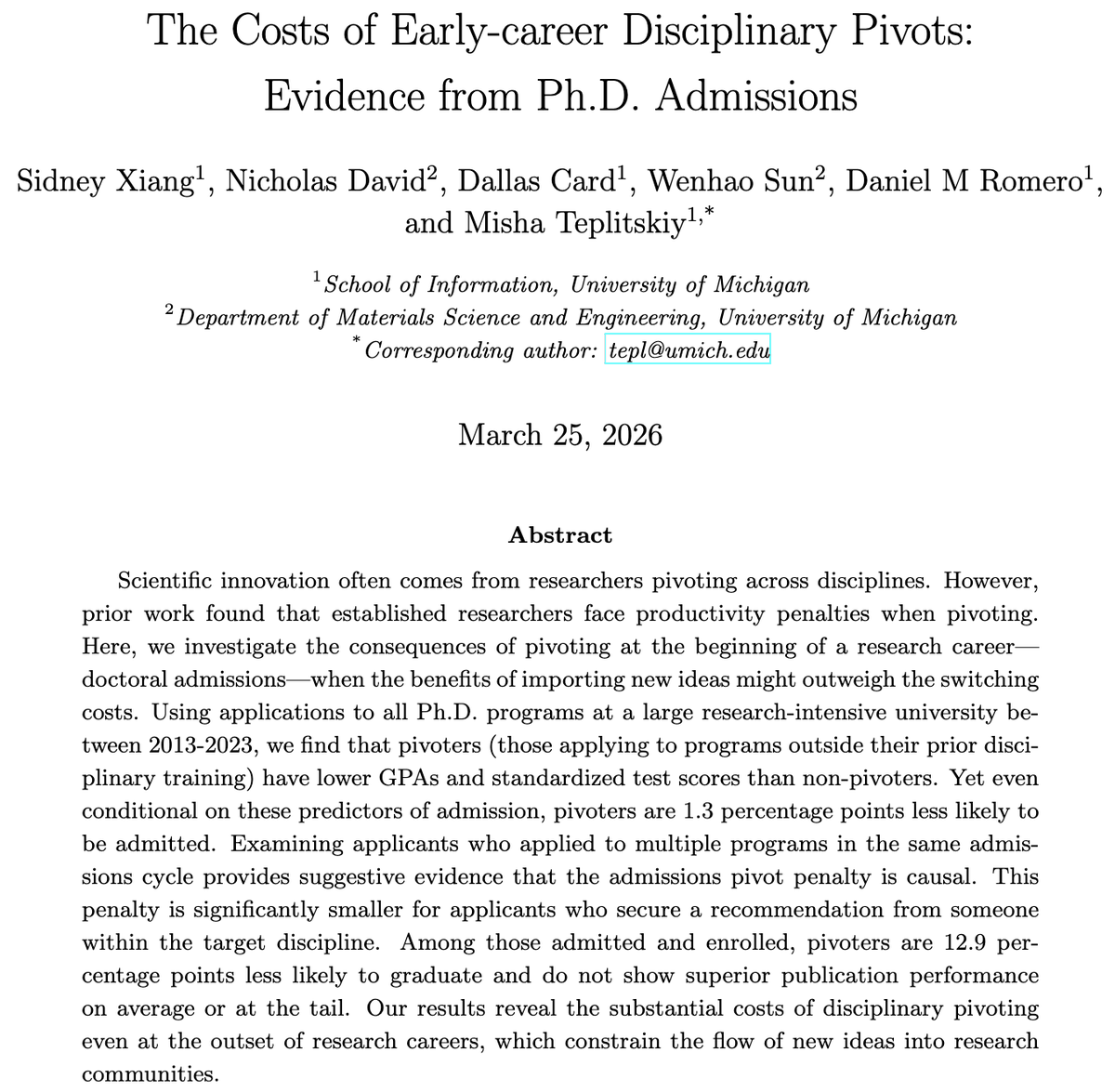
New paper on PhD admissions and pivots! Scientific communities need new ideas to stay productive and relevant. One source of new ideas is students who pivot from other fields. Do such pivots pay off for the student or the community? 🤔 1/3
Misha Teplitskiy | Science of Science tweet media
English
9
27
199
24.7K
Honglin (虹霖) Bao retweetet
Jessica Hullman
Jessica Hullman@JessicaHullman·
This paper equates taste w/impact as citations. Can a paper in poor taste be highly cited? Can elegant papers be undercited? Taste seems best defined at the individual level. I see it as recognizing value before the community does (& they may never). It's not citation prediction
Antonio Mele@antoniomele101

The "Human researchers still have an advantage because AI does not have research taste" take lasted about one month... arxiv.org/abs/2603.14473

English
2
3
25
2.1K
Honglin (虹霖) Bao retweetet
Nathan Goldschlag
Nathan Goldschlag@ngoldschlag·
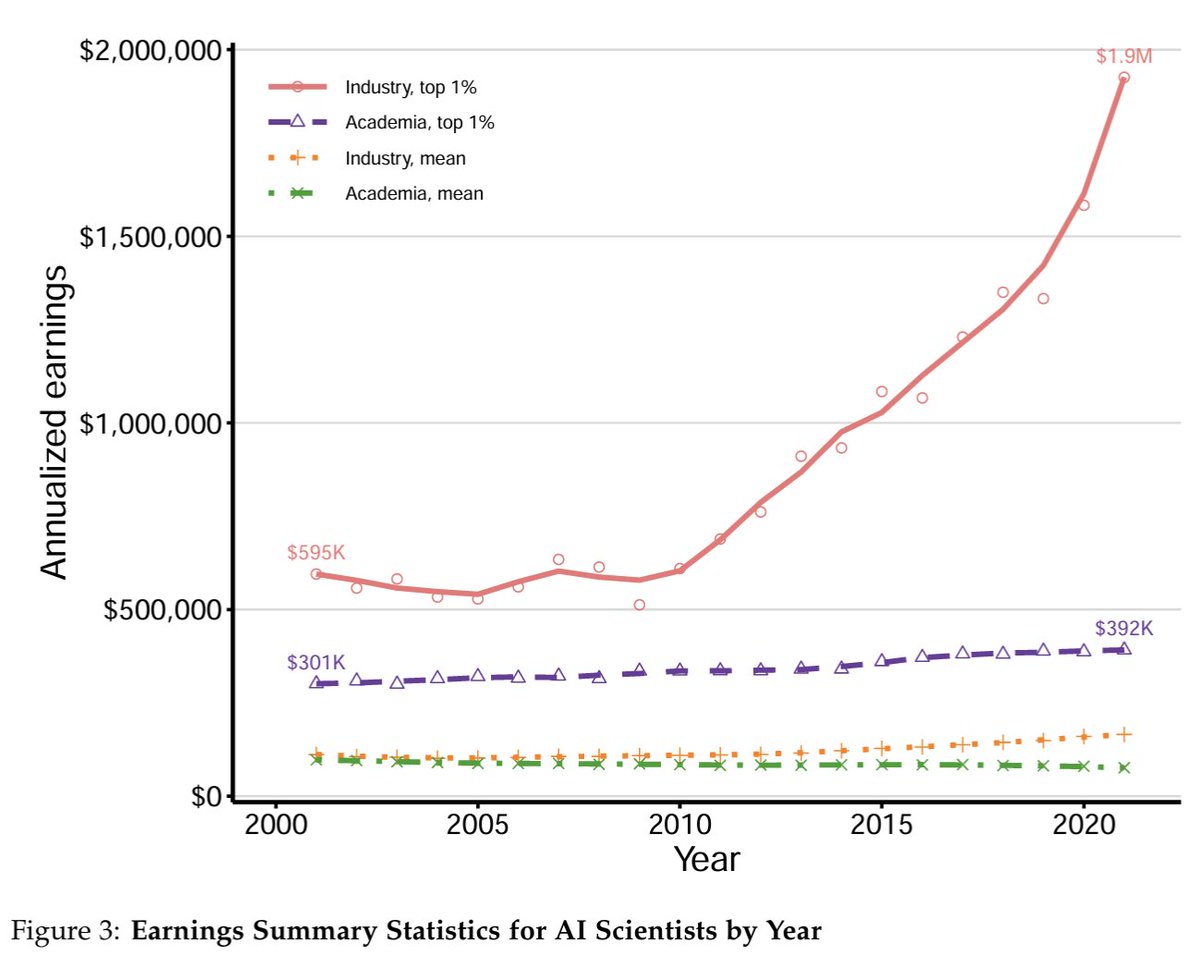
Very excited our paper on AI scientists is out at NBER (w/ @ProfUfukAkcigit, Craig A. Chikis, and Emin Dinlersoz). We link authors of academic papers to administrative records at the U.S. Census Bureau (via anonymized record linkage) and zoom in on AI scientists. We see dramatic top 1% earnings increases in the private sector, widening the industry-academia gap. This coincides with increased transitions out of academia, particularly among young AI researchers flowing to incumbent firms. After transitioning from academia to industry, researchers on average write fewer papers and issue more patents (relative to similar job switchers within academia).
Nathan Goldschlag tweet mediaNathan Goldschlag tweet media
Séb Krier@sebkrier

Study tracking 42,000 AI researchers: "The top 1% of publishing industry scientists now earn $1.5 million more annually than comparable academics, a fivefold increase since 2001. Researchers who move to industry publish less but patent more." nber.org/papers/w34964

English
10
53
180
103.5K
Honglin (虹霖) Bao retweetet
Ryan Hill
Ryan Hill@RyanReedHill·
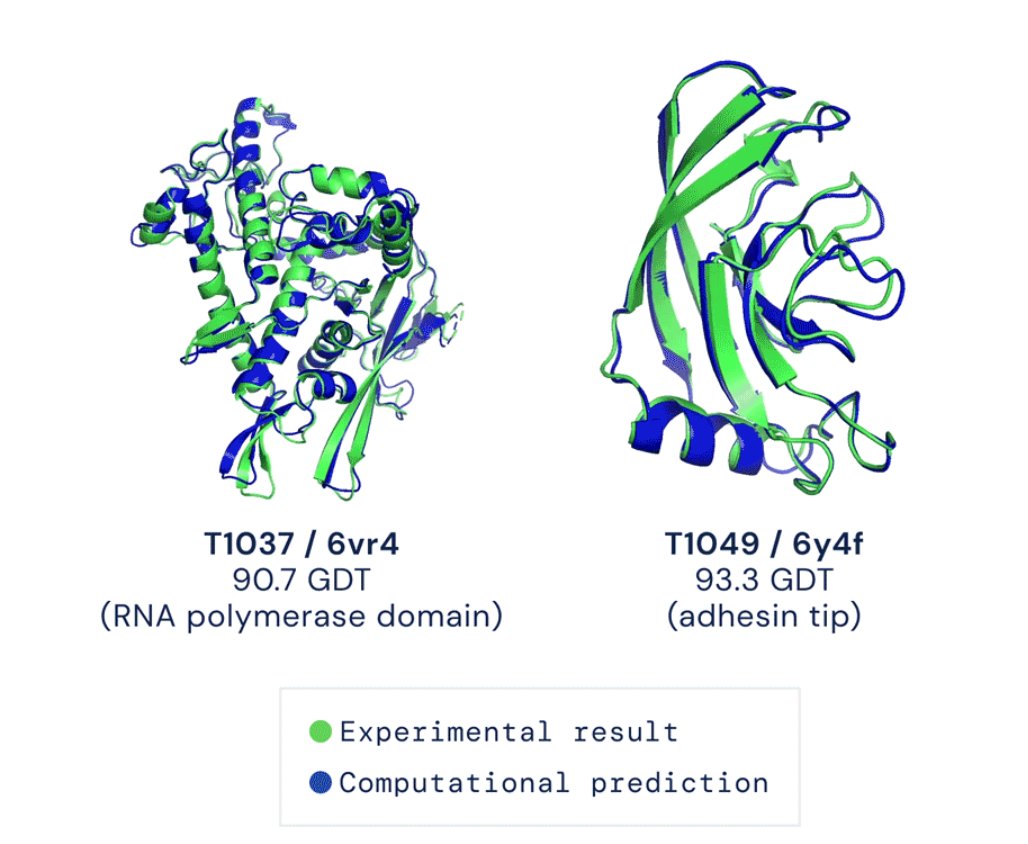
There is great excitement about the potential for AI to reshape science, but so far very little empirical evidence about how that is (or is not??) happening in real time. I'm excited to share a new working paper with @carolyn_sms about the impact of AlphaFold on science ->
Ryan Hill tweet media
English
1
35
116
19.5K
Honglin (虹霖) Bao retweetet
Xihong Lin
Xihong Lin@XihongLin·
Our review article on harnessing synthetic data from generative AI for statistical inference. We discuss generative models for synthetic data & their principled use for valid downstream statistical inference, esp when generative models are misspecified. arxiv.org/abs/2603.05396.
English
1
11
72
8.2K
Honglin (虹霖) Bao retweetet
Oleg Urminsky
Oleg Urminsky@OlegUrminsky·
When you collect data online, are the results from humans or AI? In a project led by Booth PhD student Grace Zhang, we estimate the prevalence of AI agents on commonly used survey platforms: osf.io/preprints/psya… 🧵
English
6
62
197
36.2K
Honglin (虹霖) Bao retweetet
Dashun Wang
Dashun Wang@dashunwang·
AI agents are “Airplanes for the mind”. Check out my latest piece in @Nature, where I outline an agenda for how to think about AI agents in science and discovery. Steve Jobs famously called computers “bicycles for the mind”—a metaphor for the personal-computing era, emphasizing tools that let individuals go farther and faster with less effort. Today, AI agents demand a new metaphor. They are airplanes for the mind: heavier-than-air machines that should not fly but do. These “airplanes” have the potential to dramatically extend the scale, speed, and coordination of human cognition, while introducing new challenges for science and discovery. The piece outlines five key principles to help us understand what changes for science when AI systems move from passive tools to active partners. Throughout history, discoveries have been made by humans. As AI systems increasingly participate in discovery, the central question is how we design human–AI collaboration to make science more accountable, reproducible, and ultimately transformative. The question is not whether machines replace scientists, but what kind of scientist emerges when we learn to fly. Check out the piece and let me know what you think! Link in the first reply
Dashun Wang tweet media
English
2
9
20
2.2K
Honglin (虹霖) Bao retweetet
Serina Chang
Serina Chang@serinachang5·
📢 I'm recruiting a postdoc to start in summer 2026! My lab is part of @Berkeley_EECS, @UCJointCPH & @berkeley_ai. We're looking for candidates in AI & society, with projects on the societal impacts of gen AI (collaborating w/ real-world orgs) and modeling human behavior with AI!
English
4
60
307
30.2K
Honglin (虹霖) Bao retweetet
James Evans
James Evans@profjamesevans·
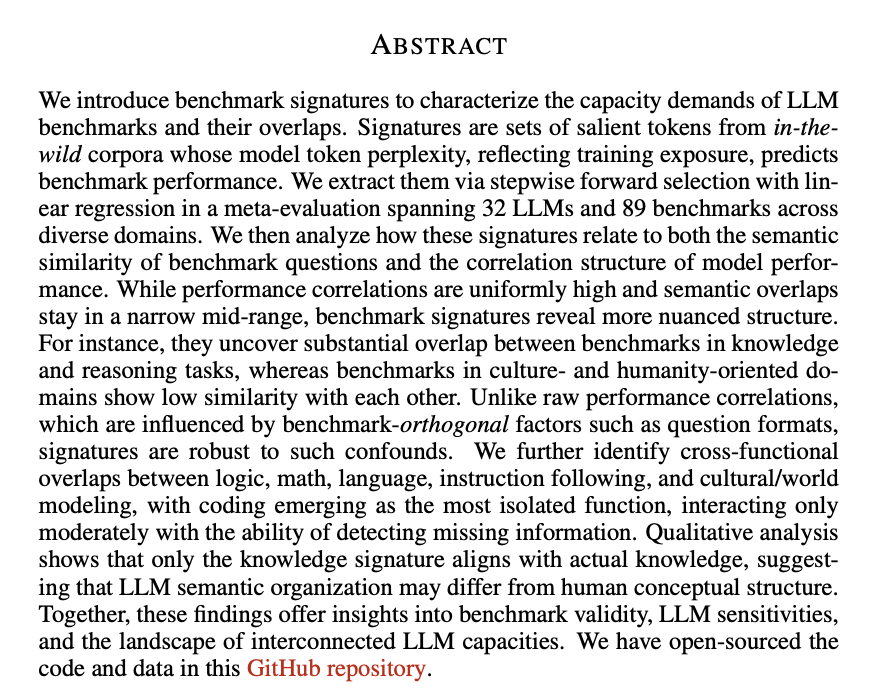
I loved working on this ICLR paper with brilliant colleagues. It benefited from the insight that we can infer what data models have been trained on from their surprise (perplexity) at samples of web data. Then we take this insight and show how the universe of current benchmarks relates to the core knowledge on which models are built, and, through that, how those benchmarks relate to one another. Our findings suggest both the importance of refactoring existing benchmarks (and reweighting model performance across them to reflect balanced capacity) and where new benchmarks can be developed to capture valuable but un(der)measured capacity!
Honglin (虹霖) Bao@HonglinB

Excited to share our @DSI_UChicago new work accepted by ICLR 2026, with the remarkable Siyang Wu, Sida Li, Ari Holtzman @universeinanegg, and @profjamesevans James Evans! Link: lnkd.in/gd9YZNBh A thread (1/n)
English
1
6
20
2.4K
Honglin (虹霖) Bao
Honglin (虹霖) Bao@HonglinB·
Together, we believe the current evaluation ecosystem would benefit from a more rigorous and principled reconstruction. (n/n)
English
1
0
0
185