Jesko

21 posts

Jesko

Jesko

@IND_Jesko

Beigetreten Nisan 2012
75 Folgt29 Follower
Jesko retweetet
Gal Arnon
Gal Arnon@GalArnon42·
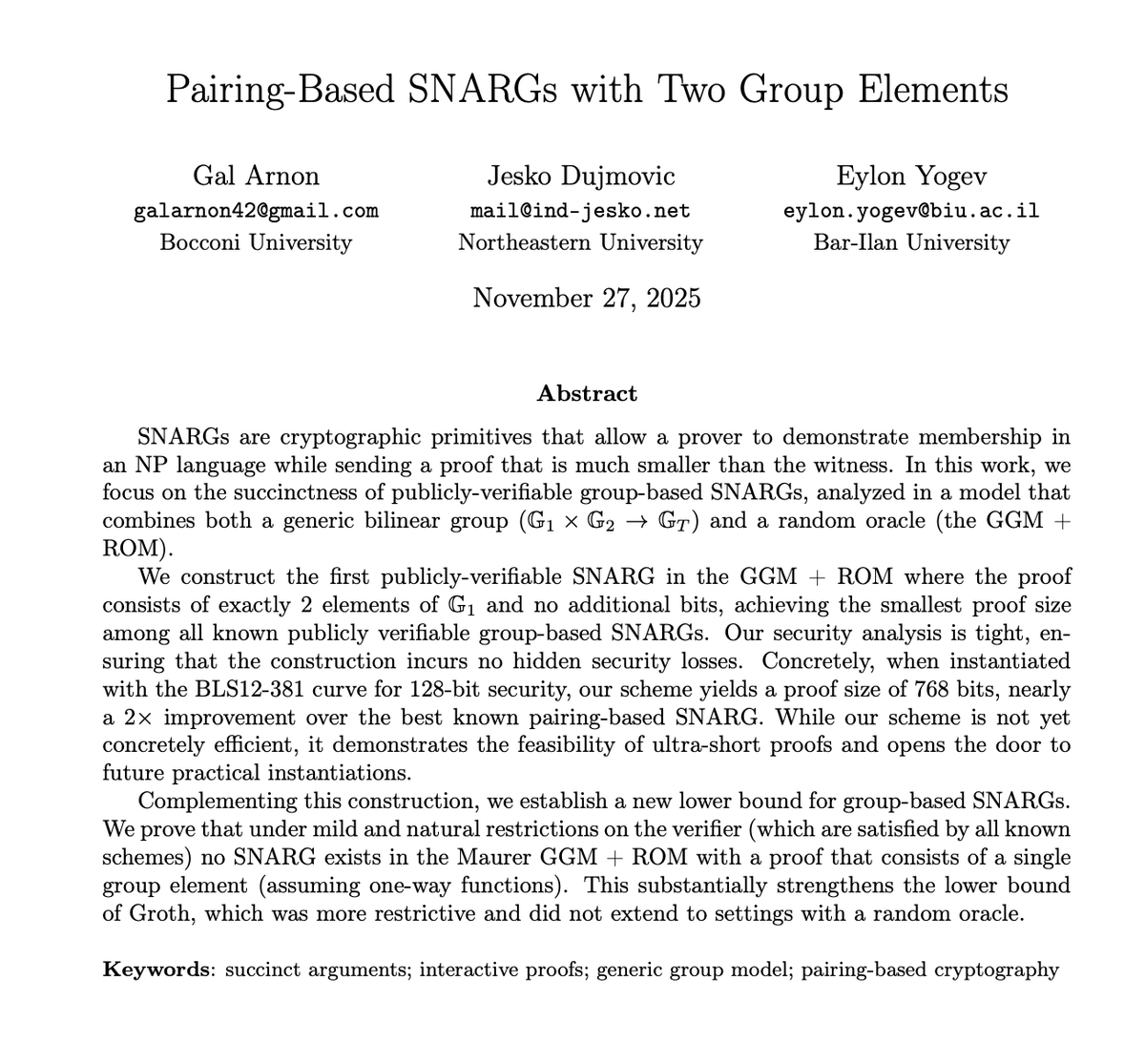
What's the limit of succinctness for pairing-based SNARGs? We answer this by constructing the first pairing-based SNARG with a proof of exactly 2 group elements (and 0 additional bits!)! Joint work w/@IND_Jesko & Eylon Yogev.🧵👇 🔗 ia.cr/2025/2160
Gal Arnon tweet media
English
2
14
64
7.8K
Jesko
Jesko@IND_Jesko·
This year's (IACR) Crypto shirt is teaching me new words. #succim
Jesko tweet media
English
1
0
2
191
Jesko
Jesko@IND_Jesko·
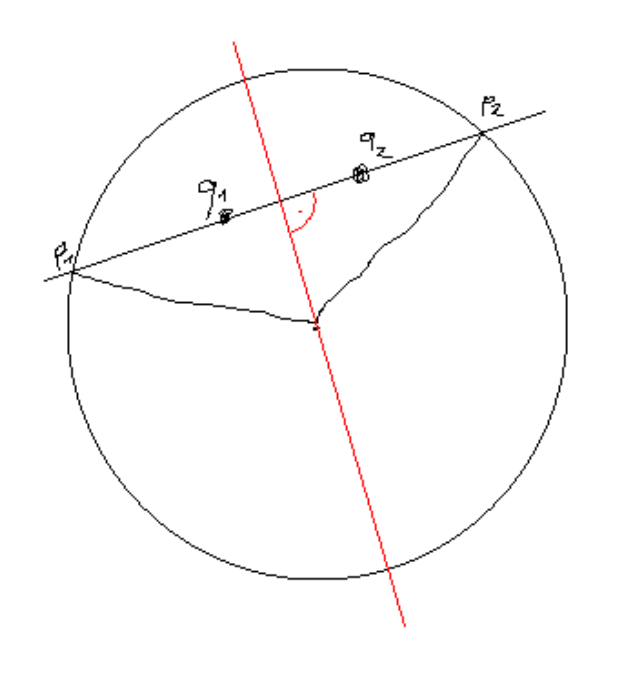
@CryptoOrrDun Once I have two points in the ball q1, q2 (and I can pick the query points) I can do a binary search in both directions to find the intersection points p1,p2. That is all I need to query for the dim reduction. Then recurse on the red n-1 dim space. (no artist)
Jesko tweet media
English
1
0
0
56
Orr Dunkelman
Orr Dunkelman@CryptoOrrDun·
@IND_Jesko If the points are generated non-randomly, you get into trouble. If the points are generated randomly, then it takes a lot of time for each new dimension reduction.
English
1
0
0
19
Orr Dunkelman
Orr Dunkelman@CryptoOrrDun·
A quick question: I have a sphere hidden in R^n. I know it's radius, and I am allowed membership queries. I know that if I pick points from some distribution, the chance of the point to be in the sphere is p. So after 1/p points, I'm inside the sphere. Now what?
English
4
0
4
981
Jesko
Jesko@IND_Jesko·
@CryptoOrrDun Here is a different approach (maybe better). Find two points in the ball. Find the points where the line though these intersect the n-dim ball. The n-1 dimensional space at the center of these intersection points contains a n-1 dimensional ball with the same center. Recurse.
English
1
0
0
36
Jesko
Jesko@IND_Jesko·
@CryptoOrrDun You can also skip queries that hit the convex hull of the points you know are in the ball around the center. Those will be in the ball too
English
1
0
1
38
Jesko
Jesko@IND_Jesko·
@avCva_mei We need that the operations can be modeled via some find of oracle and this is rather hard to do with non generic applications of lattice-based cryptography
English
1
0
1
56
Jesko
Jesko@IND_Jesko·
@avCva_mei Our result only really applies to PIR without preprocessing. Of course you can turn this Ashe based pir into one without preprocessing by doing the preprocessing in the online phase. But even then it is still very hard to apply our result.
English
1
0
0
63
Jesko
Jesko@IND_Jesko·
You are a Eurocrypt attendee and hungover from all the boating yesterday? Come join my talk at 9:00 in track 3. Ill talk about lower bounds on the number of public key operations in PIR in a hangover respecting manner.
English
1
3
14
1.7K
Jesko
Jesko@IND_Jesko·
I'm excited for the laconic cryptography event tomorrow at eurocrypt
English
0
0
0
217
Nigel Smart
Nigel Smart@SmartCryptology·
@HLipmaa @PratyushRT A nice rule of thumb is about 10k bits per bit of message (it using TFHE). However with TFHE transciphering is super fast (see our recent WAHC paper). So you can send and store messages using something like Krevium to get one bit of message = one bit of ciphertext.
English
2
0
7
299
Pratyush Ranjan Tiwari
Pratyush Ranjan Tiwari@PratyushRT·
So much fuss about FHE, but is there an FHE scheme where the ciphertext is not 7000 bits at the 128-bit security level?
English
1
0
2
808
Nils Fleischhacker 🥩🔪
Nils Fleischhacker 🥩🔪@Cryptomaeher·
Apropos weird things that screw up beautiful definitions: is it wlog to assume that in a PKE there's a uniquely determined sk for every pk? Naturally there are PKE where many equivalent sk exist, but are there any that I can't fix by always choosing a "canonical" sk?
English
2
0
1
0
Jesko
Jesko@IND_Jesko·
@gkaptchuk @tusharjois Just saw this at RWC and was interested. Can you explain in more detail than the paper why you changed you to sample from the language model in comparison to arxiv.org/pdf/1909.01496… ? It seems to me they make better use of the entropy in natural language
English
0
0
0
0
Gabe Kaptchuk
Gabe Kaptchuk@gkaptchuk·
@tusharjois put together an amazing, easy-to-use way to play with Meteor via Google Colab. You can just load it up and start generating steganographic messages! Link available from meteorfrom.space. If you're interested, check out the paper at ia.cr/2021/686 10/10
GIF
English
1
2
5
0
Gabe Kaptchuk
Gabe Kaptchuk@gkaptchuk·
My joint work "Meteor: Cryptographically Secure Steganography for Realistic Distributions" w/ @tusharjois, @matthew_d_green , and @avirubin is going to be featured tonight at CCS! Why is steganography interesting in 2021? Hasn't everyone stopped working on stego? A quick🧵1/?
English
2
8
46
0
Jesko
Jesko@IND_Jesko·
@secparam I've just recently read the paper and was wandering why in the construction with restricted false-positive rates you always choose ambiguous encryptions with message space 2? Wouldn't power of 2,4,8... lead to smaller ciphertexts with the same false positive rate?
English
0
0
0
0
Ian Miers
Ian Miers@secparam·
Introducing fuzzy message detection. Testing if a ciphertext is yours is a recurring problem in anonymous messaging and private cryptocurrencies. Existing approaches require you to fully trust a server or download all messages. We found a middle ground: eprint.iacr.org/2021/089
English
4
28
73
0