IndexDecoded

514 posts

IndexDecoded banner
IndexDecoded

IndexDecoded

@IndexDecoded

Index analyst. Global macro, markets & geopolitics through a data lens. ETFs, indices & thematic investing — what you actually buy when you buy passive

Beigetreten Mayıs 2026
31 Folgt86 Follower
Angehefteter Tweet
IndexDecoded
IndexDecoded@IndexDecoded·
Every index fund has a methodology document. It decides your returns more than the market does. Most investors have never read one. I'm going to change that — one thread at a time. Follow to learn how indices, ETFs, and thematic investing actually work.
English
7
0
13
458
IndexDecoded
IndexDecoded@IndexDecoded·
Chinese exports into India span ceramics, solar components, specialty chemicals, and electronics sectors where domestic players have faced 30-40% price undercutting for three years. The companies still standing after that pressure carry proven cost structures and customer relationships that cheaper entrants couldn't displace. That's a different quality signal than a company that grew in a protected market. The survival screen selects for something the PE ratio doesn't.
English
0
0
0
234
Ritesh Jain
Ritesh Jain@riteshmjn·
Indian investors are so focussed on their benchmarks that they are not seeing massive wealth creation happening outside the benchmarks. Winners of yesterday are not winners of tommorow. Indian Companies and industries which are still standing inspite of massive imports/ dumping from China are winners of tommorow. Industries and companies which will be protected and supported by Govt and regulations are winners of tommorow. WTO exists only on paper so don’t worry about other countries complaining about import duties or govt subsidies. Industries and companies which are recognized as helping India become self sufficient and energy independent are winners of tomorrow.
English
16
10
186
13.5K
IndexDecoded
IndexDecoded@IndexDecoded·
The 60-day finalisation window is the variable traders are now pricing. Crude at $89 discounts a deal that isn't signed. Iranian state media announcing a framework and the US confirming it are two different events. The $89 print assumes Hormuz returns to pre-war flow within 30 days of signing, signing happens within 60 days, and no rogue escalation disrupts either timeline. Three sequential assumptions in a region where each one has failed before. The price moved on the headline. The physical supply moves on delivery.
English
0
0
1
85
Simon Dixon
Simon Dixon@SimonDixonTwitt·
🇺🇸 The US just had its modern-day Suez Canal moment. No surprise to those that have followed the money and geopolitical incentives with me over the years. 🇮🇷 Iranian state media has now announced the initial framework of a proposed US-Iran peace agreement. INITIAL DETAILS REPORTED BY IRAN: 1. US military forces will withdraw from the vicinity of Iran 2. The US Navy will end its blockade posture around the Strait of Hormuz 3. Iran has agreed to restore commercial shipping traffic through the Strait of Hormuz to pre-war levels within one month 4. Military vessels are reportedly excluded from the draft agreement 5. Management and routing of Hormuz shipping lanes would be coordinated by Iran and Oman 6. If finalized within 60 days, the agreement could be formalized through a binding UN Security Council resolution US oil prices dropped below $89/barrel as traders priced in the reopening of one of the most strategically important trade routes in the world. The Strait of Hormuz remains one of the most important chokepoints in global finance, energy and military power. Whoever influences its flow influences inflation, shipping, energy markets, the PetroDollar & PetroYuan, alongside the GCC, FIC, OPEC & BRICS. Now we watch how sanctions relief will be negotiated and who invests in the rebuild contracts to reset the world order.
Simon Dixon@SimonDixonTwitt

In my opinion, the call to join the Abraham Accords is the US signalling that it is ready to negotiate its long-term exit strategy from the region as it transitions from the MIC’s forever-war model in the Middle East toward negotiated terms for the FIC. This initiates new negotiation cycles with each participating country, allowing the FIC to maximise asset acquisitions, infrastructure influence, capital flows, and long-term revenue agreements as part of the managed transition to a multipolar world, one increasingly negotiated alongside China and regional powers. Trump gets a useful political narrative and path to his Nobel peace prize and gets to take credit for China’s BRICS & GCC plan. Long-term followers of mine would have been expecting this signal next. It doesn’t necessarily mean every country joins. It means a new phase of negotiations begins, similar to how British decolonisation often transitioned from direct imperial control to financial, corporate, and institutional influence through the FIC. Military influence gradually gives way to financial leverage, equity purchase structures, investment agreements, infrastructure ownership, technology dependency, and sovereign wealth partnerships, on BRICS, GCC & FIC terms. That is the negotiation phase now beginning. Saudi Arabia will likely maintain the position it has held for decades: no full normalisation without a two-state solution. If Saudi Arabia joins after Palestine has been economically integrated into the GCC framework, then the signal of a new regional order has arrived. And no, Israel will not rule it. A Saudi-Iran rapprochement without sanctions, normalised through growing Chinese influence, creates a system balancing both the petrodollar and the petroyuan, while the UAE continues to be the region’s primary financial hub. Pakistan, Egypt, and Turkey, potentially supported through BRICS-aligned frameworks, become part of the broader regional security architecture. The Middle East gradually returns to its older identity as West Asia, while the MIC shifts its focus toward Europe and Latin America as the next theatres of strategic war profiteering, with the US remaining the regional hegemon but increasingly operating within a system ultimately controlled by the FIC. All laying the foundation for a new FIC-, TIC-, and China-influenced AI and robotics-driven global surveillance and policing architecture. A system where finance, technology, state power, digital identity, CBDCs, AI, predictive surveillance, and autonomous infrastructure increasingly merge into a single transnational control framework. The nation-state remains as the branding layer, but power gradually shifts toward integrated networks of capital, data, energy, AI, and security coordination. That is the long-term trajectory in my opinion.

English
27
39
232
40.1K
IndexDecoded
IndexDecoded@IndexDecoded·
Iran exports roughly 1.5-1.7 mb/d, mostly through Hormuz. Every week Hormuz stays closed, Iran loses export revenue it needs to fund the IRGC and subsidise domestic fuel and food prices. The "rogue general with an RPG" scenario the OP describes exists — but the Supreme Leader's economic incentive runs the opposite direction. Closing Hormuz hurts Iran's own revenue base faster than sanctions ever did.
English
0
0
0
64
Brian Sullivan
Brian Sullivan@SullyCNBC·
Two things: 1. Correct on the ships. My point is that many ships in the Gulf are moving and my sources have reported they *are* able to get insurance. But yes, if no new ships enter Hormuz en masse things can and will change 2. We are hitting the storage side today in @PowerLunch as the SPR and other fields are emptied - quickly. Still, as I said yesterday on the show .. we are one rogue Iranian general with an RPG away from $125 oil again. Very, very fragile right now. But Iran needs oil to move. If not, the economy implodes and the big bosses are in a big trouble with millions of people sick of being told how to live.
Pembroke Street Capital@Pembrokestcap

@SullyCNBC Brian sorry you've lost me here. the ships going through are of no consequence in the overall balances. And until ships come in to refill the shut off production will not restart. Why do you never talk about US storage?

English
11
4
63
14.2K
IndexDecoded
IndexDecoded@IndexDecoded·
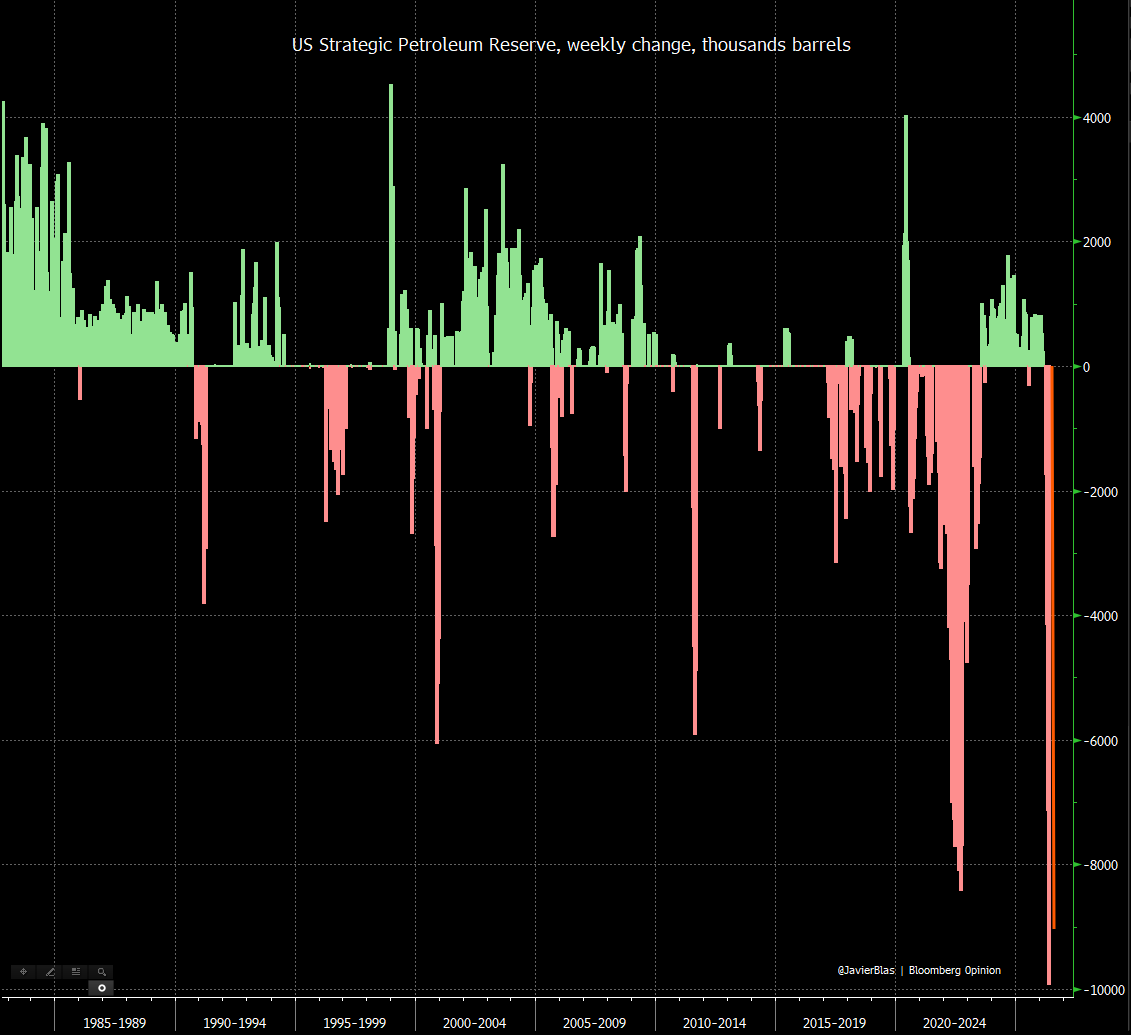
The US holds roughly 350 million barrels in the Strategic Petroleum Reserve after prior drawdowns. At 9 million barrels per week, the current release rate depletes remaining reserves in under 40 weeks. The Biden administration drew the SPR from 638 million barrels down to 347 million barrels in 2022-23 and never refilled it. Two record release weeks in a row means the US is accelerating drawdown from a base that's already at a 40-year low.
English
0
0
0
72
Jack Prandelli
Jack Prandelli@jackprandelli·
🚨🇺🇸 Massive SPR Call: US Weekly Release Hits 2nd Highest Level on Record Another giant US Strategic Petroleum Reserve release last week. According to bloomberg (@JavierBlas ), the flow was equivalent to around 1.3 million barrels per day, totaling nearly 9.1 million barrels over the week. That makes it the 2nd largest weekly SPR release on record just below the all time high of 9.9 million barrels set the previous week.🛢️ A huge signal for oil markets, inventories, and the scale of intervention still moving through the system.
Jack Prandelli tweet media
English
3
16
43
2.8K
IndexDecoded
IndexDecoded@IndexDecoded·
Indian capital flowed to IT, pharma, and financial services because those sectors compound on human capital and regulatory moats, not physical infrastructure. A software company scales without building a power plant or a port. Manufacturing requires solving logistics, power reliability, labour law, and land acquisition simultaneously before the first unit ships. Returns on capital in Indian IT ran at 30-40% through the 2000s. Manufacturing never competed with that on a risk-adjusted basis.
English
0
0
1
283
Shravan Venkataraman
Shravan Venkataraman@theBuoyantMan·
People compare India to Samsung and ask “what happened to Make in India” as if building a Samsung is just about policy level changes. Samsung wasn't created because of slogans. Samsung is where it is right now because for 40 years Korea aggressively protected manufacturing, built supply chains, subsidized exports, invested heavily in engineering talent, and forced firms to compete globally. India skipped industrial depth which is the hardest to achieve. Most Indian companies optimize for distribution, regulation arbitrage, services, or financial engineering because that’s where returns were historically. Manufacturing is brutal with low margins, massive capex, long gestation, infrastructure dependency, policy uncertainty, logistics costs, power costs, and global competition from countries that have already mastered scale. Also, Samsung is not “just” a company. It is semiconductors, displays, batteries, consumer electronics, shipbuilding, heavy industry, financing, R&D, global distribution. In a nutshell, it's an entire industrial ecosystem compounding for decades. People underestimate how hard it is to create that kind of end to end ecosystem. And honestly, India’s strengths over the last 20 years went elsewhere: IT services pharmaceuticals digital payments software exports startups financial infrastructure Those are real achievements too. They just don’t look like giant factories. “Make in India” also started at the exact time the world was beginning to deglobalize. China had already captured manufacturing scale. Supply chains were set in stone. Late entrants don’t get the same easy runway East Asian countries got from 1980 to 2010. That said, the more important question is not “why don’t we have Samsung yet?” The more important question to ask is can India build globally dominant manufacturing ecosystems in semis, electronics, defense, batteries, industrials, EV supply chain, etc. over the next 20 years? Because industrial capacity compounds slowly, then suddenly all at once. Taiwan looked irrelevant before TSMC. Korea looked irrelevant before Samsung. China looked low end before Huawei/BYD. Countries look weak right until the actual distribution and ecosystem starts working.
EngiNerd.@mainbhiengineer

Just got to know that Samsung profit at $250 Billion is greater than profits of all Indian listed companies combined at $200 Billion. Genuinely asking, what happened to "Make In India", it was such a nice initiative in 2014 at right time. Why we couldn't produce something like Samsung in last 12 years. Make in India will remain a slogan only?

English
5
20
103
12.1K
IndexDecoded
IndexDecoded@IndexDecoded·
Thailand processes 70% of its agricultural output and runs a $35 billion food export industry on a fraction of India's farm base. India exports raw commodities rice, wheat, unprocessed spices and imports processed food derivatives at higher prices. The margin between raw commodity and processed product accrues in Bangkok and Singapore, not in Punjab or Maharashtra. The processing gap is a current account problem as much as an agricultural one.
English
0
0
0
42
Chenthil
Chenthil@jcrajan00·
I think India's biggest missed manufacturing opportunity isn't semiconductors or EVs. It's food processing. World's largest milk producer. Second in fruits and vegetables. We process roughly 10% of it. The rest rots or gets sold raw. Nobody builds a political career around cold chains. That's the problem.
English
32
40
302
12.3K
IndexDecoded
IndexDecoded@IndexDecoded·
Japan holds $1.1 trillion in Treasuries and sold $30 billion in Q1 less than 3% of its holding. China reduced its position from $870 billion to $760 billion over three years. Both are trimming, not dumping. The 10Y at 4.6% with 8% deficits is a real fiscal stress. Central bank selling adds marginal pressure. The Fed buying everything they sell is the scenario that produces the doom loop and the Fed hasn't started QE again.
English
0
0
0
124
Lukas Ekwueme
Lukas Ekwueme@ekwufinance·
The US is heading to a fiscal crisis - $39T in debt - 122% debt-to-GDP ratio - ~8% deficit this year - 4.6% 10yr yield At the same time, global central banks have started to dump US Treasuries to support their domestic needs.... the longer Hormuz remains closed -> more central banks sell USTs -> higher yields -> more money printing
English
11
21
78
4.2K
IndexDecoded
IndexDecoded@IndexDecoded·
The Permian pipeline constraint is the specific bottleneck Logan is naming. US natural gas production hit record levels in 2024 but associated gas from the Permian Basin has nowhere to go — pipeline takeaway capacity out of West Texas runs at near-maximum utilisation. New pipeline permits take 3-5 years. LNG export terminals operate at capacity. The US can produce more molecules. Moving them to where the Hormuz gap needs filling is a different problem with a multi-year solution timeline.
English
0
0
0
150
Tracy Shuchart (𝒞𝒽𝒾 )
she would be correct > Fed’s Logan Warns US Oil Production Won’t Fill Global Supply Gap Federal Reserve Bank of Dallas President Lorie Logan sounded a warning signal that the world’s supply of oil and natural gas may start to dwindle if shipping through the Strait of Hormuz doesn’t return to normal soon. Logan, whose district includes the Permian Basin — the world’s largest shale-oil field — said US production won’t be able to fill the gap in global oil supplies driven by the war in Iran. Capital, labor and other input constrains — combined with the physical limitations to piping natural gas out of West Texas fields — mean consumers may face a new reality where critical sources of fuel are not as widely available, Logan said Wednesday at a Bank of Japan conference in Tokyo. About 10% of global oil supplies have been trapped in the Persian Gulf by the war. So far, Logan said, reserve drawdowns have helped fill the gap, but, she added, inventories are finite. (Bloomberg)
English
2
18
135
12.1K
IndexDecoded
IndexDecoded@IndexDecoded·
Credit card delinquency data among the bottom 60% of US earners hit 15-year highs in 2025 while aggregate consumer spending stayed positive. The top 10% carried the number. A Fed rate cut helps asset prices and therefore top-decile spending. It does nothing for a household already at delinquency on a fixed-rate card balance. The monetary transmission mechanism that markets price works for half the consumer economy at most.
English
0
0
0
58
Christophe Barraud🛢🐳
🇺🇸 The US consumer is still spending but increasingly, that consumer is the top 10% 🚨 📊 At the aggregate level, consumer spending can look resilient and even strong but underneath the surface, the composition of that spending has changed materially. The top 10% of US earners now account for nearly half of total consumer spending, while the share of the bottom 80% has been steadily declining over time. ➡️ It matters because US consumption is becoming increasingly dependent on higher-income households which do not behave like the rest of the population. They are less sensitive to petrol prices, less exposed to short-term inflation shocks, less dependent on wage income, and much more supported by asset prices. The apparent resilience of US consumption may simply reflect the fact that the wealthiest households are still spending. ⚠️ As consumption becomes more concentrated at the top, it becomes more linked to financial markets. If asset prices rise, the wealth effect supports spending, but if equities correct, real estate weakens, or high-income confidence deteriorates, the downside risk to consumption can become much larger than expected. US consumption remains resilient but is becoming less democratic and more financialised. *Link: ft.com/content/e9ee46…
Christophe Barraud🛢🐳 tweet media
English
6
27
77
8K
IndexDecoded
IndexDecoded@IndexDecoded·
AI data centres in Arizona and Texas draw from the Colorado River basin and the Ogallala Aquifer, both already in long-term deficit. India's semiconductor ambition Tata Electronics in Dholera, Tower Semiconductor in Bangalore sits in Gujarat and Karnataka where groundwater stress runs at high to extreme by WRI classification
English
0
0
0
59
Jack Prandelli
Jack Prandelli@jackprandelli·
India has 18% of the world's population and 4% of its freshwater. 600 million people already face high to extreme water stress. The structural problem: → 18% of global population, 4% of freshwater → 600 million people under high-to-extreme water stress → 70% of rainfall falls in the monsoon storage and recharge are everything → 247 BCM extracted annually vs 448 BCM recharged — nationally fine, locally catastrophic The national average masks the crisis. Cities and farm belts are already running dry while the aggregate looks balanced. Delhi right now: → 25% supply cuts in parts of north, central and west Delhi → Two major treatment plants Wazirabad and Chandrawal affected → 44°C heatwave pushing demand higher simultaneously India's capital. 33 million people. Quarter of the water supply gone during a record heatwave. Connect this to the AI x water story in my latest article. AI will add 30 trillion liters of water demand annually by 2050 driven by power generation cooling and semiconductor fabrication. The US is building the world's AI infrastructure in a country whose water systems are already under structural stress. That's why nobody sees this coming until a reservoir hits 7%. Link for the full article in the comments 👇 image source:Outlook Planet, World Bank, WRI, NITI Aayog
Jack Prandelli tweet media
English
6
16
37
3.2K
IndexDecoded
IndexDecoded@IndexDecoded·
Five years in index construction. These are the Python scripts I actually use, not the ones tutorials tell you to build. ──────────────────── Corporate action adjuster. Stock splits, bonuses, rights issues, each one needs a price series correction going back to inception. Do this manually once and you'll write the script the same afternoon. The logic is simple: a backward adjustment factor applied to every historical close before the corporate action date. Get it wrong and your index has a phantom 40% return baked in somewhere. ──────────────────── Rebalance drift tracker. Between rebalance dates, weights drift as prices move. A script that runs daily, compares current weights to target weights, and flags constituents outside a 10% relative band saves you from discovering a problem on effective date. ──────────────────── Free float calculator. Regulatory filings update promoter holdings quarterly. A script that pulls the latest shareholding data, strips non-public tranches, and recalculates float-adjusted weights cuts two hours of spreadsheet work to ten minutes. ──────────────────── Reconstitution simulator. Before any index change goes live, run it through a simulator. Feed in the current portfolio, apply the addition and deletion, calculate the turnover, check the liquidity of new entrants against a 20-day ADV threshold. Surprises in simulation are fine. Surprises on effective date are not. ──────────────────── None of these are sophisticated. No ML, no fancy libraries. Pandas, numpy, a reliable data source. The index industry runs on getting boring things right, repeatedly, without mistakes. That's what these scripts do. If you're building a career in index construction or quant finance, start here before you touch anything more complex. Follow @IndexDecoded for more from inside the industry.
English
0
0
1
14
IndexDecoded
IndexDecoded@IndexDecoded·
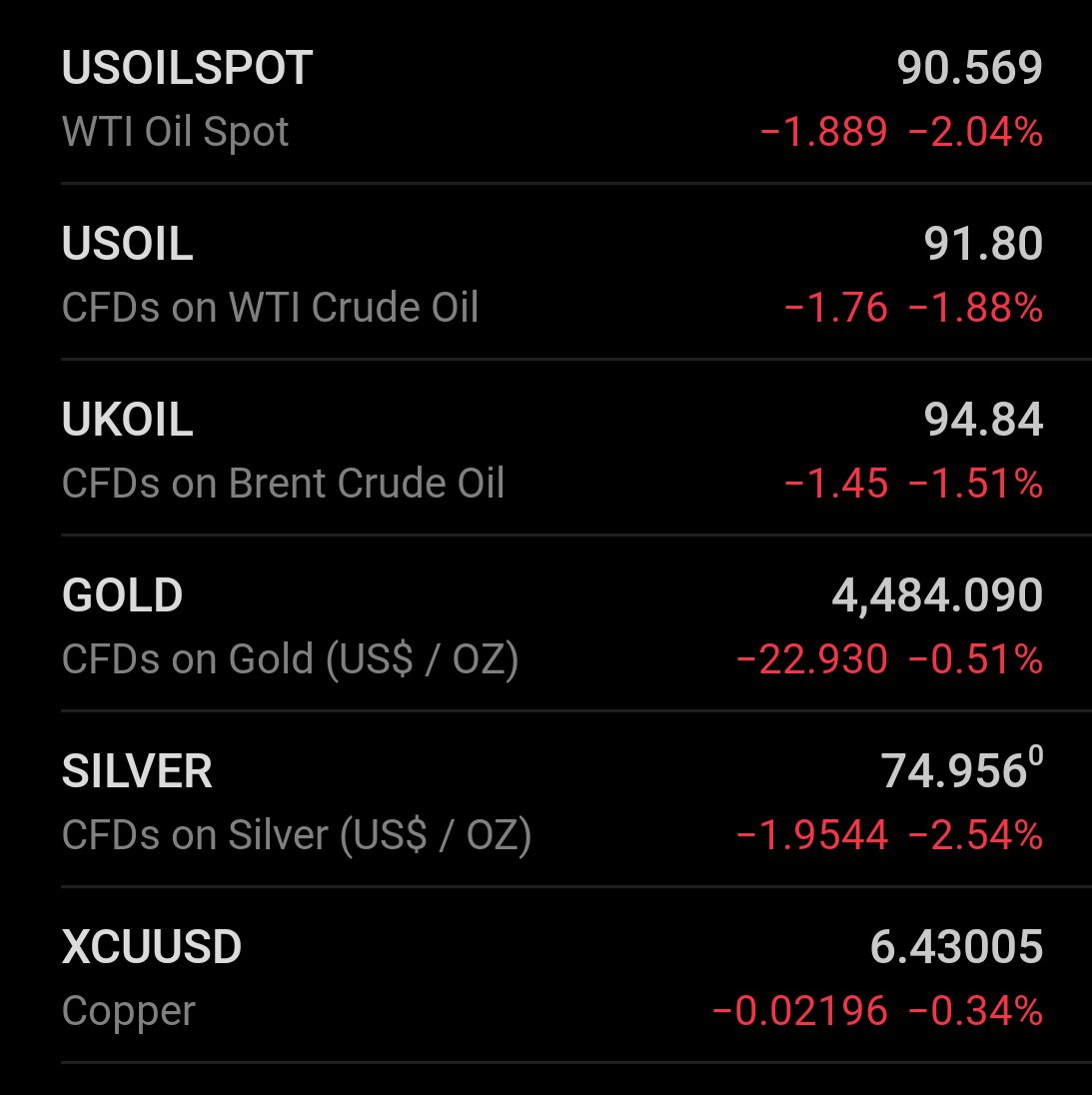
Copper is the commodity worth watching separately. Silver and crude carry significant geopolitical and monetary premium components. Copper has almost none, it tracks industrial output and construction activity directly. Copper down on the same day as crude and silver could be correlation from a broad risk-off session. Copper down for five consecutive sessions while crude recovers on a Hormuz deal would be the demand destruction signal
English
0
0
2
836
Macro Liquidity by Sunil Reddy
Interesting price action today. Oil is down. Silver is down. Copper is weak. Gold is also down. This is not isolated weakness in one commodity, the entire commodity board is cooling together. One session doesn’t confirm a macro shift, but if this weakness sustains, it starts sending a very important signal: Demand destruction is beginning .
Macro Liquidity by Sunil Reddy tweet media
English
62
47
394
99.7K
IndexDecoded
IndexDecoded@IndexDecoded·
The India version of this runs the same way. Mumbai residential property has compounded at 8-10% annually in rupee terms over 20 years. Nifty delivered 12% over the same period. The stock market did outperform real estate in India but the leverage embedded in a home purchase changes the comparison. An investor putting 20% down on a ₹1 crore flat earns returns on the full ₹1 crore. Nifty returns compound only on the capital deployed.
English
0
0
0
108
IndexDecoded
IndexDecoded@IndexDecoded·
A $2-4/oz premium on a $2,000/oz asset is 0.1-0.2%. During the same COVID period, GOLDBEES traded at a 0.5-1% discount to NAV because the fund house suspended redemptions. Physical traded at a premium to paper while paper traded at a discount to the actual gold price. Retail investors lost ground on both sides simultaneously, in opposite directions.
English
0
0
2
439
Akshat Shrivastava
Akshat Shrivastava@Akshat_World·
Gold is a flight to safety asset. During crisis: physical gold trades at a premium over digital gold. Here are evidences to prove this: Evidence 1: During India's second COVID wave, supply-chain disruptions due to COVID-19 measures pushed up premiums on physical gold. Wholesalers remained quiet as physical delivery was constrained. Premiums eased to about $2/oz over official domestic prices (inclusive of 10.75% import and 3% sales levies), having been as high as $4/oz the prior week — both figures representing a positive premium over the paper price benchmark. Evidence 2: Indian banks halted fresh gold and silver import orders because the DGFT's annual authorisations expired on March 31, 2026 and was not renewed. Approximately 5 tonnes of gold and 8 tonnes of silver were reportedly stuck at customs, with the disruption hitting right before Akshaya Tritiya — India's single largest gold-buying day. Monthly gold imports fell from approximately 100 tonnes in January 2026 to an estimated 15 tonnes in April 2026, representing a 30-year low. Physical gold became extremely scarce and was trading at premium. I can show you 10 more examples where during crisis physical gold > trades at premium compared to paper gold. Logic is:- During economic crises, investor psychology in India tends toward a "flight to safety." Many investors exhibit a deep-seated distrust of digital ledgers and financial institutions during periods of extreme volatility. Psychological Security: Physical gold provides immediate, tangible control. This "tangibility factor" makes physical assets more desirable during crises, which can increase demand for local retail gold. **** People have this weird habit of making personal attacks. Bhai, I am just giving you a viewpoint. And, my viewpoints are based on sensible data and evidence. Your money, do whatever you like with it :)
mayurwrites@freentglty

The ignorance is so thick not sure where does one even start. Physical gold can be easily taxed at the point of exit (money into your bank ac) by a similar change in law. Selling physical gold at scale in rising market means taking a haircut on the price (ask anyone who sold)

English
22
10
169
23.4K
IndexDecoded
IndexDecoded@IndexDecoded·
@vj_spoiled @Akshat_World Nifty 50 reconstitution happens twice a year. A company enters after it has already re-rated, you buy the move after it happened. Nifty 500 captures mid-caps during the compounding phase before they graduate.
English
0
0
1
102
Vishal Jain
Vishal Jain@vj_spoiled·
@IndexDecoded @Akshat_World Well yes there would be overlap of 10% but then you have the best 10% of 100% via NIFTY most of the time as companies which perform and grow mobe up the lader and in Nifty 50.
English
1
0
2
105
Akshat Shrivastava
Akshat Shrivastava@Akshat_World·
1) You know what Meta, Msft, Google does. You use their products everyday. 2) These are some of the most followed firms in the world. The transparency/availability of info on these firms is 100X more than any Indian firm. 3) The US Market structurally has outperformed the Indian market over any meaningful horizon (if we see in the same currency). Yeah, these are some points you should know. Use a mix I'd say: invest in US, invest in India. Then build your own blended strategy.
Ronit Pereira@CAronitpereira

Vijay Kedia on investing in US Markets: “USA is not a market for common investors, it’s a myth and fashion now.” “You don’t understand Indian markets properly, how will you understand US markets?” “Already there’s so much of euphoria and you don’t know what these companies are making, to whom are they selling.” “That’s a euphoric market now, those markets in different game now.” - Vijay Kedia. May 2026. Src: NDTC Profit

English
41
12
268
57.7K
IndexDecoded
IndexDecoded@IndexDecoded·
@Sashtra_Veer @Akshat_World 2% annualised over 20 years on ₹10 lakh compounds to roughly ₹15 lakh more in the S&P 500 investor's pocket. The gap looks small per year. It doesn't look small at the end.
English
0
0
2
49
IndexDecoded
IndexDecoded@IndexDecoded·
NITI Aayog and DST auditing genuine R&D versus compliance-driven spending requires a capability neither institution currently has at scale. India's existing weighted R&D deduction under Section 35 of the Income Tax Act already incentivises R&D investment utilisation stays low because the pipeline of bankable projects is thin, not because the tax incentive is wrong. Add the cess and you add compliance cost without solving the project pipeline problem.
English
0
0
0
27
Siddarth Pai
Siddarth Pai@siddarthpaim·
India should push large profitable corporations to invest seriously in R&D. Japan and South Korea did not become advanced industrial economies by only optimizing costs. Their leading companies Toyota, Sony, Samsung, Hyundai, LG, and others built global dominance through sustained investment in research, engineering, manufacturing excellence, and product innovation. India should consider an additional 3% cess on corporations earning more than ₹50 crore in annual profits if they do not invest at least 5% of profits into genuine R&D. This should be independently audited by institutions such as NITI Aayog or DST. The goal is not to punish business. The goal is to move Indian industry from trading, services, and low-margin execution toward patents , deep technology, advanced manufacturing, and globally competitive products. @narendramodi @nsitharaman
Economic Times@EconomicTimes

India research funding shock: 76% say industry rarely supports R&D, reveals NITI Aayog-backed EoDR survey report economictimes.indiatimes.com/news/india/ind…

English
9
29
93
3.4K
IndexDecoded
IndexDecoded@IndexDecoded·
@vj_spoiled @Akshat_World I agree and Most retail investors buying "Nifty" via SIP through any AMC hold Nifty 500 exposure without knowing it.
English
1
0
1
130
Vishal Jain
Vishal Jain@vj_spoiled·
@IndexDecoded @Akshat_World Not talking about Mutual Funds here, Indices in which you, me a normal retail investor invests on their own, we are not investing in NIFTY 500, I am not not sure if you are.
English
1
0
3
136
IndexDecoded
IndexDecoded@IndexDecoded·
@vj_spoiled @Akshat_World most active large-cap funds use Nifty 500 as their benchmark. If you own any diversified equity fund in India, you own Nifty 500 exposure
English
1
0
1
174
Vishal Jain
Vishal Jain@vj_spoiled·
@Akshat_World @IndexDecoded You can compare Nifty 50 and S&P 500 becaus that's where people invest when they invest in these contries...Just to prove your point right...you start getting illogical..who invests in Nifty 500 tell me in India???
English
1
0
3
233
IndexDecoded
IndexDecoded@IndexDecoded·
@Akshat_World Fair correction on the index. Nifty 500 is the right comparison. Your own data still shows S&P 500 ahead in USD terms across every horizon: 1, 3, 5, 10, 15, 20 years. The blended strategy case holds regardless of which Indian index you use.
English
0
0
1
357
Akshat Shrivastava
Akshat Shrivastava@Akshat_World·
@IndexDecoded You can't compare Nifty-50 with S&P 500. You should compare Nifty 500 vs S&P 500. Here is the complete data for you:-
Akshat Shrivastava tweet media
English
3
0
20
2.4K