

InternetJenkins
144 posts

To find the best SEO agency, you should simply search "best SEO agency"
English
@xwanyex When I lived in the Mission, I only saw a raving crazy guy on the sidewalk slashing the air with a knife once or twice a year. That was enough to make me want to move my family the hell out of there.
English

There's also a zero-to-one affect that's persistently underrated. You can live in a society where this basically never happens. Or you can live in a society where this sometimes happens. Big difference (even if they don't look that different on a chart).
Stephen Miller@StephenM
“None of the witnesses to the attack approached or offered assistance to the man as he remained on the ground.” There are things you cannot measure in a CATO line graph.
English
@dchackethal And yet, you and I managed to have a productive conversation without coding anything up.
English

@InternetJenkins Maybe that could work. Would need to code it up tho
English
Which of these three ideas is hardest to vary and why?
1. Pop-Tarts got their name because they pop out of the toaster.
2. They’re called that because the filling tastes tart.
3. They’re called that as a nod to the then-current Pop Art movement.
Score/rank/weigh them somehow
English
@dchackethal @greatirl What if you thought of HTV as a filter for nonsense, rather than a metric with a score?
English
Then you disagree with DD that HTV is central to progress. You seem to be saying it’s just one of many reasons to prefer a theory. He says it’s THE core of science and the enlightenment generally.
Regardless, you didn’t answer my question. GIVEN some set theories, how do you tell which is hardest to vary?
English
@dchackethal @greatirl > Saying the choosing is the growing is like saying picking a card from a deck makes new cards.
This is wrong because you choose a theory *for a reason you have created*. Whatever reason you think applies. That could include HTV or anything else you can think of.
English
@InternetJenkins @greatirl Most theories aren’t knowledge, I agree, but that’s not what I’m talking about.
Saying the choosing is the growing is like saying picking a card from a deck makes new cards.
GIVEN some set theories, how do you tell which is hardest to vary?
English
"Growth" of knowledge doesn't mean just making new theories. You could make infinitely many theories (inspiration), but that would not improve your understand of reality unless you were able to identify one or more which actually help you solve a problem. That is why the choosing (which takes perspiration) is the growing.
The "algo to determine which is HTV" is the same as "also to determine any new knowledge" which again is not possible. The only tools we have available are conjecture and criticism.
And just because we cannot program them, doesn't mean we can't use them.
English
Choosing isn’t creating. Creation is a big part of the rational process, I agree, but it’s not 100%. Here I’m interested in the parts that are not creation.
Inspiration vs perspiration. Life isn’t 100% inspiration.
And no I don’t think HTV should be an algorithm to determine what’s true. You’ve misunderstood me. There should be an algorithm to determine which explanation is HTV.
*That* is not an impossible standard. On the contrary, it’s the standard DD himself suggests for all computational tasks: if we can’t program it, we haven’t understood it. Choosing rationally between ideas is a computational task. So if we can’t program HTV, we haven’t understood it, either.
You already proposed an alternative decision-making method. Now you’re claiming not to know one.
Anyway. If you’re interested, read this article, where I dive deep into this topic. blog.dennishackethal.com/posts/hard-to-… If you then have something new I haven’t considered, let me know.
English
I won't try and argue against the downsides, there are def unintended consequences to tech products.
But there is a massive *present bias* here. It's like how people talk about having children: Day-to-day, parents are stressed, sleep-deprived, and less happy in the immediate sense. But nobody looks at a family and says it's a failure because the toddler is screaming.
Present bias means we look at the past + future with a sense of meaning and solutions, but we judge the present solely on the problems. In some sense we are always in the "screaming toddler" phase of tech.
If we judged the Industrial Revolution in 1840 the way you’re judging tech today, we’d have dismantled the factories and missed out on the gains you've pointed out.
English
I’m still an extremely pro-market guy, but I think we’ve sort of lost track of why we want markets. A certain kind of guy thinks that it’s entirely about the outcomes that markets produce, that it’s about, to echo the video, “letting technology rip” so that we get all these great inventions that make our lives better.
That’s just so obviously a mixed bag now that it’s making a lot of technology enthusiasts look foolish.
There has to be something underneath it all, something deeper, that justifies markets. And I think there is.
And we need to remember what that is really quick or the populists are going to win against markets, because if you keep talking about outcomes — man, I just don’t know what to tell you. People can see that you’re increasingly wrong about the outcomes.
You can’t ride on the back of the big improvements to quality of life that were developed during the industrial revolution forever. You’re not going to win that argument. All future technology is not rendered good and desirable just because we created the refrigerator and the dishwasher in the 20th century, or even because we got better at fixing broken bones or preventing heart attacks.
Those gains are already built-in. You need a better story.
English
@birdofprey81 @CogniCarbon What theory of gravity would they have believed instead?
English

@InternetJenkins @CogniCarbon Would it not have been at an all time high prior to the 1859 discovering that Newtonian Mechanics couldn't account for the orbit of Mercury?
Is you claim based on surveys of consensus at the time?
English


"In half a lifetime, many Americans have seen their God dethroned, their heroes defiled, their culture polluted, their values assaulted, their country invaded, and themselves demonized as extremists and bigots for holding on to beliefs Americans have held for generations." - Pat Buchanan
English

That's an interesting chart. Young men have stayed similarly conservative for over 25 years, while young women have drifted much further left.
Why such a divergence? What has changed for young women that hasn't changed for young men?

English
@SmAsher1921 @Romy_Holland Yeah, and end stage isn’t the end either right? That would be “final final ultimate finish stage” which is still a ways away imo
English

@DanFriedman81 "We must reject the idea that every time a law's broken, society is guilty rather than the lawbreaker. It is time to restore the American precept that each individual is accountable for his actions." - Ronald Reagan
English

Oakland has a population of 450,000 people. It is blessed with geographic conditions existing almost nowhere else that allow year-round temperatures in the low 70s. It is also, notoriously, a crime ridden hellhole.
90 percent of the crime is committed by about 1200 recidivists.
Oakland could make crime vanish by making these people vanish. Into a prison or whatever. Instead, Oakland elects progressive mayors and prosecutors who keep these people on the streets, keep encampments in the parks, provide no remedy for rampant property crime and disorder and keep spending hundreds of thousands of public dollars in social services and criminal justice expenditures every year for each of these individuals who are nothing but detrimental and will never be anything else.
Marc Porter Magee 🎓@marcportermagee
“approximately 50 violent groups or gangs in Oakland with an active membership of between 1,000 and 1,200 people, which represented just 0.3% of the population … were responsible for up to 85% of the city’s homicides”
English
@DKThomp “From the greatest to the smallest, happiness and usefulness are largely found in the same soul, and the joy of life is won in its deepest and truest sense only by those who have not shirked life's burdens.” - Theodore Roosevelt
English
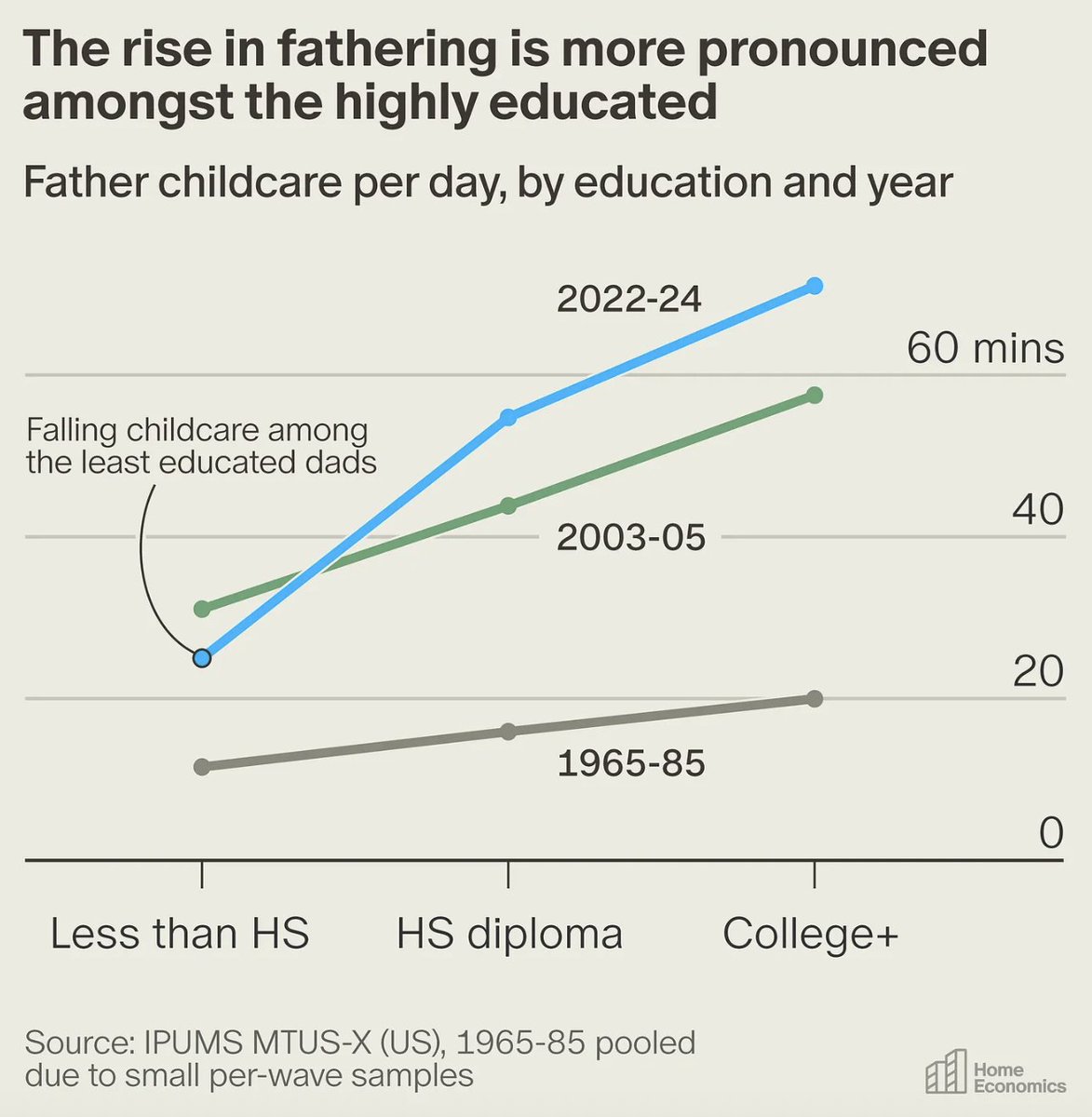
New newsletter: MODERN FATHERHOOD WOULD BE UNRECOGNIZABLE TO A 1950'S DAD
Compared to their Boomer parents, childcare time among Millennial dads has more than doubled.
Compared to their Silent Generation grandparents, it’s nearly quadrupled.
You will be hard-pressed to find any part of day-to-day modern life that has changed more in the last half-century than the way today’s parents—and fathers, in particular—spend their time.
The new American dad is more present and more exhausted—but also, more satisfied with life. What's behind this half-century transformation? Today's piece combines history, economic analysis, and gorgeous charts galore from @AzizSunderji



English
@dwarkesh_sp “The violence and injustice of the rulers of mankind is an ancient evil, for which, I am afraid, the nature of human affairs can scarce admit a remedy.” -Adam Smith
English

David Reich on how much ancient DNA evidence has overturned so much consensus thinking how ancient cultures spread.
"It wasn't peaceful, it wasn't friendly, it wasn't nice.
Some of our archaeologist co-authors were just really distressed."
English
@leyden_alex @mattyglesias But not you, right good guy?
English

@InternetJenkins @mattyglesias Many people do not, in fact, have rational reasons for their politics. They are often completely irrational and against their own interests.
English

Not that this stuff doesn't contain some elements of truth, but I notice that conservatives have gotten unhealthily obsessed with various efforts to pathologize and psychoanalyze why people disagree with them — all this "luxury beliefs" stuff blah blah.
It's loser shit.
English
The "right side of history" narrative is strong armor, shielding believers from engaging with a rigorous body of thought (Sowell, Burke, etc.) that views human agency differently. It’s not that liberal beliefs aren't rational, it's that the crusader framing makes it easy to dismiss valid, non-progressive frameworks.
InternetJenkins@InternetJenkins
@mattyglesias It’s not loser shit it’s based on a real phenomenon: Pretty much everyone has rational reasons for their politics. But liberals have the added “we are the good guys” factor which makes it harder for them to see their own flaws.
English
> Choosing between existing options isn’t creation, by definition.
I can’t imagine how you’d make any progress without choosing (which is itself a creative process).
You’re criticizing HTV for not being rigorous or universal. I took that to mean you think it should be essentially an algorithm for determining what’s true. That’s what I mean when I say you are being a justificationist…you are holding HTV to an impossible standard by insisting it serve as an external form of authority that proves one idea is true or better without the creative work of criticism.
And I say no “known” because I don’t think I know anything with certainty, except that I certainly don’t have any good theories for an alternative.
English
On second thought, re: “It’s impossible, I agree, but not justificationist”, you don’t seem to agree it’s impossible because you say “there is no known algorithm”. So maybe you’re open to the idea that there could be one and we just don’t know it, idk. But you speak with the confidence of someone who knows Popper and Deutsch very well, so it would surprise me if you were open to an idea they were both opposed to, while arguing their viewpoint
English
First, choosing between explanations is part of knowledge creation.
But also what you are asking for is justificationism.
Both Popper and Deutsch are anti-justificationist. They would say there is no known algorithm that can automate the growth of knowledge.
As for your example you don't choose Pop Art because it has the highest "hard-to-vary” score. You choose it because you have criticisms that invalidate the other options.
English
> Deutsch proposed hard to vary as one characteristic of good explanations.
No he proposed it as THE standard of good explanations. A good explanation is synonymous with a hard-to-vary one.
> … rigorous or universal methods which produce knowledge …
But it’s not about producing new knowledge. I’m not interested in creativity in this context. Here it’s about choosing rationally between ideas you’ve *already* created.
English
Ok, I think that’s a bad standard. Deutsch proposed hard to vary as one characteristic of good explanations. But neither Deutsch nor Popper would support to the idea that there are rigorous or universal methods which produce knowledge (or allow you to choose from multiple choice answers) other than open ended conjecture and criticism.
English