Michael D. Farkas retweetet
Michael D. Farkas
887 posts

Michael D. Farkas retweetet


To those speaking of iran's infrastructure being destroyed as a consequence of this war:
Let’s talk about your staggering hypocrisy.
When they set the Rasht market ablaze with our people trapped inside, your heart didn't bleed. You felt absolutely nothing for the innocent lives burning to ash. But now that a bridge in Karaj gets blown to pieces, suddenly you want to weep over "Iranian infrastructure"?
Let me tell you exactly what kind of bridge this was.
It was never meant for us. Not a single civilian has ever set foot on it. It wasn't even open to the public. It was a phantom structure, built for one reason and one reason only: to connect two IRGC military bases and serve as a direct, covert artery to an underground missile city. It was carved right behind the Azimiyeh mountains, stretching west toward Radar Mountain. God only knows what dark, malignant operations these terrorists are hiding in the tunnels beneath that rock.
In short: it was a pure military asset for an occupying terror syndicate.
So yes, when I saw the sky light up with that explosion, I cheered. I watched their concrete shatter, and I smiled. Because it meant only one thing: another massive, crippling blow to the terror machine of the Islamic Republic that holds my country hostage.
You can mourn the rubble of their military bases all you want. When this occupation is finally eradicated, we will build our own bridges.
English

The EzShop x @Gopuff partnership logic simply: EzFill already has the customer base. Gopuff has the inventory and fulfillment. Bringing them together in one app creates value for customers and a new revenue stream for NextNRG, without meaningful new investment. Good partnerships work like that. $NXXT #EzFill #EzShop
English
Michael D. Farkas retweetet

Picked up a pizza order. As I walked out, an elderly couple was getting out of their new Tesla Model Y. I said, “Beautiful car.” He said, “Thank you. It’s the best car I’ve ever owned.”
I said, “Why?”
He said, “You see me—I’m 78 and can barely walk, let alone drive. I’m taking my wife out for date night again after 52 years of marriage. We couldn’t do this with our old car. I didn’t buy this to save the planet. I bought it to save me.” 😢
All choked up, I said, “Thank you for sharing. You two go enjoy your dinner!”
I see and hear this so often from elderly people buying Teslas, but it never gets old. Tesla is freedom🫶🏻

English
Michael D. Farkas retweetet

@NextNRGinc $NXXT EzShop launch powered by Gopuff to deliver fuel and groceries direct to customers. Deep research report $6.30 PT. Ai-powered microgrids respond to disruptions and offer autonomous distributed balanced generation while optimizing for cost and resilience. Links
English

NextNRG is partnering with @Gopuff to launch EzShop inside the EzFill app.
Coming Q2 2026; 5,000+ everyday essentials available to EzFill customers, fulfilled by Gopuff, directly in the app.
We started EzFill to bring fuel to your door. EzShop is us building a real alternative to the gas station run.
Full details → globenewswire.com/news-release/2…
$NXXT #EzShop #EzFill
English
Michael D. Farkas retweetet

A distribution center processing 50,000 orders/day loses revenue every minute it's offline.
The grid isn't getting more reliable. Demand is up 25% by 2030. Generation grew 2.5% last year.
Microgrid adoption for logistics isn't a sustainability play. It's a business continuity decision.
nextnrg.com/blog/microgrid…
$NXXT #Microgrid #Logistics

English
Michael D. Farkas retweetet

This 93 year old has found new freedom after she bought a new @Tesla Model Y with FSD. She also uses Grok navigation.
"Although she has always been a good driver, my mom can now drive without the fear or fatigue that can naturally come with age. No more relying on others for every trip. No more feeling stuck. This is true mobility that can spark new adventures in a still adventurous women!"
(via Dan Doyle's Family Channel. Full video below)
English

Who’s not going to want to get one?
Jesse Richards@iamjesserichard
Introducing Tesla Optimus v3
English

Storage hardware is a commodity. Operations is the moat. 💯
NextNRG@NextNRGinc
Battery storage hit ~$125/kWh in 2025. The world's first 628 Ah LFP grid-scale project just went live. The hardware race is over. The operations race has started. Dispatch quality, forecast accuracy, and battery health logic now decide who actually captures ROI. $NXXT #BatteryStorage #Microgrid
English
Michael D. Farkas retweetet

🔥 BEST VIDEO OF THE YEAR
Rare moment of truth at the UN from brave Kuwaiti dissident @JJJuraid, invited by UN Watch:
Mr. Chair,
I heard the term “colonizers.” But who are the real colonizers? A Jewish Kingdom ruled in Judea for a thousand years. We, the Arabs, took this land.
Who Arabized Egyptians, Phoenicians, Persians and Amazighs? It was us, the Arabs.
So why does the council enshrine a lie by keeping a permanent agenda item on Palestine, while ignoring the indigenous heart of Israel returning home?
Let us be clear about who is actually defending our sovereignty. Today, Israel is a fighter for peaceful nations, freeing Gaza from Hamas and saving Iranians from the Islamic Republic.
What Israel is doing to the IRGC — stopping a genocidal regime from acquiring nuclear weapons — is a gift to humanity.
There are 57 Islamic countries and only one Jewish state, Israel. Despite the ongoing hateful desire to eliminate it, Israel has not only survived, it has thrived.
I don't believe in miracles, but this is one.
So I ask the UN: when will you end the ritual of condemning Israel?
Is it not time, instead, to learn from Israel? How to defeat terror, defend free societies, and pursue peace.
Thank you.
English
Michael D. Farkas retweetet

This is NOT Gaza. This is NOT Iran.
This is Philadelphia, United States of America.
In a Muslim American Society (MAS) Islamic school, young children are being taught to glorify jihad, martyrdom, and the murder of Jews.
Listen to what they’re singing and reciting on stage:
“Glorious steeds call us… The blood of martyrs protects us…
We will chop off their heads and liberate Al-Aqsa…
We will subject them to eternal torture.”
One little girl proudly asks: “Will Jerusalem be a hotbed for cowards?”
Another declares: “We will defend Palestine with our bodies.”
MAS Philly is part of the Muslim American Society, which has 42 chapters across the US. Their official mission? “To convey Islam with utmost clarity” and build a “virtuous and just American society.”
Teaching American kids to become martyrs and chop off heads is not “virtuous.”
It’s grooming the next generation of jihadists, on U.S. soil.
This is insane.
And it’s happening right now in America.
Share this. The denial has to end.
English

Check out Louie Carabott's video! #TikTok tiktok.com/t/ZP8b4BVLm/ Global car manufacturers are fukked.
English
Michael D. Farkas retweetet

Microsoft paid to restart a nuclear reactor at Three Mile Island. Amazon spent $650 million buying a nuclear-powered data center campus. Google signed the first-ever corporate deal to buy power from small modular reactors that don't even exist yet.
Three of the most valuable companies on earth are so desperate for electricity that they're buying nuclear plants.
Global data center power demand is projected to double to over 1,000 TWh by 2026. The grid operator serving 65 million Americans says it will be six gigawatts short by 2027. Retail electricity prices are up 42% since 2019. Elon Musk couldn't get grid access for his xAI data center in Tennessee so he brought in mobile gas generators and powered the entire facility off-grid.
The demand for power is growing faster than the grid can supply it. And every month it takes to build new generation capacity, the companies that already own power plants get more pricing power.
I'm buying the power generators and the nuclear operators.
Constellation Energy (CEG) operates the largest nuclear fleet in the country. They're the ones restarting Three Mile Island for Microsoft. Nuclear runs 24/7, produces zero carbon, and operates at 90%+ capacity factors. It's the only baseload power source that meets every requirement data centers have. Every major hyperscaler is now negotiating long-term power purchase agreements with nuclear operators. Those contracts lock in revenue visibility for 10-20 years. Constellation hasn't had that kind of earnings certainty in its history.
Vistra (VST) is the largest competitive power generator in the US. Natural gas and nuclear in Texas and PJM territory where data centers are concentrated. When data centers sign decade-long PPAs at premium rates, the revenue certainty transforms how you value these companies. They stop looking like volatile utilities and start looking like infrastructure monopolies with contracted cash flows.
Cameco (CCJ) is the uranium play underneath the nuclear renaissance. 34 countries pledged to triple nuclear capacity. There are only 8 publicly traded uranium miners at scale. Supply is already in a 7,000 tonne annual deficit before a single new reactor gets approved. When Microsoft, Amazon, and Google are all competing for nuclear power, uranium demand isn't theoretical anymore. It's contracted.
On the infrastructure side, Quanta Services (PWR) and MasTec (MTZ) build the transmission lines and substations these data centers need. Transformer lead times are 2-4 years. Permitting takes a decade. The companies with existing crews and utility relationships are raising prices because there aren't enough qualified teams to do the work.
I'm heaviest in the nuclear operators because the demand is locked in by 10-20 year contracts with the richest companies on earth. When Microsoft signs a 20-year PPA, that's not a forecast. That's a binding commitment.
I break down nuclear, energy infrastructure, and uranium plays every week in a 100% FREE webinar. Link is in comments.
English
Michael D. Farkas retweetet

While the world argues over oil routes, geopolitics, and who controls what…
Electric trucks are quietly getting on with the job.
Very quietly compared to diesel truck.
That’s because a Tesla Semi just covered 585 miles in a single day.
It drove 292 miles, charged at 750kW for just 45 minutes to top up and drove from Stockton to Bakersfield and back without missing a beat.
That 45 minutes…
The truck couldn’t be driven anyway without swapping drivers, leaving a driver 290 miles away.
No diesel. No fumes. No drama.
This is what people don’t seem to grasp…
The shift isn’t some future concept.
It’s already happening. At scale. In the real world.
And while headlines focus on conflict and fuel supply risks, electric is doing what it does best:
➡️ Moving goods
➡️ Reducing costs
➡️ Cutting emissions
➡️ Improving driver experience
No waiting around for the “perfect time” to transition.
Because there never is one.
The companies that move first…win.

English
Michael D. Farkas retweetet

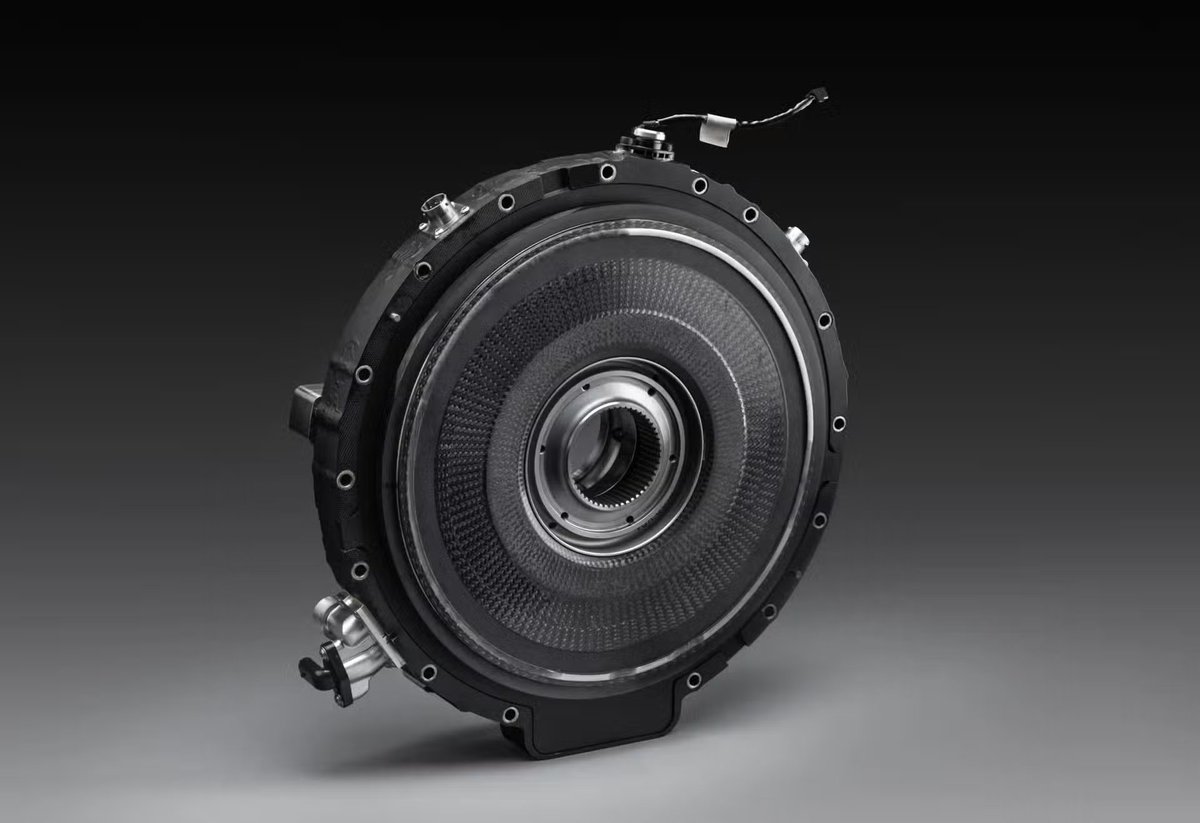
New 28-pound electric motor out-powers a Tesla Model S Plaid | Joshua Shavit and Joseph Shavit, The Brighter Side of News
A 28-pound electric motor that puts out more than 1,000 horsepower sounds like something a screenwriter invented for a car commercial. It isn’t.
YASA , a British electric motor company owned by Mercedes-Benz and based out of an innovation center in Oxford, has done it twice now, and the second time came only a few months after the first. The company builds what are called axial flux motors, a design that stacks magnetic components differently than conventional motors, producing more power from a much smaller package. Earlier this summer, YASA set an unofficial world record for power density with a 13.1-kilogram motor producing 550 kilowatts. Then it went back to the dyno and beat itself.
The new prototype weighs 12.7 kilograms (28 lbs) and generates a peak of 750 kilowatts, which works out to just over 1,000 horsepower. That translates to a power density of 59 kilowatts per kilogram, a 40 percent jump over the already record-setting figure from just months prior.
The new prototype weighs 12.7 kilograms (28 lbs) and generates a peak of 750 kilowatts. (CREDIT: YASA)
Not a rendering, not a simulation
Tim Woolmer, YASA’s founder and chief technology officer, was direct about what the company had actually built. “This isn’t a concept on a screen,” he said. “It’s running, right now, on the dynos. We’ve built an electric motor that’s significantly more power-dense than anything before it, all with scalable materials and processes.”
That distinction matters more than it might seem. The electric motor space has no shortage of announced breakthroughs that live primarily in press releases and CAD files. YASA is describing a physical object generating real data in real time, something its chief of new technology, Simon Odling, was eager to emphasize. “This is real hardware, in real life, delivering real data,” Odling said, “and it’s performing beautifully.”
The motor’s peak output is the headline figure, but sustained performance tells a more complete story. Continuous power, which is what actually drives a vehicle over time rather than just during a brief surge, lands somewhere between 350 and 400 kilowatts, or roughly 469 to 536 horsepower. That continuous power density of approximately 27.6 kilowatts per kilogram exceeds the peak figures of most competing motors outright.
For comparison, some of the other power-dense motors that generated attention in recent years, including units from H3X and Equipmake aimed at aerospace and marine applications, top out around 13 to 14 kilowatts per kilogram at peak. Donut Labs produced an automotive hub motor earlier this year that reached 15.8 kilowatts per kilogram. YASA’s new prototype is nearly four times that.
Where the competition actually stands
Before YASA’s first record this summer, the most power-dense motor covered in the specialty press was the Evolito D250, an aerospace spinoff with its own roots in YASA’s axial flux lineage, rated at 28 kilowatts per kilogram. Around the same time, British firm Helix tested its SPX177 radial flux motor, a 28-kilogram unit built for a hypercar project that hit 711 kilowatts, putting its density at about 25.4 kilowatts per kilogram.
YASA’s new number bests both of those by more than double.
Joerg Miska, YASA’s CEO, framed the gap this way: “With three times the performance density of today’s leading radial flux motors, YASA continues to redefine the boundaries of what’s possible in electric motor design.” The comparison to radial flux motors is significant because radial flux is the dominant architecture in mass-market electric vehicles today, including those from Tesla and most other mainstream manufacturers.
The three motors in a Tesla Model S Plaid combine for roughly 1,020 horsepower. YASA’s single 12.7-kilogram prototype essentially matches that on its own.
Engineered for scale, not just spectacle
One recurring point in YASA’s announcements is that the motor uses no exotic or prohibitively expensive materials. That’s a pointed contrast to some high-performance motor programs where cost and manufacturability are treated as problems for someone else to solve later. YASA describes the design as scalable, built on precision engineering, advanced thermal management, and packaging optimization rather than rare-earth windfalls or one-off fabrication techniques.
The Advanced Propulsion Centre in the UK provided support for the motor’s development, which gives it a degree of institutional backing beyond a single company’s ambitions.
Whether any of this reaches consumers anytime soon is a different question. YASA declined to offer even a rough timeline for when this prototype architecture might move toward production. Mercedes-Benz is confirmed to be using YASA axial flux motors in an upcoming electric AMG super-GT , but what goes into that car may differ substantially from what’s currently running on the test bench. The record-breaking prototype remains in a rigorous development program, and the company is continuing to release updates as testing progresses.
The Helix SPX177, by contrast, was built more like an F1 development exercise, with ultimate performance as the singular goal and production viability a distant consideration. YASA is explicitly not doing that, which suggests this technology has a longer arc in mind.
Practical implications of the research
For the automotive industry broadly, a scalable, high-density motor architecture that doesn’t rely on exotic materials represents genuine leverage.
Smaller, lighter motors mean more flexibility in vehicle design, including the possibility of packaging multiple motors into platforms without the weight penalties that currently come with that approach.
Performance vehicles stand to benefit most immediately, but the underlying engineering, particularly the thermal management and packaging methods that allow such power from such a small unit, could influence drivetrain design across segments over time.
If the architecture proves manufacturable at the scale YASA suggests is possible, the gap between hypercar-grade power density and production-vehicle hardware could close considerably in the coming years.
thebrighterside.news/post/new-28-po…

English