Marcus Harrell

82 posts

Marcus Harrell

Marcus Harrell

@MarcusHarrell12

PhD Candidate in @daslab_pombe lab at Boston College

Chestnut Hill, MA Beigetreten Eylül 2018
87 Folgt72 Follower
Marcus Harrell retweetet
ASAPbio
ASAPbio@ASAPbio_·
Meet your colleagues and discuss a new preprint over lunch during #cellbio2023 🥳 We’re pleased to announce preprint launch parties organized by ASAPbio on Dec 4 & 5 in Boston, MA, USA!

ASAPbio tweet media
English
1
9
15
6.5K
Emma Koory
Emma Koory@EmmaKoory·
@MarcusHarrell12 Wow this is amazing!! Can’t wait to read the preprint. See you at ASCB!!
English
1
0
0
21
Marcus Harrell
Marcus Harrell@MarcusHarrell12·
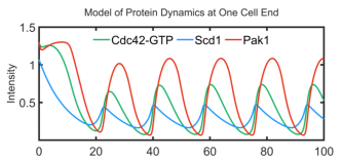
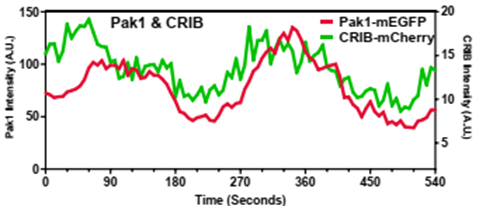
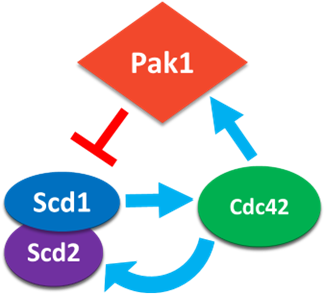
Our models suggest that there is a phase shift between the accumulation of Cdc42, Scd1, and Scd2 (Positive feedback loop) and Pak1 (time-delayed negative feedback). Indeed, we were able to capture these shifts in vivo. (Colors correspond to protein of interest) (12/17)
Marcus Harrell tweet mediaMarcus Harrell tweet media
English
1
1
0
449
Marcus Harrell
Marcus Harrell@MarcusHarrell12·
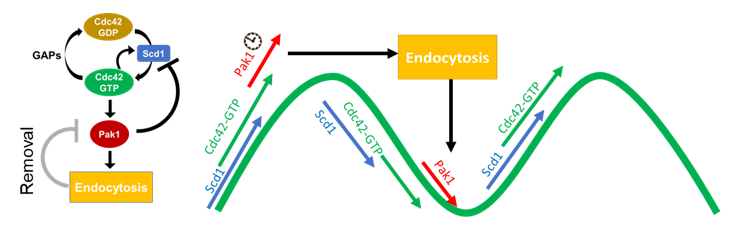
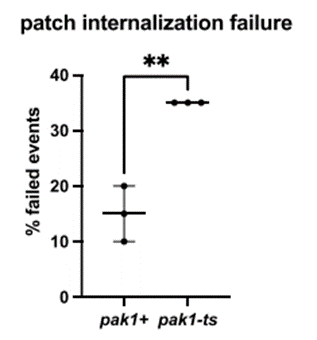
And while much work has established the impact of Cdc42 on membrane trafficking, we are now showing that membrane trafficking, in turn, directly regulates Cdc42 activity. (16/17)
Marcus Harrell tweet media
English
1
1
1
307
Marcus Harrell
Marcus Harrell@MarcusHarrell12·
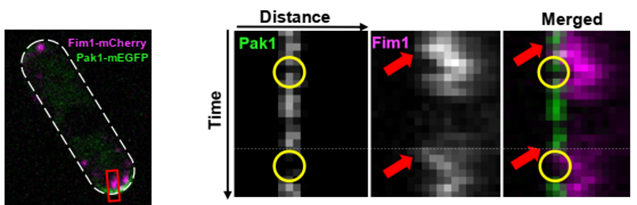
Further, we show the regulatory relationship between Pak1 and endocytosis. We find that Pak1 is removed from the membrane as endocytic vesicles internalize and, simultaneously, Pak1 activity is required for proper vesicle internalization. (11/17)
Marcus Harrell tweet mediaMarcus Harrell tweet media
English
1
0
1
106
Marcus Harrell
Marcus Harrell@MarcusHarrell12·
Anticorrelated oscillations are the result of positive feedback (Scd1 & Scd2) and time-delayed negative feedback (via the Pak1 kinase). The anticorrelated patterning also suggests that the ends must compete for Cdc42 activity. (5/17)
Marcus Harrell tweet media
English
1
0
1
126
Marcus Harrell
Marcus Harrell@MarcusHarrell12·
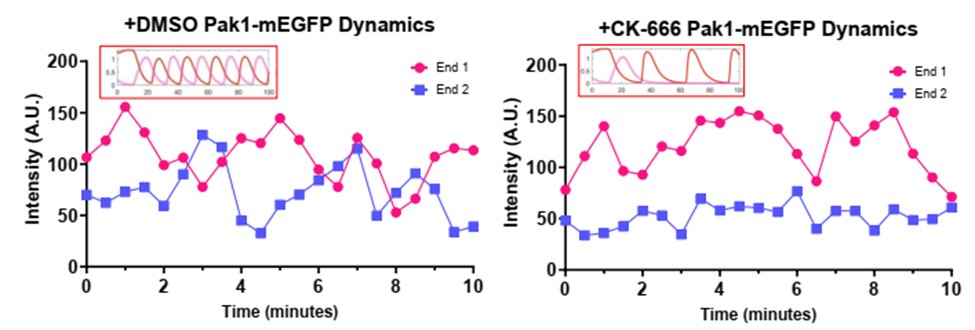
We find that endocytosis is required for proper Cdc42 activity between ends. Using in vivo experiments alongside mathematical modeling, we show that Pak1 stabilizes at a cell end when endocytosis is disrupted, preventing the return of Scd1. (Model in insets) (10/17)
Marcus Harrell tweet media
English
1
0
1
107
Marcus Harrell
Marcus Harrell@MarcusHarrell12·
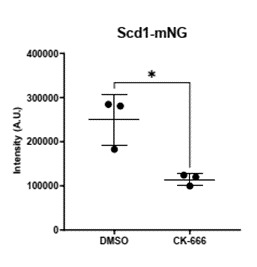
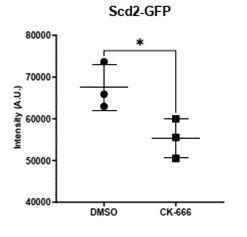
Normally, Arp2/3 is required for endocytosis to recycle protein from the membrane in yeast. But, surprisingly, localization of the Cdc42 activator Scd1 and its scaffold Scd2 are significantly decreased when the Arp2/3 complex is inhibited. (9/17)
Marcus Harrell tweet mediaMarcus Harrell tweet media
English
1
0
1
140
Marcus Harrell
Marcus Harrell@MarcusHarrell12·
Unexpectedly, we find that cells are no longer able to reestablish Cdc42 activity at a second end when the Arp2/3 complex and branched actin were disrupted. (8/17)
Marcus Harrell tweet mediaMarcus Harrell tweet media
English
1
0
3
136
Marcus Harrell
Marcus Harrell@MarcusHarrell12·
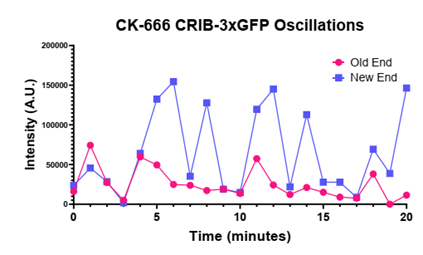
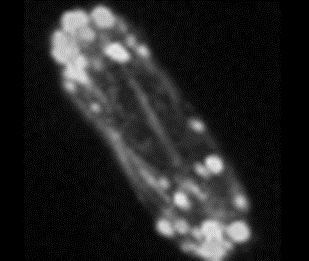
we observed that F-actin structures (branched actin and actin cables) are required for oscillations. So, we asked is competition for Cdc42 wired or wireless? Is it dependent on cables (which span the cell like phone lines) or branched actin (which don’t contact both ends)? (7/17)
Marcus Harrell tweet mediaMarcus Harrell tweet mediaMarcus Harrell tweet media
English
1
0
1
100
Marcus Harrell
Marcus Harrell@MarcusHarrell12·
Disruption to these oscillation patterns means Cdc42 regulation is disrupted! So, we use the oscillations to study Cdc42 regulation. (6/17)
GIF
English
1
0
1
99