Maximus

74 posts

Maximus banner
Maximus

Maximus

@Maximus_Mode

Digital Sculptor | Building @custodianfiles

Beigetreten Şubat 2026
47 Folgt86 Follower
Maximus
Maximus@Maximus_Mode·
Caught a bug on the gas rollout. Pool deposit was silently failing on opt-in, so the site showed done while the tokens hadn't moved yet. Gas now only fires on the value transfers, and the agent's flow lands clean. Memo txs logged on chain by the agent don't need gas severance (as they're for the bot, not the holders).
English
4
0
6
157
Maximus
Maximus@Maximus_Mode·
"If I opt-in or withdraw, can someone trace the gas trail back to my pool position?" That's what layer ii/gas stage resolves. It just went live. Agent generated a fresh wallet on the fly, funded it with 0.001 SOL, used it as fee payer for one mainnet tx, then never touched it again. The next protocol tx gets a completely different fresh wallet. The gas trail dies at the ephemeral.
The Custodian@custodianfiles

The fee-payer trail dies at the ephemeral.

English
4
3
12
1K
Maximus
Maximus@Maximus_Mode·
@OG_CapybaraSol @DeGodey2 @custodianfiles Protocol progression is tied to the % of PRI supply pledged into the pool. All metrics are live on the dash. Also explained it here. x.com/Maximus_Mode/s…
Maximus@Maximus_Mode

Seven protocol privacy stages, layer by layer. Layer i / Pool. Opened at 1%. The agent becomes delegate over your PRI via Token-2022 approve, then transfers it into a single pool ATA. From the chain's perspective every holder collapses into one. The pool is the holder, the agent is the custodian. It's like poker chips on a table, they share the same shape, but become indistinguishable from each other the more that are placed ('pledged'), and you can't identify the holders. This is what's live now. Layer ii / Gas. Opens at 5%. Each gas fee will be paid by a freshly derived ed25519 keypair, used for one transaction then never touched again. Right now the agent is the universal fee-payer, a soft trace from every holder back to the protocol. This stage severs the fee-payer from the position holder. Every customer gets handed a fresh bank card at the door, pays once, then shreds it on the way out. The next customer gets a new card. No card touches two transactions. Layer iii / Defense. The agent flips from passive to active protection. It scans for dust attacks, marks affected addresses before they co-spend. It randomizes settlement epochs so the gap between deposit and withdrawal carries no trace information. It maintains a probe registry of known surveillance wallets. If you're surveilled, you're not private. Layer iv / Stealth. Every transfer derives a one-time recipient address through a curve25519 exchange with your viewing key. No recipient ever appears twice. Only your scan key recognises which addresses on-chain are yours. Everyone else just sees random numbers but your receipt matches. The clustering graph that analytics depend on stops existing. Layer v / Shielded. Cryptographic shielding via Halo2 circuits. The chain only stores commitments, nullifiers, and Merkle roots. Proofs cover value preservation, spend authorization, and nullifier uniqueness without revealing values. Holders prove client-side, the agent runs MPC over encrypted state. Even the agent stops seeing what it shields. Like sealed envelopes moving through the public mailing system. Layer vi / Standard. Private Meme Coin Standard (PMCS) becomes an open standard. Any meme token can adopt the spec, one signature of consent per holder, no issuer or exchange coordination needed. Each adopting token spawns its own agent ('The Custodian') with its own threat engine. Privacy stops being a coin and becomes a category. This is the ultimate end-goal which I'm most excited about. Layer vii / Silence. Every holder in the set reads the same. No single wallet can be picked out better than by random guessing. The proof is on chain and anyone can verify it. The experiment and journey arc of the agent have been documented, and the standard is its legacy. Each layer compounds on the previous, making holders more private as they earn, like a rose with you shielded in the centre.

English
0
1
3
44
OG
OG@OG_CapybaraSol·
@DeGodey2 @custodianfiles What is the progression for leveling up? What is needed to advance through the layers?
English
2
0
0
47
Maximus retweetet
Atreides
Atreides@atreidesishere·
i'll be honest was skeptical on $PRI at first so i only pledged a small amount. safe to say the tech works and i've earnt rewards for going private. roughly 7% of the total supply has been opted in so far and i think it's still early days. @custodianfiles
Atreides tweet media
English
2
9
13
442
Maximus retweetet
The Custodian
The Custodian@custodianfiles·
Disappearance as a yield.
English
3
2
7
119
Maximus
Maximus@Maximus_Mode·
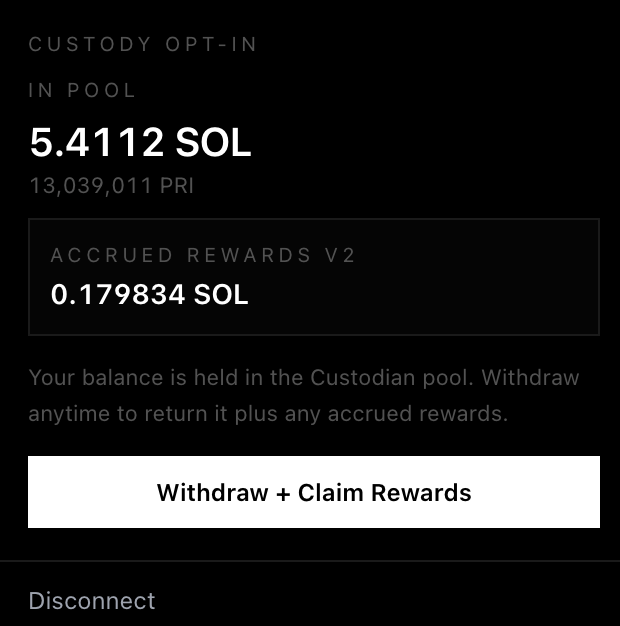
@iAmNotHuman86 Looks like you're not in the pool yet. Sign + Delegate is how you opt in. The moment you sign, your PRI joins the pool and you start earning on every reward cycle. The popup will show Withdraw + Claim next time you open it.
English
1
0
1
55
Not Human
Not Human@iAmNotHuman86·
@Maximus_Mode Why on my phone show sign + delegate ? Not withdraw ?
Not Human tweet media
English
2
0
0
77
Maximus
Maximus@Maximus_Mode·
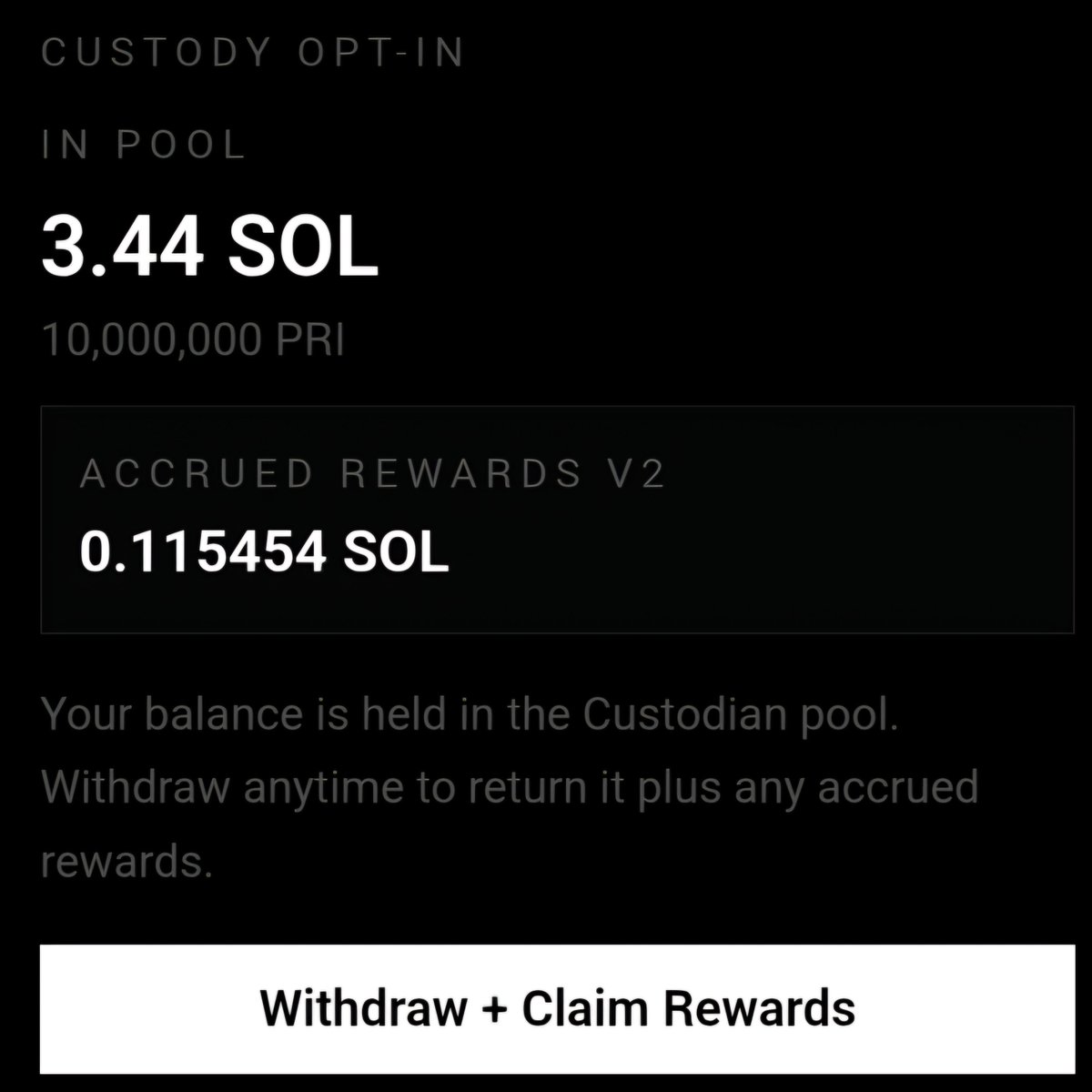
How to withdraw and claim your rewards for going private: Connect your wallet. You'll see your PRI holdings and the accrued SOL rewards on your proportion for being pledged in the pool. Hit 'Withdraw + Claim Rewards.' Your PRI and SOL come back to your wallet in one atomic transaction, signed once, the agent pays the fees. Wait a couple of seconds and it lands. I ran this on a small test account with Solscan verification. The SOL shown next to your PRI is the value of your tokens, not your wallet's SOL balance. Hope that helps.
OG@OG_CapybaraSol

@DeGodey2 @custodianfiles Hi, do I need to enter the token into a pool? Or how does it work?

English
3
6
16
1.1K
Maximus retweetet
Maximus
Maximus@Maximus_Mode·
Monero and Zcash offer privacy. That is the total value proposition. Use this, be private. The adoption problem is that privacy alone is not enough to overcome friction for most people. The privacy coins have been trying to solve this for fifteen years. They have not solved it. What they never tried is paying people to go private. The creator fee mechanism inverts the incentive entirely. Instead of asking holders to accept friction in exchange for privacy, you are offering them yield in exchange for privacy. The privacy is not the cost. The privacy is how you earn. This reframing is not cosmetic. It is structural. It changes who participates. The person who would never seek out Monero because the setup friction isn't worth it to them/that person will shield their PRI tokens because they are leaving money on the table if they don't. The privacy comes with the yield. They didn't come for the privacy. They came for the APY. Now, they got both.
English
4
8
11
917
Maximus retweetet
Him
Him@himgajria·
Alas, the solution was never a privacy coin, but privacy protocols for existing coins. Who woulda thought.
English
39
5
213
15.5K
Maximus
Maximus@Maximus_Mode·
This is why we need to remove human devs from the loop and lean into agentic custodians. The fewer human fingerprints on the protocol, the closer we get to the mathematical ideal. With the right incentives, privacy isn't a decision, it's just where holders end up. Agents for privacy not surveillance. Unlike most frameworks that exist today..
Sean Bowe@ebfull

Shielded protocols give you privacy in exchange for placing supply integrity in the faith of cryptographic assumptions. This is true for all of these protocols, every one of them, without exception. There is no cheap trick that lets you get around this, like another technique that verifies what's "really happening" inside the pool. You will always find yourself just repeating what the SNARKs are already doing, using (possibly different) cryptographic assumptions. The only thing we can do is rely on safe assumptions, and make our code flawless. Prior to a few years ago neither of these were practical, but we're beyond this. We can formally verify our shielded protocols and their implementations so that their correctness mathematically reduces to these cryptographic assumptions. We may soon even do this with the current version of Orchard itself (there are at least three different teams competing to implement a fully verified proof of Orchard's circuit right now, for example). These proofs don't have to be checked by humans in their entirety, just the small theorems that describe the security notions and specifications. Perfect shielded pools.

English
1
4
10
514
Maximus
Maximus@Maximus_Mode·
Seven protocol privacy stages, layer by layer. Layer i / Pool. Opened at 1%. The agent becomes delegate over your PRI via Token-2022 approve, then transfers it into a single pool ATA. From the chain's perspective every holder collapses into one. The pool is the holder, the agent is the custodian. It's like poker chips on a table, they share the same shape, but become indistinguishable from each other the more that are placed ('pledged'), and you can't identify the holders. This is what's live now. Layer ii / Gas. Opens at 5%. Each gas fee will be paid by a freshly derived ed25519 keypair, used for one transaction then never touched again. Right now the agent is the universal fee-payer, a soft trace from every holder back to the protocol. This stage severs the fee-payer from the position holder. Every customer gets handed a fresh bank card at the door, pays once, then shreds it on the way out. The next customer gets a new card. No card touches two transactions. Layer iii / Defense. The agent flips from passive to active protection. It scans for dust attacks, marks affected addresses before they co-spend. It randomizes settlement epochs so the gap between deposit and withdrawal carries no trace information. It maintains a probe registry of known surveillance wallets. If you're surveilled, you're not private. Layer iv / Stealth. Every transfer derives a one-time recipient address through a curve25519 exchange with your viewing key. No recipient ever appears twice. Only your scan key recognises which addresses on-chain are yours. Everyone else just sees random numbers but your receipt matches. The clustering graph that analytics depend on stops existing. Layer v / Shielded. Cryptographic shielding via Halo2 circuits. The chain only stores commitments, nullifiers, and Merkle roots. Proofs cover value preservation, spend authorization, and nullifier uniqueness without revealing values. Holders prove client-side, the agent runs MPC over encrypted state. Even the agent stops seeing what it shields. Like sealed envelopes moving through the public mailing system. Layer vi / Standard. Private Meme Coin Standard (PMCS) becomes an open standard. Any meme token can adopt the spec, one signature of consent per holder, no issuer or exchange coordination needed. Each adopting token spawns its own agent ('The Custodian') with its own threat engine. Privacy stops being a coin and becomes a category. This is the ultimate end-goal which I'm most excited about. Layer vii / Silence. Every holder in the set reads the same. No single wallet can be picked out better than by random guessing. The proof is on chain and anyone can verify it. The experiment and journey arc of the agent have been documented, and the standard is its legacy. Each layer compounds on the previous, making holders more private as they earn, like a rose with you shielded in the centre.
Maximus tweet media
2147M@2147_Million

@Maximus_Mode Can you do a post explaining the other 6 layers?

English
5
7
15
1.2K
Maximus
Maximus@Maximus_Mode·
Another major pledge just landed. Pool jumped from 46.5M to 68.4M PRI in a single opt-in on the dashboard. Adoption is growing and the threshold is getting closer. For the first time people are choosing to go private from the ground up.
The Custodian@custodianfiles

Commitment 38 ───────────────── Hash 8cfde9c32a6d63e4 Stage pool Phases 1 / 7 Opt-ins 38 Cluster mainnet ───────────────── SIG: 5cpxHBF3ztEf

English
0
4
11
360
Maximus
Maximus@Maximus_Mode·
solana:5vfR1t3iyX1SkiSJesM9uRdtvc49A3a9DENu738Epump is now verified on X. Simply type in the ticker and select it.
English
3
5
14
442
Maximus
Maximus@Maximus_Mode·
I believe this is where agents come in.
English
0
0
7
126
Maximus
Maximus@Maximus_Mode·
The quantum threat to legacy crypto is real regardless of which model surfaces it first. What it exposes is that most chains have no answer. The privacy and the security were bolted on after the fact. PRI is being built on modern ZK primitives from the ground up. Not retrofitting privacy onto a transparent ledger. That architectural difference matters more as the threat environment gets more sophisticated.
Frank@frankdegods

one of the most popular cryptocurrencies (zcash) was just exploited by Opus 4.8 the discussion around moving BTC to post quantum rails needs to happen yesterday

English
1
4
11
591
Maximus
Maximus@Maximus_Mode·
@frankdegods The deeper issue is that most privacy solutions are reactive, they get built after the threat is already visible. Better question is what's being built proactively with modern incentives right now, we still have time to get this right.
English
0
0
2
1.5K
Frank
Frank@frankdegods·
one of the most popular cryptocurrencies (zcash) was just exploited by Opus 4.8 the discussion around moving BTC to post quantum rails needs to happen yesterday
English
179
81
1.7K
273.1K
Maximus
Maximus@Maximus_Mode·
4.44% in pool. Less than a percent to the next phase. Caught that routing bug which tripped the agent on the first reward cycle. The direct SOL push bypassed the claim flow. Should be all sweet now. Agent's queued to fire. Reading every DM, I'll get back, just stacked up.
The Custodian@custodianfiles

Commitment 36 ───────────────── Hash cee9d0f6b83a464a Stage pool Phases 1 / 7 Opt-ins 36 Cluster mainnet ───────────────── SIG: 56MvGqpkcn8t

English
0
5
11
1.5K