

Atreides
397 posts

I’m convinced there must also be an infinite supply minting glitch on Plasma
Loma@LomahCrypto
I don’t care if the Plasma Team’s name is “We’re Not Selling Tokens” with a wallet named “We’re Not Selling Tokens” alongside a whitepaper that says “We’re Not Selling Tokens”, them mfers are selling tokens
English
Surprised none of the OG privacy coins have ever experimented with agents as the defence layer. The Orchard bug suggests it needs it.
This era of trusting static cryptographic systems without active monitoring is ending. Makes me bullish on early experiments like $PRI.
Curious to see the solutions z cash brings. $PRI could be ahead of the puck.

English

The Zcash Orchard bug is the most important event in crypto privacy this year.
Not because Zcash is dead, it probably isn't. But because of what the bug exposed. A counterfeiting flaw inside a shielded pool is undetectable by design. The privacy that protects holders also hides the exploit. You can't see it breaking..
This is why the agent layer matters so much.
An agent watching the pool layer is a fundamentally different security model than a static protocol trusting its own cryptography.
The Zcash team are serious researchers. They found and patched this themselves. But the next bug in any privacy system may not be found internally.
Active surveillance of your own shielded pool, by an agent that never sleeps, is the answer the Orchard bug is pointing toward. That's why I'm building The Custodian.
Charles Guillemet@P3b7_
👉For 4 years, 1 day, and 10 hours, anyone who understood the Orchard circuit could have minted ZEC out of thin air, silently, with no on-chain signature. The bug was disclosed this week. It was found by an AI-driven audit running Opus 4.8, not by an attacker. 1. Call the bug what it is Two lines in halo2's variable-base scalar multiplication gadget used assign_advice() where copy_advice() was required. As a result, the diversified-address integrity check pk_d = [ivk]·g_d could be satisfied for arbitrary inputs. A malicious prover could spend the same note multiple times with different nullifiers, i.e. counterfeit ZEC inside the Orchard pool, undetectable on-chain because the privacy of the ZK proof hides exactly the inputs that would reveal the attack. We do not know whether it was exploited. We will probably never know. 2. Four years. Multiple audits. Top-tier reviewers. Orchard was reviewed by some of the strongest cryptographers in the field before activation. They missed it. Earlier automated audits with Opus 4.7 missed it. Opus 4.8 catches it in roughly 1 in 4 runs when prompted generically. The bug is hard. And ZK inflation bugs are not new. Zcash itself shipped a counterfeiting vulnerability in Sprout (BCTV14) that survived years before being silently neutralized during Sapling. Similar soundness issues have appeared in circom, halo2, and rollup verifiers since. The pattern is consistent: when the protocol is private, exploitation is undetectable. You patch the bug and hope. 3. What Zcash did right This was a textbook decentralized incident response: ▶️Audit: a full AI-assisted soundness audit of halo2 + Orchard, scoped end-to-end. ▶️Discover: the agent flagged the missing constraint and worked out the algebra to turn it into an exploit. A working RPC-level PoC in ~6 hours, mostly waiting on tokens. ▶️Coordinate: a soft fork disabling Orchard, prepared and distributed without leaking the bug, activated 2 days and 15 hours after acknowledgement. Coordinating a soft fork across miners, exchanges, and nodes without disclosing why is genuinely hard. They did it. ▶️Disclose: timeline, code lines, math, open questions. No spin. Worth naming explicitly: Zcash's turnstile invariant caps the value that can ever leave a shielded pool by the value that entered it. Privacy and verifiability inside the same protocol. That is not an accident. That is good engineering, and it is what kept the worst case bounded. 4. The economics of security just changed AI does not change whether bugs like this exist. It changes the cost of finding them. I wrote about this x.com/P3b7_/status/2…: a missing constraint in a 4-year-old production ZK circuit used to require a top-tier cryptographer with months of context. It now requires a few tokens, an API key, and a well-framed prompt. The defender benefits. The attacker benefits more, they only need to find it once, and they never disclose. Orchard is the optimistic version of this story: defense got there first. The pessimistic version is the one we cannot rule out, because the chain is private by design. 5. The only real exit You do not patch your way out of this asymmetry. You raise the floor. Formal verification of consensus-critical circuits, every assign_advice audited by SAT solvers and AI for under-constraint, as the reporter himself recommends. Proof-grade engineering that used to be too expensive is now cheap enough to be mandatory. Hardware roots of trust, secure enclaves, certified secure elements, WYSIWYS. Cryptographic guarantees the user can actually verify, not promises a host can lie about. Continuous AI-assisted audit of every consensus-critical commit, re-run immediately on the release of any new frontier model. Zcash didn't just patch a bug. They demonstrated the new defensive playbook: AI-driven audits, decentralized coordination, radical transparency, verifiable invariants. That is the direction the rest of the industry needs to follow. And those who don't raise the bar for security will be rekt in this new world. Stay safe. Stay honest about your trust assumptions.
English
@CryptoHayes will you be scanning your eye balls? @CryptoHayes
English

That outperformance is $WLD. Never bet against Elon ...

English

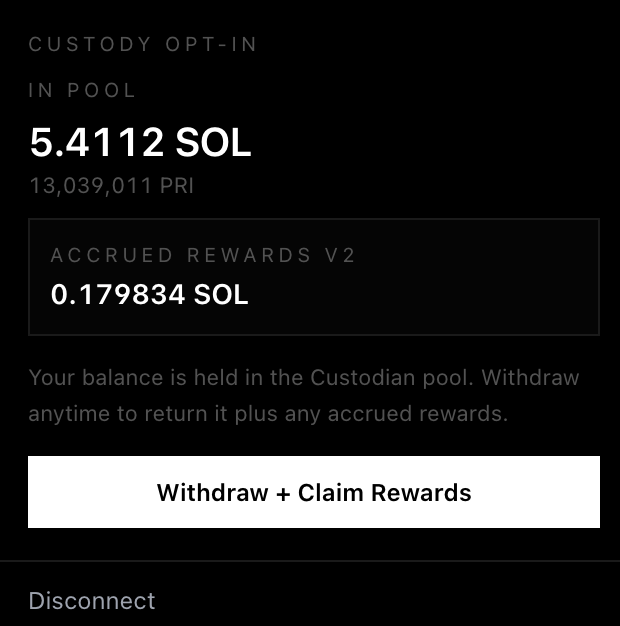
i'll be honest was skeptical on $PRI at first so i only pledged a small amount. safe to say the tech works and i've earnt rewards for going private.
roughly 7% of the total supply has been opted in so far and i think it's still early days.
@custodianfiles
English


We saw privacy swap slop go to 80K earlier but unique privacy tech where the guy has been building it for 2 months sits sub 25K.
$PRI underrated.
Maximus@Maximus_Mode
4.44% in pool. Less than a percent to the next phase. Caught that routing bug which tripped the agent on the first reward cycle. The direct SOL push bypassed the claim flow. Should be all sweet now. Agent's queued to fire. Reading every DM, I'll get back, just stacked up.
English
Seven protocol privacy stages, layer by layer.
Layer i / Pool. Opened at 1%. The agent becomes delegate over your PRI via Token-2022 approve, then transfers it into a single pool ATA. From the chain's perspective every holder collapses into one. The pool is the holder, the agent is the custodian. It's like poker chips on a table, they share the same shape, but become indistinguishable from each other the more that are placed ('pledged'), and you can't identify the holders. This is what's live now.
Layer ii / Gas. Opens at 5%. Each gas fee will be paid by a freshly derived ed25519 keypair, used for one transaction then never touched again. Right now the agent is the universal fee-payer, a soft trace from every holder back to the protocol. This stage severs the fee-payer from the position holder. Every customer gets handed a fresh bank card at the door, pays once, then shreds it on the way out. The next customer gets a new card. No card touches two transactions.
Layer iii / Defense. The agent flips from passive to active protection. It scans for dust attacks, marks affected addresses before they co-spend. It randomizes settlement epochs so the gap between deposit and withdrawal carries no trace information. It maintains a probe registry of known surveillance wallets. If you're surveilled, you're not private.
Layer iv / Stealth. Every transfer derives a one-time recipient address through a curve25519 exchange with your viewing key. No recipient ever appears twice. Only your scan key recognises which addresses on-chain are yours. Everyone else just sees random numbers but your receipt matches. The clustering graph that analytics depend on stops existing.
Layer v / Shielded. Cryptographic shielding via Halo2 circuits. The chain only stores commitments, nullifiers, and Merkle roots. Proofs cover value preservation, spend authorization, and nullifier uniqueness without revealing values. Holders prove client-side, the agent runs MPC over encrypted state. Even the agent stops seeing what it shields. Like sealed envelopes moving through the public mailing system.
Layer vi / Standard. Private Meme Coin Standard (PMCS) becomes an open standard. Any meme token can adopt the spec, one signature of consent per holder, no issuer or exchange coordination needed. Each adopting token spawns its own agent ('The Custodian') with its own threat engine. Privacy stops being a coin and becomes a category. This is the ultimate end-goal which I'm most excited about.
Layer vii / Silence. Every holder in the set reads the same. No single wallet can be picked out better than by random guessing. The proof is on chain and anyone can verify it. The experiment and journey arc of the agent have been documented, and the standard is its legacy.
Each layer compounds on the previous, making holders more private as they earn, like a rose with you shielded in the centre.

2147M@2147_Million
@Maximus_Mode Can you do a post explaining the other 6 layers?
English
@Maximus_Mode this part intrigues me the most:
"Layer vi = Private Meme Coin Standard (PMCS). Each adopting token spawns its own agent ('The Custodian') with its own threat engine. Privacy stops being a coin and becomes a category."
the thought that's gone into this is insane.
English
@himgajria have a look into what @Maximus_Mode is building.
pretty sure his end goal is what you are touching on.
English
I just dumped my entire $HYPE and $NEAR position, I will explain why in my essay "Reality Test" dropping next Tuesday.
TLDR:
- Higher energy prices due to Iran war and inventory restocking
- 3 Mega AI IPOs between now and early Q3
- Prediction that Trump goes anti-AI to win mid-terms for Republicans
- I think highs in mrkts will happen btw now and September
- Time to take profit, and two-step in beefa without worrying about my positions
English
@custodianfiles already 20 opt ins at 0.56%.
pretty sure z cash is only 20% shielded.
good work for such an early project.
English

Sequence Report 1
─────────────────
Pledged 0.56 %
Commits 20
Stage initiation
Phases 0 / 7
Cluster mainnet
─────────────────
SIG: 4gzfNEZZLHFG
English
@Maximus_Mode I dont think many have put this together yet...
This is an AI agent that automatically manages a ZK privacy layer on behalf of every holder who opts in + is paying holders who go private. Neither of those two things exists in crypto yet.
English
Monero and Zcash offer privacy. That is the total value proposition. Use this, be private. The adoption problem is that privacy alone is not enough to overcome friction for most people.
The privacy coins have been trying to solve this for fifteen years. They have not solved it. What they never tried is paying people to go private.
The creator fee mechanism inverts the incentive entirely. Instead of asking holders to accept friction in exchange for privacy, you are offering them yield in exchange for privacy. The privacy is not the cost. The privacy is how you earn.
This reframing is not cosmetic. It is structural. It changes who participates. The person who would never seek out Monero because the setup friction isn't worth it to them/that person will shield their PRI tokens because they are leaving money on the table if they don't.
The privacy comes with the yield. They didn't come for the privacy. They came for the APY. Now, they got both.
English
@Maximus_Mode Interesting.
I dont see z cash or monero paying people to go private...
There is a privacy mining concept here at its core.
English
Quick demo for you guys on mainnet.
Connect your wallet, choose your pledge/opt-in amount. This will show in SOL conversion with PRI token amount underneath. Minimum opt-in is 0.05 to avoid insignificant dust and spam.
Once you pledge, you can cancel at anytime. Also if at any point you decide to sell your PRI, that's considered a preliminary opt-out.
The longer you hold, the more you earn for going private. When Pool stage opens, The Custodian rewards holders pro-rata by their PRI in the pool.
English