

Monaco Macro
3.1K posts


GOOGLE HA LIBERADO EN SILENCIO UNA IA QUE PREDICE PATRONES
Ventas. Precios de mercado. Tráfico web.
Demanda energética. Volatilidad cripto.
Se llama TimesFM:
→ Entrenada con 100B de datos reales
→ Forecasting zero-shot, sin fine-tuning
→ Corre en local.
100% Gratis y Open Source.
Enlace abajo👇
Español

@lochan_twt @grok what is Hermes and did it take over openclaw and how and how can one use it
English


GOLDMAN SACHS open-sourced most dangerous quant repo on the internet.
THE EXACT FRAMEWORK THEIR INTERNAL DESKS USE TO BUILD & RUN TRADING STRATEGIES.
They even left their Claude skills inside. Plug them in & you've a Goldman Sachs quant building strategies for you. BOOKMARK.

Roan@RohOnChain
English
🚨 A 2-3% swipe fee sounds boring.
It funds 60% operating margins at $V and $MA: among the highest in business history.
Bill Gurley just explained why that ends.
Why the card toll is finally exposed, and what to track: 🧵
One major economy already moved most of its payments off cards in under 6 years.
The number drops below.
The mechanism is simple.
Cards charge a percentage because the US never built an instant bank to bank rail.
Stablecoins settle in seconds for pennies, flat.
A percentage cut cannot survive next to a flat fee that rounds to 0.
The proof is already running.
Brazil’s PIX: an instant central bank rail.
Per Gurley it took 60-70% of all transactions in roughly 6 years.
India’s UPI and UK Faster Payments did the same. The US is the outlier that blocked it.
Why is the US the outlier?
Per Gurley: bank driven regulatory capture.
FedNow exists. It stalled in committee.
So the fix routes around the banks: dollar stablecoins, riding the crypto momentum in DC.
Follow the exposure.
Most at risk: $V and $MA take rate, plus the issuing banks and processors built on swipe fees.
Leverage to the shift: $COIN through USDC, and Circle’s reserve float.
The line to watch: blended take rate, every quarter.
The bear case, and it stings:
US payments is where disruption shorts go to die.
Cards win on rewards, float, and fraud protection. A stablecoin debit replaces none of that.
It gets worse for the short.
$V and $MA can settle stablecoins inside their own networks and keep the cut.
PIX won in a thin card market. The US runs on deep credit culture.
This is a multi year migration, not a 2026 catalyst.
Full teardown on Monaco Macro: link in bio.
If this sharpened how you see the card duopoly, repost the top tweet.
The toll booth always swears the road cannot exist without it. 🚀
youtube.com/watch?v=yBBhd0…

YouTube
English
Monaco Macro retweetet



Normal? I don’t think so

English

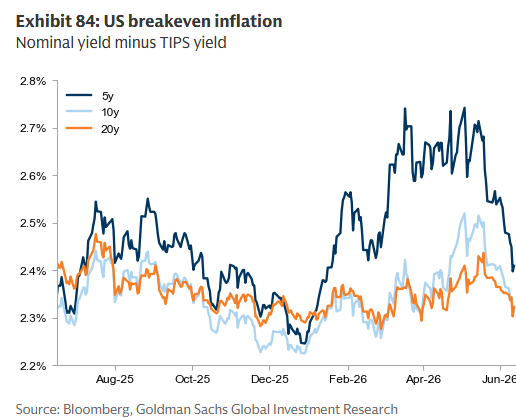
US breakeven inflation rates have plunged
2.4% 5yr
English
🇺🇸 US Visa rejection rate in 2025:
🇲🇨 Monaco - 0%
🇦🇪 United Arab Emirates - 2.17%
🇯🇵 Japan - 5.68%
🇨🇭 Switzerland - 5.82%
🇸🇦 Saudi Arabia - 5.98%
🇦🇷 Argentina - 7.47%
🇲🇾 Malaysia - 7.92%
🇫🇷 France - 9.67%
🇮🇱 Israel - 11.32%
🇵🇱 Poland - 11.63%
🇿🇦 South Africa - 11.66%
🇩🇪 Germany - 12.22%
🇮🇹 Italy - 12.65%
🇨🇱 Chile - 16.38%
🇫🇮 Finland - 18.09%
🇨🇳 China - 20.21%
🇬🇧 United Kingdom - 20.44%
🇵🇪 Peru - 20.90%
🇲🇽 Mexico - 21.36%
🇸🇪 Sweden - 21.77%
🇮🇳 India - 22.04%
🇻🇳 Vietnam - 22.08%
🇹🇷 Turkey - 22.25%
🇪🇸 Spain - 23.67%
🇰🇷 South Korea - 24.73%
🇹🇭 Thailand - 25.67%
🇮🇩 Indonesia - 26.69%
🇲🇦 Morocco - 26.91%
🇵🇭 Philippines - 30.76%
🇰🇵 North Korea - 33.33%
🇺🇦 Ukraine - 33.92%
🇹🇿 Tanzania - 39.41%
🇷🇺 Russia - 40.38%
🇪🇬 Egypt - 47.61%
🇻🇪 Venezuela - 48.22%
🇩🇿 Algeria - 51.23%
🇰🇿 Kazakhstan - 51.75%
🇵🇰 Pakistan - 52.32%
🇺🇿 Uzbekistan - 52.46%
🇨🇦 Canada - 53.10%
🇳🇬 Nigeria - 57.00%
🇮🇷 Iran - 62.44%
🇦🇫 Afghanistan - 63.25%
🇲🇲 Myanmar - 64.19%
🇬🇭 Ghana - 64.34%
🇾🇪 Yemen - 67.98%
🇰🇪 Kenya - 68.23%
🇳🇵 Nepal - 69.47%
🇧🇩 Bangladesh - 61.45%
🇫🇲 Micronesia - 100%
Note: business (visa category B-1), for tourism (visa category B-2), or for a combination of both purposes (B-1/B-2).
English
1/
The deeper signal from Anthropic is not the model drama.
It is the power shift underneath it.
Frontier AI is starting to move from a software market into a national-security market.
And when that happens, the question changes.
It is no longer just:
Who has the best model?
It becomes:
Who controls the rails around the model?
2/
That is the part worth watching.
Anthropic is one of the few companies operating near the frontier.
Its models are no longer just products.
They are becoming strategic assets.
That means the normal startup playbook may not apply anymore.
Build.
Launch.
Raise.
Scale.
IPO.
That path gets harder when the government starts treating your product like sensitive infrastructure.
3/
In a normal software market, performance wins.
Better product.
Better pricing.
Better distribution.
Better brand.
But in a national-security market, something else matters just as much:
Trust.
Who can host the model securely?
Who can verify users?
Who can enforce access rules?
Who can satisfy regulators?
Who can work with government without creating chaos?
4/
This is where Amazon becomes important.
Amazon does not need to be the headline.
It does not need to be the lab with the flashiest model.
It may become more important for a quieter reason:
Amazon controls many of the layers that matter once AI becomes regulated infrastructure.
5/
Amazon is not a random player here.
It is Anthropic’s investor.
It is a cloud partner.
It is an infrastructure provider.
It is a distribution channel.
It is one of the main paths between Anthropic and enterprise customers.
That makes Amazon’s position strategically important.
Not loud.
But important.
6/
If frontier AI becomes more controlled, the model alone is not enough.
The model needs a wrapper.
Cloud infrastructure.
Security.
Compliance.
Identity systems.
Access controls.
Audit logs.
Government relationships.
Enterprise distribution.
That wrapper may become the real control point.
7/
This is the deeper signal.
The company that builds the model may not be the only company with leverage.
The company that makes the model usable, compliant, trusted, and distributable at scale may end up with enormous power.
That is not a conspiracy theory.
That is how regulated markets work.
8/
In regulated markets, power often sits in the rails.
Payments.
Energy.
Telecom.
Defense.
Cloud.
Now maybe AI.
The winning position is not always “best product.”
Sometimes it is:
The company everyone needs in order to operate legally, safely, and at scale.
9/
That is the lens for Anthropic and Amazon.
Not ownership.
Dependency.
Compute dependency.
Distribution dependency.
Compliance dependency.
Government-trust dependency.
Each one looks reasonable on its own.
Together, they can become a power structure.
10/
And this is why the story matters beyond one model-access controversy.
If frontier AI keeps moving toward national-security oversight, standalone AI labs will need more than talent and GPUs.
They will need political cover.
They will need compliant infrastructure.
They will need trusted deployment channels.
They will need partners government and enterprise customers already understand.
11/
That is Amazon’s opening.
Amazon does not need to be the loudest AI brand.
It does not need to win every benchmark.
It does not need to look like the main character.
It can play a different role:
The infrastructure layer that makes frontier AI usable inside the real world.
12/
As AI gets more powerful, the bottleneck may not only be intelligence.
It may be permission.
Who can use the model?
Where can it be deployed?
Who monitors it?
Who handles compliance?
Who does government trust?
That is why Amazon’s role matters.
13/
The deeper signal from Anthropic is this:
Frontier AI is becoming infrastructure.
And infrastructure markets do not reward only the smartest builder.
They reward the company that controls the rails.
That is why Amazon’s role is worth watching
English

There is a 61% chance that Claude Fable 5 is restored for US customers by June 22, per Polymarket:

English
@pmarca What bad things happened during the bust? My landscaper lost 20 million that he made 3 months earlier trading call options on E*Trade?
English


@TheProfInvestor A bull market is just one almost-top after another.
English


@michaeljburry @StanphylCap A bull market is just one almost-top after another.
English

It has been ridiculous for a very very long time.
English
@Polymarket A bull market is just one almost-top after another.
English

NEW: Australia’s richest person, Gina Rinehart, has reportedly taken a $1 billion stake in SpaceX.
English