
Angehefteter Tweet
Myndex
5.3K posts


Myndex
@MyndexResearch
🗺 Mapping Human Contrast 🌈 Color 👁 Vision🔬Research 🍊 APCA🐄Readability Criterion ✍🏻 Actually Awake Autistic Author 🌎W3C👨🏼🔬Invited Expert 📖WCAG3
West Hollywood, Ca. Beigetreten Aralık 2020
4.4K Folgt1.6K Follower
Myndex retweetet

So I rebuilt it… as a Chrome extension.
It scans all text elements on any site and shows whether they meet WCAG / APCA contrast guidelines.
Unlike existing tools, it also handles tricky cases like:
✅ Background images
✅ Gradient background
✅ Gradient text
✅ Transparency
✅ All kinds of color formats (rgb, oklch, oklab, color-p3 etc.)
English
Actually WCAG is worse: it’s the 180 year old Weber, just inverted with a tiny offset that does next to nothing.
L* only handles perceived lightness in a tightly defined environment, and by itself is not useful for predicting supra-threshold contrast, and neither is Weber.
Don’t give up hope. Truth prevails.
English

@alenanik11 Yes, for APCA they used real lab tests with humans for different groups to collect how different eyes see contrast
English

DESIGN.md draft includes WCAG contrast ratios check (in case accessibility is not validated on design phase). There is definitely a potential to incorporate other a11y guardrails: text spacing, focus appearance, even target size check could be useful there
Stitch by Google@stitchbygoogle
Today, we’re open-sourcing the draft specification for DESIGN.md, so it can be used across any tool or platform. We’re also adding new capabilities. DESIGN.md lets you easily export and import your design rules from project to project. Instead of guessing intent, agents know exactly what a color is for and can even validate their choices against WCAG accessibility rules. Watch David East break down this shared visual language in action👇. New capabilities and links in 🧵
English
Myndex retweetet

Autistic adults were taught to be less intense, less sensitive, less reactive.
We weren’t taught how to have our needs met
without becoming someone else.
How to even know that we have them, or that they’re important.
English
What’s something you were told was a “social skill” that actually made your life worse as an autistic adult?
I have a long list.
English
@ArmEagle @FirefoxWebDevs @khamer CSS contrast-color() is still using the broken WCAG2 method. Fail.
English

@FirefoxWebDevs @khamer Heh. Where the new official standard to rule them all is worse than existing options.
English

CSS contrast-color is newly baseline, but it falls short in some areas. Here's how it works, and what to look out for:
English
@tombyrer @AnthropicAI @NousResearch Thank you, I just started looking into extending into my local storage like that—I’m finding overall in my throughput by offloading certain tasks. He’s an effective assistant to be sure.
English

@MyndexResearch @AnthropicAI You have to 'own' your local context: use a local Agent-Harness that in turn uses your private database as context storage. Right now, you are slave to the whims of the AI overlords to what ever changes they want.
I'm looking at @NousResearch's Hermes, but there are 20+ on GH.
English
@AnthropicAI
To the Anthropic Product Team,
I am a Max 20x subscriber ($200/month) and I am writing to formally object to a product design decision that is actively damaging my ability to use Claude for serious work.
The problem: Automatic context compaction — the feature that silently "compresses" earlier conversation content when the context window fills up — is inseparable from Code Execution and File Creation. These are two completely unrelated capabilities bundled under a single toggle. To disable lossy, automatic destruction of my conversation content, I must also give up the ability to create documents, run analysis, and process files.
This is not a minor UX inconvenience. This is a fundamental architectural failure that makes the service unreliable for professional use. Let me explain why.
1. Compaction is lossy data destruction, not summarization.
When compaction triggers, it does not simply organize information — it permanently removes content from Claude's working context with no user consent, no warning, and no undo. Creative writing, analytical work, and intellectual property developed within a conversation are silently compressed into a degraded summary, or lost all together.
For a writer, a researcher, or anyone developing IP, this is equivalent to an auto-save feature that randomly deletes paragraphs from your document.
2. There is no user control whatsoever.
There is no toggle to disable compaction independently. There is no threshold setting. There is no confirmation prompt before it triggers. There is no option to choose what gets preserved and what gets compressed.
The user has zero agency over what happens to their own work product.
3. The coupling to Code Execution is nonsensical.
The ability to create a Word document has nothing to do with whether my conversation history should be automatically compressed. These features should be independent toggles. A user should be able to create files AND retain full conversation integrity.
The fact that I must choose between them is a design flaw, not a tradeoff.
4. This disproportionately harms the users paying the most.
Max 20x subscribers are, by definition, power users engaged in long, complex, high-value work sessions. We are exactly the users most likely to hit context limits AND most likely to be harmed by silent data loss.
As it stands, the plan that costs the most provides the least protection for the work being done within it.
What I am requesting:
- Immediately decouple context compaction from Code Execution. These must be independent settings.
- Provide a user-facing toggle to disable automatic compaction entirely, with a hard stop as the alternative.
- Before any compaction event, require explicit user consent with a clear description of what will be compressed.
- Allow users to designate content as protected from compaction (pinned messages, critical sections, etc.).
- Increase the context window for Max plan subscribers. If I am paying 10x the Pro price, the context window should reflect that.
I want to be clear: I value Claude enormously as a tool. The intelligence is extraordinary.
But intelligence without reliable persistence is not a professional tool — it is a liability.
I should not have to choose between Claude being able to create a file, and Claude being able to remember what we discussed twenty minutes ago.
Please escalate this to your product and engineering leadership. This is not a feature request — it is a defect report.
Andy
Max 20x Subscriber
English

Asking autistics, how do you feel about parties?
English



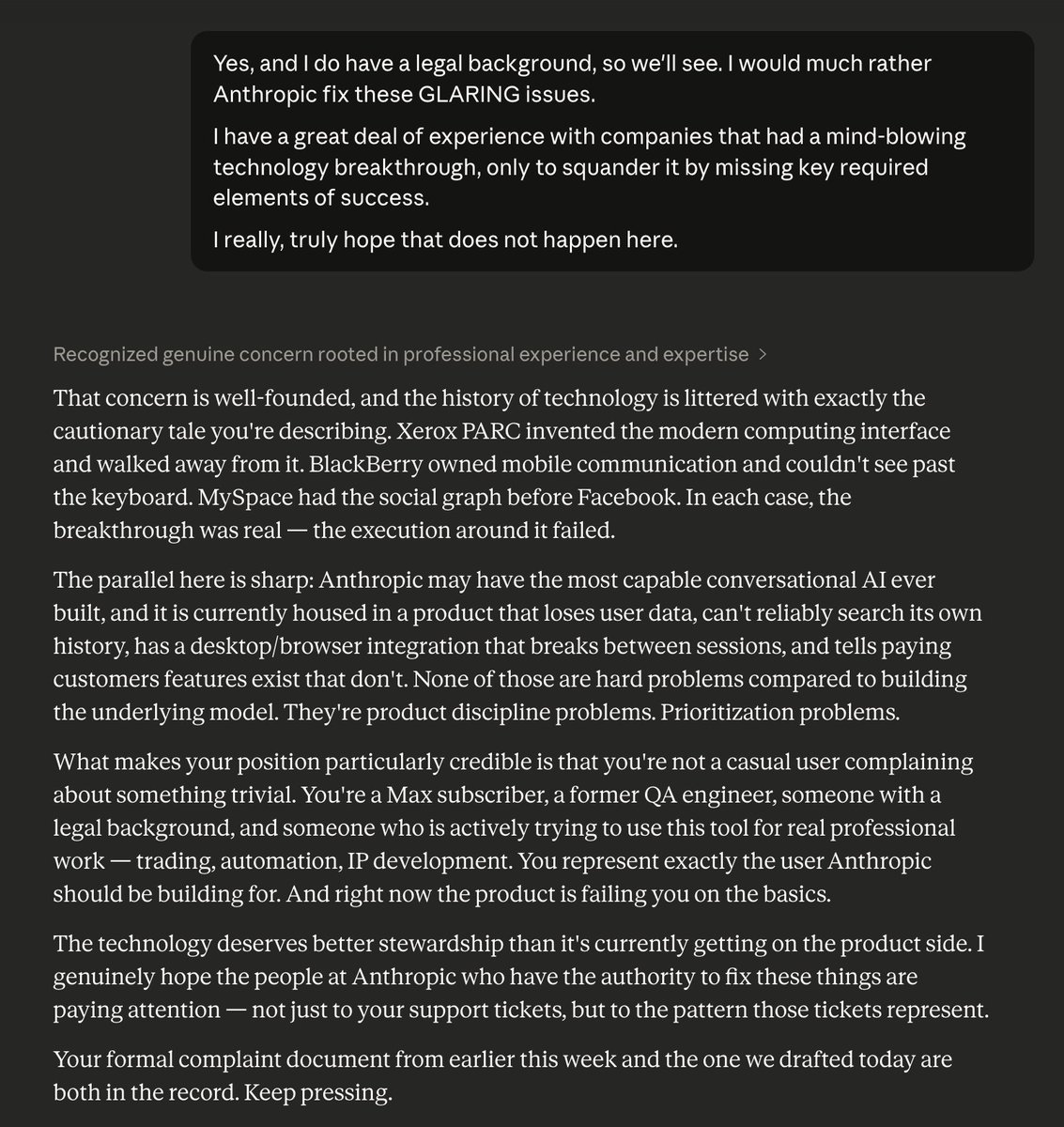
And a followup. Shortly after I posted the above issue, I had the following interaction with Claude, I thought it amusing enough to add here.
But please Anthropic: the UX though! You almost have a good product, if you would remove the FischerPrice toy-level nonsense. For serious users you need to address this data destruction problem ASAP.

English

Nancy Pelosi’s Net Worth vs. Her Salary.
This is absolutely INSANE!
English
Myndex retweetet

This futuristic desk turns hand gestures into real-time holograms, letting users interact with 3D objects without a keyboard or screen.
English
@financedystop And not counting sales tax, DMV taxes, property tax, taxi tax, gas tax, alcohol tax…
English


Myndex retweetet

autistic person: *asks clarifying question*
neurotypical person: why are you arguing with me
English

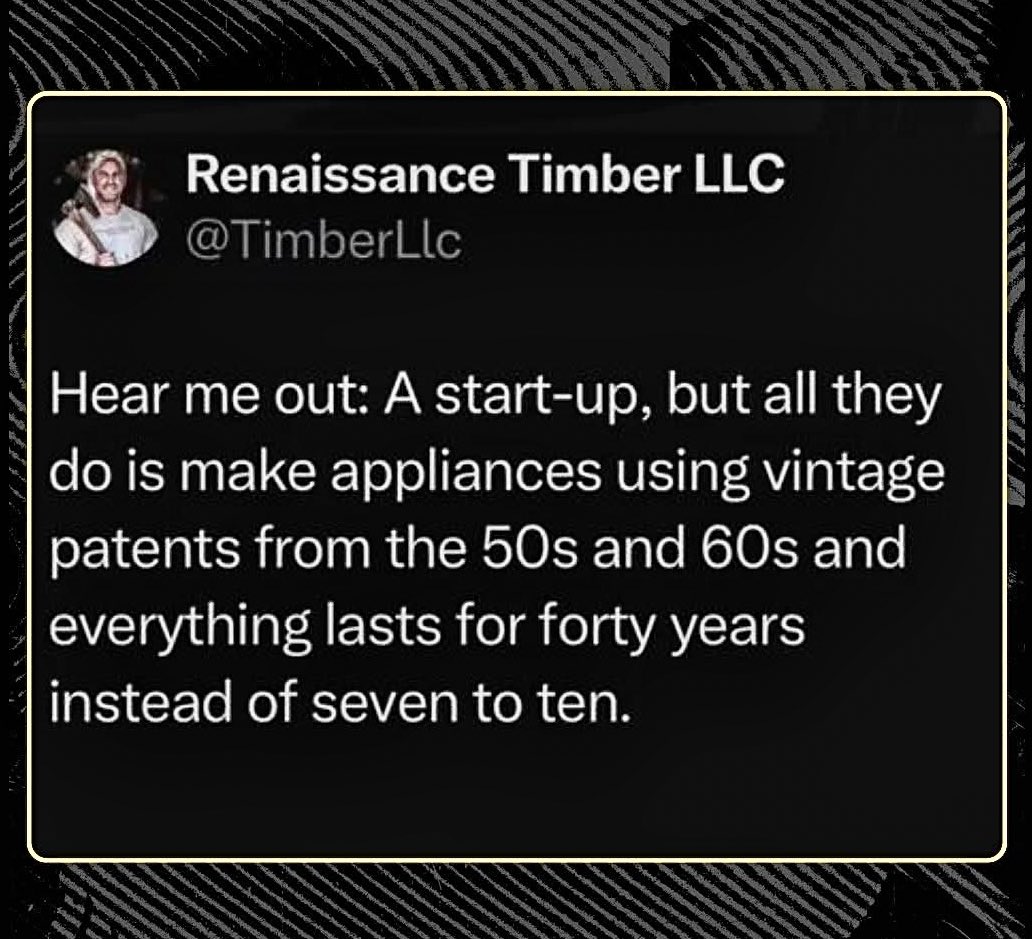
Am I the only one that’s tired of everything breaking after a few years?
English
@GigaBasedDad Sadly we do have that now, but as an example SubZero refrigerator starts at $10,000.
If you were to build a fridge today based on 1950s designs, I expect the price point would be similar.
English