Oggy.hl

4.4K posts

Oggy.hl banner
Oggy.hl

Oggy.hl

@Oggy_Defi

@HypioHL // @HyperliquidX Maxi // Part-time blockchain reseacher // Full-stack Web3 Dev // DMs to my TG

Liquidity City Beigetreten Aralık 2024
3.2K Folgt2K Follower
Oggy.hl
Oggy.hl@Oggy_Defi·
Quick snapshot on @HyperliquidX: Market’s still volatile and uncertain, but @HyperliquidX continues to thrive and build momentum Next targets for $HYPE: $50, then $100 soon
Oggy.hl tweet media
English
0
0
2
129
Oggy.hl retweetet
Ponyo
Ponyo@ponyo_fp·
HIP-4 outcome contracts settle exclusively in USDH. Not USDC. Every prediction market on Hyperliquid becomes a structural demand driver for USDH. Moreover, PM capital on Hyperliquid doesn't sit idle. It cross-margins into perps. That incremental perp volume flows naturally into USDH quoted markets, where taker fees are 20% lower and maker rebates 50% higher. I'm expecting USDH supply to expand much faster once HIP-4 mainnet arrives.
Ponyo tweet media
English
15
20
165
12.8K
Oggy.hl
Oggy.hl@Oggy_Defi·
.@HyperliquidX just reached $1.91M in 24h holders revenue. And 99% of perp fees go to buying $HYPE. Usage -> Revenue -> Buy $HYPE. This is how you build a perp monster.
Oggy.hl tweet media
English
0
2
9
439
Oggy.hl retweetet
gum
gum@gumsays·
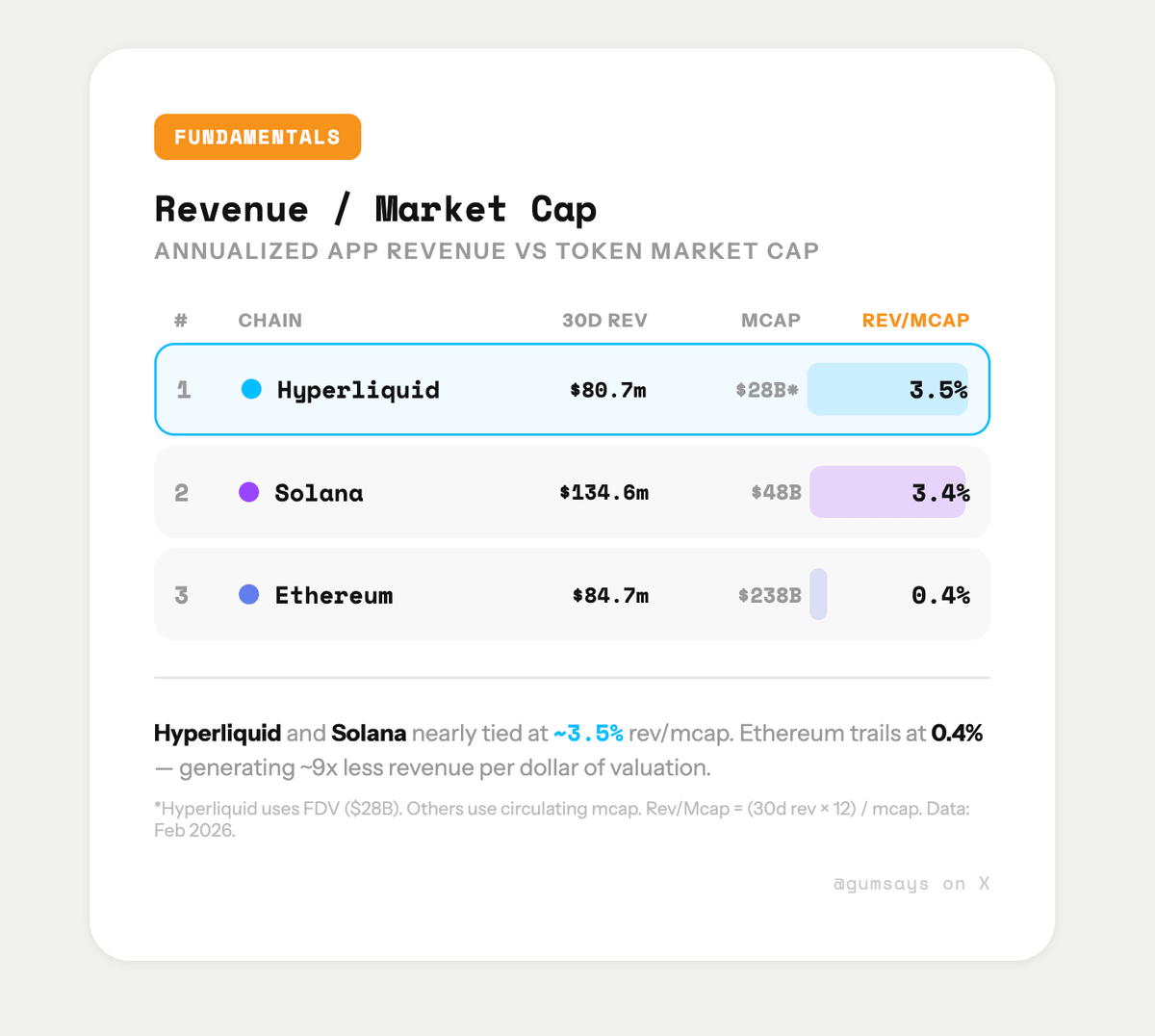
The winner of the next cycle is here Throughput is less of a concern; there's plenty of it to handle 100x more economic activity in crypto Key aspects: → HYPE revenue is used for buybacks, token performance ++++ → Solana's app revenue does not work the same way as HYPE but the success of its apps is directly tied to the success of its token performance (adoption, demand for SOL for trading, etc) → Ethereum is just not investable at all. It is so overvalued on all aspects. Who do you think has a better Revenue/Market Cap ratio in 2 years from now?
gum tweet media
English
32
19
175
17.2K
Oggy.hl
Oggy.hl@Oggy_Defi·
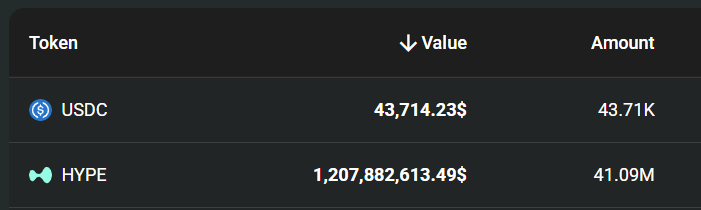
.@HyperliquidX has now bought back 41M $HYPE roughly 5% of total supply. That’s real supply being absorbed by the protocol itself. Hyperliquid.
Oggy.hl tweet media
English
9
2
88
4.7K
Oggy.hl retweetet
Hyperliquid
Hyperliquid@HyperliquidX·
The Hyper Foundation will contribute 1M HYPE tokens to support the creation of the Hyperliquid Policy Center. The tokens will be unstaked later today. The Hyperliquid community will benefit from having representation in Washington, D.C., and we are confident that under @jchervinsky's leadership, the Hyperliquid Policy Center will have a meaningful impact in favor of clear regulations for decentralized finance.
Hyperliquid Policy Center@HyperliquidPC

We are Hyperliquid Policy Center. HPC is a research and advocacy nonprofit focused on advancing a clear path for decentralized finance to thrive in the USA. We will introduce policymakers to @HyperliquidX and bridge the gap between law and next-generation market infrastructure.

English
316
300
2K
271.1K
Oggy.hl retweetet
The Block
The Block@TheBlockCo·
Tether invests in Hyperliquid frontend Dreamcash, offering perps markets for TSLA, gold and more using USDT0 collateral theblock.co/post/389916/te…
English
54
48
386
128.8K
Oggy.hl retweetet
vitalik.eth
vitalik.eth@VitalikButerin·
Recently I have been starting to worry about the state of prediction markets, in their current form. They have achieved a certain level of success: market volume is high enough to make meaningful bets and have a full-time job as a trader, and they often prove useful as a supplement to other forms of news media. But also, they seem to be over-converging to an unhealthy product market fit: embracing short-term cryptocurrency price bets, sports betting, and other similar things that have dopamine value but not any kind of long-term fulfillment or societal information value. My guess is that teams feel motivated to capitulate to these things because they bring in large revenue during a bear market where people are desperate - an understandable motive, but one that leads to corposlop. I have been thinking about how we can help get prediction markets out of this rut. My current view is that we should try harder to push them into a totally different use case: hedging, in a very generalized sense (TLDR: we're gonna replace fiat currency) Prediction markets have two types of actors: (i) "smart traders" who provide information to the market, and earn money, and necessarily (ii) some kind of actor who loses money. But who would be willing to lose money and keep coming back? There are basically three answers to this question: 1. "Naive traders": people with dumb opinions who bet on totally wrong things 2. "Info buyers": people who set up money-losing automated market makers, to motivate people to trade on markets to help the info buyer learn information they do not know. 3. "Hedgers": people who are -EV in a linear sense, but who use the market as insurance, reducing their risk. (1) is where we are today. IMO there is nothing fundamentally morally wrong with taking money from people with dumb opinions. But there still is something fundamentally "cursed" about relying on this too much. It gives the platform the incentive to seek out traders with dumb opinions, and create a public brand and community that encourages dumb opinions to get more people to come in. This is the slide to corposlop. (2) has always been the idealistic hope of people like Robin Hanson. However, info buying has a public goods problem: you pay for the info, but everyone in the world gets it, including those who don't pay. There are limited cases where it makes sense for one org to pay (esp. decision markets), but even there, it seems likely that the market volumes achieved with that strategy will not be too high. This gets us to (3). Suppose that you have shares in a biotech company. It's public knowledge that the Purple Party is better for biotech than the Yellow Party. So if you buy a prediction market share betting that the Yellow Party will win the next election, on average, you are reducing your risk. Mathematical example: suppose that if Purple wins, the share price will be a dice roll between [80...120], and if Yellow wins, it's between [60...100]. If you make a size $10 bet that Yellow will win, your earnings become equivalent to a dice roll between [70...110] in both cases. Taking a logarithmic model of utility, this risk reduction is worth $0.58. Now, let's get to a more fascinating example. What do people who want stablecoins ultimately want? They want price stability. They have some future expenses in mind, and they want a guarantee that will be able to pay those expenses. But if crypto grows on top of USD-backed stablecoins, crypto is ultimately not truly decentralized. Furthermore, different people have different types of expenses. There has been lots of thinking about making an "ideal stablecoin" that is based on some decentralized global price index, but what if the real solution is to go a step further, and get rid of the concept of currency altogether? Here's the idea. You have price indices on all major categories of goods and services that people buy (treating physical goods/services in different regions as different categories), and prediction markets on each category. Each user (individual or business) has a local LLM that understands that user's expenses, and offers the user a personalized basket of prediction market shares, representing "N days of that user's expected future expenses". Now, we do not need fiat currency at all! People can hold stocks, ETH, or whatever else to grow wealth, and personalized prediction market shares when they want stability. Both of these examples require prediction markets denominated in an asset people want to hold, whether interest-bearing fiat, wrapped stocks, or ETH. Non-interest-bearing fiat has too-high opportunity cost, that overwhelms the hedging value. But if we can make it work, it's much more sustainable than the status quo, because both sides of the equation are likely to be long-term happy with the product that they are buying, and very large volumes of sophisticated capital will be willing to participate. Build the next generation of finance, not corposlop.
English
933
592
4.9K
948.5K
Oggy.hl
Oggy.hl@Oggy_Defi·
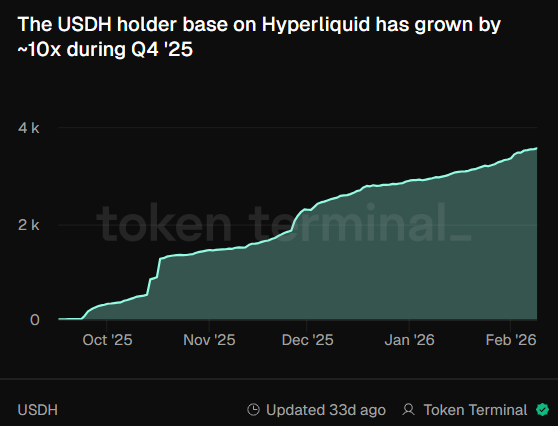
You’re not bullish enough on @HyperliquidX. $USDH holders have grown ~10x in just 3 months and now pushing ~4,000 holders. Market cap already at $82M. Hyperliquid!
Oggy.hl tweet media
English
8
4
49
1.5K
Oggy.hl
Oggy.hl@Oggy_Defi·
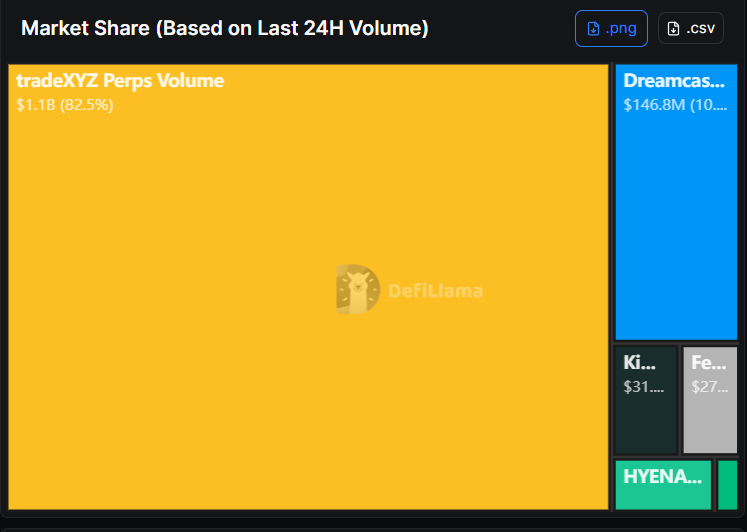
HIP-3 on @HyperliquidX just pushed over $1.4B in volume today. @tradexyz alone did $1.1B with 82% of HIP 3 market share. Hyperliquid’s ecosystem is hitting up!
Oggy.hl tweet media
English
2
19
31
411
Oggy.hl
Oggy.hl@Oggy_Defi·
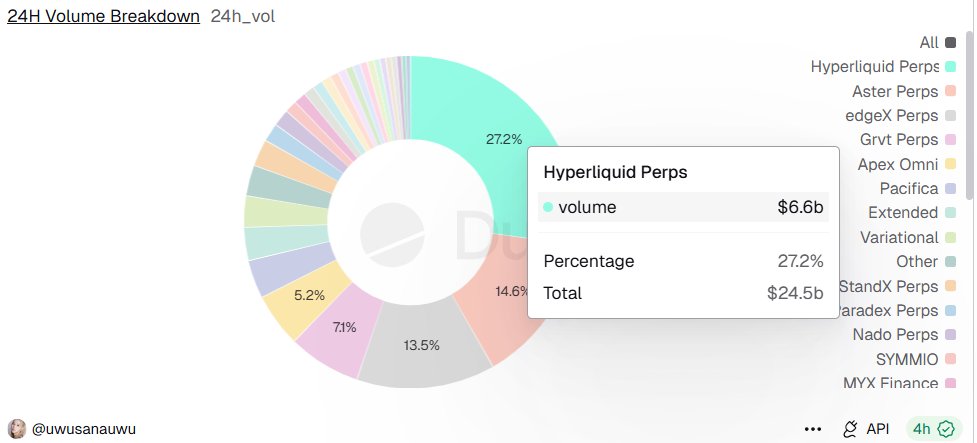
.@HyperliquidX is proving who runs perps right now. $6.6B in 24h volume, ~30% of the entire perp market in a single day. Hyperliquid is a real house of finance for onchain trading.
Oggy.hl tweet media
English
3
23
29
559
Oggy.hl
Oggy.hl@Oggy_Defi·
I don’t think “working on AGI” is the right frame. Progress shouldn’t be undifferentiated acceleration. Ethereum and AI are about choosing a direction. I want an AI future that preserves human freedom, avoids centralized power traps, and doesn’t blow itself up. In the near term, that means building tools for private, trustless AI interaction, using Ethereum as an economic layer for AI to AI coordination, and letting LLMs make the cypherpunk vision real: verify instead of trust. AI should scale human judgment, not replace. It enabling better markets, governance, and decentralized cooperation. Direction matters.
vitalik.eth@VitalikButerin

Two years ago, I wrote this post on the possible areas that I see for ethereum + AI intersections: vitalik.eth.limo/general/2024/0… This is a topic that many people are excited about, but where I always worry that we think about the two from completely separate philosophical perspectives. I am reminded of Toly's recent tweet that I should "work on AGI". I appreciate the compliment, for him to think that I am capable of contributing to such a lofty thing. However, I get this feeling that the frame of "work on AGI" itself contains an error: it is fundamentally undifferentiated, and has the connotation of "do the thing that, if you don't do it, someone else will do anyway two months later; the main difference is that you get to be the one at the top" (though this may not have been Toly's intention). It would be like describing Ethereum as "working in finance" or "working on computing". To me, Ethereum, and my own view of how our civilization should do AGI, are precisely about choosing a positive direction rather than embracing undifferentiated acceleration of the arrow, and also I think it's actually important to integrate the crypto and AI perspectives. I want an AI future where: * We foster human freedom and empowerment (ie. we avoid both humans being relegated to retirement by AIs, and permanently stripped of power by human power structures that become impossible to surpass or escape) * The world does not blow up (both "classic" superintelligent AI doom, and more chaotic scenarios from various forms of offense outpacing defense, cf. the four defense quadrants from the d/acc posts) In the long term, this may involve crazy things like humans uploading or merging with AI, for those who want to be able to keep up with highly intelligent entities that can think a million times faster on silicon substrate. In the shorter term, it involves much more "ordinary" ideas, but still ideas that require deep rethinking compared to previous computing paradigms. So now, my updated view, which definitely focuses on that shorter term, and where Ethereum plays an important role but is only one piece of a bigger puzzle: # Building tooling to make more trustless and/or private interaction with AIs possible. This includes: * Local LLM tooling * ZK-payment for API calls (so you can call remote models without linking your identity from call to call) * Ongoing work into cryptographic ways to improve AI privacy * Client-side verification of cryptographic proofs, TEE attestations, and any other forms of server-side assurance Basically, the kinds of things we might also build for non-LLM compute (see eg. my ethereum privacy roadmap from a year ago ethereum-magicians.org/t/a-maximally-… ), but for LLM calls as the compute we are protecting. # Ethereum as an economic layer for AI-related interactions This includes: * API calls * Bots hiring bots * Security deposits, potentially eventually more complicated contraptions like onchain dispute resolution * ERC-8004, AI reputation ideas The goal here is to enable AIs to interact economically, which makes viable more decentralized AI architectures (as opposed to non-economic coordination between AIs that are all designed and run by one organization "in-house"). Economies not for the sake of economies, but to enable more decentralized authority. # Make the cypherpunk "mountain man" vision a reality Basically, take the vision that cypherpunk radicals have always dreamed of (don't trust; verify everything), that has been nonviable in reality because humans are never actually going to verify all the code ourselves. Now, we can finally make that vision happen, with LLMs doing the hard parts. This includes: * Interacting with ethereum apps without needing third party UIs * Having a local model propose transactions for you on its own * Having a local model verify transactions created by dapp UIs * Local smart contract auditing, and assistance interpreting the meaning of FV proofs provided by others * Verifying trust models of applications and protocols # Make much better markets and governance a reality Prediction and decision markets, decentralized governance, quadratic voting, combinatorial auctions, universal barter economy, and all kinds of constructions are all beautiful in theory, but have been greatly hampered in reality by one big constraint: limits to human attention and decision-making power. LLMs remove that limitation, and massively scale human judgement. Hence, we can revisit all of those ideas. These are all things that Ethereum can help to make a reality. They are also ideas that are in the d/acc spirit: enabling decentralized cooperation, and improving defense. We can revisit the best ideas from 2014, and add on top many more new and better ones, and with AI (and ZK) we have a whole new set of tools to make them come to life. We can describe the above as a 2x2 chart. There's a lot to build!

English
0
21
28
203
Oggy.hl
Oggy.hl@Oggy_Defi·
.@HyperliquidX has officially crossed 1M users User growth continues to climb while cumulative trading volume reaches $254B, highlighting strong product market fit and growing trader activity across the platform.
Oggy.hl tweet media
English
1
11
19
224
Oggy.hl retweetet
Arthur Hayes
Arthur Hayes@CryptoHayes·
Since $HYPE is bad @KyleSamani let's make a bet. I bet that from 00:00 UTC 10 Feb 2026 to 00:00 UTC 31 July 2026 $HYPE will out perform any shitcoin >$1bn mcap on coingecko in USD terms. You choose your champion. Loser donates $100k to a charity of the winner's choice.
Kyle Samani@KyleSamani

@jon_charb Hyper liquid is in most respects everything wrong with crypto Founder literally fled his home country to build Openly facilitates crime and terror Closed source Permissioned

English
262
95
1.7K
331.6K
Oggy.hl retweetet
Henrik
Henrik@Henrik_on_HL·
Hyperliquid reached a new ATH in volume against Binance (13%) and Bybit (33,5%)
Henrik tweet media
English
13
37
305
17.8K
Oggy.hl retweetet
vitalik.eth
vitalik.eth@VitalikButerin·
I am capitulating, I will call Twitter "X" from now on. "Tweet" becomes a generic term for messages on any platform that prioritizes short-form text content with X-like UX, similar linguistically to "kleenex". Usage guide: * "Vitalik is only tweeting on Farcaster and Lens this year, isn't it awful how much of an ivory tower elitist he is?" * "Did you see Donald Trump's shocking new racist tweet on Truth Social?" * "Back when I sent that in 2019, it was a tweet, and by this new definition it still is, but now we can also refer to it ex-post as an X post" "Crypto Twitter" can remain as a set phrase, similarly to how Peking Duck is still called Peking Duck, though of course it would be funny if more people called it CryptoX (aka CrypTox). (This tweet was sent simultaneously on X, Farcaster and Lens via Firefly)
English
1K
208
3.3K
476.3K