ReshapeTech

2.6K posts

ReshapeTech banner
ReshapeTech

ReshapeTech

@ReshapeTech

Investing journal for small hedge fund (2025 +22.4%). Current bets: 70% Cash, LAND, IH2O, URNM). xTradFi 15yrs.

Beigetreten Aralık 2021
482 Folgt529 Follower
Angehefteter Tweet
ReshapeTech
ReshapeTech@ReshapeTech·
@yq_acc The single biggest problem with crypto: Devs got used to easy funding & aren't competitive with web2 startups For yrs crypto gave no need to deliver - useful products - sustainable revenue ..& yet multi Billion valuations Reality has arrived: create real value or leave
English
0
0
4
568
ReshapeTech
ReshapeTech@ReshapeTech·
@adamscochran There's only one way out for Trump; He's already made a soft deal with Iran and he's just saber rattling to save face Then comes out with "they listened to my threats and they backed down" ..without that, Trump & markets are screwed
English
0
0
2
191
Adam Cochran (adamscochran.eth)
That second point is one that many people are underestimating. If Trump takes no action, and makes large concessions to get a deal - then ANY future military threat becomes hollow. His entire foreign policy through threat approach falls apart. Beyond just ego, he has interest in carrying out action, just so his words don’t seem empty. That’s not a good position for us to be in.
Loopify 🧙‍♂️@Loopify

both scenarios of this are bad: - he actually decides to go through with this - he doesn’t and loses all of his aura to his supporters making all future threats meaningless

English
10
42
277
25K
ReshapeTech
ReshapeTech@ReshapeTech·
@financialjuice Pezeshkian has no authority Listen to the real decision makers - Vahidi - Ghalibaf
English
0
0
0
309
FinancialJuice
FinancialJuice@financialjuice·
Iran's President Pezeshkian: We're ready to end war, but want guarantees.
English
55
97
429
199.9K
ReshapeTech
ReshapeTech@ReshapeTech·
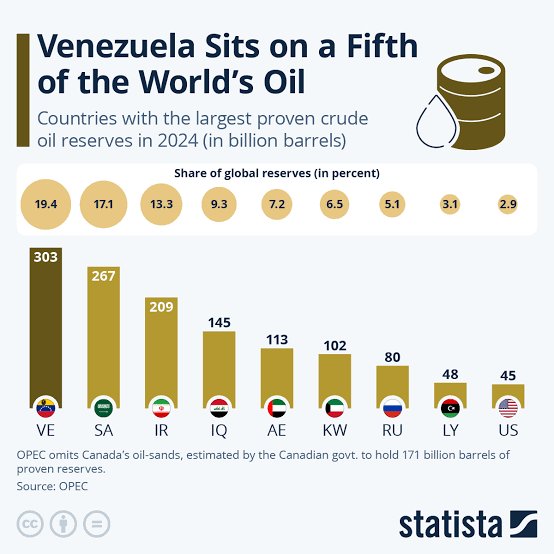
@ericnuttall Devil's advocate: 1. US now hv Venezuelan latest global supply (will take time, but its coming) 2. Oil intensity keeps declining (and will continue with solar + nuclear) x.com/i/status/20367…
ReshapeTech tweet media
Ali Al-Salim@alialsalim

As everyone scrambles for oil and gas, its worth appreciating the world's energy intensity has fallen precipitously over the last 45 years. The chart and table from JP Morgan illustrate how relentless the push to doing more with less has been.

English
1
0
0
240
Eric Nuttall
Eric Nuttall@ericnuttall·
“The most anticipated oil supply glut in history”™️ is dead, and with it the biggest bear thesis for oil. We believe we are now in a multi-year oil bull market based on the twilight of US shale, peaking non-OPEC production, and minimal OPEC spare capacity.
English
5
56
378
61.6K
ReshapeTech retweetet
SandraCobena
SandraCobena@SandraCobena_·
Listening to @PierrePoilievre break down monetary policy on Joe Rogan, this is exactly the kind of conviction I stand behind. #cdnpoli
English
249
1.7K
7.2K
132.2K
ReshapeTech
ReshapeTech@ReshapeTech·
@0xNairolf we need better ratings (surely with AI its easier, the same way auditing smart contracts is easier) some interesting starts but not good enough (yet): x.com/MeshClans/stat…
Mesh@MeshClans

DeFi just got something it's never had before: actual risk ratings Independent, daily-updated risk grades went live on @sparkdotfi a few days ago, and every Spark Savings vault now shows a Credora rating based on quantitative models and decades of historical default data. For the first time, you can see institutional-grade risk assessment right next to your APY. Six Spark Savings products, each with its own Credora rating. A+, A, A-, B+ (one letter that tells you what you're actually risking to earn that yield, updated daily as market conditions shift). Here's what the ratings show (per the current official report; check live in Spark Savings for any intraday shifts): > Savings ETH → SparkLend ETH lending market → 0.25% PSL → A > Savings PYUSD → USDS collateral backing → 0.58% PSL → A- > Savings USDC → USDS collateral backing → 0.61% PSL → A- > Savings USDT → USDS collateral backing → 0.60% PSL → A- > Savings USDS → USDS collateral backing → 0.63% PSL → A- > Staked USDS → SKY/USDS Aave lending market → 1.03% PSL → B+ This is risk-aware DeFi. Every rating answers three questions: How safe is the collateral? What happens if prices move? Who's protecting your deposit? The PSL (Probability of Significant Loss) gives you an annual percentage chance that you actually lose money, not just paper volatility. It's calibrated against 30+ years of credit default data from traditional markets, then adapted for DeFi's unique risk profile. Behind each letter grade sits serious quantitative work. Monte Carlo simulations stress-test liquidation scenarios and bad debt risk under extreme price moves. Risk modifiers adjust for collateral quality, governance structures, peg stability, and market depth. The difference from traditional ratings: > TradFi measures credit risk on issuers, Credora measures it on protocols and vaults > TradFi updates ratings quarterly through committees, DeFi gets live updates pushed onchain > TradFi relies on prospectuses and disclosures, DeFi reads onchain parameters directly Savings ETH gets an A because of its conservative setup, deep liquidity, and battle-tested liquidator ecosystem. Staked USDS gets a B+ because there's high concentration in certain LTV bands, with $78M in positions against roughly $600K of liquidity at 2% depth. Higher yield, tighter liquidity cushions. The rating just reflects that trade-off. When risk is transparent, people trust it. When people trust it, capital flows. IMO, this is how DeFi crosses the chasm. Institutions don't deploy capital based on vibes and APY screenshots. They need quantified downside, stress-tested scenarios, and a risk framework that maps to existing mandates. @CredoraNetwork built exactly that, and Spark is the first major protocol to surface it directly in the user experience. As @hexonaut, co-founder of Spark, put it: "Until now, DeFi participants have had to piece together risk information from multiple sources, or worse, make decisions based on APY alone. Credora is the missing link!" You can check it out yourself right now. Head to spark(dot)fi/savings, open any vault, hit the Risk Assessment tab, and you'll see every rating, every underlying market, every modifier in real time. Want the full picture? There's a 20-page institutional report with detailed breakdowns, collateral analysis, simulations, and complete methodology at reports(dot)credora(dot)io/spark/latest.pdf The bigger picture here is Credora already rated 100+ vaults on Morpho, and early data shows rated vaults seeing faster TVL growth and stickier deposits. Sky/USDS integration is coming next, then wallets, fintech apps, maybe even AI agents routing based on risk-adjusted returns. This isn't just Spark getting a feature upgrade. It's the infrastructure that lets DeFi absorb institutional capital at scale. Note: Ratings update daily based on market conditions. Always check current ratings before deploying capital. Quick disclaimer: ratings and data are informational only, not investment advice. Do your own research. Know your risk.

English
0
0
0
94
ReshapeTech
ReshapeTech@ReshapeTech·
@goodalexander Hype is still good for the *many* 1. Non US traders 2. US trader who dont want to kyc
English
0
0
0
15
goodalexander
goodalexander@goodalexander·
Question: if the main purpose of hyperliquid is for US users to trade perpetual swaps without kyc and the US legalizes perpetual swaps is that good or bad?
English
112
5
406
97.1K
@aahan_prometheus
@aahan_prometheus@AahanPrometheus·
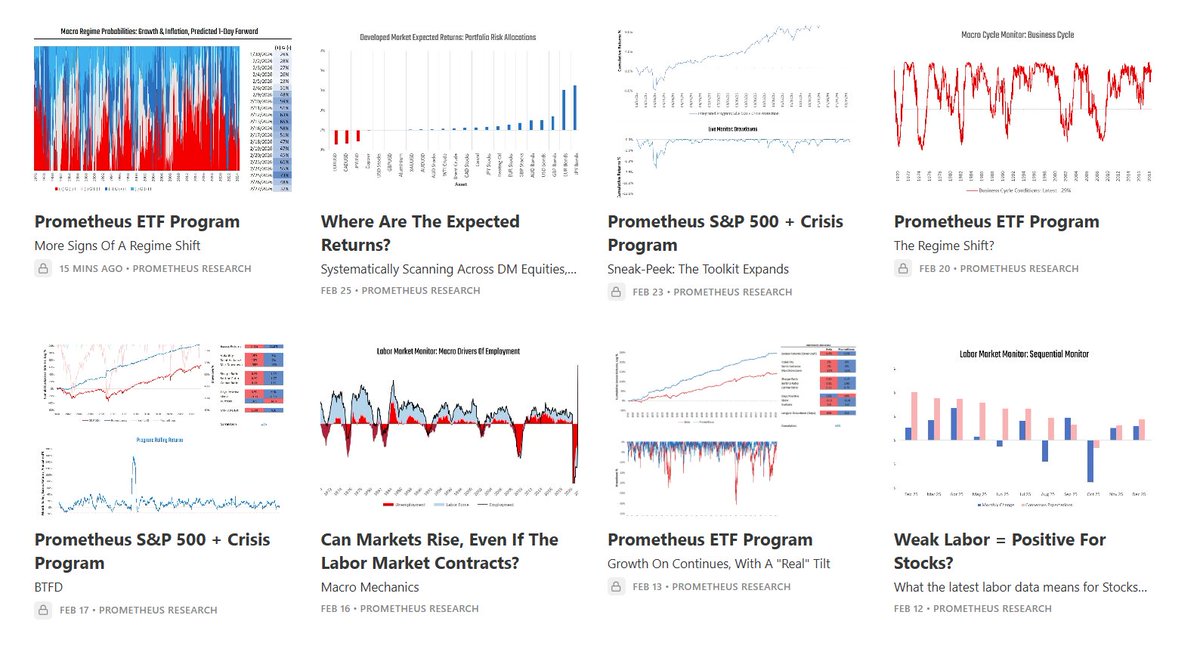
No marketing hype, I'm proud of the body of work we put out. Recent highlights: ☑️Deep-dive into the complex divergence between equities & labor market ☑️ Systematic scan across the global expected returns across 25 assets & 5 countries ☑️A whole lot of systematic portfolios
@aahan_prometheus tweet media
English
3
3
25
4.4K
ellington
ellington@not_ellington·
The entire idea of a perpetual underclass as a looming threat of AGI is so stupid because it already exists and has for decades for those with the eyes to see. The entire point of technology is that it makes humans less useful. The steamboat made rowers useless. The loom made seamstresses useless. The computer made human algebraists useless. And now AI is going to make most white-collar humans useless. It is important to understand that this is not a new phenomenon, it is just the first time that many 'computer people' have seen it with their own eyes and are shaken by it because they lived an entire life of arrogance believing their own intelligence to be uncommoditizable. So, naturally, to cope with this slightly overblown but also very real fear that they are becoming economically useless, many of these white collar professionals have been joking about the 'perpetual underclass'. Yeah, its kinda funny, mostly worn out by now, but I think the extent to which it is referenced is a sign that it is a real anxiety a lot of people are facing. I do think that it is coming in one form or another, so what do we do? What do we do with millions of people when AI can do their job for cheaper and better than they themselves can? Andrew Yang style UBI? Hmmmm. Maybe we give everyone a fake job to make them still feel productive. Maybe we have them entirely reliant on the government for all necessary goods (food, housing, etc.). Maybe, after they get home from their (fake) Real Hard Intellectually Stimulating and Meaningful™ job, we just let them ingest marginal cost, addictive, meaningless entertainment. What else could a realistic underclass look like? It cannot be cartoonish (i.e. industrial London circa 1894 with rampant pollution, starvation, etc.) because then we risk a serious revolt. What these types who comment on this don't understand (apropos the previous paragraph) is that the 'permanent underclass' already exists and has for quite some time now. The only difference is that most in the permanent underclass ('The Matrix' as some more controversial figures call it) are so blinded by societal norms and trivialities (sports, politics, etc.) to recognize the extreme wealth inequality that is right in fucking front of them. What these types also don't understand is that many people are born into slavery. Not 1850s South Carolina, but mental, psychological slavery. They don't believe in their own agency. They don't believe in their own potential salvation. Life is just what passes through your eyes and you are a viewer. What's more, even if they did seek agency, they do not have the intelligence, ideas, charisma, confidence, strength, or creativeness to capitalize. Most people are slaves because the non-slaves are so individual most could only believe that they were touched by God. The issue is that those who were born with the aforementioned qualities are dwindling with respect to the prerequisites to outpace AI/automation. You now need to be 4 standard deviations above the mean in one of (if not more) of these qualities because AI, when prompted correctly, is already capable of up to 3 standard deviation skill in ALL of these domains (rough example metrics). This trend will continue frighteningly quickly until those whose skills are truly unique number in the thousands. So what do you do with the rest of society? Unfortunately you have two options. One right-wing-coded, one left-wing-coded. Option 1. Only the strong survive. Let natural selection run its course until there are a few tens of thousand Übermensch that run the neo-feudal system. Option 2. The entire Earth is turned into a welfare state akin to what is happening now on a much smaller scale. Go to your fake job, go to your state-sanctioned 10ft x 10ft apartment, and watch TikTok with your state-sanctioned AI girlfriend (the real women are reserved for the A10s) All to say, the perpetual underclass is real. It is coming, but the reality is most people actually want it to. Most people want to outsource thinking to an AI and live hedonistically. The K shaped world will accelerate. It is up to us to decide whether this rising tide lifts or sinks all ships.
English
26
36
396
25.5K
ReshapeTech
ReshapeTech@ReshapeTech·
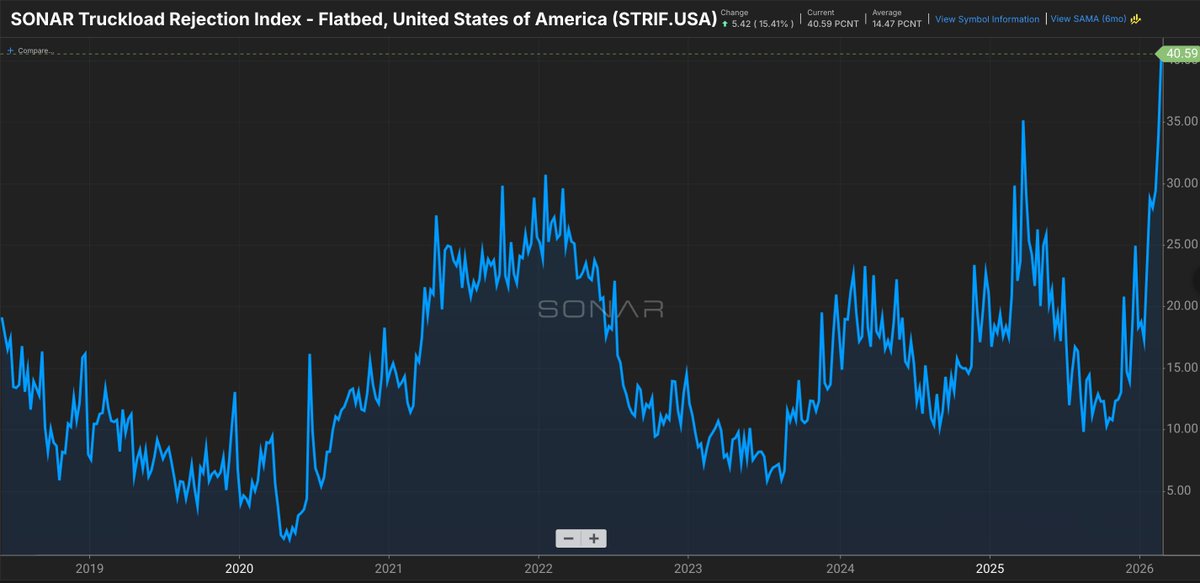
flatbed rejections are a good indicator for small/mid-cap industrials AIRR ETF (small cap industrials) is up 24% YTD and 221% over 5yrs Less so for S&P which is 70%+ tech/services. Also worth noting the dataset is thin (<5% of SONAR tenders) and the last spike to 41% was mostly tariff front-loading. Real confirmation is ISM PMI just hitting 52.6 - first expansion in a year. Flatbed x PMI x homebuilders is a good proxy for economy growing again
English
0
0
0
48
Craig Fuller 🛩🚛🚂⚓️
Craig Fuller 🛩🚛🚂⚓️@FreightAlley·
Flatbed rejection rates are on fire to 40%. Flatbeds are breaking out above previous records that were broken in 2021, the height of COVID. This is an extremely bullish indicator for heavy industrial and manufacturing activity in the economy.
Craig Fuller 🛩🚛🚂⚓️ tweet media
English
50
139
894
157.7K
ReshapeTech
ReshapeTech@ReshapeTech·
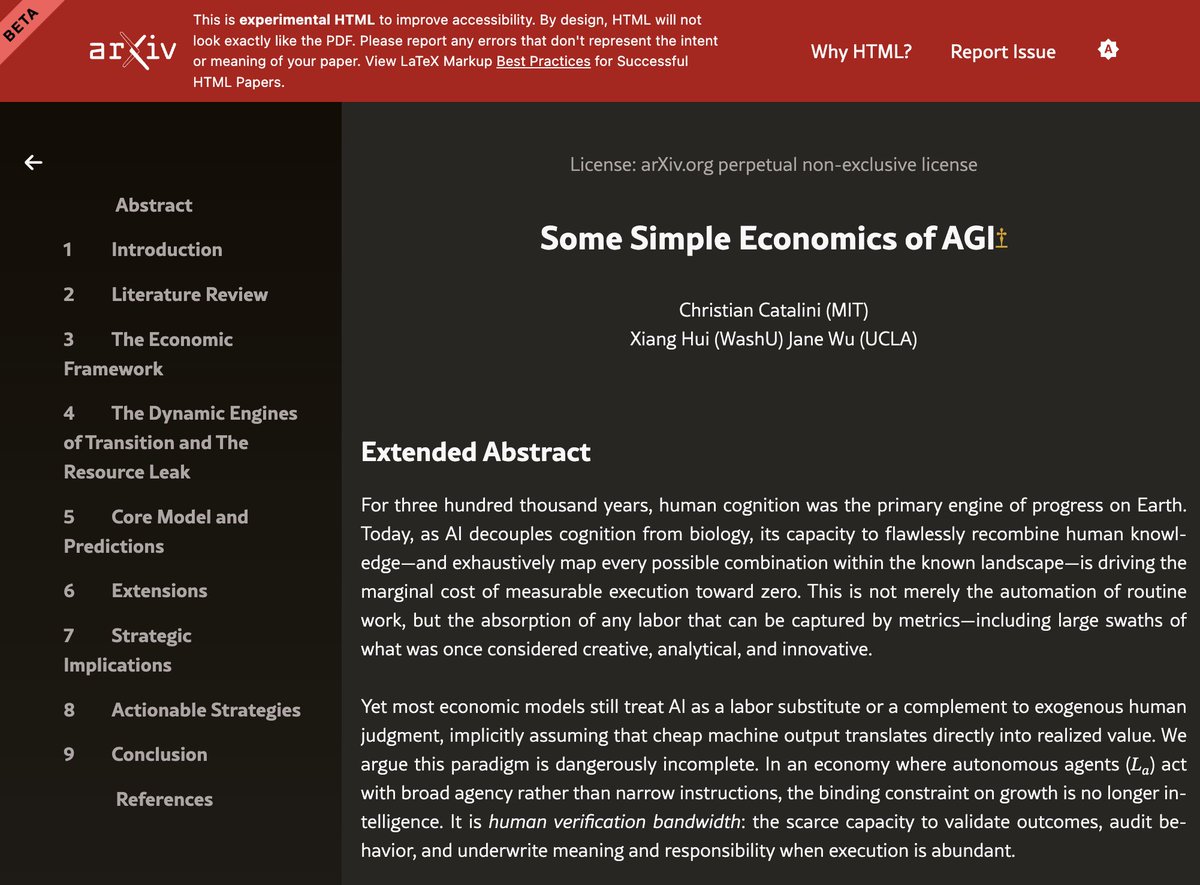
@ccatalini You missed the whole physical world: Buy a farm, become self-sufficient Otherwise great paper! Albeit depressing
English
1
0
1
748
Christian Catalini
Christian Catalini@ccatalini·
1/ Some Simple Economics of AGI—🔥🧵 Right now, there is a low-grade panic running through the economy. Everyone is asking the same anxious question: what exactly is AI going to automate, and what will be left for us?
Christian Catalini tweet media
English
146
383
2K
614.3K
ReshapeTech
ReshapeTech@ReshapeTech·
@VitalikButerin Get apps with paying users, all else is noise Revenue is fuel; sustaining any other mission
English
0
0
0
4
vitalik.eth
vitalik.eth@VitalikButerin·
In these five years, the Ethereum Foundation is entering a period of mild austerity, in order to be able to simultaneously meet two goals: 1. Deliver on an aggressive roadmap that ensures Ethereum's status as a performant and scalable world computer that does not compromise on robustness, sustainability and decentralization. 2. Ensures the Ethereum Foundation's own ability to sustain into the long term, and protect Ethereum's core mission and goals, including both the core blockchain layer as well as users' ability to access and use the chain with self-sovereignty, security and privacy. To this end, my own share of the austerity is that I am personally taking on responsibilities that might in another time have been "special projects" of the EF. Specifically, we are seeking the existence of an open-source, secure and verifiable full stack of software and hardware that can protect both our personal lives and our public environments ( see vitalik.eth.limo/general/2025/0… ). This includes applications such as finance, communication and governance, blockchains, operating systems, secure hardware, biotech (including both personal and public health), and more. If you have seen the Vensa announcement (seeking to make open silicon a commercially viable reality at least for security-critical applications), the ucritter.com including recent versions with built in ZK + FHE + differential-privacy features, the air quality work, my donations to encrypted messaging apps, my own enthusiasm and use for privacy-preserving, walkaway-test-friendly and local-first software (including operating systems), then you know the general spirit of what I am planning to support. For this reason I have just withdrawn 16,384 ETH, which will be deployed toward these goals over the next few years. I am also exploring secure decentralized staking options that will allow even more capital from staking rewards to be put toward these goals in the long term. Ethereum itself is an indispensable part of the "full-stack openness and verifiability" vision. The Ethereum Foundation will continue with a steadfast focus on developing Ethereum, with that goal in mind. "Ethereum everywhere" is nice, but the primary priority is "Ethereum for people who need it". Not corposlop, but self-sovereignty, and the baseline infrastructure that enables cooperation without domination. In a world where many people's default mindset is that we need to race to become a big strong bully, because otherwise the existing big strong bullies will eat you first, this is the needed alternative. It will involve much more than technology to succeed, but the technical layer is something which is in our control to make happen. The tools to ensure your, and your community's, autonomy and safety, as a basic right that belongs to everyone. Open not in a bullshit "open means everyone has the right to buy it from us and use our API for $200/month" way, but actually open, and secure and verifiable so that you know that your technology is working for you.
English
783
597
4.2K
875.8K
Damian Player
Damian Player@damianplayer·
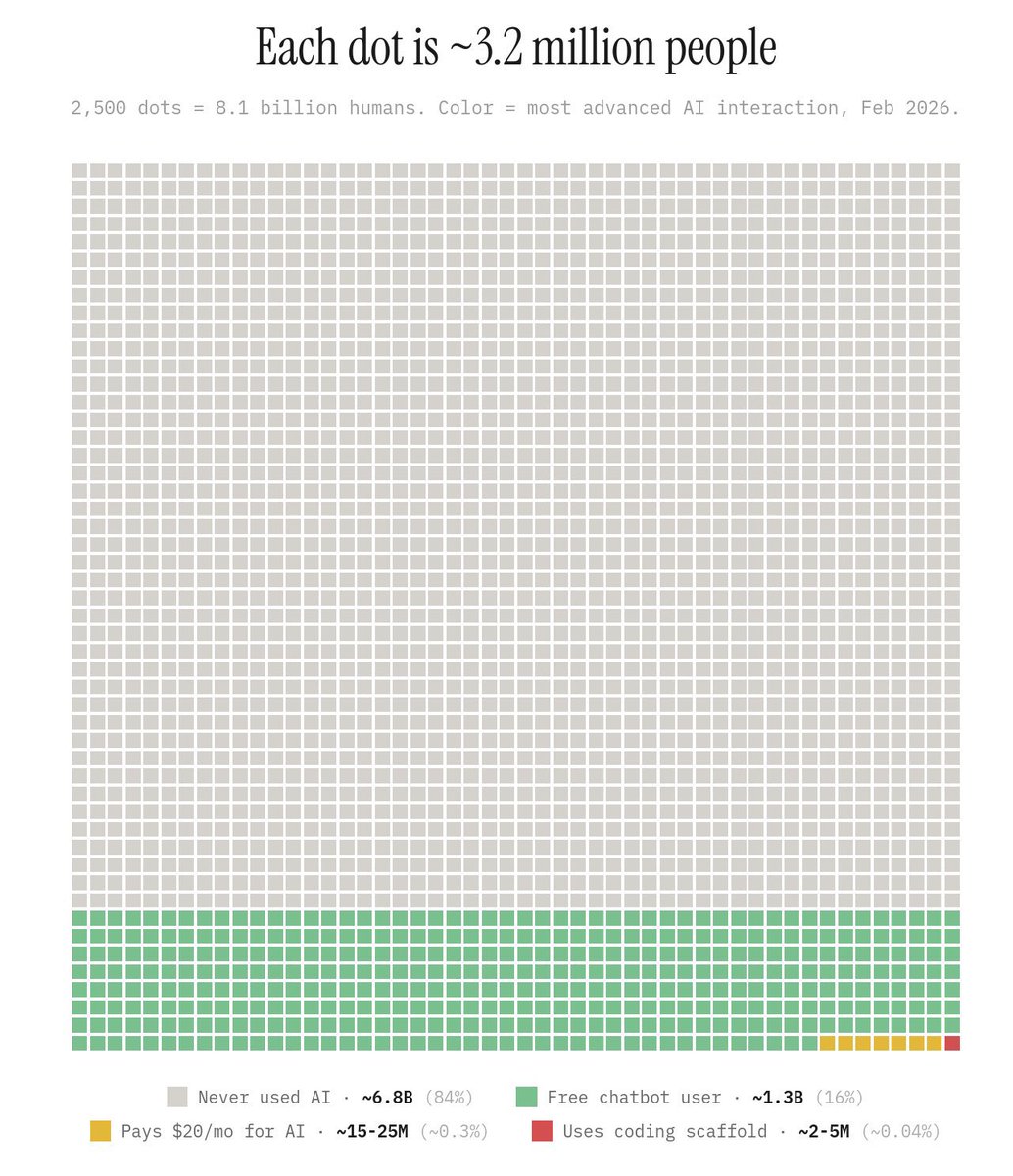
your timeline convinced you AI is in a bubble. talk to a boomer above the age 35 for 5 minutes. most people don’t even know what claude is.​​​​​​​​​​​​​​​​ kind of wild when you zoom out.
Damian Player tweet media
English
973
1.1K
9.1K
3.3M
ReshapeTech
ReshapeTech@ReshapeTech·
So true, Anthropic is the best generalist But can't replicate specialists using AI Imagine Claude managing ALL the diverse: - domain knowledge - client relationships - industry process nuances Its too much supply chain for 1 co - Microsoft makes the platform (Excel, Word Windows), specialists use the platform and still make money
English
0
0
0
21
Boring_Business
Boring_Business@BoringBiz_·
When the tractor was first invented, everyone thought that people will now grow their own food since they have access to new equipment The reality that followed was exactly the opposite > farming became even more hyper specialized > that industry became more concentrated amongst larger players I suspect that the same exact discourse is now taking place within AI and software Not every company wants to build their own internal SaaS products. It just doesnt make sense to do it when solutions already exist Specialization also just brings a lot of benefits, including better unit economics and margins Will some companies be disintermediated? Sure. But I suspect that more value will accrue to the best of breed SaaS platforms that are actually embracing AI and using it as a tailwind for their product today
English
23
15
186
18.2K
ReshapeTech
ReshapeTech@ReshapeTech·
@hosseeb Crypto is banking for AI, > Banks won't give Agents bank accounts > Crypto allows Agents to transact in the global economy, making them (even) more useful The million-dollar question is: Will Agents use any crypto as a SoV ..if so; huge upside
English
0
0
0
77
ReshapeTech
ReshapeTech@ReshapeTech·
@karsenthil simple: 1. Gold has Chinese size bid, NFTs are commoditised, AI stocks are more exciting & hv revenue 2. crypto tokens didn't solve value accrual (they focused on hype & marketing instead) & the 0.01% who do have value accrual (Hype Aave etc) are at rich valuations
English
0
0
3
133
Karthik Senthil
Karthik Senthil@karsenthil·
It's a weird time in crypto. The stuff that the industry has been talking about/predicting forever is actually happening, but no eyes or capital is bidding the space right now. Currency debasement is a real narrative, but gold has been ripping (not BTC) The collectibles market is only growing (Pokeman cards are selling for $16M) but it's happening over traditional physical venues, not via NFTs. Prediction markets are bigger than probably anyone outside of Shayne thought they would be, but its not seen as a crypto thing and Kalshi markets AFAIK don't use crypto rails (yet) Stablecoin volumes are up and to the right, but most of the attention is focused in fintechs, not DeFi. Why is this happening? There's probably a lot of reasons but the biggest is that the crypto industry is guilty of wasting the public's curiosity/goodwill/capital on BS/infra no one asked for/founders + VCs doing cash grab, vs. focusing on actual products that people outside
English
19
6
72
5.3K
ReshapeTech
ReshapeTech@ReshapeTech·
@jessewldn @laurashin @nic_carter Jesse with respect; regulation has lifted Yet tokens are still valueless The real issues are 1. Weak products/PMF 2. Weak tokenomics (protocol revenues don't go to tokenholders) 3. Unrealistic market caps, due to speculation But I agree, tokens will move to equity
English
0
0
0
32
Jesse Walden
Jesse Walden@jessewldn·
respectfully think you and nic are glossing over important nuance: yes, many tokens were not tied to any durable value (startups that didn't work, or worse, were never intended to work) but also, many tokens were significantly hampered by an adversarial regulatory environment, where teams were restricted from staying involved to build durable value and cash flows. end state, many tokens will end up looking more similar to equity (but not exactly the same) - and hopefully, this will be regulated under SEC safe harbor rules. x.com/jessewldn/stat…
English
3
0
18
1.2K
Laura Shin
Laura Shin@laurashin·
I think @nic_carter is right about this: crypto's token era didn't fail because of regulation. It failed because the model never produced durable value. What comes next, according to Nic, is more mundane and more sustainable. Cash-flow businesses. Real revenue. The kind of "boring" that actually compounds.
English
34
5
89
19.3K
ReshapeTech
ReshapeTech@ReshapeTech·
@AvgJoesCrypto There's lack of PMF to allocate capital to What tokens hv sustained value accrual? (PMF) Maybe Hype + 0.01% others
English
1
0
1
142
AJC
AJC@AvgJoesCrypto·
Perhaps a hot take, but crypto does not have a “lack of PMF” problem, but a “deeply unserious capital allocator” problem
English
37
10
187
14.1K
ReshapeTech
ReshapeTech@ReshapeTech·
AI = tech recession But a Renaissance in hard assets Since dotcom, tech got high PE multiples, from asset-light software with high margins AI permanently compresses software premium Hard assets (factories, infra, energy, mining, utilities) are hard to replace Atoms > bits
BuccoCapital Bloke@buccocapital

For 50 yrs we treated the supremacy of asset-light businesses as a permanent economic law But if AI commoditizes asset-light businesses, we’d just be reverting to the historical mean where value accrued to atoms, infrastructure, energy It would be a 50 year blip. An anomaly

English
0
0
0
61
ReshapeTech
ReshapeTech@ReshapeTech·
Nexus do pay, but no one had v2 insurance bc it (has to be) expensive Aave is best (battled tested). Morpho silo'ing pools is stronger design, but they're less lindy. Key issue holding back DeFi/Aave 1. Hack risk can't be quantified (best we can do is use crypto history, but its too short) 2. Insurance cost reduces investors yield too much
English
0
0
1
15