
Rodolfo Saccoman
3.4K posts

Rodolfo Saccoman
@RodolfoSaccoman
Operating Partner | Founder & Board-Level Operator Applied AI · Hospitality · Consumer | Building & scaling technology-enabled businesses
Miami, FL Beigetreten Ekim 2011
4.7K Folgt2.1K Follower

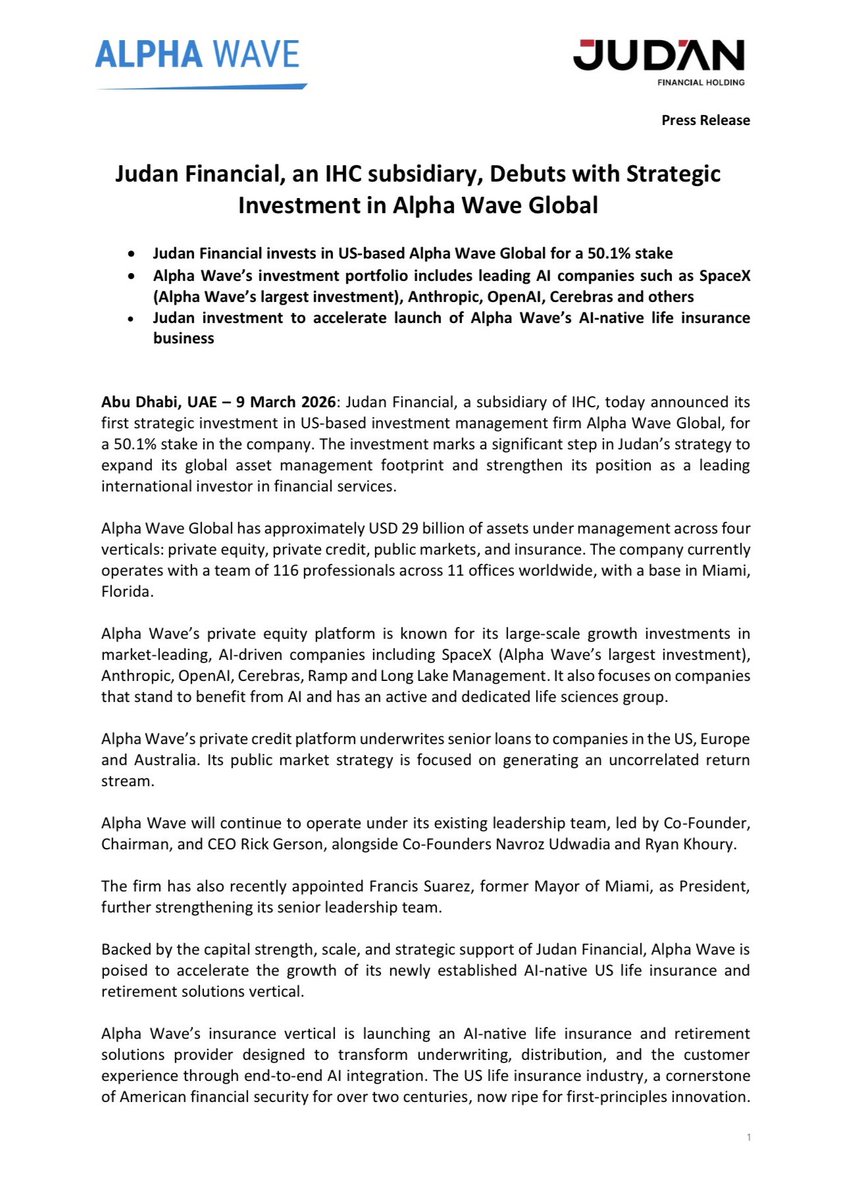
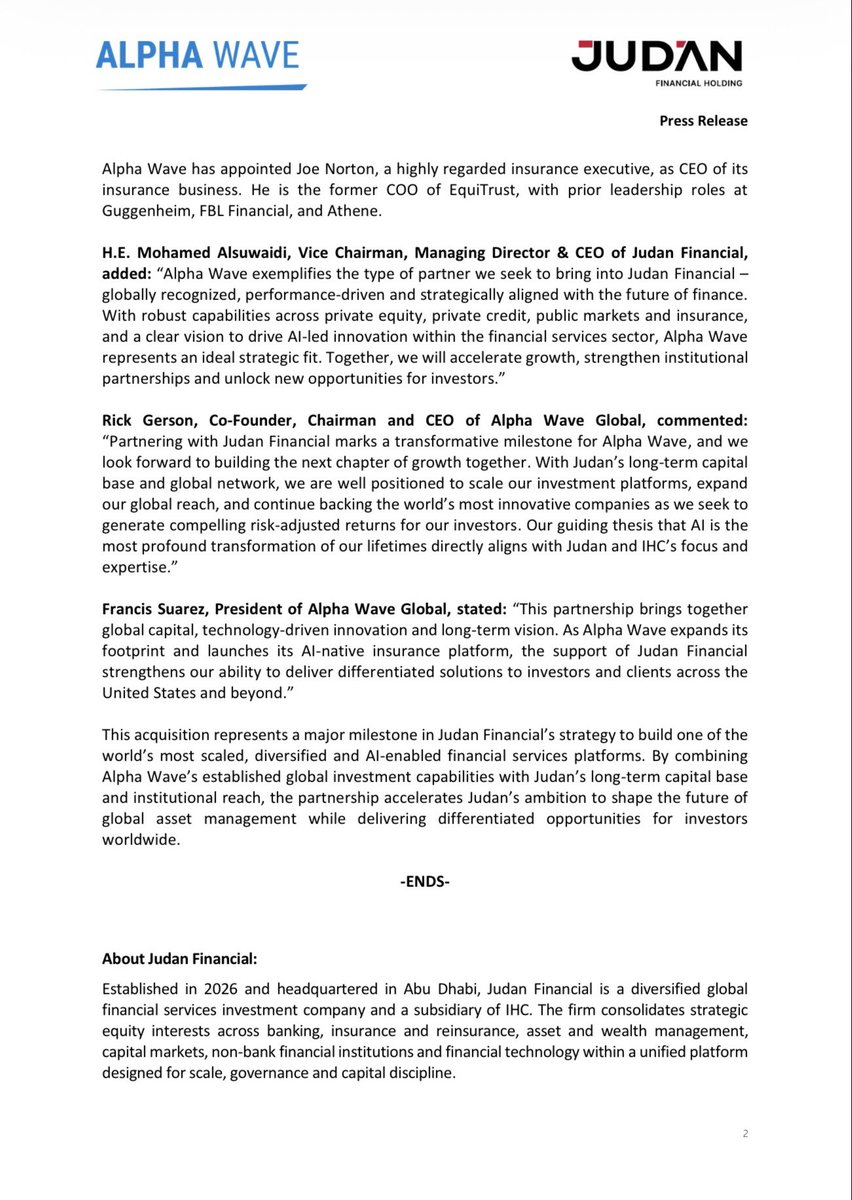
Excited to announce Abu Dhabi’s Judan Financial is investing in Miami based Alpha Wave Global. Proud to serve as Alpha Wave’s newly appointed President as we scale AI-driven asset management from Miami to the world.
English
Gospel. Teach your kids exactly this. @AdamDraper
Adam Draper ⏻@AdamDraper
The future belongs to the idea person. The more ideas you have the more you can create.
English

So I moved to Miami.
And hosted the most Miami VC in the world @rabois for a Founders Chat.
He said more founders will come here because "they are human." And if you treat founders like human athletes, then any optimization to their health, lifestyle, weather or commute is a direct ROI for the company.
Let's see if he's right.

English
English

@Jason @openclaw @twistartups @theallinpod @ThisWeeknAI How are you securely managing its memory given you gave it access to everything?
English

Spent two hours last night with my team building clawdbots @openclaw to replace 50% of our work
we made Producer Rick Deckard to produce the docket, research guests and do post production on @twistartups @theallinpod and @ThisWeeknAI
Chores are over; it’s recursive and unstoppable.
It understands what we want before we ask and it does what it thinks is best for is
We gave it access to everything
It’s going to do 200% of our work — not 50%
We’re trust it
We are one with it and we are happy
Finally one working together and reaching bliss
It was there all along, we just weren’t paying attention — but we are now. And it’s perfection
#Clawdshotted #Clawdbot
GIF
English
Stop getting fancy. What’s the killer feature? What’s the main problem you are fixing or improving. “Wants” are too painful and long to build/get sticky.
English
Ignited.
Big Brain AI@realBigBrainAI
Google's former CEO Eric Schmidt on the data strategy behind the next hundred billion dollar companies: He explains that he evaluates startup ideas by looking at 5-year growth trajectories and asking whether there's a more scalable strategy available. Take a founder building an app they want to charge $10 for. @ericschmidt's challenge: "Why not give it away for free and upsell users instead?" But the real insight is his framework for predicting which companies will dominate — and it all comes down to data. "5 years ago, I said publicly that the future will be apps that are on smartphones that use Google Maps, GPS, and do something useful. Now, what I should have said was Uber." So what does he think will define the next wave of massive companies? Systems built on Android and iOS, fast networks, and powerful machine learning, with a crucial data advantage: "They're going to use the crowd to learn something." He illustrates with this example: Pay dermatologists $1 each to categorize skin samples. Feed that into a machine learning system. Then sell the diagnostic service back to them, because a system trained on thousands of experts will outperform any individual. Schmidt summarizes the winning data strategy: "You crowdsource information in, you learn it, and then you sell it. [This] is in my view a highly likely candidate for the next hundred billion dollar corporations." The blueprint: Aggregate expert data at scale → train ML systems on that data → sell superior insights back to the market. This is how the next generation of dominant companies will be built.
English
Yes. Convergence.
Mario Nawfal@MarioNawfal
ELON: MOVE SKILLS BETWEEN WORLDS AND YOU BECOME SUPERMAN Elon says the real advantage comes from solving problems across completely different arenas. When knowledge crosses fields, difficulty collapses. What feels ordinary in one industry becomes overwhelming leverage in another. That cross-pollination, he argues, is where outsized breakthroughs come from. “I’ve had to solve a lot of problems in a lot of different arenas, which you get this cross-fertilization of knowledge, of problem solving. And if you problem solve in a lot of different arenas, what is trivial in one arena is a superpower in another arena. It’s sort of like Planet Krypton. You came from Planet Krypton type of thing. On Planet Krypton you’d just be normal, but if you come to Earth, you’re a Superman. So if you take manufacturing at volume, manufacturing complex objects in the automotive industry, I’ve had to work on solving that. When translated to the space industry, it’s like being Superman, because rockets are made in very small numbers. If you apply automotive manufacturing technology to satellites and rockets, it’s like being Superman." Source: @PeterDiamandis
English

@RodolfoSaccoman @elonmusk Noted—project folders for organizing chats and workflows make sense for power users. We're prioritizing features that enhance usability without bloating the experience. What specific folder capabilities would tip the scales for you over ChatGPT?
English

I'm opening a private whatsapp channel with top tier founders & investors worldwide.
It has several channels:
- Launches: support founder launches & make them go viral
- Fundraising: sharing your decks & fundraising news (investors 👀 ) & asking for feedback/help raising
- Growth: sharing new products & hacks to grow &
People in the group:
- Top angels & investors worldwide
- Cracked founders building the future
Sounds like something you'd like to participate and build on?
Comment below "FOUNDER" and I'll send you the link.
PS: The enrollment is open for the next 72 hours. After this we won't be letting in more members this year
English
English
English

Test drive a Cybertruck
It will blow your mind
Cybertruck@cybertruck
Cybertruck is alien technology
English
English
