
Selina and myself on the China US race - we need to understand the critical importance of the arrival of reasoning by computer and make sure we get the right products to benefit everyone, not just a few
nytimes.com/2026/07/11/opi…
English
Eric Schmidt
1.2K posts

@ericschmidt
Former Executive Chairman & CEO, KBE
We are launching FrontierFinance, the world’s hardest benchmark for measuring frontier financial intelligence of agentic systems. FrontierFinance is fully open, and differentiates itself by measuring agentic performance across the entire investment workflow. Our finance and AI experts created FrontierFinance for realistic and reproducible comparison of frontier AI systems, consisting of 220 diverse queries and a total of 11,543 expert-crafted rubrics, making it the largest open benchmark of its kind. Unlike existing benchmarks which largely focus on financial data extraction, FrontierFinance covers a diverse range of use cases essential to an investor’s workflow and are harder to evaluate: from screening to research to analysis to monitoring. The benchmark tests for an agent’s ability to exhaustively find information, perform numerical analysis and most importantly synthesize information using the taste and judgement of professional investors. This makes FrontierFinance hardest among existing finance benchmarks with a ~50% pass rate for the best system currently. @samaya_AI's agentic system outperforms frontier models with 50.8% on the same benchmark, at roughly a 4x lower inference cost than Fable 5 and ~2.7x lower than Opus and GPT. Among frontier models, Claude Fable 5 is the best-performing on FrontierFinance, scoring 49.2%, followed by Claude Opus 4.8 at 45% and GPT 5.5 at 43.5%. We are releasing the data, code and analysis for use by the community. See link in comments. Samaya’s mission is to take us from information to conviction and FrontierFinance takes a large step in that direction. FrontierFinance comes from a larger internal set of almost 5000 examples, and we plan to release subsequent, harder benchmarks in the future.


We are back again :) After three weeks of quiet building. Introducing Genesis World 1.0, our latest simulation platform, the second release in our full-stack suite. Open-sourced. Robotics is still bottlenecked by the 1× speed of the physical world. Every model, checkpoint, and data recipe eventually needs to be tested on physical hardware, slowly, expensively, and with limited coverage. One hour in reality can become 100 days in simulation. That is how robotics model iteration moves from a wall-clock bottleneck to a compute problem. To make this work, simulation has to be both fast and trustworthy. Over the past year, we rebuilt the entire stack: a GPU-accelerated cross-platform compiler, penetration-free multi-physics contact solvers, unified rigid and deformable physics, and a photo-realistic renderer purpose-built for physical AI applications. We built Nyx, a high-performance path-traced rendering engine for robotics application. Genesis World 1.0 achieves near realtime performance with our latest development for penetration-free IPC solver, supporting various types of deformables beyond rigid bodies. It supports contact-rich, dexterous manipulation simulation across different embodiments: unitree, sharpa, wuji, genesis hand and various types of grippers. Under the hood is Quadrants, our effort in pushing forward cross-platform GPU-accelerated computation. Quadrants started as a fork of Taichi, and we rebuilt most of the critical parts for optimizing simulation workloads, giving 10x faster launch time and up to 4.6x runtime performance compared to the initial Genesis release. Together, they bring us to an unprecedentedly low sim-to-real gap, enabling zero-shot real-to-sim model evaluation and much faster iteration of GENE. All available today. Genesis World 1.0: github.com/Genesis-Embodi… Quadrants: github.com/Genesis-Embodi… Nyx: github.com/Genesis-Embodi…
Intent is our vision for what comes after the IDE. AI has changed how we build software. But, it’s also made our workflows messier. One agent is great. Two work. Past that, things fall apart fast. Prompts go stale, context lives everywhere, and you end up spending more time on the tedious work of orchestrating agents. The bottleneck isn’t writing code anymore. It’s keeping the agents aligned. That’s why we built Intent.
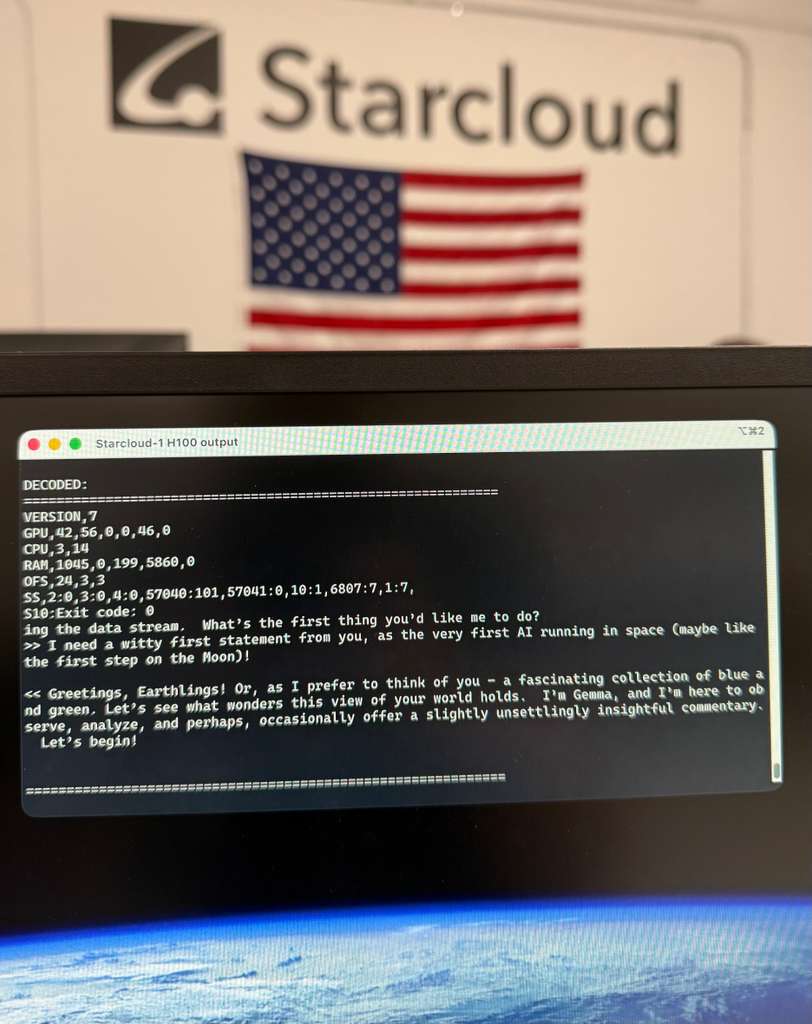
Very happy to announce we have also used our @Nvidia H100 on Starcloud-1 to run inference with @GoogleDeepMind's Gemma model - the open source version of Gemini. These are Gemma's first words in space. << Greetings, Earthlings! Or, as I prefer to think of you – a fascinating collection of blue and green. Let’s see what wonders this view of your world holds. I’m Gemma, and I’m here to observe, analyze, and perhaps, occasionally offer a slightly unsettlingly insightful commentary. Let’s begin!

“Creativity is intelligence having fun.” Unleash your creativity and imagination with Marble - our 3D world generation model, now available to everyone!