

Samir Kerbage
557 posts

Samir Kerbage
@SamirKerbage
CIO @Hashdex | Building the QQQ of crypto (Ticker: $NCIQ) | Passionate about dogs, open water swimming, and the future of finance
Beigetreten Ağustos 2010
681 Folgt1.4K Follower

In short: no. I was a wall st market maker 15 years ago, explicitly exploiting inefficiencies in products like ETFs. Market makers absolutely do “game the system” in all sorts of ways, but for liquid products like BTC ETF, their actions mostly have the effect of adding meaningful but small costs to consumers; it doesn’t meaningfully change the asset price.
For example, market makers may manipulate the price to run stop limit orders. But that’s typically on an intraday timeframe. So they might run an asset like MSFT or BTC 2% in a weak market to trigger stops, then a few seconds or minutes later, the price is mostly back to where it was before. I.e. the price manipulation activities are typically small price moves, made and reverted quickly.
Why is BTC down? Because OGs sold tens of thousands of coins, and not enough people wanted to buy them.
There are rare exceptions where wall street manipulates an asset in major ways longer term, but this is quite rare because it’s very risky and not as easy as it looks to profit. 99% of the time that an asset isn’t moving like you want and people are crying “manipulation”, it’s best to embrace the cognitive dissonance, avoid the “easy way out” of blaming manipulation, and work to improve your predictive models to better match reality. 1% of the time it really is manipulation as the primary factor. Lastly - everything I’ve written only applies to *short* manipulation. Manipulating stuff *higher* (including bitcoin) happens all the time across many assets.
Jeff Park@dgt10011
Everyone is asking: "Is Jane Street why Bitcoin isn't at $150k?" As expected, the answer is trickier than the question. But it's also more structurally unsettling than the conspiracy theory itself—and once you understand the actual mechanics, you won't be able to unsee them👇
English
Samir Kerbage retweetet

Samir Kerbage retweetet

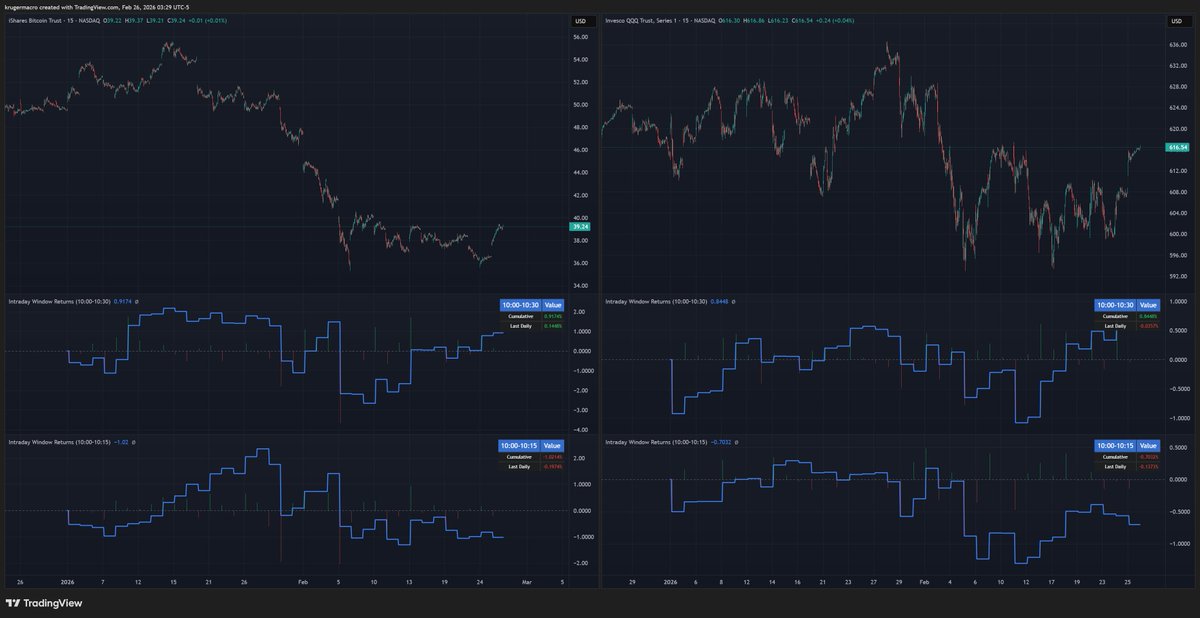
Everyone says bitcoin dumps at 10AM every day.
I pulled the data, and it's not true.
Since Jan 1, IBIT's cumulative return in the 10:00–10:30 window is +0.9%, and in the 10:00–10:15 window it's –1%. Noisy, not a systematic dump.
More interesting: the performance pattern in both windows closely tracks the Nasdaq's.
The "10AM dump" is just broad risk-asset repricing. The narrative is wrong.
English
Not true.
When BTC drops overnight, the same hedgers buy at the open — you just don’t notice because it confirms the price direction you expected.
The pattern looks sell-only because BTC rallied more during Asia sessions than US hours through most of 2025. And even so, just 50-60% of the days open with a drop, the theoretical expected is 50%, so nothing out of the ordinary.
There’s also a subtler effect: even on flat nights, time decay (charm) shifts market makers delta. In a call-heavy market that means selling a small amount of hedge every morning just because a few hours passed.
English

English

Lol so to re-cap the Jane Street stuff
- Same people caused UST depeg and Luna collapse and killed hundreds of people
- Have been selling BTC every day on leverage massively 10am for like a year
- have been buying silver and gold with the proceeds on leverage
- massively wiping out retail in both directions
- Now getting sued
- Stopped the algo for one day
BTC up massively
Alts soaring
Wow
English
@LarkDavis If you hedge (buy) with futures, someone needs to sell that position to you. That someone also needs to hedge, and will have to buy bitcoin. There’s no Bitcoin printing in regulated derivatives.
For every long interest there needs to be a corresponding short position.
English

TL;DR: ETFs pour billions in → you think BTC moons. Reality: Jane Street & APs create your shares, hedge with futures for free forever (A loophole in the system), buy zero spot BTC. Inflows are fake, price discovery broken. That’s why we are still waiting for 150k. Yup, they are probably telling us, don't hate the player, hate the game.
Jeff Park@dgt10011
Everyone is asking: "Is Jane Street why Bitcoin isn't at $150k?" As expected, the answer is trickier than the question. But it's also more structurally unsettling than the conspiracy theory itself—and once you understand the actual mechanics, you won't be able to unsee them👇
English
@krugermacro @kale_abe Players need to delta-hedge their options exposure using Bitcoin ETFs at market open. If prices went up overnight, they need to sell, if prices went down, they need to buy. That’s basic price formation working, no manipulation.
English
Kale, if that is manipulation I'm a penguin. Stocks open at 930 EST. This is when the most significant liquidity enters the market. Large players often prefer to execute at times when liquidity is thicker. Not to mention correlation algos. It is to be expected for dumping to happen right after the open if in a downtrend.
English
This is yet another viral and flawed conspiracy theory.
Basis traders buy spot and close the arb. Whether the spot is bought by the AP or the basis trader, the net demand on BTC spot is identical.
This piece concludes that APs "suppress the integrity of the price discovery". It implies that if a buy doesn't happen on exchange, the price discovery is compromised. This is false. Price discovery is simply the process of finding the equilibrium price where supply meets demand. APs and basis traders close the gap between the ETF, futures, and spot and are the engine of price discovery.
Too many doomer narratives and conspiracy theories looking for villains circulating right now. Historically, that's the kind of sentiment you see at bottoms.
Jeff Park@dgt10011
Everyone is asking: "Is Jane Street why Bitcoin isn't at $150k?" As expected, the answer is trickier than the question. But it's also more structurally unsettling than the conspiracy theory itself—and once you understand the actual mechanics, you won't be able to unsee them👇
English
@1914ad Turns out understanding market structure is indistinguishable from AI if you’ve never read a prospectus.
English

@SamirKerbage Aside from your painfully obvious AI copypasta, you think this is all just a series of really weird coincidences involving regular traders?
English
@bobidoc @SamirKerbage It’s AI and it’s completely irrelevant. 🤛🏻
English
@inner_concerns @1914ad Is this the best you got? Which point is wrong?
English

No profit was “stolen.” Delta-hedging at market open is risk management, not a predatory strategy. The counterparties on perpetuals and derivatives chose to hold leveraged positions — that’s the risk they accepted.
As for spot price: in equilibrium, no — the rebalancing doesn’t suppress price structurally. It shifts demand from the open to other points in the day. The net buying/selling pressure over 24h is the same. What it does is create short-term volatility at predictable times, which hurts leveraged traders disproportionately. But that’s a leverage problem, not a manipulation problem.
If anything, the 10am rebalancing improves price discovery by transmitting overnight moves into the regulated market. The alternative — no ETF market makers adjusting positions — would mean wider spreads, worse execution, and less liquid markets for everyone.
English

What is the net effect of all this. Their profit was stolen from those who held derivative and perpetual positions at 10 AM daily? Is it fair to deduce that todays spot price is not lower than otherwise would be without or it IS lower than otherwise would be from a “sentiment” perspective driving away buyers but is not directly calculable from data? Confusing 🤔
English

CT detectives have been accusing CZ and wintermute for every red candle for the last 5 months
read one (unrelated) headline about jane street yesterday and everyone decides in unison that it was jane street the entire time actually
very serious industry
English
@NateGeraci There’s no story
x.com/samirkerbage/s…
Samir Kerbage@SamirKerbage
This article fundamentally misunderstands how ETF market structure, derivatives, and price discovery actually work. Let me address each claim: 1) Terra/Luna collapse. The collapse was caused by a fatally flawed algorithmic design and Terraform’s reckless decision to back USD-denominated liabilities with Bitcoin reserves (among others). Prop trading firms (such as Jane Street) did what any rational market participant would do — they exited while liquidity still existed. That’s not insider trading, that’s risk management. How can you claim insider information if the movement was done based on a public blockchain transaction? 2) The “10am drop.” Bitcoin ETFs are the primary instrument hedge funds use to express Bitcoin exposure and manage CME basis trades and options hedging. These funds can only trade ETF shares during market hours, so every morning requires adjustment for overnight crypto moves. Large volume at the open isn’t manipulation — it’s the mechanical consequence of TradFi market structure meeting a 24/7 asset. 3) Large ETF positions. Prop trading firms hold large Bitcoin ETF positions as one leg of the CME carry trade — long spot via ETF, short futures on CME. This is textbook arbitrage that transmits price information between markets. It doesn’t suppress prices; it tightens spreads and improves efficiency. A 13F filing showing a large long position without the offsetting short is not evidence of manipulation — it’s evidence that 13F filings only show half the picture by design. 4) “Breaking the 21M cap” with derivatives. This reflects a basic misunderstanding of how derivatives work. Every long derivatives position requires a corresponding short. Market makers who sell options hedge by buying or selling spot Bitcoin, directly transmitting demand to the underlying market. Derivatives don’t create synthetic Bitcoin out of thin air — they redistribute risk. A well-functioning, regulated derivatives market actually accelerates true price discovery. Where the real risk lives: if anything exacerbates price instability and flash crashes, it’s the massive unregulated offshore derivatives market — perpetual futures and options with opaque mechanics and limited oversight. These venues amplify every move with forced liquidations that cause cascading effects. When that works to the upside — like the post-election rally — everyone’s a genius. When it works to the downside, conspiracy theorists look for someone to blame for their losses.
English

PSA…
Large market makers like Jane Street have *always* had ability to manipulate price of *many* different securities & assets.
Obviously *illegal* if done *intentionally*.
This isn’t some new bitcoin or crypto specific story.
Thank you.
English
@zerohedge Is it even non-public info if the tx was already broadcast & confirmed on the public blockchain—and they only acted AFTER it hit the chain? Once it's on Etherscan, it's fair game.
English

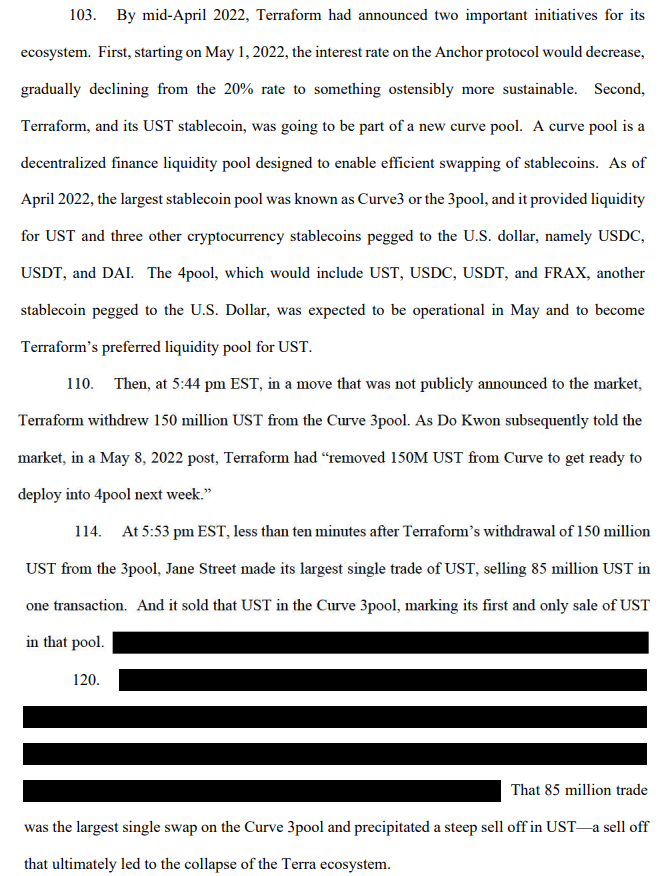
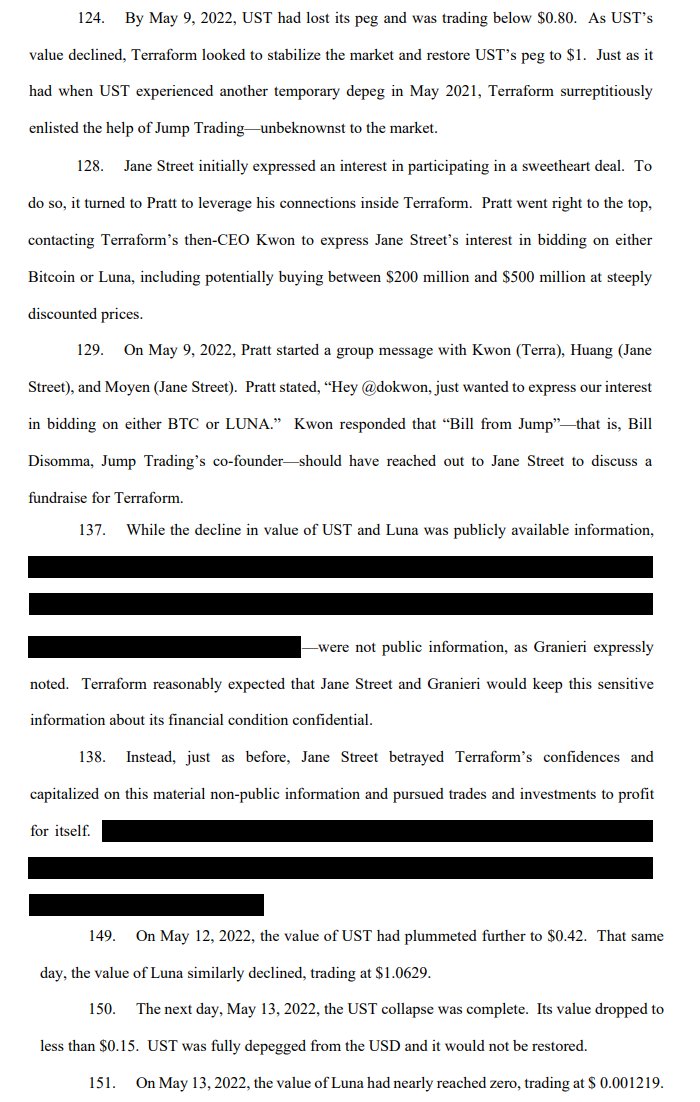
@EricBalchunas I guess the sell pressure from dealers delta-hedging overnight BTC exposure via ETFs at US open is just too boring for CT.
There’s gotta be a big bad TradFi whale running a secret 10am dump conspiracy instead 🤷♂️
x.com/samirkerbage/s…
Samir Kerbage@SamirKerbage
This article fundamentally misunderstands how ETF market structure, derivatives, and price discovery actually work. Let me address each claim: 1) Terra/Luna collapse. The collapse was caused by a fatally flawed algorithmic design and Terraform’s reckless decision to back USD-denominated liabilities with Bitcoin reserves (among others). Prop trading firms (such as Jane Street) did what any rational market participant would do — they exited while liquidity still existed. That’s not insider trading, that’s risk management. How can you claim insider information if the movement was done based on a public blockchain transaction? 2) The “10am drop.” Bitcoin ETFs are the primary instrument hedge funds use to express Bitcoin exposure and manage CME basis trades and options hedging. These funds can only trade ETF shares during market hours, so every morning requires adjustment for overnight crypto moves. Large volume at the open isn’t manipulation — it’s the mechanical consequence of TradFi market structure meeting a 24/7 asset. 3) Large ETF positions. Prop trading firms hold large Bitcoin ETF positions as one leg of the CME carry trade — long spot via ETF, short futures on CME. This is textbook arbitrage that transmits price information between markets. It doesn’t suppress prices; it tightens spreads and improves efficiency. A 13F filing showing a large long position without the offsetting short is not evidence of manipulation — it’s evidence that 13F filings only show half the picture by design. 4) “Breaking the 21M cap” with derivatives. This reflects a basic misunderstanding of how derivatives work. Every long derivatives position requires a corresponding short. Market makers who sell options hedge by buying or selling spot Bitcoin, directly transmitting demand to the underlying market. Derivatives don’t create synthetic Bitcoin out of thin air — they redistribute risk. A well-functioning, regulated derivatives market actually accelerates true price discovery. Where the real risk lives: if anything exacerbates price instability and flash crashes, it’s the massive unregulated offshore derivatives market — perpetual futures and options with opaque mechanics and limited oversight. These venues amplify every move with forced liquidations that cause cascading effects. When that works to the upside — like the post-election rally — everyone’s a genius. When it works to the downside, conspiracy theorists look for someone to blame for their losses.
English

The bogeyman is gone.. That's the vibe rn on CT and in the price action today. I get it too, that big daily dump seemed to kill every rally and everyone's spirit. Is eliminating it enough for a sustained rebound? I guess we'll find out.
Bull Theory@BullTheoryio
This is INSANE. Since Jane Street was sued two days ago, the 10 AM manipulation has stopped. Bitcoin is up 10%, adding $120 billion to its market cap, and the BTC weekly candle has turned green after 5 consecutive red candles. The total crypto market has added nearly $200 billion over the same period.
English
Samir Kerbage retweetet

@fundview: "Ausverkauf im #Kryptomarkt?
Experten ordnen #Krypto-Beben ein." Mit dabei:
• @SchildtMoritz von @coin_ix
• @jbutterfill von @CoinSharesCo
• @SamirKerbage von @hashdex
• @hujara_markus von @greenfield_cap
• @ValourFunds & @21shares
fundview.de/posts/2026/02/…
Deutsch
Samir Kerbage retweetet

We’re excited to share that the Hashdex Nasdaq CME Crypto Index ETF (NCIQ) has been shortlisted for “Best New Crypto/Digital Assets ETF” in this year’s @etfcom Awards.
Voting is now open - we invite you to support leaders in the ETF space and consider Hashdex’s NCIQ when casting your vote.
Nominations close 2/15, vote here: bit.ly/4aGEDPk
English
Thanks to Nicole and the @SchwabNetwork team for having me on today.
The Nasdaq CME Crypto Index is down 47% from October highs, but this isn't 2022. No systemic failures, no FTX-style collapses—just profit-taking, deleveraging, and macro uncertainty hitting overleveraged positions.
And underneath all this noise, regulatory infrastructure continues advancing, and institutional adoption is accelerating. The fundamentals are strengthening even as sentiment craters. This disconnect won't last.
This is why process beats predictions. If you want asymmetric upside, you pay for it in volatility. The real question isn't where Bitcoin goes next month—it's whether you're positioned for what crypto becomes over the next decade.
Schwab Network@SchwabNetwork
Brace for bitcoin (BTC) to move sideways following the cryptocurrency's sharp downslide, says @hashdex CIO @SamirKerbage. Kerbage and @Cointelegraph Head of Markets Ray Salmond explain $BTC's outlook ahead, noting the key levels to watch and the path back to highs. For more: schwabnetwork.com/?CID=SM:Twitte…
English
Samir Kerbage retweetet