
Samir Kerbage
557 posts

Samir Kerbage
@SamirKerbage
CIO @Hashdex | Building the QQQ of crypto (Ticker: $NCIQ) | Passionate about dogs, open water swimming, and the future of finance

Everyone is asking: "Is Jane Street why Bitcoin isn't at $150k?" As expected, the answer is trickier than the question. But it's also more structurally unsettling than the conspiracy theory itself—and once you understand the actual mechanics, you won't be able to unsee them👇


Everyone is asking: "Is Jane Street why Bitcoin isn't at $150k?" As expected, the answer is trickier than the question. But it's also more structurally unsettling than the conspiracy theory itself—and once you understand the actual mechanics, you won't be able to unsee them👇


Everyone is asking: "Is Jane Street why Bitcoin isn't at $150k?" As expected, the answer is trickier than the question. But it's also more structurally unsettling than the conspiracy theory itself—and once you understand the actual mechanics, you won't be able to unsee them👇


This article fundamentally misunderstands how ETF market structure, derivatives, and price discovery actually work. Let me address each claim: 1) Terra/Luna collapse. The collapse was caused by a fatally flawed algorithmic design and Terraform’s reckless decision to back USD-denominated liabilities with Bitcoin reserves (among others). Prop trading firms (such as Jane Street) did what any rational market participant would do — they exited while liquidity still existed. That’s not insider trading, that’s risk management. How can you claim insider information if the movement was done based on a public blockchain transaction? 2) The “10am drop.” Bitcoin ETFs are the primary instrument hedge funds use to express Bitcoin exposure and manage CME basis trades and options hedging. These funds can only trade ETF shares during market hours, so every morning requires adjustment for overnight crypto moves. Large volume at the open isn’t manipulation — it’s the mechanical consequence of TradFi market structure meeting a 24/7 asset. 3) Large ETF positions. Prop trading firms hold large Bitcoin ETF positions as one leg of the CME carry trade — long spot via ETF, short futures on CME. This is textbook arbitrage that transmits price information between markets. It doesn’t suppress prices; it tightens spreads and improves efficiency. A 13F filing showing a large long position without the offsetting short is not evidence of manipulation — it’s evidence that 13F filings only show half the picture by design. 4) “Breaking the 21M cap” with derivatives. This reflects a basic misunderstanding of how derivatives work. Every long derivatives position requires a corresponding short. Market makers who sell options hedge by buying or selling spot Bitcoin, directly transmitting demand to the underlying market. Derivatives don’t create synthetic Bitcoin out of thin air — they redistribute risk. A well-functioning, regulated derivatives market actually accelerates true price discovery. Where the real risk lives: if anything exacerbates price instability and flash crashes, it’s the massive unregulated offshore derivatives market — perpetual futures and options with opaque mechanics and limited oversight. These venues amplify every move with forced liquidations that cause cascading effects. When that works to the upside — like the post-election rally — everyone’s a genius. When it works to the downside, conspiracy theorists look for someone to blame for their losses.


This article fundamentally misunderstands how ETF market structure, derivatives, and price discovery actually work. Let me address each claim: 1) Terra/Luna collapse. The collapse was caused by a fatally flawed algorithmic design and Terraform’s reckless decision to back USD-denominated liabilities with Bitcoin reserves (among others). Prop trading firms (such as Jane Street) did what any rational market participant would do — they exited while liquidity still existed. That’s not insider trading, that’s risk management. How can you claim insider information if the movement was done based on a public blockchain transaction? 2) The “10am drop.” Bitcoin ETFs are the primary instrument hedge funds use to express Bitcoin exposure and manage CME basis trades and options hedging. These funds can only trade ETF shares during market hours, so every morning requires adjustment for overnight crypto moves. Large volume at the open isn’t manipulation — it’s the mechanical consequence of TradFi market structure meeting a 24/7 asset. 3) Large ETF positions. Prop trading firms hold large Bitcoin ETF positions as one leg of the CME carry trade — long spot via ETF, short futures on CME. This is textbook arbitrage that transmits price information between markets. It doesn’t suppress prices; it tightens spreads and improves efficiency. A 13F filing showing a large long position without the offsetting short is not evidence of manipulation — it’s evidence that 13F filings only show half the picture by design. 4) “Breaking the 21M cap” with derivatives. This reflects a basic misunderstanding of how derivatives work. Every long derivatives position requires a corresponding short. Market makers who sell options hedge by buying or selling spot Bitcoin, directly transmitting demand to the underlying market. Derivatives don’t create synthetic Bitcoin out of thin air — they redistribute risk. A well-functioning, regulated derivatives market actually accelerates true price discovery. Where the real risk lives: if anything exacerbates price instability and flash crashes, it’s the massive unregulated offshore derivatives market — perpetual futures and options with opaque mechanics and limited oversight. These venues amplify every move with forced liquidations that cause cascading effects. When that works to the upside — like the post-election rally — everyone’s a genius. When it works to the downside, conspiracy theorists look for someone to blame for their losses.

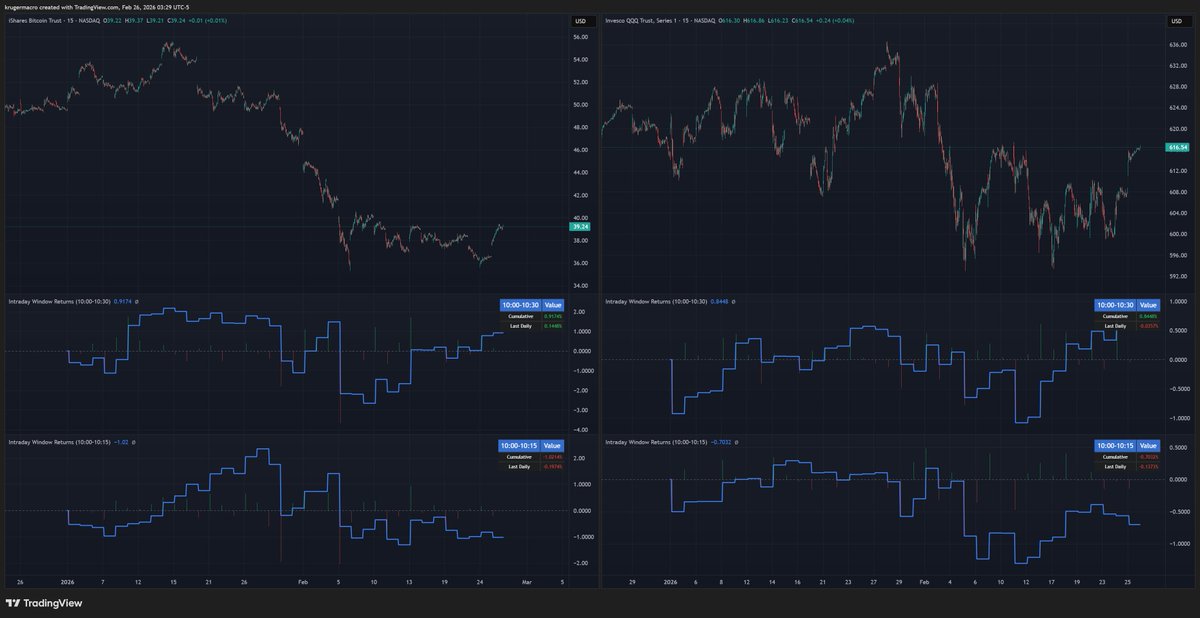
This is INSANE. Since Jane Street was sued two days ago, the 10 AM manipulation has stopped. Bitcoin is up 10%, adding $120 billion to its market cap, and the BTC weekly candle has turned green after 5 consecutive red candles. The total crypto market has added nearly $200 billion over the same period.


Brace for bitcoin (BTC) to move sideways following the cryptocurrency's sharp downslide, says @hashdex CIO @SamirKerbage. Kerbage and @Cointelegraph Head of Markets Ray Salmond explain $BTC's outlook ahead, noting the key levels to watch and the path back to highs. For more: schwabnetwork.com/?CID=SM:Twitte…