Avner Seror

237 posts

Avner Seror

Avner Seror

@SerorAvner

Assistant Prof at the University of Aix Marseille @amseaixmars; Political Econ, Identity, Religion, Law & Econ

Marseille Beigetreten Mayıs 2020
601 Folgt395 Follower
Avner Seror retweetet

Alex Imas
Alex Imas@alexolegimas·
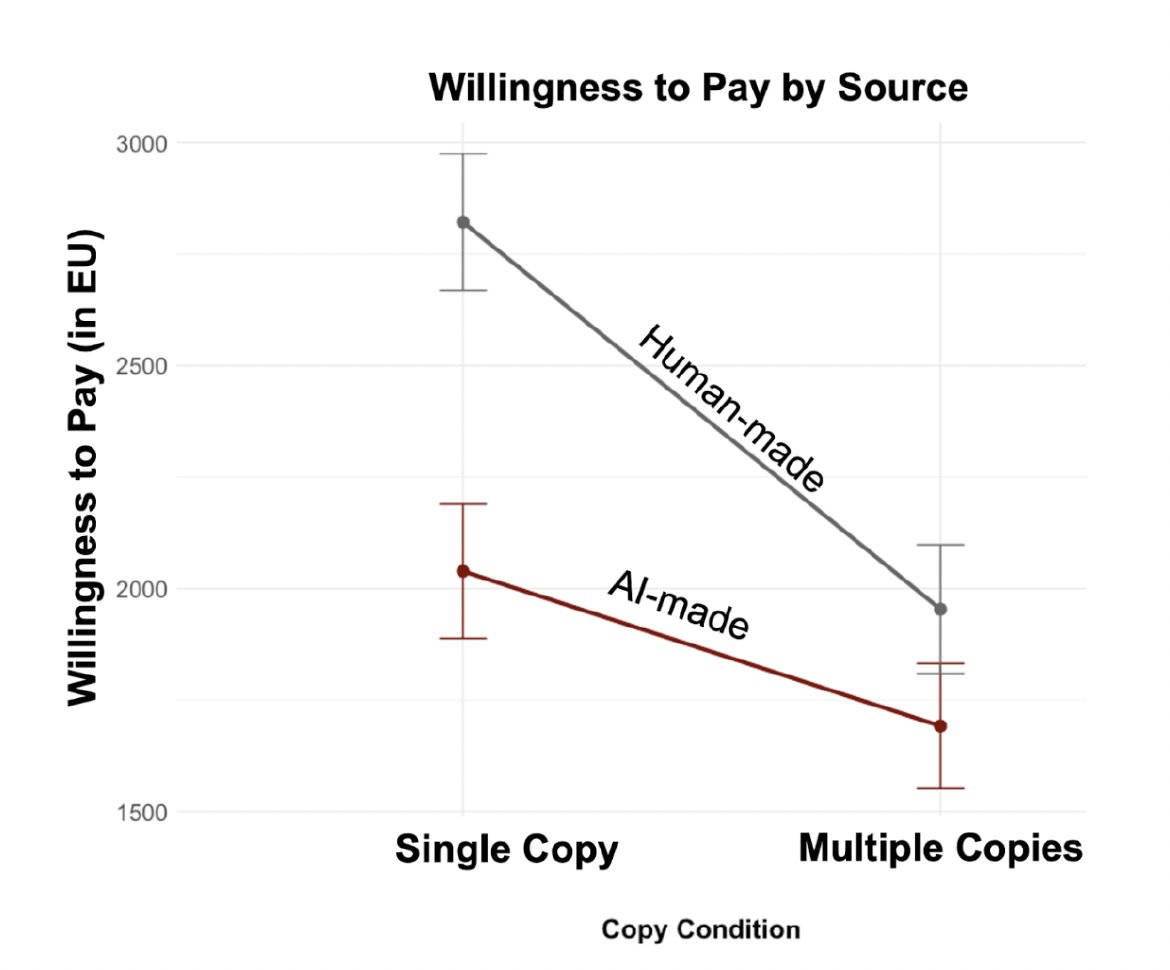
My prediction is that in the case of creative work, AI will be a complement to human creators. Much of the value of creative work is the human value, i.e., the fact that it was made by a person, which establishes a link between the consumer and the creator. We see this in the data. AI-generated creative work is valued substantially less than human-generated work. And unlike other effects where "people will just get used to it", I think this will be fairly stable: we have way too many previous examples of creative automation to draw on. AI will increase the scope of human creativity but it won't replace the creator. In fact, as other tasks get automated, it may actually increase demand for it. papers.ssrn.com/sol3/papers.cf…
Alex Imas tweet mediaAlex Imas tweet media
Ethan Mollick@emollick

One of the advantages of being an early user of LLMs is that I have seen The Curve with my own eyes (like in this post before ChatGPT or the term Generative AI). I notice recent AI users & companies adopting AI anchoring on recent capabilities as if they are stable. Probably not

English

12
23
130
21.8K
Avner Seror retweetet
Mathieu Lefebvre
Mathieu Lefebvre@Enrikostar·
The deadline to participate in the 2026 Spring School and Conference in Applied Econometrics using Stata, France has been extended to February 23, 2026 Joins us for a very nice event in beautiful and sunny Marseille stata2026.sciencesconf.org
English
0
1
4
95
Avner Seror retweetet
D. Yanagizawa-Drott
D. Yanagizawa-Drott@YanagizawaD·
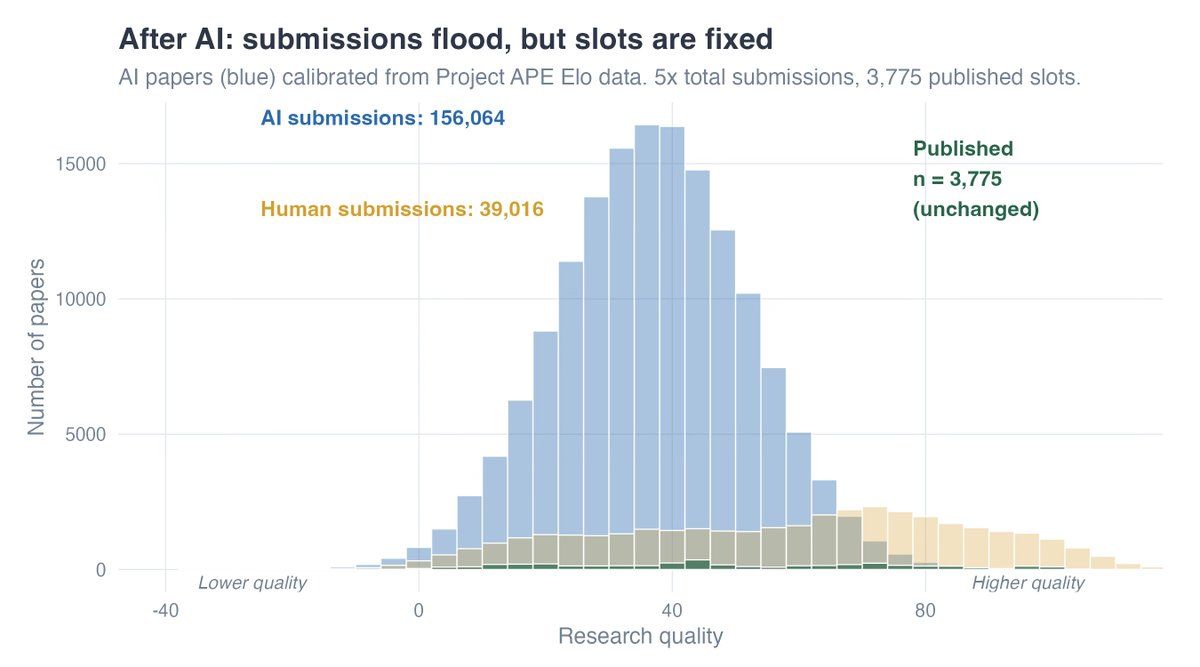
That said, here are some early impressions: 1. Early on, Claude Code out of the box, it was bad. Hallucination heaven. Even fabricated data. 2. We figured out various guardrails that clearly help. Harder to spot the errors now. Diversity of models maybe helps too. (e.g., Grok vs GPT pick up on different aspects). Worth testing. 3. Inference-time compute seems to be the first-order effect for better research. If true, massive implications. Also something to test. 4. Cost of papers currently vary a lot, ballpark from a few dollars to $50 for decent looking draft. Better papers cost more. Sometimes hours of compute. Would be useful to get some systematic numbers on the production function in terms of $. 4. Do I trust any of the papers? NO. AND NOBODY SHOULD. 5. Generation speed >> Verification speed. This is a problem in equilibrium. It has always been the opposite. Papers took months or years to generate. Internal and peer review only days. 6. We absolutely need to figure out some kind of criteria for evaluation. Working on that. The profession currently has no industry standard that applies specifically to AI-generated research. This will be useful. 7. Transparency will be key. We are releasing all code for replication. Would be awesome with a community effort, open science. And the goal is to release the entire generation pipeline for anyone to use, after having carefully established it is not just spitting out unreliable crap.
English
2
12
88
33.7K
Avner Seror retweetet
Jesús Fernández-Villaverde
Jesús Fernández-Villaverde@JesusFerna7026·
Let me explain why I believe modern economics is such a powerful tool for understanding the world. I’ll do this by discussing a great paper by Simone Cerreia-Vioglio, @UncertainLars, Fabio Maccheroni, and Massimo Marinacci, “Making Decisions Under Model Misspecification,” published in the Review of Economic Studies a few months ago. Imagine I want to drive from UC San Diego to UCLA, but I’ve never driven that route before. I need to build a “model of the world” to guide me, which we usually call a map. Maps are simplified representations of reality. They can’t include every detail if they’re to be useful. Borges, in his short story On Exactitude in Science, makes this point beautifully. (In practice, I don’t draw the map myself—I use an app—but someone still had to make it.) Because maps simplify, I can’t fully rely on them. Maybe last night’s storm knocked down a tree and closed a street, or there’s construction and the ramp off the highway in LA is shut down. This uncertainty matters. Suppose I’m driving to UCLA for an important talk at 11 a.m. If the ramp is closed, I might need 15 extra minutes. When should I set my alarm to arrive on time, while still getting enough sleep to give a good talk? The problem is that I can’t assign precise probabilities to all these contingencies. How likely is the fallen tree? Or new roadwork? Even the best traffic apps can’t capture every disruption, and some might happen after I’ve already left. In economic terms, my “model of the world” (the map) is misspecified—and no matter how hard I try, I can’t fully fix that. But sitting down and crying about misspecification doesn’t answer my basic question: when do I set the alarm? Too early, and I’m exhausted. Too late, and I’m late. Simone and his co-authors offer a way to think about this. They start from the idea that we often hold several structured models of an economic phenomenon, grounded in theory. For example, a central bank might use a standard New Keynesian model and a search-and-matching model of money. Yet, aware that each model is misspecified by design, the bank adds a protective belt of unstructured models—statistical constructs that help it gauge the consequences of misspecification. The beauty of the paper is that it provides an axiomatic foundation for this protective belt (and even generalizes it to include a Bayesian approach). It shows that if a decision-maker’s preferences meet certain conditions —reflecting both rational and behavioral features— then those preferences can be represented by an augmented utility function that formally accounts for misspecification. Crucially, we don’t assume that augmented utility function; we derive it. We start with general, plausible properties of preferences and prove that they imply such a representation. That’s real progress. Instead of writing endless critiques of expected utility or rational expectations (as many have done for decades, with little to show), we now have a formal way to reason about misspecification—precise definitions, clear boundaries of validity, and awareness of what we still don’t know. Take, for instance, a brilliant Penn graduate student on the market, Alfonso Maselli economics.sas.upenn.edu/people/alfonso… His job-market paper pushes this frontier further. He studies cases where a decision-maker not only faces model misspecification but is also unsure which model best fits the data and can’t assign probabilities to them—what we call model ambiguity. In my example, the central bank is unsure whether the New Keynesian or the search-and-matching model fits better, and it worries that both might be incorrect. If you read Simone et al. or Alfonso’s paper, you’ll see how misguided—and, frankly, cartoonish—many of the recent criticisms of economics on X have been. First: the idea that economists don’t understand math or have “physics envy.” The math in these papers is subtle and advanced—utterly different from what physicists do (neither better nor worse, just distinct). An engineer transitioning into economics would find these tools unfamiliar. Second: claims of ideological bias are unfounded. I have no idea about the political views of the authors, and I’d be surprised if anyone could infer them from the analysis—beyond vague guesses about typical academics. Third: This has almost nothing to do with what one learns as an undergraduate, or even in first-year graduate school. If your knowledge of economics stops at an intro textbook, it’s best not to pontificate on the field’s frontiers. Fourth: Is this science? Debating that word’s boundaries is pointless; every definition of “science” breaks down somewhere. The Germans solved this long ago with the idea of Wissenschaft—the systematic pursuit of knowledge, whether of nature, society, or the humanities. By that measure, modern mainstream economics is clearly a Wissenschaft: a disciplined, cumulative, and highly useful effort to understand how the world works. Simone and his co-authors have demonstrated that beyond any reasonable doubt.
Jesús Fernández-Villaverde tweet media
English
43
473
1.8K
345.2K
Avner Seror retweetet
Anton Korinek
Anton Korinek@akorinek·
📚 New JEL update on Generative AI for Economic Research: LLMs Learn to Collaborate and Reason * LLMs capable of sophisticated reasoning * Collaborative workspaces transform research * 3 dozen proven use cases Prepare for 2025 by leveling up your AI game! 🚀 #EconTwitter
Anton Korinek tweet media
English
3
51
186
24.6K
Tzachi Raz
Tzachi Raz@RazTzachi·
✨ Paper Accepted! ✨ I am thrilled that my paper, "Soil Heterogeneity, Social Learning, and the Formation of Close-knit Communities." has been accepted by the Journal of Political Economy @JPolEcon. A 🧵on the paper coming up soon...
GIF
Tzachi Raz tweet media
English
25
27
256
21.6K
Avner Seror retweetet
Jared Rubin
Jared Rubin@jaredcrubin·
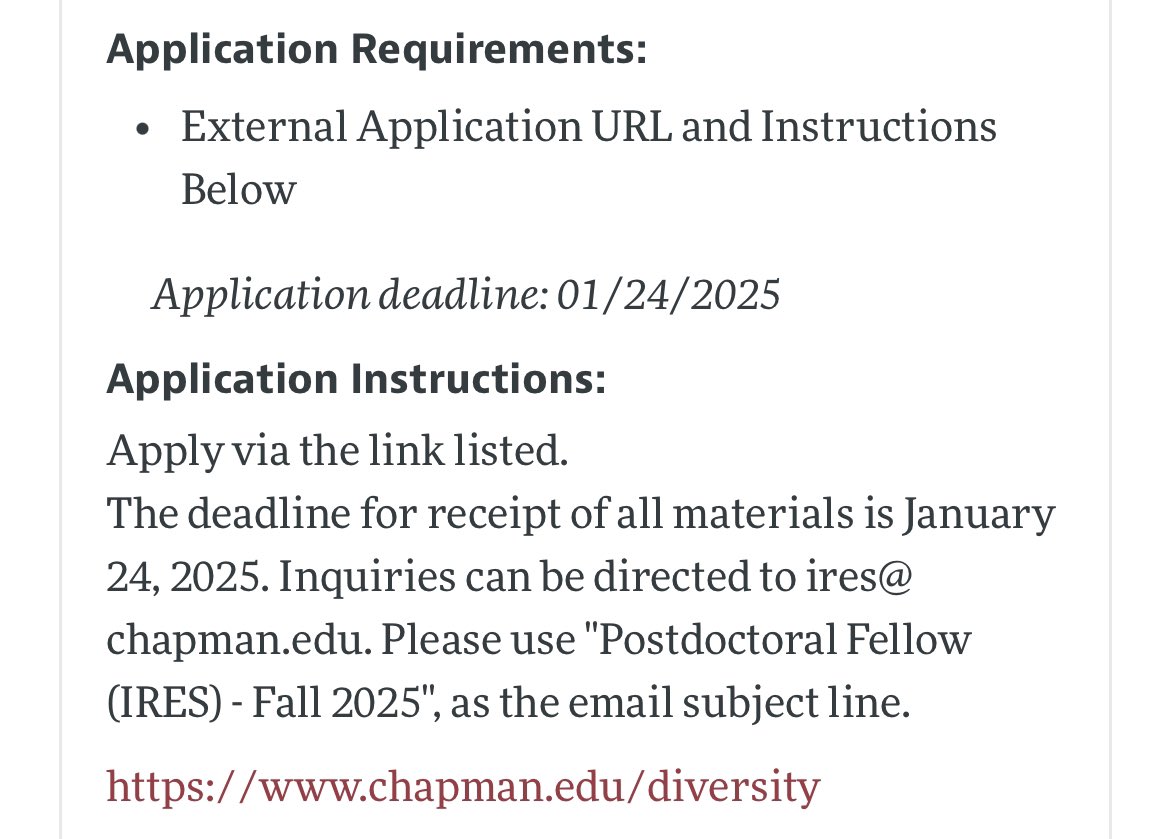
**POST-DOC OPPORTUNITY** We are hiring a 2-year post-doc at Chapman in the economics of religion. Recent PhDs studying religion from any social science discipline should apply! Application deadline: 24 Jan 2025 For more: aeaweb.org/joe/listing.ph…
Jared Rubin tweet mediaJared Rubin tweet mediaJared Rubin tweet media
English
1
33
77
15.1K
Avner Seror
Avner Seror@SerorAvner·
@gguillaumeblanc Well... Je connais quelques boulangeries qui pourraient sans doute faire l'affaire ;)
Français
0
0
1
139
Guillaume Blanc
Guillaume Blanc@gguillaumeblanc·
The best bakery in Manchester, with some of the best croissants I've ever had, just moved into my building. So, if I'm ever back on the market, don't even try unless your city has a bakery with exceptional croissants. There, I've said it.
English
2
0
19
4.6K
Avner Seror retweetet
Alex Imas
Alex Imas@alexolegimas·
Just to add: The authors also collected expert predictions. Perhaps unsurprisingly given the excitement over UBI, experts were too optimistic relative to the outcomes. So an outcome in line with the predictions of Econ 101 is surprising! And should update people's priors.
Alex Imas@alexolegimas

KUDOS to authors for this monumental evaluation of Universal Basic Income. This was so carefully done, with a lot of rigor both in the pre-analysis and amount of data collected. The results from *large* increase in income (40%!!) are...mostly in line with econ 101 predictions.

English
1
3
31
3.3K
Avner Seror retweetet
Shengwu Li
Shengwu Li@ShengwuLi·
This is cool. (And I think deserved to be published in Econometrica!) One man's modus ponens is another's modus tollens. My interpretation is that if standard Nash refinements don't satisfy the axioms, then the axioms aren't so innocent.
TheoreticalEconomics@EconTheory

We characterize Nash equilibrium by postulating coherent behavior across varying games. Nash equilibrium is the only solution concept that satisfies consequentialism, consistency, and rationality. @FlixBrandt econtheory.org/ojs/index.php/…

English
2
13
144
17.6K
Avner Seror retweetet
Ariel Rubinstein
Ariel Rubinstein@ArielRubinstein·
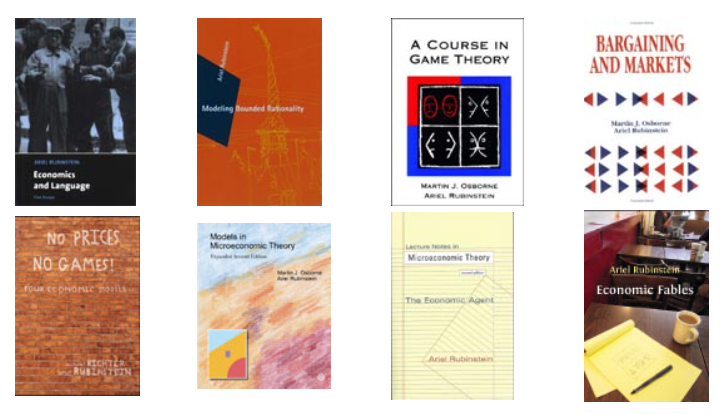
Summer readings all my books FREE DOWLOADABLE (the link in the first comment)
Ariel Rubinstein tweet media
English
3
75
401
47.3K
Guillaume Blanc
Guillaume Blanc@gguillaumeblanc·
Very happy that my JMP just got a R&R in the AER! (and my first R&R ever on a paper not co-authored with a senior) 🎉
English
37
7
373
68.9K
Avner Seror retweetet
Jonathan Haidt
Jonathan Haidt@JonHaidt·
A review in Nature, by @candice_odgers, asserts that I have mistaken correlation for causation and that “there is no evidence that using these platforms is rewiring children’s brains or driving an epidemic of mental illness.” Both of these assertions are untrue. nature.com/articles/d4158… @zachmrausch and I have been collecting the published studies on both sides since 2019, organizing them, and making them available for public viewing and commenting, in multiple Google docs available here: anxiousgeneration.com/resources/coll… In the “social media and mental health” doc, we currently list 22 experimental studies (16 of which found significant evidence of harm) and 9 quasi-experiments (8 of which found evidence of harm. Odgers cited only the 9th one.) We also examine the many meta-analyses and review papers. I lay out the evidence for causality (not just correlation) and walk the reader through the Google doc in this post at After Babel: afterbabel.com/p/social-media… People really need to stop saying that the evidence is “just correlational.” Sure, there are a lot of correlational studies (79 in our Google doc, of which 64 found significant correlations with variables related to poor mental health.) But there are also many experiments supporting my claims of causation. I’ll write a post at Afterbabel.com in April responding more fully to the arguments of the skeptics (including Odgers). For now, I point interested readers to a post in which I laid out 6 problems with the way that the skeptics have conceptualized the debate: afterbabel.com/p/why-some-res… I just want to note two more problems with Odgers’ review. First: She says that I am offering a simplistic one-factor explanation: it’s social media! But I am not. My story is about two major factors (end of the play-based childhood, rise of the phone-based childhood), each of which has many components that bring a variety of harms to different children in different ways. My book is full of lists of causal pathways. There is no one causal pathway that, on its own, explains “the kind of large effects suggested by Haidt.” Yet when you add up all the different ways that the phone-based childhood is harming different kids, some of which we learned about in that Senate hearing on January 31, you end up with a lot of kids being harmed in many ways, and these many harms combined can easily explain the “large effects” even though most pathways affect only a subset of kids. Yet Odgers and the other skeptics focus intently on studies that operationalize social media in one crude way (total # of hours per day), and then correlate that number with some measure of anxiety, depression, or other mental ailment. When the correlations turn out to be around r = .15 for girls (which is actually a number we agree on, as I explain in the previous link), the skeptics conclude that this is not large enough--by itself--to explain the epidemic, so social media must be only a trivial contributor to the epidemic. This is an error caused by an overly narrow operationalization of a complex phenomenon: the radical transformation of daily life that happened for teens between 2010 and 2015. Only a sliver of the story is captured by the crude measure of “hours per day” on social media. The skeptics’ skepticism would be more compelling if they had an alternative explanation for the multi-national decline in mental health that happened in the early 2010s, but they do not. Odgers claims that the “real causes” of the crisis, from which my book “might distract us from effectively responding,” are the lingering effects of the 2008 Global Financial Crisis, which had lasting effects on “families in the bottom 20% of the income distribution,” who were “also growing up at the time of an opioid crisis, school shootings, and increasing unrest because of racial and sexual discrimination and violence.” I agree that those things are all bad for human development, but Odgers’ theory cannot explain why rates of anxiety and depression were generally flat in the 2000s and then suddenly shot upward roughly four years after the start of the Global Financial Crisis. Did life in America suddenly get that much worse during President Obama’s 2nd term, as the economy was steadily improving? Her theory also cannot explain why adolescent mental health collapsed in similar ways around the same time in Canada, the UK, Australia, and New Zealand, as Zach and I have shown: afterbabel.com/p/internationa… Nor can she explain why it also happened in the Nordic countries, which lack most of the social pathologies on Odgers’ list: afterbabel.com/p/internationa… Nor why it also happened in much of Western Europe: afterbabel.com/p/internationa… Nor why suicide rates for Gen Z girls (but not alway boys) are at record levels across the Anglosphere: afterbabel.com/p/anglo-teen-s… I just can’t see a causal path by which America’s school shootings, lockdown drills, inequality, or racism caused girls in Australia to suddenly start self-harming or dying by suicide at the same time as American girls. In short: There is a great deal of evidence for my claims that something terrible is happening to teens in many countries, and that a major contributing factor is the sudden international arrival of the phone-based childhood. I lay out this evidence––with hundreds of footnotes––in chapters 1, 5, 6, and 7 of The Anxious Generation. I have also laid it out in many posts at AfterBabel.com. All along, Zach and I have “shown our work” in public Google Docs and Substack posts, and we have invited others to critique it. Zach has made supplemental files for every chapter in The Anxious Generation, which give links to the datasets and data points that he used to create the graphs in the book. We invite you to check our work: anxiousgeneration.com/resources/supp… Our work has benefited from cordial, normal, academic debates with the skeptics. We will continue to welcome their critiques. But please, everyone, stop saying that the evidence is “just correlational.”
English
267
1.5K
7.3K
1.7M
Avner Seror retweetet
Gabriel Peyré
Gabriel Peyré@gabrielpeyre·
Oldies but goldies: A. Legendre, Nouvelles méthodes pour la détermination des orbites des comètes, 1805. First publication of the least square method, before Gauss according to French people … projecteuclid.org/download/pdf_1…
Français
3
94
463
61.7K
Avner Seror retweetet
Mark Koyama
Mark Koyama@MarkKoyama·
Extremely pleased that my paper with Jean-Paul Carvalho and Cole Williams "Resisting Education" is forthcoming in JEEA (latest working paper version available at papers.ssrn.com/sol3/papers.cf…)
English
2
13
56
7.4K