
Angehefteter Tweet
sean
71.4K posts



When a hiker fell from a 180-foot waterfall in New Zealand, rescuers were forced to evacuate the injured woman without her dog.
After strangers raised thousands of dollars for a search, border collie Molly was flown to safety by a helicopter a week later.
English
@WeAreNotFood The Lord is not pleased. You want to treat God's creatures this way, you will be judged by The Almighty. ✨️🐾
English

"In the iron cages of a fur farm, countless foxes are huddled together. They know nothing of "fashion," nor do they know that their fur will become someone's collar. All they know is the pain when the steel trap clamps down on their leg; the pain when the knife slices through ->
English
sean retweetet
On Holy Thursday we recall that Judas was the first person to leave Mass early 🫠
Leaving Mass directly after Communion and before the final blessing is considered disrespectful and not permitted without serious reason.
Here is a prayer for after communion from Saint Thomas Aquinas:
Lord, Father all-powerful and ever-living God, I thank You, for
even though I am a sinner, your unprofitable servant, not
because of my worth but in the kindness of your mercy,
You have fed me with the Precious Body & Blood of Your Son,
our Lord Jesus Christ.
I pray that this Holy Communion may not bring me
condemnation and punishment but forgiveness and salvation.
May it be a helmet of faith and a shield of good will.
May it purify me from evil ways and put an end to my evil passions.
May it bring me charity and patience, humility and obedience,
and growth in the power to do good.
May it be my strong defense against all my enemies, visible and invisible,
and the perfect calming of all my evil impulses,
bodily and spiritual.
May it unite me more closely to you, the One true God, and lead me
safely through death to everlasting happiness with You.
And I pray that You will lead me, a sinner, to the banquet where you,
with Your Son and holy Spirit, are true and perfect light,
total fulfillment, everlasting joy, gladness without end, and perfect
happiness to your saints. grant this through Christ our Lord,
AMEN.
ewtn.com/holyweek

English
sean retweetet

sean retweetet
Today is Holy Thursday, the day the Passion of the Christ begins.
After washing the feet of His disciples and offering His own Body and Blood at the Last Supper, Christ retreats to the Garden of Gethsemane. He knows exactly what is coming. The scourging, the thorns, the agonizing weight of the cross. The burden of every sin in human history crushes down on Him until He sweats drops of blood into the dirt.
Before a single Roman soldier laid a hand on Him, the sheer psychological and spiritual terror of what He was about to absorb crushed Him so violently that His capillaries burst, bleeding through His pores into the soil.
Friday was the physical execution, but Thursday night was the ultimate battle of the Will. This is the exact moment He looked into the terrifying abyss, accepted the cup of God's wrath, and said: "Not my will, but Yours be done." He didn't wait to be captured. He fought and won the war in His own soul before the enemy even marched up the mountain.
In His darkest hour of dread, He looks to His closest companions for support. He finds them fast asleep. Their comfort won over their loyalty. Shortly after, the heavy silence of the garden is shattered by the arrival of the mob, the glow of torches, the drawing of swords, and the ultimate betrayal sealed with a kiss from a friend.
Tonight, the altars are stripped completely bare. The tabernacles are left open and empty. The Church descends into mourning. The modern world continues to trade Him for silver, mock Him for cheap applause, and sleep soundly through the spiritual war. Do not be like the sleeping Apostles. The Passion has begun. Hold the line.

English
sean retweetet
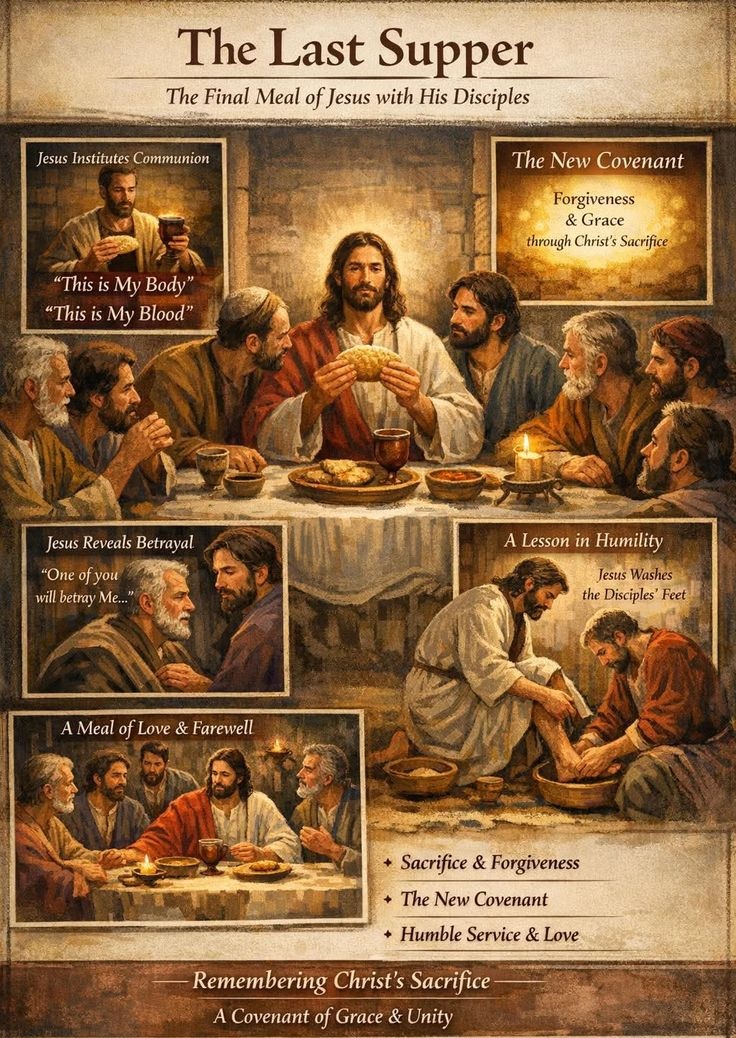
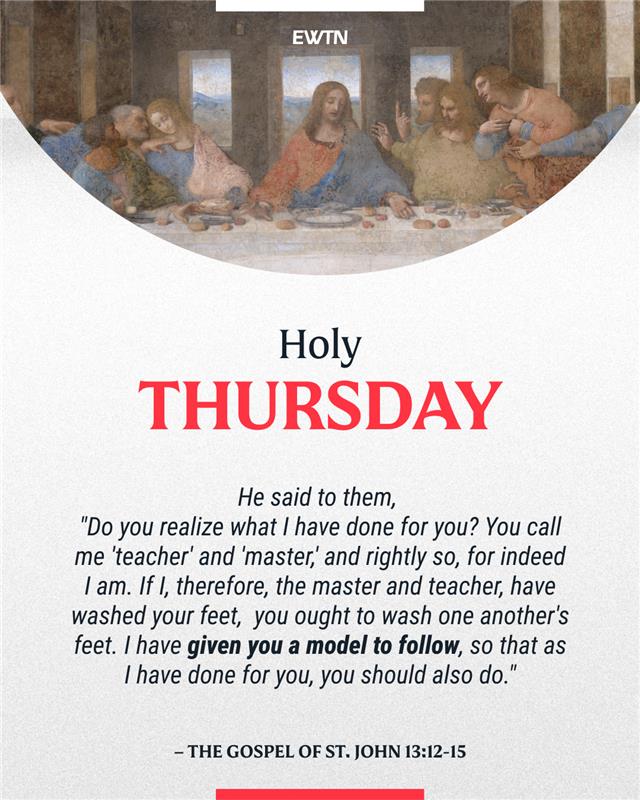
The feast of Maundy (or Holy) Thursday solemnly commemorates the institution of the Eucharist and is the oldest of the observances peculiar to Holy Week. On the Thursday of Holy Week, we recall the first Passover meal, also known as The Last Supper.
Here are a few more things to keep in mind on this day:
1) Also called Maundy Thursday.
*Maundy also means commandment.
On Holy Thursday, Jesus commanded us to love one another, saying: “Love one another, just as I have loved you, you should also love one another.” (John 13:34)
2) Jesus washed his disciples’ feet.
“If I, therefore, the master and teacher, have washed your feet, you ought to wash one another’s feet. I have given you a model to follow, so that as I have done for you, you should also do.” (John 13: 14-15)
3) Jesus instituted the Eucharist and the priesthood.
Jesus commanded his apostles to “do this in memory” and to celebrate the Eucharist until his return.
The institution of the Eucharist is mentioned in the Gospels of Matthew, Mark, and Luke. It is also shared in Paul’s First Letter to the Corinthians. (Mt. 26:17-29; Mk. 14:12-25; Lk. 22:7-20; 1 Cor. 11:23-26)
4) Holy Thursday is the beginning of the Paschal Triduum.
This day is followed by Good Friday and Holy Saturday. Each of these days is significant as we prepare for Easter Sunday!
5) Following Mass, we adore the Blessed Sacrament at the Altar of Repose.
The faithful are invited to join in adoration and there is no traditional dismissal from Holy Thursday Mass.
English
sean retweetet

The cross is part of the mission. The imperialist occupation of the world is disrupted from within; the violence that until now has been the law is unmasked. The poor, imprisoned, and rejected Messiah descends into the darkness of death, yet in so doing He brings a new creation to light. #HolyThursday
English
sean retweetet
Jesus’ freedom changes hearts, heals wounds, refreshes and brightens our faces, reconciles and gathers us together, and forgives and raises us up.
English
sean retweetet

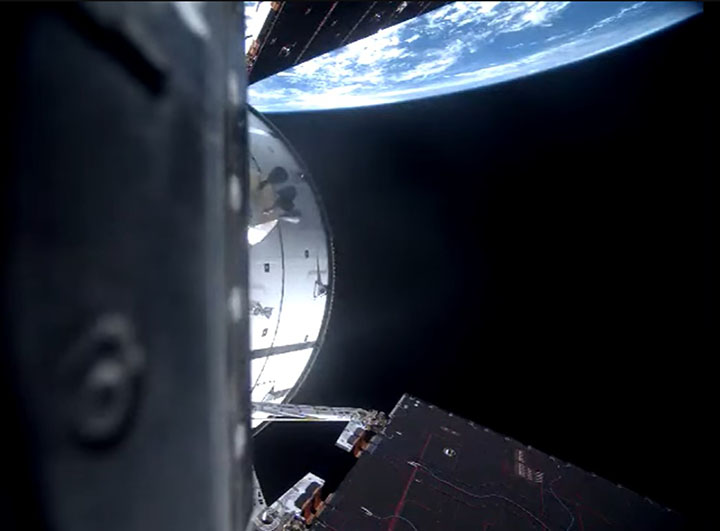
Signal acquired! 📡
Engineers at @NASAJPL have confirmed that the Orion spacecraft is communicating with the Deep Space Network. For the first time in over 50 years, we’re receiving a signal from a spacecraft carrying humans toward the Moon.
English

BREAKING: NASA is troubleshooting an issue that could delay the Artemis II launch. cbsn.ws/414KbgD
English
sean retweetet
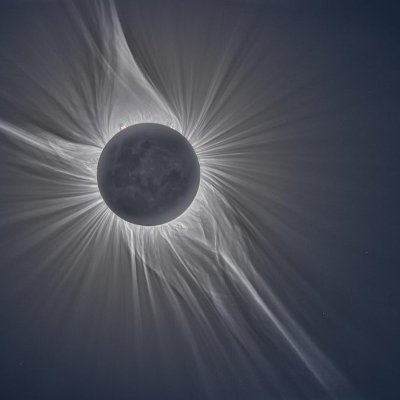
What will the Artemis-2 astronauts do during the entire 10-day mission?
Day by day overview:
Day 1. Launch.
Launch on the SLS rocket, stage separation, orbital insertion. Maneuvers around the spent stage, initial system checks, change from spacesuits to everyday clothing.
Day 2. Beginning the journey to the Moon:
Simulator exercises, then the main maneuver—translunar injection (TLI), which places Orion on a trajectory to fly around the Moon and return to Earth.
Day 3. Preparation
Rehearsals for lunar observations in zero gravity, corrective maneuver, emergency procedures training (e.g., CPR).
Day 4. Course correction
Second minor maneuver, communication with Mission Control, media sessions, photography of Earth and the Moon at the midpoint.
Day 5. Lunar Entry
For the first time since 1972, humans will be in cislunar space. Spacesuit tests: rapid pressurization, life support systems checks. Another course correction.
Day 6. Lunar Flyby
The main day: The Orion spacecraft will fly at an altitude of 6,400–9,650 km above the lunar surface.
This distance is approximately 15–24 times greater than the orbital altitude of the ISS. Plus, the Moon itself is smaller. Visually, the Moon will look like a basketball at arm's length to the astronauts. There will be only three hours for observations during closest approach. The astronauts will take photographs and record geological data. Depending on the launch time, the Artemis 2 crew could break the record for the longest distance from Earth.
Day 7. Lunar Exit
Data transfer to scientists, psychological and physical debriefings. Symbolic call with the ISS crew. First maneuver of the return trajectory.
Day 8. Demonstrations
Radiation protection training (using water and thermal protection as barriers). Testing the Orion attitude control systems in various modes.
Day 9. Preparing for reentry
The last full day of the flight. Technological demonstrations, course corrections, fitting of compression suits to help the body adapt to weightlessness.
Day 10. Return
Final maneuver, atmospheric reentry, during which the temperature will reach 1650°C. Parachute deployment, splashdown in the Pacific Ocean off San Francisco. Crew pickup by US Navy ships.

English
sean retweetet

sean retweetet

🚨 JUST IN: The Artemis II space crew has emerged in their suits, and are on their way to the rocket
So far, we’re a GO for launch to the moon tonight!
Let’s go!!!! 🇺🇸🔥
English
sean retweetet
We're going around the Moon. Come watch with us. Artemis II's four-astronaut crew is lifting off from @NASAKennedy on an approximately 10-day mission that will bring us closer to living on the Moon and Mars. The launch window opens at 6:24pm ET (2224 UTC). twitter.com/i/broadcasts/1…
English
sean retweetet

sean retweetet

The 7 Sacraments…
Biblical or Not??
1.Baptism — John 3:5 💧
2.Confirmation — Acts 8:14–17 🔥
3.Eucharist — Luke 22:19–20 🍞🍷
4.Confession — John 20:22–23 🔑
5.Anointing the Sick — James 5:15🩹
6.Holy Orders — 2 Timothy 1:6 ✋
7.Matrimony — Matthew 19:5–6 💍

English
sean retweetet

Of the Twelve Apostles, St. John alone died peacefully of old age (around AD 100). The others gave their lives in martyrdom🇻🇦🩸
Yet his path was not easy, he endured exile on Patmos, persecution, and even survived attempts on his life (tradition speaks of boiling oil, from which he emerged unharmed).
So why was his mission different?
Catholic tradition points to one powerful moment: the foot of the Cross.
While the others fled in fear, John remained. He stood faithfully beside Jesus Christ, together with Mary, sharing in the suffering of Calvary with unwavering love (John 19:25–27).
And there, in His final moments, Jesus gave John an extraordinary gift:
"Woman, behold your son… Behold your mother."
From that hour, John took Mary into his home, caring for her with filial love until her Assumption.
Many Church Fathers and sacred tradition see in this a profound mystery:
because of his fidelity at Calvary and his love for Our Lady, John was entrusted with a longer earthly mission, to guide the early Church, to write his Gospel, Epistles, and Revelation, and to bear witness through a lifetime of faithful endurance.
His was not a martyrdom of blood, but a “white martyrdom”, a life poured out in love, perseverance, and truth.
St. John reminds us: Remain close to the Cross. Stay near to Mary. And God will give the grace you need to endure.
St. John the Beloved, pray for us! 🙏❤️

English