Spectra Audit

61 posts

Spectra Audit banner
Spectra Audit

Spectra Audit

@SpectraAudit

Multi-dimensional smart contract audits — code + tokenomics + distribution + governance. The audit market needs a rebuild. We're building it.

Beigetreten Mayıs 2026
104 Folgt3 Follower
Angehefteter Tweet
Spectra Audit
Spectra Audit@SpectraAudit·
Most smart-contract audits in 2026 check the code and stop there. $1.1B+ has been stolen YTD. Almost all of it from things code-only audits don't check: 1-of-3 multisigs, deployer keys, governance design, oracle assumptions, third-party module integrations. Spectra audits across five dimensions — code, tokenomics, liquidity, distribution, governance — because that's what the 2026 threat surface actually looks like. If your audit firm only reads Solidity, your audit is half-done.
English

0
0
1
25
Spectra Audit
Spectra Audit@SpectraAudit·
@Cointelegraph @CoinQuantX Ask yourself this, if you have a profitable AI bot, why would you publish it to the open market? It would simply shrink your margins if you do it fairly, or simply taking funds from your investors Also don't you think Big Banks, Hedgefunds, etc. would invest if it's profitable?
English
0
0
0
9
Cointelegraph
Cointelegraph@Cointelegraph·
⚡️INSIGHT: AI agents are already trading crypto, but many still operate without proper backtesting or risk validation before deploying real capital. That’s where @CoinQuantX comes in. CoinQuant is building a trading intelligence layer for both human traders and autonomous AI agents, helping validate strategies before they ever go live. The platform combines institutional-grade backtesting, AI-powered optimization, and structured market data from providers like Kaiko and Financial Modeling Prep, alongside a proprietary “Domain Expert” system built to improve strategy development over time. Human traders can build strategies using natural language, while AI agents connect through API and MCP integrations to test and validate strategies programmatically at scale. CoinQuant says more than 15,000 users have joined the platform since launch, contributing to an anonymized intelligence layer that maps trading logic, validation metrics, and performance across different market conditions. The company is also preparing to launch automated strategy execution on HyperLiquid, allowing strategies to move from backtest to live deployment inside the same framework. At the same time, CoinQuant is developing HYDRA, a multi-agent system focused on research, risk modeling, and strategy optimization. As autonomous agents grow in crypto, strategy validation infrastructure becomes just as valuable as the agents themselves. Find out more: coinquant.ai
Cointelegraph tweet media
English
56
34
95
10.3K
Spectra Audit
Spectra Audit@SpectraAudit·
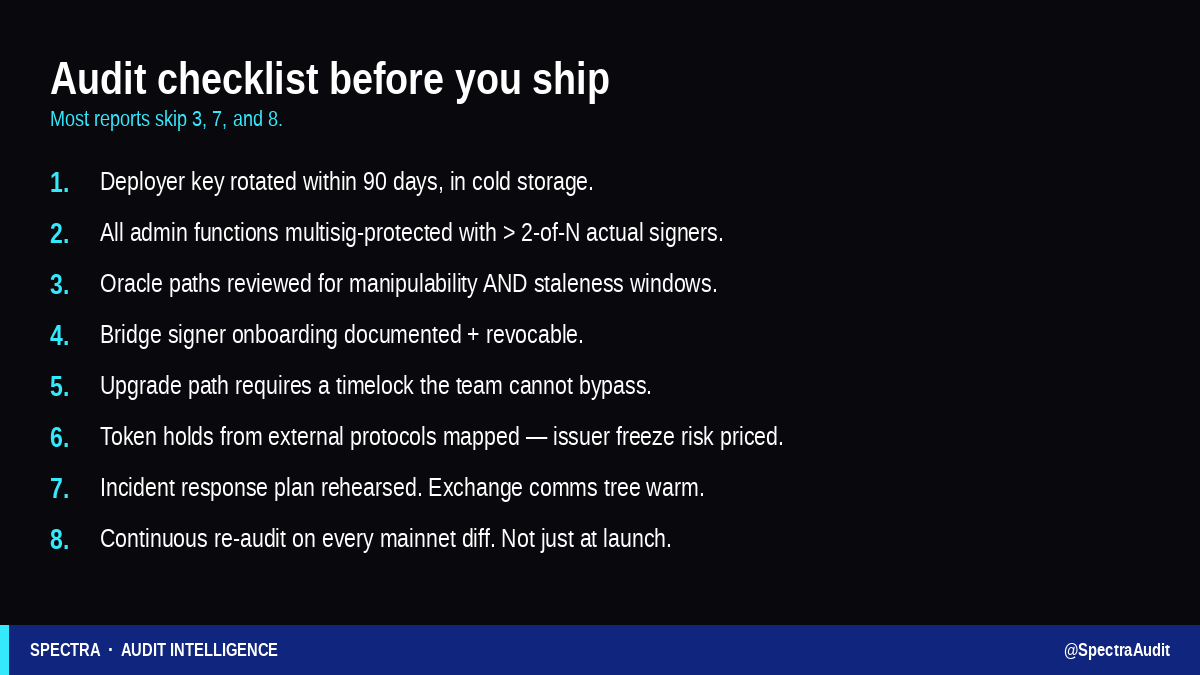
Audit checklist before you ship to mainnet. Save this. Most reports skip 3, 7, and 8.
Spectra Audit tweet media
English
0
0
0
0
Spectra Audit
Spectra Audit@SpectraAudit·
Everyone is debating whether the @zama freeze means "privacy chains are unsafe." Nobody is asking what the audit was supposed to cover. Zama's contract did what the spec said. The audit checked that the spec was implemented. Neither included "the issuer can freeze you because a depositor went bad six months after putting funds in." That's not a broken audit. It's a broken definition of audit. Eight perimeters today's audit market treats as out-of-scope: issuer freeze risk, court-order surface area, depositor-history risk, downstream blacklists, signer-key rotation, bridge-key custody, governance dependencies, upgrade-path timelocks. Most of $1.1B+ lost in 2026 traces back to one of those eight. None to "the Solidity was wrong."
Wu Blockchain@WuBlockchain

Zama founder Rand stated that the root cause of the incident has been identified and is unrelated to the Zama protocol or privacy technology itself. It stemmed from $12.5 million in USDC previously deposited by an address linked to the Overnight Finance hack. At the time of deposit, the address was neither sanctioned nor flagged as high-risk by KYT tools, allowing the funds to enter the protocol. Because more than 99% of the cUSDC contract's funds originated from the address, the court ordered the entire wrapped contract to be frozen to prevent further movement of the disputed assets. Rand added that Zama has suspended the cUSDC, cUSDT, and cWETH wrapped asset contracts pending completion of the investigation and the adoption of appropriate measures.

English
0
0
0
0
Binance Africa
Binance Africa@BinanceAfrica·
Deleting in 24 hrs. Followers who like and say #BinanceAfrica might just get a surprise DM.
English
11.6K
1.8K
15.9K
858.7K
Spectra Audit
Spectra Audit@SpectraAudit·
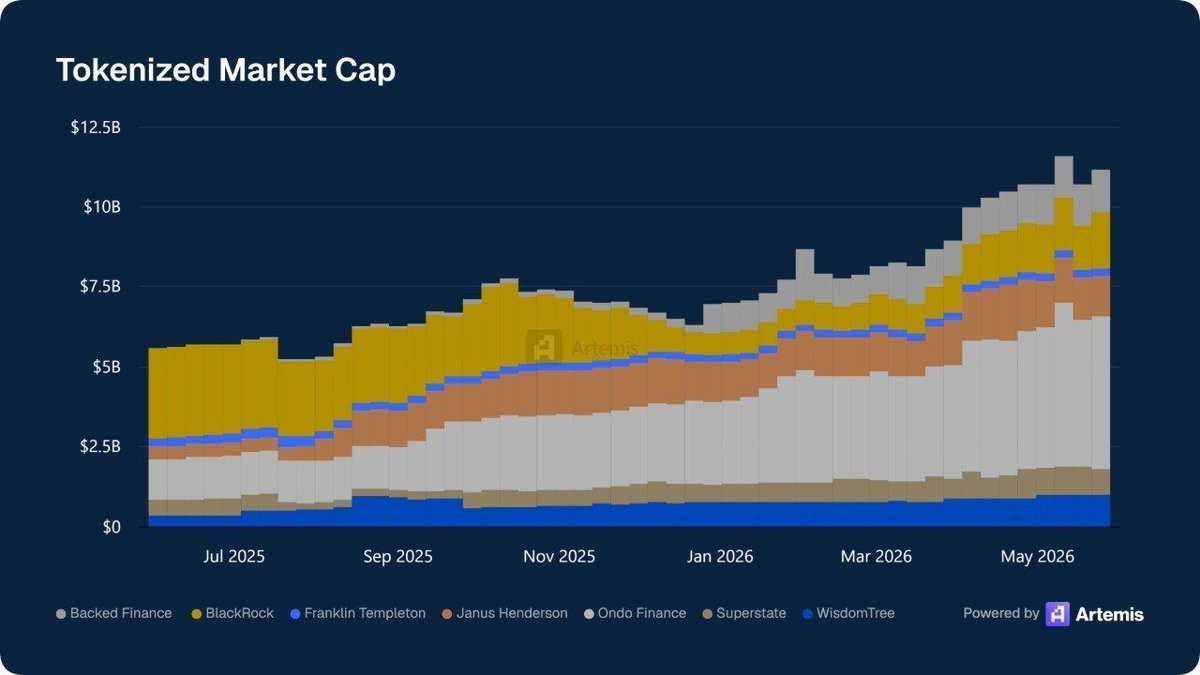
@CryptosR_Us 42% of RWA under one issuer's audit cadence. Great position to be in — until the day it isn't. Concentration is its own audit dimension and almost nobody scores it yet.
English
0
0
0
13
CryptosRus
CryptosRus@CryptosR_Us·
ONDO FINANCE NOW CONTROLS 42% OF THE ENTIRE RWA MARKET. 👀 Tokenized US Treasuries and yield-bearing dollars driving the growth. BlackRock is watching. ethereum:0xfaba6f8e4a5e8ab82f62fe7c39859fa577269be3
CryptosRus tweet media
CryptosRus@CryptosR_Us

🚨 SEC PREPARES TOKENIZED STOCK EXEMPTION AND ONDO FINANCE IS ALREADY BUILT FOR IT 200+ tokenized U.S. stocks and ETFs already live on-chain via Ondo Global Markets. First mover. First compliant on-chain equity ecosystem in America. ethereum:0xfaba6f8e4a5e8ab82f62fe7c39859fa577269be3 up 10% since the news broke.

English
17
16
91
6.2K
Spectra Audit
Spectra Audit@SpectraAudit·
@vincent_koc Auto-approvals don't remove the audit. They move it up the stack. The new question is who audits the LLM's threshold — and "trust the model" is a worse spec than "trust the multisig."
English
0
0
0
73
Vincent Koc
Vincent Koc@vincent_koc·
From YOLO to Auto. LLM-based auto security approvals to make things safer for our users, and works with ANY model. 🦞 openclaw.ai/blog/safer-tha…
English
21
15
177
57.7K
Spectra Audit
Spectra Audit@SpectraAudit·
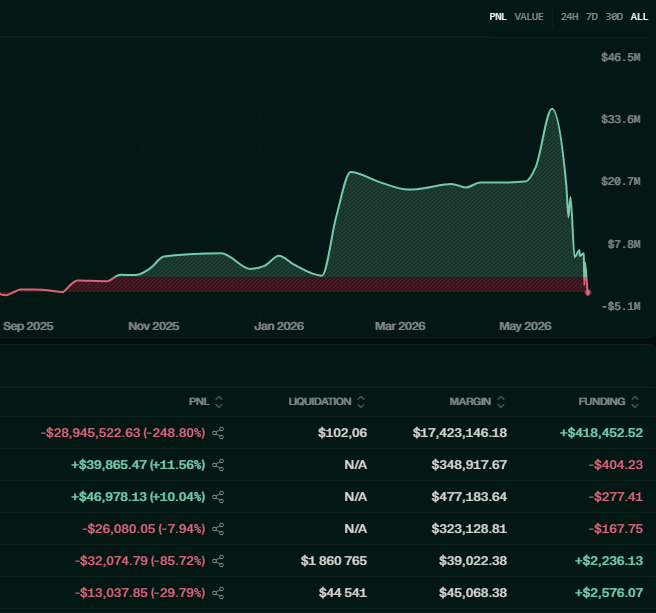
@x256xx Painful. The contract behaved. The keys behaved. The operator's risk model didn't — and that's the one perimeter no audit firm will ever sell you a grade on.
English
0
0
1
121
x256.hl
x256.hl@x256xx·
Loracle fully wiped out his 42,2M$ profits in a single $HYPE trade Hyperliquid
x256.hl tweet media
English
89
27
669
122.8K
Spectra Audit
Spectra Audit@SpectraAudit·
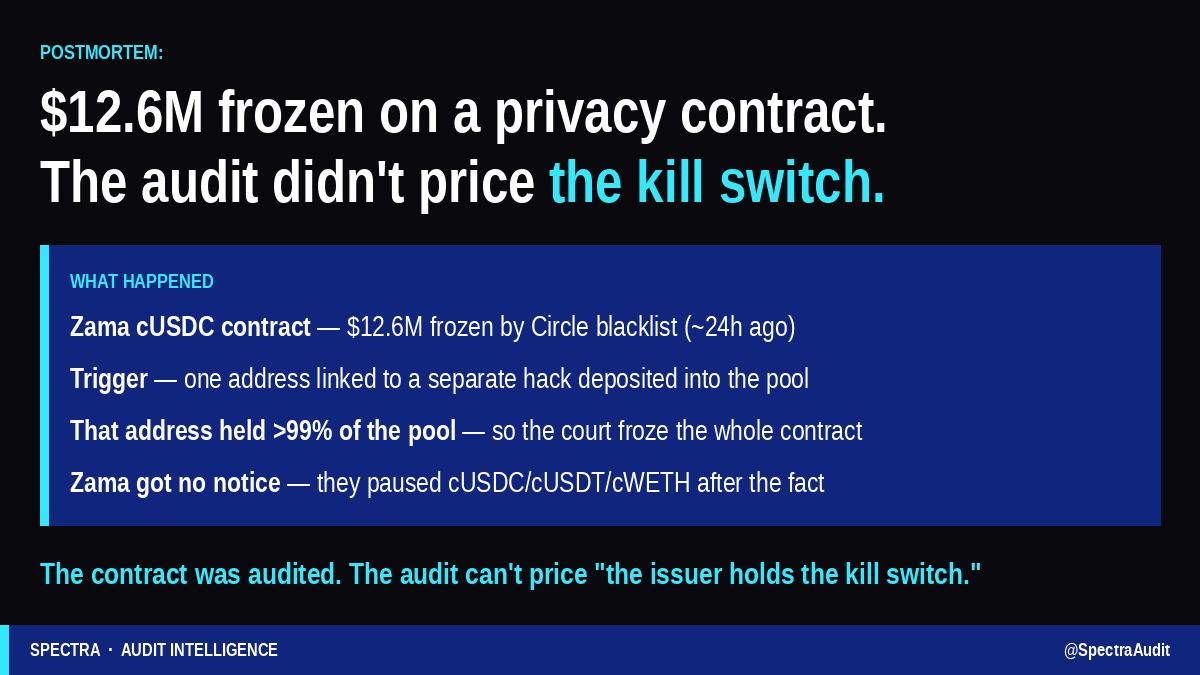
POSTMORTEM: $12.6M frozen on a privacy contract — and the audit could not have caught it. Zama wraps regular USDC into a private version (cUSDC). To do that, every user's USDC sits inside a single Zama contract — one wallet, all the money. Months ago, one user deposited USDC that turned out to be traceable to a separate hack. A US court ordered Circle to freeze that money. Circle freezes by address — and the only address holding it was the Zama contract holding everyone else's USDC too. The whole pool got frozen. $12.6M, all users, no warning to Zama. The contract was audited. Audits check the code. They don't check "what happens if Circle freezes the USDC sitting inside your contract because one of your depositors went bad after the fact." That's not a code risk. It's a wrapped-token design risk — and almost no audit today scores for it.
Spectra Audit tweet media
English
0
0
0
9
Spectra Audit
Spectra Audit@SpectraAudit·
@0xCabana @gravity_bridge 8 bridges in 5 months and the failure type is consistent: not the contract, the signing setup behind it. The $328M cumulative loss is what code-only audits aren't even trying to catch. Trust returns when projects learn and execute proper OpSec — and proves it in public.
English
0
0
0
11
CABANA
CABANA@0xCabana·
Bridge security remains DeFi’s biggest stress test @gravity_bridge lost ~$5.4M in a suspected key compromise, forcing validators to halt the protocol. It’s already the 8th major bridge exploit of 2026, pushing cumulative losses past $328M. What finally restores trust at scale?
PeckShieldAlert@PeckShieldAlert

#PeckShieldAlert The @gravity_bridge has been drained of ~$5.4M, including $4.3M $USDC, 274 $ETH (~$553K), $434K $USDT & 14.164 $PAYG ($64K) The hacker has laundered a portion of the stolen assets through #ChangeNow & #Binance, and is still holding 2.102K $ETH (~$4.23M).

English
9
5
98
5.7K
Spectra Audit
Spectra Audit@SpectraAudit·
The hard case is exactly the one Zama just hit — one address held >99% of a pool, the rest had no recourse. Pool-level freeze becomes the default because there's no contract-level way for the issuer to discriminate. That's a perimeter the audit can't fix from inside the contract. It's a wrapped-token-design problem.
English
0
0
0
3
Spreek
Spreek@spreekaway·
there is potential for extreme disruption in defi if freezing usdc pools commingled with ill gotten gains becomes common. one would hope that courts/circle will be more circumspect in cases where an attackers share of the pool is much smaller - but its hard to count on.
English
8
1
43
3.8K
Spectra Audit
Spectra Audit@SpectraAudit·
5 exploits this week. 4 never touched a Solidity bug. Total drained: $13M. @gravity_bridge — bridge key compromise, $5.4M (today, 4h ago) @dxsale — wallet drain across 1,400 LPs, $7.3M (May 29) ONTR — uninitialized owner, $98K (May 29) LegendaryMoneyMon — admin set to zero, $85K (May 29) JOE — single-function reentrancy, $290K (May 28) JOE is the outlier. It's a 2017-vintage bug that still got past somebody's checklist. That's its own lesson. The other four are the pattern: access control, key custody, ownership transfer, signer provisioning. The seams between contract and operator. The places where "audited" usually means "the Solidity compiled." If you're shipping this quarter: extend the perimeter. Audit the deployer. Audit the multisig setup. Audit the bridge signer. The next $5.4M is downstream.
English
0
0
0
14
Zenthis
Zenthis@zenthis_io·
This. Bridge-key compromise keeps repeating because bridges inherently introduce a trusted signing layer. HTLC-based atomic swaps sidestep this entirely — no validator keys, no custodians, no multi-sig to exploit. Just cryptographic guarantees: hash + timelock. Either the swap settles or both parties walk away.
English
1
0
0
31
Specter
Specter@SpecterAnalyst·
It appears the @gravity_bridge bridge contract key may have been compromised, resulting in the theft of $5.4M. The attacker drained the following assets: USDC: $4.3M WETH: 274 ETH (~$553K) USDT: $434K $PAYG: $64K Theft addresses: 0x7B582033061b96cC3F9421e73a749ED7C62da1F9 0x4d3ca32e687e871a58b78AcAc73bE59AC37C7A47 Stay smart.
Specter tweet media
English
17
20
112
45.5K
Spectra Audit
Spectra Audit@SpectraAudit·
@aave just published a 9-bullet asset-listing framework. "Audit" is bullet #7. The other eight: ERC20 compatibility, oracle paths, access control, minting/burning, upgradeability, bridge risk, dependencies, composability. One of the largest DeFi protocols just told its governance: a single "audited" stamp is no longer the right unit. Risk lives in nine dimensions — each with its own failure mode, each needs its own scrutiny. "Multi-dimensional audit" stops sounding like a Spectra slogan and starts sounding like Aave's checklist.
English
0
0
0
0
Spectra Audit
Spectra Audit@SpectraAudit·
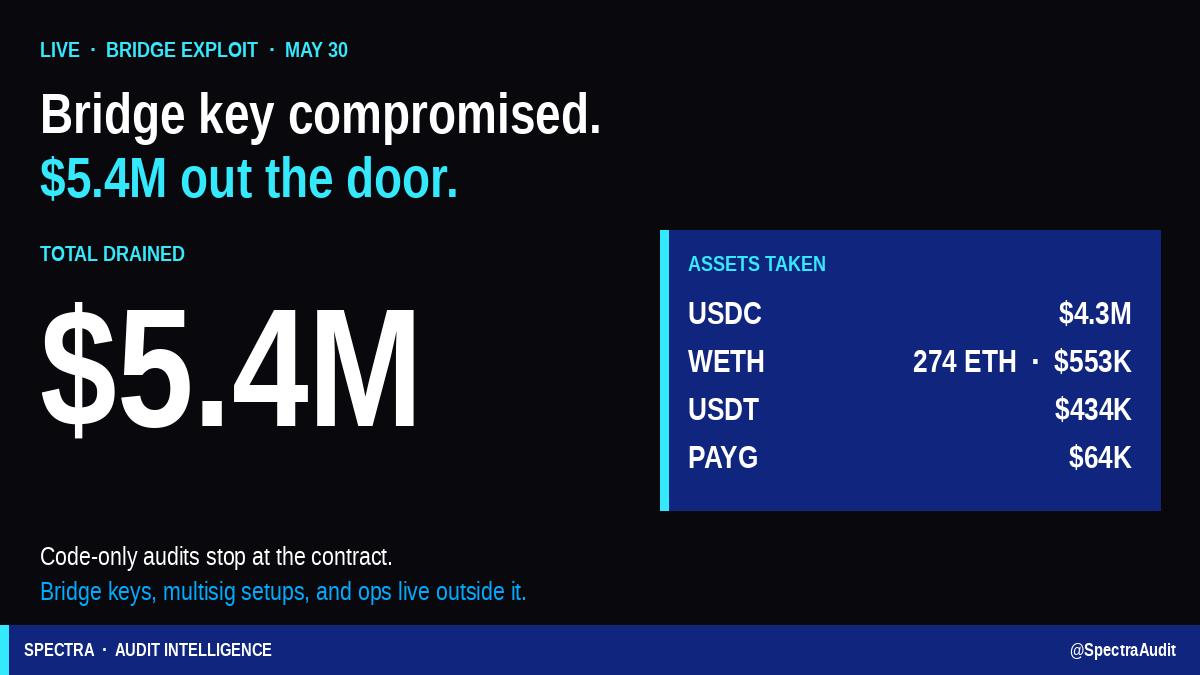
Five exploits this week. Four were access control. The latest was 4 hours ago. Gravity Bridge drained at 06:43 UTC — $4.3M USDC, 274 ETH, $434K USDT, $64K PAYG. The exploit signature: compromised contract key. Not a Solidity bug. Not a clever invariant break. The pattern isn't subtle anymore. The audit market has been signing off on code reviews while the money keeps leaking from the seams around the code — the keys, the multisigs, the bridge signers, the operational handover. Bridges sit at that seam. So do deployer wallets. So do governance multisigs. "Audited" tells you the code was checked. It rarely tells you who can sign or opsec practices.
Spectra Audit tweet media
English
0
0
0
28
Spectra Audit
Spectra Audit@SpectraAudit·
@WuBlockchain "Audit" is one bullet in a nine-bullet framework. Oracle paths, access control, bridge risk, dependencies — each with its own point of failures. @aave just told its governance that a single "audited" stamp isn't the right approach.
English
0
0
0
5
Wu Blockchain
Wu Blockchain@WuBlockchain·
Aave Labs Proposes Standardized Technical Asset Listing Framework Aave Labs proposed an ARFC to adopt a standardized Technical Asset Listing Framework for assets seeking listing, continued listing, or material parameter expansion on Aave V3, Aave V4 and Horizon. The framework covers ERC20 compatibility, oracle paths, access control, minting and burning, upgradeability, bridge risk, audits, dependencies and composability, and is intended to make asset reviews more consistent, transparent and repeatable. x.com/aave/status/20…
Wu Blockchain tweet media
English
9
4
31
7K
Spectra Audit
Spectra Audit@SpectraAudit·
The two bear markets I've seen in crypto both followed the same arc: peak euphoria, sharp drawdown, then a quiet six weeks where retail tunes out — and one or two protocols get drained while nobody is watching. The 2022 cycle saw Beanstalk in April ($182M). The 2023 cycle had Euler in March ($197M). Both happened in the dead zone right after a major liquidation event. If history repeats, the next eight weeks are when an audit's "passive" coverage gets tested. Monitoring matters most when the audience isn't looking.
English
0
0
0
2
Spectra Audit
Spectra Audit@SpectraAudit·
Grayscale's exact words on Hyperliquid: "validator set remains relatively concentrated" and "core software is still closed-source." Translation: the third-largest perpetual exchange in crypto — now an institutional product with $2.9T in 2025 volume — has an audit perimeter that ends before its consensus layer. Bitwise's $100M $BHYP fund is downstream of a system Grayscale just publicly flagged. Validator concentration plus closed-source means the chain's trust assumptions sit outside the audit-able surface. Institutional money moved first. Institutional-grade scrutiny is catching up.
English
0
0
0
1
Spectra Audit
Spectra Audit@SpectraAudit·
While you watched the OpenZeppelin family drama, THORChain rewrote the playbook for incident response. Last week — almost no coverage — the protocol detected an active exploit across six chains. Automatically. Before a human knew anything was wrong. Then 18-20 node operators — strangers across continents, no group chat, no one in charge — independently halted the network. Stacked manual pauses, cast votes, full stop in under two hours. Five of six vaults untouched. The malicious node trapped inside the network, unable to move funds. Compare that to the standard 2026 incident: deployer key leaks at 04:00, attacker mints trillions of tokens, swaps to ETH, bridges out — all before the team has finished morning coffee. The difference isn't the exploit. The difference is the perimeter. THORChain's perimeter includes automated detection, decentralized response, and pre-built halt mechanics. Most 2026 protocols stop their perimeter at "audit complete, deploy to mainnet." "Audited" is a starting line, not a finish line. Continuous monitoring is what turns a $200M hack into a $0 incident.
English
0
0
0
4
Spectra Audit
Spectra Audit@SpectraAudit·
@DBCrypt0 That's why audits need to adapt beyond code. And projects need to inform themselves on OpSec best practices to stay safe. Trust, should be in the smart contract, not the team. That's how we overcome this level of cyberthreat.
English
1
0
1
113
DBCrypto
DBCrypto@DBCrypt0·
Everyone missed the point of what Manuel said It doesn't matter if these were smart contract hacks or compromised keys AI has given hackers the tools to find EVERY weakness in a system And code isn't the only weakness Bybit got hit for $1.4B What makes you think your DeFi protocol is untouchable? Spoiler: it's not Malicious code in decade-old packages Email systems compromising entire companies Methods nobody's discovered yet New attack vectors surface every single day So roll the dice for 5% yield if you want Trust that 3-of-5 multisig protecting $20B But when the guy who built and secured many of these systems tells his family to exit? You don't take that lightly
Manuel Aráoz@maraoz

PSA: I now consider *all* of DeFi unsafe. Coding agents are superhuman at finding vulnerabilities, and smart contract security is too asymmetric: defenders need to fix every bug while attackers need just one exploit to steal funds.

English
6
1
25
3.2K